

AI A/B Testing: Boost SMB Conversion Rates
AI A/B Testing: Boost SMB Conversion Rates
AI A/B testing is transforming how small and medium-sized businesses (SMBs) improve website conversions. Unlike older methods that require significant traffic, time, and resources, AI-powered tools automate testing, optimize traffic allocation in real time, and deliver faster results. Here's why SMBs are turning to AI for conversion rate optimization (CRO):
- Faster Results: AI tools like Multi-Armed Bandit algorithms dynamically send more traffic to better-performing variants during tests, reducing delays.
- Easy to Use: Generative AI simplifies variant creation, enabling non-technical users to test headlines, images, or CTAs without coding.
- Better for Low Traffic: AI adjusts to limited traffic, making it practical for SMBs that struggle to reach statistical significance in traditional tests.
- Higher ROI: Businesses using AI-driven CRO report increased conversion rates and reduced customer acquisition costs.
AI A/B testing eliminates guesswork, speeds up decision-making, and helps SMBs achieve more with fewer resources. By focusing on high-impact areas like landing pages and email campaigns, SMBs can see conversion rates improve by 15–25% in just a few months.
A/B Testing with AI: Automate & Optimize Your Experiments 🚀
sbb-itb-63525a7
Problems with Traditional A/B Testing for SMBs
Small and medium-sized businesses (SMBs) often encounter significant challenges when trying to use traditional A/B testing to improve conversions. These hurdles can make it difficult to achieve meaningful results in a timely and efficient manner.
Time and Resource Limitations
Traditional A/B testing demands a lot of manual effort, even for a handful of variations. For SMBs, this process can become a major roadblock. Adding to the challenge is the technical expertise required - setting up tests often involves coding or developer support, something many SMBs simply don't have access to.
"Traditional A/B testing involves selecting one element, crafting multiple versions manually, and waiting weeks to gather data – a process that is too slow and resource-intensive for most SMBs."
- Graeme Parton, Content Marketing Specialist, Pipedrive
The statistics are telling: only 1 in 8 A/B tests delivers meaningful business results, and 94% of beginner testers fail to establish clear priorities for their experiments. Without a dedicated expert, interpreting complex metrics like p-values and confidence intervals often becomes a guessing game.
For SMBs already stretched thin on resources, these challenges are compounded by another issue - low traffic, which makes achieving statistical significance a struggle.
Low Traffic and Statistical Significance
A major obstacle for SMBs is the need for high volumes of traffic to generate reliable A/B test results. Many small businesses simply don't have enough visitors to their websites. For example, while a 20-conversion difference might matter with 50 visitors, it becomes almost meaningless with 20,000. This lack of traffic forces SMBs into long testing periods. While email subject line tests might yield results within a few days, tests for landing pages can take weeks or even months.
"Marketers often wait weeks for A/B test results, only to find the winning variant is already outdated. Customer behavior shifts faster than traditional testing can keep up."
- Team Braze
The reality is that only 20% of tests ever reach the 95% statistical confidence needed to trust the results. For SMBs with limited traffic, most tests end up inconclusive, wasting both time and the opportunity to make improvements.
And even when tests do run their course, the narrow focus of traditional methods limits the insights they provide.
Limited Testing Scope
Traditional A/B testing typically focuses on one element at a time, such as a headline, image, or call-to-action button. This approach doesn't account for how these elements interact with each other, which means SMBs might miss out on opportunities for combined improvements. Additionally, the fixed 50/50 traffic split of traditional testing methods can be inefficient. Even if one variant starts performing better early on, underperforming versions still consume resources until the test is manually adjusted or restarted.
"Traditional A/B testing was designed for a slower environment - one where customer behavior stayed relatively stable between the start and end of a test. That's no longer the case."
- Team Braze
In today's fast-paced digital world, where customer preferences can shift rapidly, the limitations of traditional A/B testing make it a poor fit for many SMBs.
How AI A/B Testing Solves SMB Problems
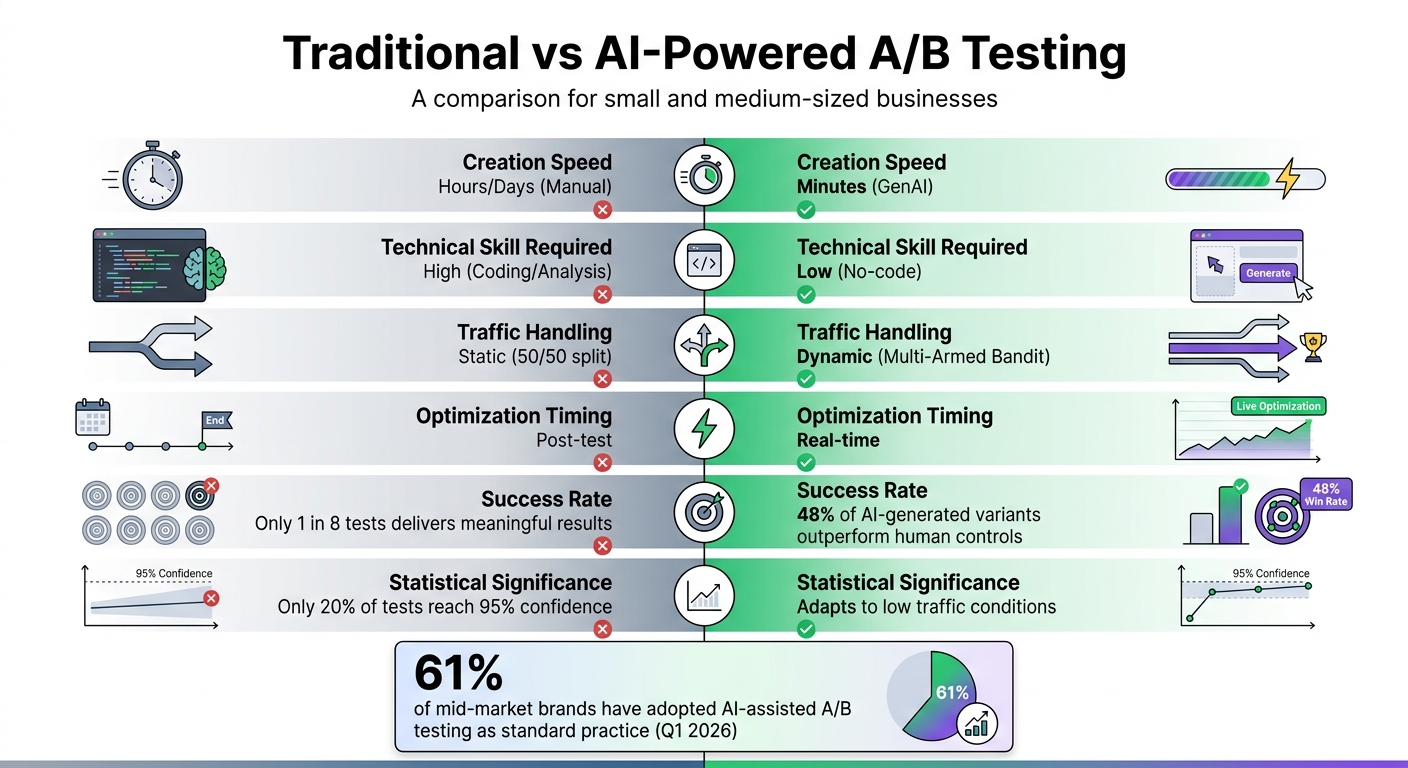
Traditional vs AI-Powered A/B Testing Comparison for SMBs
AI has revolutionized A/B testing, handling everything from idea generation to traffic allocation in real time. By automating these processes, it eliminates the delays and guesswork that often challenge small and medium-sized businesses (SMBs). Here's how AI tackles these issues head-on.
Automated Hypothesis Generation
AI tools dive into your existing data to uncover areas ripe for improvement - instantly. For example, platforms like VWO AI Copilot can analyze a single page URL and suggest actionable changes, such as streamlining form fields or adding trust indicators. These tools identify patterns in customer behavior and pinpoint specific weak spots, saving SMBs from hours of manual analysis. Even without a dedicated conversion rate optimization (CRO) specialist, AI steps in to interpret data and recommend targeted improvements, making it an ideal solution for businesses with tight budgets and limited resources.
Faster Variant Creation with Generative AI
Generative AI tools make creating test variants a breeze. Instead of spending hours manually crafting options - like email subject lines or call-to-action (CTA) button text - you can generate multiple alternatives in seconds using smart prompts. In fact, around 75% of businesses now use AI for content creation. Add to that the availability of visual editors and "AI Copilots", and even non-technical users can implement changes without needing coding expertise or developer support. This no-code functionality empowers SMBs to run advanced experiments, overcoming the lack of in-house technical staff.
Quick variant creation is just part of the equation. AI also ensures your tests perform better through dynamic traffic allocation.
Dynamic Traffic Allocation with Multi-Armed Bandit Testing
Multi-armed bandit (MAB) testing takes a smarter approach to traffic distribution compared to traditional methods. Instead of sticking to fixed 50/50 splits, MAB uses machine learning to direct more traffic to the best-performing variants - while the test is still running. This approach is especially valuable for SMBs, where limited traffic means every conversion counts.
Take the example of the music platform BUGECE. In 2025, they used AI-driven optimization to test the timing of message delivery, leading to a 63% increase in email open rates and a 32% boost in signup conversions. MAB testing also shortens test cycles, reallocating traffic dynamically based on real-time performance data. Unlike traditional A/B testing, which often stops after identifying a "winner", MAB adapts continuously, avoiding stagnation as customer behavior evolves.
These advancements make A/B testing more efficient and impactful for SMBs, turning it into a tool that drives growth without draining resources.
| Feature | Traditional A/B Testing | AI-Powered A/B Testing |
|---|---|---|
| Creation Speed | Hours/Days (Manual) | Minutes (GenAI) |
| Technical Skill | High (Coding/Analysis) | Low (No-code) |
| Traffic Handling | Static (50/50) | Dynamic (MAB) |
| Optimization | Post-test | Real-time |
AI A/B Testing Strategies for SMBs
Focus on High-Impact Areas
Start where it matters most: your profit-driving activities. Email campaigns, landing pages, and checkout flows are critical to your revenue, so prioritize these areas for your initial A/B tests. For emails, experiment with subject lines - short versus long, or formal versus casual tones. On landing pages, test different headlines, visuals, and call-to-action phrases like “Sign Up” versus “Register Now.” For pricing pages, try tweaking how offers are presented, comparing discount-focused language against value-driven messaging.
A great example comes from 2025 when Too Good To Go used AI to test discount-based outreach against value-added notifications. By blending customer preferences with live supply data, they didn’t just improve - they doubled their message conversion rates and saw a 135% boost in purchases tied to CRM campaigns. This shows the power of focusing your testing budget on channels that directly impact sales.
Once you've identified these high-impact areas, keep a close eye on their ongoing performance to ensure consistent results.
Use Real-Time Insights
Leverage AI dashboards to track your tests as they happen. Real-time monitoring allows you to tweak or pause underperforming variations immediately - this is especially useful for campaigns with short timeframes.
Before diving into a test, set clear and measurable goals. Instead of aiming vaguely to "boost conversions", define a target like achieving a 10% increase in trial sign-ups. Having this clarity ensures you can confidently decide when a winning variation deserves a full rollout. Plus, it prevents wasting impressions on options that aren’t delivering.
Integrate A/B Testing into Your Marketing Strategy
A/B testing isn’t a one-off task - it’s a continuous process. Build it into your marketing routine. For example, you could set a weekly schedule: create new test variants on Monday, launch them on Tuesday, and review results the following week. This steady rhythm can drive improvements over time, and sharing successful strategies across teams can amplify results across channels.
For businesses aiming to align testing with broader goals, tools like Narrative OS from BrandMultiplier.ai can help. This platform weaves A/B testing into a broader growth framework. It captures your brand’s core message, feeds it into custom AI, and measures its impact on metrics like customer acquisition cost (CAC), conversion rates, and customer lifetime value (LTV). By continuously optimizing everything from onboarding flows to retention campaigns, you can ensure your testing efforts not only deliver results but also maintain a consistent brand identity.
Lastly, set clear boundaries for your AI tools. Define rules for brand voice, frequency caps, and privacy compliance (like GDPR). This ensures you can experiment quickly without compromising your brand’s integrity or customer trust.
Measuring Success and Scaling AI A/B Testing
Track ROI Improvements
When measuring success, focus on metrics that directly impact revenue, such as conversion rate, customer lifetime value (CLV), retention, and average revenue per user (ARPU).
Don’t forget to include efficiency gains in your ROI calculations. AI can save significant time by automating tasks like creating test variants and allocating traffic. For example, in October 2025, Panera Bread utilized AI-driven decision-making during a major menu update. The result? They saved over 50 hours of manual work, achieved a 5% increase in retention among at-risk guests, and doubled loyalty offer redemptions.
Always confirm statistical significance before scaling. For instance, email tests often reach significance within 1–3 days, while landing page tests may require weeks, depending on traffic volume. To ensure accurate results, let tests run for at least 7 days to account for differences between weekday and weekend behaviors.
Validated results provide a solid foundation for scaling successful variations across other channels.
Repurpose Winning Variations
Once you've confirmed ROI improvements, expand the use of successful insights across multiple channels. For example:
- A high-performing email subject line could be repurposed as a social media ad hook.
- A winning landing page headline might inspire product page copy.
Reusing these proven elements allows you to amplify your testing ROI without needing to start new experiments from scratch.
Plan for Continuous Optimization
AI A/B testing isn’t a one-and-done task - it’s an ongoing process that fuels growth. To maintain momentum, establish a weekly testing routine. Dedicate about 2 hours each week to generating, evaluating, and launching 6–8 AI-driven test variants. Each winning variant becomes your new control, creating a cycle of continuous improvement. Over 16 weeks, this approach can lead to a 30–40% boost in baseline conversion rates.
To streamline this process, consider using tools like Narrative OS. This system integrates your brand’s messaging into custom AI, tracks its impact on key metrics like customer acquisition cost (CAC) and lifetime value (LTV), and ensures every experiment strengthens your brand while delivering measurable results.
Finally, centralize your test results to prevent teams from working in silos. Sharing insights across departments allows everyone to build on each other’s successes. As of Q1 2026, 61% of mid-market brands have adopted AI-assisted A/B testing as their standard practice. Those who haven’t are falling behind, with conversion rates lagging by 4–7 percentage points on average.
Conclusion
AI-powered A/B testing has proven to be a game-changer for SMBs, addressing challenges like limited budgets, small teams, and low traffic volumes. By automating variant creation, reallocating traffic dynamically, and shortening testing cycles from weeks to days, it transforms what was once a resource-heavy process into a practical and effective tool for growth.
The numbers speak for themselves. By Q1 2026, 61% of mid-market brands have integrated AI-assisted A/B testing into their standard practices. Even more striking, AI-generated landing page variants outperform human-written controls 48% of the time, a notable jump from 31% in 2024. To get started, focus on testing high-impact elements like hero headlines and primary CTAs. Maintain your brand's voice in AI-generated variants to ensure consistency. Teams that adopt a weekly testing routine often see conversion rates improve by 15–25% within just 90 days.
It’s important to remember that AI doesn’t replace human creativity or judgment - it amplifies what small teams can achieve. The brands that will dominate in 2026 won't necessarily be the ones with the deepest pockets but those who test smart, adapt quickly, and keep optimizing.
FAQs
When should an SMB use AI A/B testing instead of traditional A/B testing?
AI A/B testing is a smart choice for SMBs when speed and adaptability are key. In fast-moving markets where customer behavior shifts quickly, AI steps in to create test variations, execute ongoing optimizations, and deliver insights in real time. Unlike traditional methods that can lag behind, AI ensures businesses can stay agile and make data-driven decisions faster.
How does Multi-Armed Bandit testing work with low website traffic?
Multi-Armed Bandit testing is a smart way to handle low website traffic. It works by dynamically shifting more visitors toward the best-performing variants as the test runs. This method allows businesses to experiment effectively with smaller sample sizes and cuts down the time needed to identify winning options. Even with limited traffic, it delivers actionable results, making it especially useful for small and medium-sized businesses aiming to boost conversion rates efficiently.
What conversion metrics should I track to prove AI A/B testing ROI?
To show the return on investment (ROI) of AI-driven A/B testing, focus on tracking crucial metrics like conversion rate, statistical significance (confidence level), and deeper funnel indicators such as sales qualified leads (SQLs) and pipeline impact. These measurements help paint a clear picture of how performance improves and the overall impact on your business.
Ready to transform your brand story?
Schedule a free diagnostic to see how we can help.
Schedule The Diagnostic