
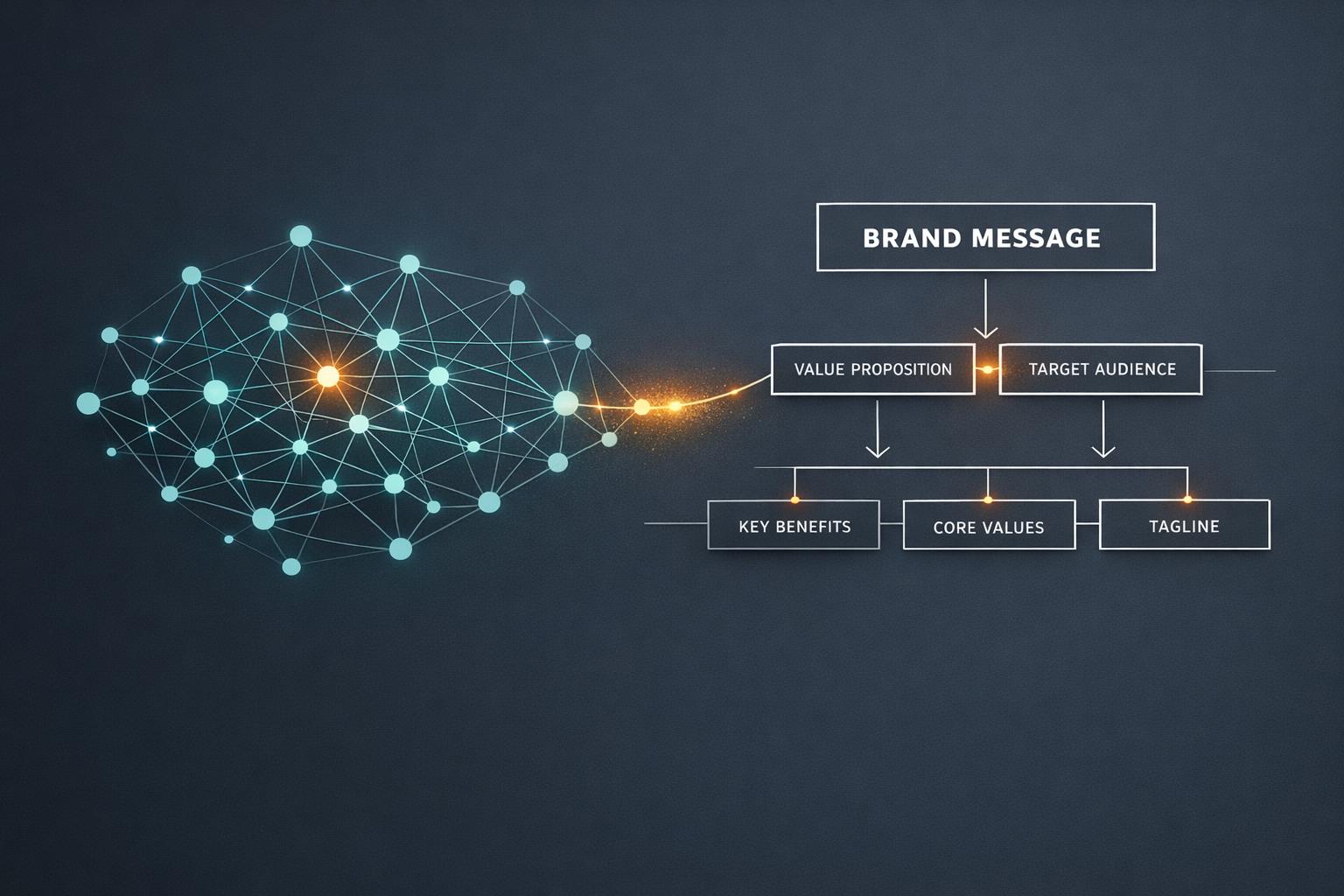
AI Brand Messaging: Neuroscience Explained
AI Brand Messaging: Neuroscience Explained
Your brand's success depends on how well it connects with your customers' emotions and memories. Neuroscience reveals that most buying decisions happen subconsciously, influenced by emotional triggers and storytelling. AI now makes it possible to harness these insights at scale, helping businesses craft messages that resonate deeply and stick in customers' minds.
Key Takeaways:
- Emotions drive decisions: Emotional content is 6x more memorable than facts and boosts loyalty.
- Simplicity matters: Clear, concise messages reduce cognitive load and improve recall.
- Storytelling builds trust: Stories sync with the brain, creating lasting emotional connections.
- AI enhances results: By analyzing neural data, AI predicts emotional triggers and optimizes messaging, increasing engagement, recall, and sales.
For small businesses, this means leveling the playing field with big brands by using neuroscience and AI to create impactful, memorable messaging that drives growth.
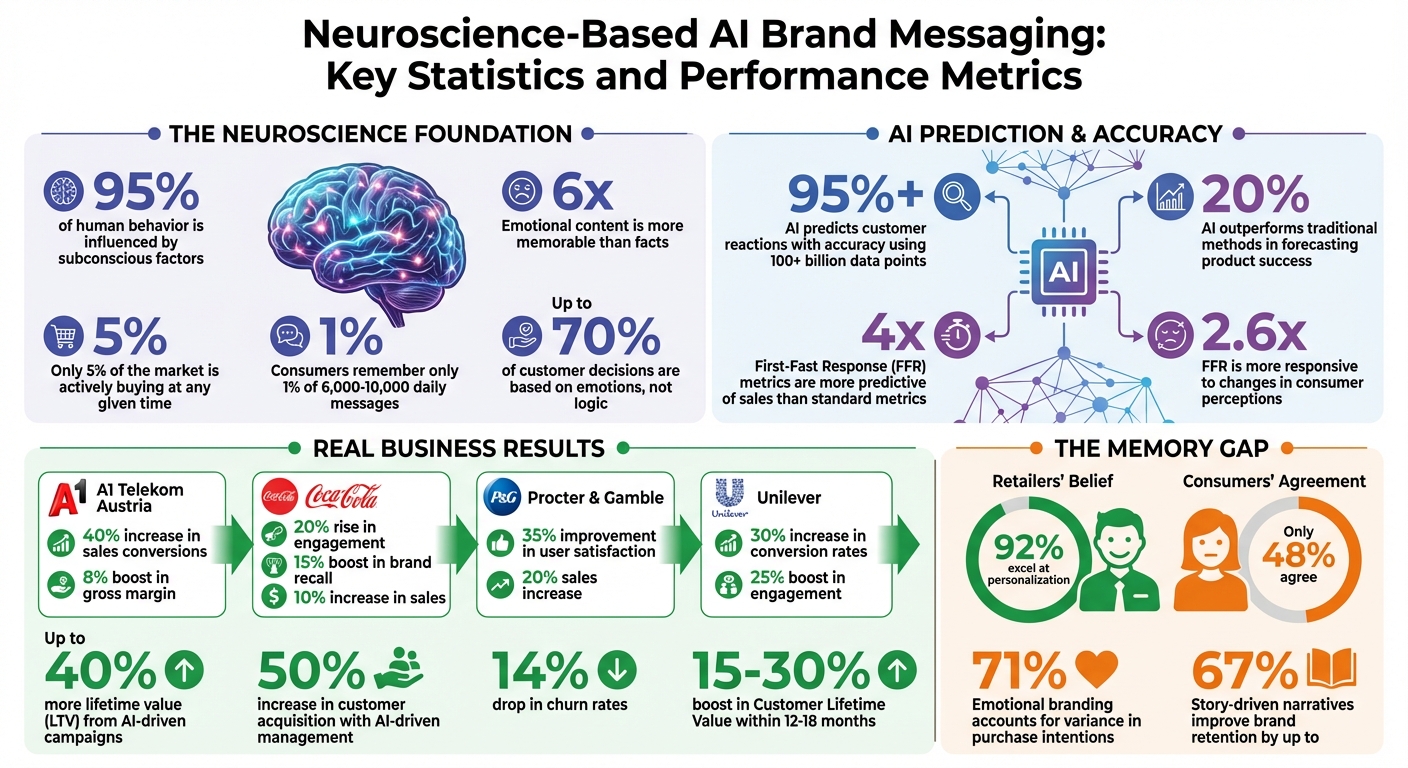
Neuroscience-Based AI Brand Messaging: Key Statistics and Performance Metrics
When AI Meets Neuroscience | The Brainy Business podcast ep 510
Neuroscience Principles Behind Effective Brand Messaging
Understanding how the brain processes information can be a game-changer for crafting brand messages that stick. Three key principles - emotional encoding, cognitive load management, and storytelling through neural coupling - determine whether your brand message resonates or fades into the background.
Emotional Encoding and Memory Formation
Think of your brand as a web of associations in your customers' minds. Research in the Journal of Brand Management describes a brand as a network of meanings, emotions, and intentions connected by neural pathways of varying strength. The stronger these emotional connections, the more likely your brand comes to mind when customers make decisions.
Most purchasing decisions aren’t made by rationally weighing every option. Instead, the brain relies on memory. Brands with strong emotional ties are the ones customers recall first. Emotionally charged messages bypass the brain’s “memory suppressors,” helping your brand information move into long-term memory.
Here’s the proof: 80% of consumers prefer brands that offer personalized experiences, and they’re willing to spend 50% more with those brands. Yet, there’s a disconnect. While 92% of retailers believe they’re excelling at personalization, only 48% of consumers agree. The gap often lies in failing to create emotionally relevant connections.
Paul Bucalo, Senior Director of Digital and Marketing Engineering at Dollar General, explains:
"Instead of amassing large quantities of data, we focus on acquiring quality data that provides a contextual understanding of our customers that we can adapt to predict trends and future behaviors".
The message is clear: to stand out, your messaging needs to trigger emotional responses, like dopamine release, which helps your brand earn a spot in the brain’s awareness. Generic messages? They get filtered out. Emotionally distinct ones? They stick.
While emotions strengthen memory, clarity and simplicity ensure your message cuts through the noise.
Cognitive Load and Message Simplicity
Every day, your customers are bombarded with information. Their brains filter out most of it, saving attention for what’s easy to process. This is where simplicity gives your brand a competitive edge.
The brain’s decision-making relies heavily on "System 1" processing - a fast, automatic, and low-effort way of thinking. Studies show that 95% of human behavior is influenced by subconscious factors. If your message is too complex or unclear, it creates a high cognitive load, making it harder for the brain to prioritize and remember.
Here’s an example: in June 2024, Macy’s implemented a personalization strategy using real-time behavioral insights. By cutting out irrelevant offers and focusing on what mattered to each customer, Macy’s saw a significant boost in engagement and conversions across digital and in-store channels.
Similarly, The Home Depot streamlined its messaging with a “Know me, Meet me, Speak to me, Value me” strategy. Erin Thorne, Director of Personalization, explained:
"We want to identify the customers and what they need, and we want to give suppliers an opportunity when it makes sense to us, them, and the customer".
By leveraging first, third, and zero-party data, The Home Depot ensured that only relevant products were promoted, cutting down on unnecessary noise and improving customer loyalty.
The takeaway? Messages that are simple, specific, and relevant to your audience strengthen the neural connections between your brand and the decision-making cues your customers rely on.
Neural Coupling in Storytelling
Storytelling takes emotional and cognitive principles to the next level by syncing your audience’s brain activity with your message. This synchronization, known as neural coupling, is why stories are so effective at building trust and creating lasting memories.
When you tell a story, you’re not just sharing facts - you’re activating a network of associations in your customer’s brain. Neuroscience shows that emotionally significant or personally relevant information is stored more securely in long-term memory and is easier to recall. This is why stories about challenges, transformation, and rewards resonate far more than a simple list of features.
The brain prioritizes information based on its relevance to specific goals or needs. When your storytelling aligns with your customer’s emotions or objectives, it helps their brain decide that your brand matters.
Personalization plays a crucial role here. By making your story uniquely relevant, you reduce the mental competition from other brands and ensure your message is the one that comes to mind when it counts. It’s not about shouting louder than the competition - it’s about connecting on a deeper, more meaningful level.
How AI Applies Neuroscience to Brand Messaging
Now that we've covered the basics of neuroscience principles, let’s dive into how AI uses these insights to craft powerful branding strategies. AI doesn’t just crunch numbers - it translates brain science into messaging that resonates deeply with customers on a subconscious level. Here’s how AI decodes emotions, adapts to context, and ensures consistent messaging to create meaningful brand connections.
AI-Powered Emotion Detection
AI taps into advanced tools like brain scans (EEG and fMRI), eye-tracking, and physiological data (heart rate, skin conductance) to interpret emotional responses in real time. With access to over 100 billion data points, AI predicts customer reactions with more than 95% accuracy and outperforms traditional methods in forecasting product success by 20%. Using Natural Language Processing (NLP), AI also analyzes social media sentiment and customer feedback to provide instant emotional insights.
For instance, in October 2024, A1 Telekom Austria collaborated with BCG X to create personalized 360° customer profiles powered by AI’s emotion and behavior prediction capabilities. This initiative led to a 40% increase in sales conversions and an 8% boost in gross margin. AI even identifies stimuli that activate the amygdala, the brain’s emotional processing hub, helping brands understand what truly resonates.
Contextual Messaging Through AI
AI doesn’t stop at identifying emotions - it ensures the timing of messages aligns perfectly with when customers are most receptive. By integrating neural data with machine learning models, AI predicts the precise moments individuals are likely to take action. This allows brands to deliver messages that fit seamlessly into customers’ decision-making processes.
Metrics like First-Fast Response (FFR) - which measure the speed of cognitive associations - are key here. FFR metrics are four times more accurate in predicting future sales and 2.6 times more sensitive to changes in consumer perceptions. As the WorkNomads community team explains:
"Attention sparks interest. Memory creates loyalty. Prediction ensures you show up at the right moment."
Cross-Channel Message Consistency
Building on insights about emotions and context, AI ensures your brand voice stays consistent across all platforms. Consistency strengthens neural associations, making your brand easier to recall. Whether it’s through social media, email, in-store interactions, or customer service, AI helps maintain a coherent brand identity. Inconsistent messaging, on the other hand, can disrupt the neural pathways that are essential for brand recall.
This is increasingly important as AI systems become more prevalent. By early 2026, 91% of retail and consumer goods companies were using or evaluating AI. With AI tools scanning the web to summarize brands, even minor inconsistencies can lead to misrepresentation or a diluted brand image. To address this, AI platforms use centralized asset systems to ensure a unified voice across digital, call center, and in-person experiences. As the WorkNomads community team aptly puts it:
"The brain does not remember campaigns, it remembers cues."
sbb-itb-63525a7
Research Evidence: Neuroscience and AI in Brand Messaging
Emotional Storytelling and Consumer Preference
Emotional storytelling consistently outshines factual messaging when it comes to capturing consumer attention and driving preferences. In September 2025, Dr. Mohammed Abdul Raffey conducted a study with 100 participants in Maharashtra, India, focusing on how brands like Coca-Cola and Tata Tea achieved strong recall by evoking positive emotions and creating deep emotional connections. His regression analysis revealed that emotional branding and cognitive triggers together account for 71% of the variance in purchase intentions, with emotional branding alone showing a 0.81 correlation with purchase intent.
Supporting this, a March 2024 brain imaging study by José Paulo Marques dos Santos and José Diogo Marques dos Santos used fMRI and Artificial Neural Networks to analyze 22 participants. The study achieved 55.9% prediction accuracy for brand preference and showed that the brain processes "preferred" and "indifferent" brands differently during early visual processing. This suggests that emotional "tagging" happens within milliseconds of seeing a brand.
Dr. Raffey summed it up succinctly:
"Emotional branding and neuromarketing significantly enhance purchase intention and brand recall".
These findings emphasize the importance of emotional triggers in shaping consumer behavior.
Message Simplicity and Cognitive Fluency
While emotional appeal grabs attention, the simplicity of the message ensures it sticks. Straightforward messaging reduces cognitive effort, making it easier for consumers to remember. Story-driven narratives, for example, are shown to improve brand retention rates by up to 67% because they deeply encode information in the brain's hippocampus and amygdala. In contrast, overly factual or complex messaging often creates cognitive friction, hindering memory formation.
Coca-Cola demonstrated the power of this approach in February 2025 by leveraging Neuro AI and EEG monitoring to fine-tune its TV commercials and packaging. By focusing on emotional engagement and cutting unnecessary complexity, Coca-Cola saw a 20% rise in engagement rates, a 15% boost in brand recall, and a 10% increase in sales in targeted regions. Procter & Gamble also tapped into Neuro AI in 2025, using eye-tracking and emotional analysis to refine product designs. The result? A 35% improvement in user satisfaction scores and a 20% sales increase for the updated products.
AI Messaging Performance Data
When neuroscience and AI come together, the results are hard to ignore. In February 2025, Unilever used Neuro AI to analyze biometric data and tailor its marketing content, achieving a 30% increase in conversion rates and a 25% boost in engagement compared to generic campaigns.
Beyond immediate results, AI-driven branding strategies also deliver long-term value. For instance, campaigns powered by AI have been shown to extract up to 40% more lifetime value (LTV) from customer portfolios. Additionally, businesses using AI-driven customer management have reported a 50% increase in customer acquisition and a 14% drop in churn rates.
Professor Moran Cerf of Columbia University highlights the science behind these results:
"This study proves that when the emotion of an ad matches the emotion of its environment, the brain works less and remembers more. Neuro-contextual advertising is just more human".
These metrics underline the transformative potential of neuroscience-driven AI in creating impactful, memorable, and effective brand messaging, particularly for small and medium-sized businesses.
Applying Neuroscience-Based AI Messaging for SMB Growth
Creating Neuroscience-Based Brand Playbooks
For small and medium-sized businesses (SMBs), creating effective brand playbooks means tapping into the brain's emotional and memory systems. By targeting the amygdala - the part of the brain that decides what’s worth remembering - brands can form emotional connections that stick. Positive emotional experiences with a brand are far more likely to build loyalty than logical arguments ever will.
One way to approach this is through the "4 Powers" framework: Attention, Emotion, Cognition, and Memory. This method uses sensory cues and visual triggers to create "memory hooks" that make your brand unforgettable. As neuroscientist and author Matt Johnson explains:
"The brand exists in the brains of consumers and in the mind of the market".
Every interaction with your audience should be designed not just to inform, but to leave a lasting impression.
A practical tool for SMBs is Aristotle's Map of Action, which organizes messaging around seven causes of human behavior: Reason, Passion, Habit, Desire, Compulsion, Chance, and Nature. By addressing multiple neural pathways, this approach avoids a one-size-fits-all strategy. With predictive AI models now achieving over 95% accuracy in forecasting customer responses, businesses can fine-tune their playbooks before rolling them out.
Once these strategies are in place, tracking their impact through measurable metrics becomes crucial.
Tracking Results with Growth Metrics
Traditional metrics like click-through rates only scratch the surface. They don’t capture what’s happening in the consumer’s brain. SMBs should focus on memory-based growth metrics - tools that measure how well their messaging is being encoded for future buying decisions. One standout metric is First-Fast Response (FFR), which tracks the immediate cognitive link between a brand and a consumer's needs. FFR is 2.6 times more responsive and 4 times more predictive of sales than standard awareness metrics.
Neuroscience-backed metrics don’t just drive immediate results - they build long-term value. Companies using these strategies often see a 15–30% boost in Customer Lifetime Value (LTV) within 12–18 months. Why? Because emotionally resonant messaging creates pricing power, allowing brands to charge more without losing customers.
Here’s the reality: Only 5% of the market is actively buying at any given time. That’s why encoding your brand into memory is so important for future sales. As brand strategist Rande Vick puts it:
"The brain doesn't buy in real time. It remembers in real time".
This shift from immediate clicks to long-term mindshare has measurable financial benefits. Research shows that for every $1 saved by cutting brand spending, companies need $1.92 in future investment to recover. For SMBs, this means tracking not just CAC (Customer Acquisition Cost) and conversion rates, but also how messaging impacts deal speed and customer retention.
| Metric Type | What It Measures | Why It Matters for SMBs |
|---|---|---|
| First-Fast Response (FFR) | Immediate brand-need associations | 4x more predictive of sales than awareness |
| Memory Encoding | How well messaging sticks in the brain | Drives the 95% who aren’t currently buying |
| Pricing Power | Ability to charge premium rates | Reflects strong emotional positioning |
| LTV Growth | Long-term customer value | Indicates compounding brand equity |
By adopting these metrics, tools like BrandMultiplier.ai’s Narrative OS help SMBs turn neuroscience into actionable growth strategies.
BrandMultiplier.ai's Narrative OS Framework
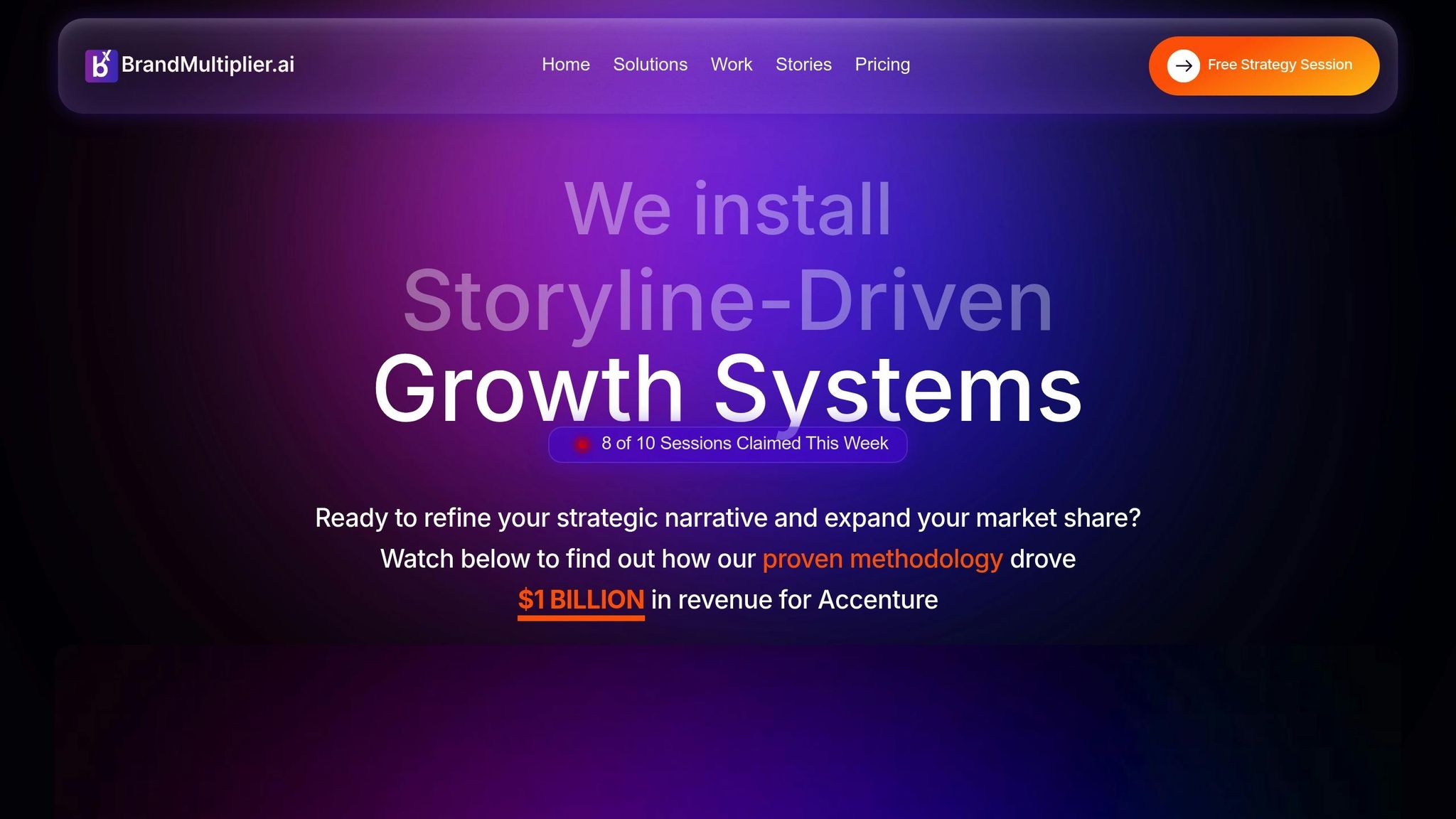
BrandMultiplier.ai has developed Narrative OS, a system that transforms neuroscience insights into a growth engine. At its core, the framework builds a brand’s strategic story using a "neuroscientific architecture". This means designing narratives that trigger neurochemical responses - like oxytocin and dopamine - that create emotional resonance and signal the hippocampus to lock the brand into long-term memory.
The system also leverages neural coupling, where effective storytelling aligns the audience’s brain activity with the brand’s narrative. This creates a "mental simulation", making the consumer feel like the hero of the brand’s story. Narrative OS ensures this story is consistently applied across all touchpoints, using sensory, verbal, and emotional patterns to build trust and familiarity.
The framework tracks how the narrative impacts CAC, deal speed, and LTV, fine-tuning it in real time. This aligns with a key neuroscience insight: up to 70% of customer decisions are based on emotions, not logic. By integrating the narrative with AI, brands achieve what’s called "AI visibility" - being recognized and recommended by AI-driven search and recommendation engines that prioritize trust and memorability.
Narrative OS also tackles the 95:5 reality: the idea that most consumers aren’t in the buying window right now. By building memory-based brand equity, the system ensures the brand is top of mind when consumers eventually enter that 5% buying phase. As Michael Platt, Director of the Wharton Neuroscience Initiative, explains:
"What comes out of our mouths is not always a perfect rendition of what's going on in our brains".
Conclusion
Studies reveal that up to 95% of purchasing decisions happen subconsciously. Brands that stick in a customer’s memory - not just those that are visible - are the ones that succeed.
By combining AI with neuroscience, small and medium-sized businesses (SMBs) can tap into emotional encoding, ease cognitive load, and use neural coupling to craft messages that truly resonate. This gives them a significant edge in creating long-lasting brand impressions.
In today’s "memory era", where consumers encounter between 6,000 and 10,000 messages daily but only remember about 1% of them, standing out is no small feat. To achieve this, brands need to focus on encoding messages that stick. Metrics like First-Fast Response (FFR) - which predicts future sales with four times the accuracy of traditional awareness metrics - highlight just how crucial this strategy is.
Dr. Lisa Genova explains it perfectly:
"Emotion tells the brain: remember this".
This intersection of science and strategy has unlocked a game-changing opportunity for SMBs. With neuroscience-driven AI, smaller businesses can now access brand-building tools that were once exclusive to massive corporations. The technology to measure, refine, and amplify messaging for lasting neural connections is here, transforming brand-building from an optional expense into a measurable, growth-driving asset.
The real question isn’t whether to embrace neuroscience and AI in your branding - it’s how quickly you can start building the memory structures that fuel your next wave of growth.
FAQs
How does AI use neuroscience to enhance emotional impact in brand messaging?
AI taps into the principles of neuroscience by analyzing subconscious brain signals to uncover emotional triggers in brand messaging. By utilizing tools like eye-tracking, facial expression analysis, and brain-wave monitoring, it can gauge how consumers emotionally react to specific elements - such as headlines, images, or slogans. These reactions are then grouped into emotions like trust, nostalgia, or excitement, giving AI the ability to identify which elements create the strongest emotional connections.
Once trained, the AI assesses various aspects of a brand's message - color schemes, word choices, or visuals - against patterns linked to emotions that influence memory and decision-making. For instance, triggers that engage the amygdala (associated with pleasure or fear) or the hippocampus (linked to memory) are flagged for their potential to enhance engagement and drive purchasing decisions. This approach, which lies at the heart of BrandMultiplier.ai's Narrative OS, enables brands to fine-tune their messaging over time, improving metrics such as customer acquisition cost (CAC), conversion rates, and lifetime value (LTV).
How does storytelling enhance brand trust and customer recall?
Storytelling has the unique ability to transform abstract brand messages into relatable, unforgettable experiences. When a story connects with someone on a personal level, something fascinating happens in their brain: neural coupling. Essentially, their thought patterns sync with the storyteller's, triggering the release of dopamine. This creates a feel-good reward and locks the story into memory as an emotional experience. Instead of recalling random facts, people remember the story's cues, making it easier to think of the brand when those cues pop up again.
Tools like BrandMultiplier.ai tap into this brain science by crafting narratives that emphasize trust-building values like authenticity and reliability. These stories are carefully deployed across critical touchpoints, ensuring they stay emotionally engaging and memorable. The outcome? A brand identity that feels dependable and sticks in the minds of consumers, turning brief encounters into meaningful, long-lasting connections.
How can small businesses use neuroscience and AI to create effective brand messaging?
Neuroscience shows that our brains latch onto brands through visual and emotional triggers - think logos, stories, and experiences that spark activity in specific brain regions. With AI trained on these principles, small businesses can craft messages that truly connect with their audience. By analyzing customer data, AI pinpoints memorable elements and predicts which brand stories will inspire engagement and loyalty.
Take BrandMultiplier.ai, for instance. Their "Narrative OS" tool uses neuroscience-based frameworks to shape and fine-tune brand messaging. It converts a brand’s story into compelling visuals, language, and experiences while tracking key metrics like customer acquisition costs, conversion rates, and lifetime value. This kind of strategy helps small businesses not only stand out but also build meaningful connections with their customers, paving the way for long-term growth.
Ready to transform your brand story?
Schedule a free diagnostic to see how we can help.
Schedule The Diagnostic