

AI Lead Scoring Metrics: CAC, LTV, and More
AI Lead Scoring Metrics: CAC, LTV, and More
AI lead scoring uses machine learning to predict which leads are most likely to convert, helping businesses prioritize efforts and reduce wasted time. This approach improves key metrics like Customer Acquisition Cost (CAC) and Customer Lifetime Value (LTV) by focusing on high-potential leads. Companies using AI see 50% more lead conversions, reduce acquisition costs by 33%, and shorten sales cycles by up to 25%.
Key takeaways:
- CAC Reduction: AI eliminates wasted effort by identifying top-performing leads, saving sales teams up to 40–60% in costs.
- Higher Conversion Rates: AI-driven scoring achieves up to 98.39% accuracy and boosts lead-to-opportunity conversion rates by 25–75%.
- Sales Velocity: Faster responses to high-priority leads improve win rates and reduce deal closure times by up to 35%.
- LTV Growth: AI focuses on retaining high-value customers, increasing retention rates by 36% and driving long-term revenue.
AI lead scoring transforms sales by cutting costs, improving efficiency, and driving better results across the funnel.
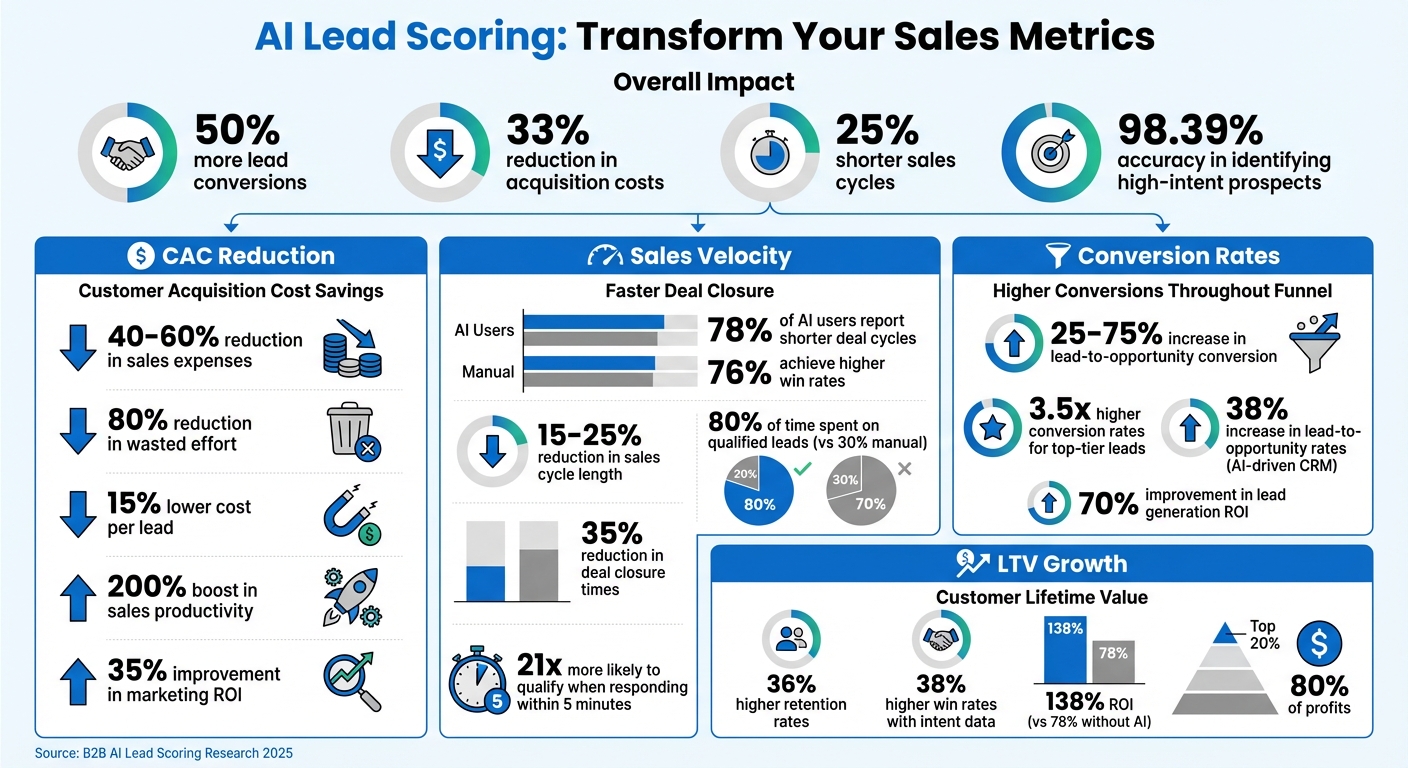
AI Lead Scoring Impact: Key Metrics for CAC, LTV, and Sales Performance
Lead Scoring vs Signals and Why AI Signals Work Better Than Traditional Lead Scoring Algorithms
sbb-itb-63525a7
How AI Lead Scoring Reduces Customer Acquisition Cost (CAC)
Customer Acquisition Cost (CAC) refers to the total investment required to acquire a new customer. When sales teams spend valuable time chasing leads that never convert, those hours - and dollars - add up quickly. AI lead scoring acts as a smart filter, cutting out this inefficiency before your team even gets involved.
Research shows that B2B companies using predictive lead scoring convert 50% more leads while reducing acquisition costs by 33%. Companies that embrace AI in their sales processes report cutting sales expenses by 40–60%. This is achieved by eliminating repetitive tasks like cold-calling unqualified leads, sending irrelevant emails, or researching prospects who aren’t a good fit.
Eliminating Wasted Sales Effort
Traditional sales methods can waste 30–40% of a representative's time on low-potential leads. AI changes the game by analyzing massive amounts of data - such as website activity, job changes, hiring trends, and technology usage - to identify the top 10–20% of leads that generate 80% of revenue.
"Revenue growth comes from saying 'no' faster and more accurately." - Malay Gupta, GrowLeads
AI systems use tiered routing to prioritize leads. For example, high-value "Tier A" leads (scoring between 81-100) trigger immediate alerts to senior sales reps, ensuring a response within five minutes. This quick engagement makes qualification 21 times more likely than waiting an hour. Meanwhile, lower-scoring leads are automatically placed into nurture campaigns, allowing your team to focus on leads with real potential. Companies adopting this system often see a 200% boost in sales productivity.
Additionally, AI provides explainability factors - specific details about why a lead scored high, such as "matched ideal customer profile (ICP) + strong pricing interest". This transparency helps reps prioritize their efforts based on solid data rather than intuition. By reallocating time away from low-quality leads, sales teams can reduce wasted effort by 80%. This efficiency not only cuts costs but also sets the stage for higher customer lifetime value.
By focusing your sales team on the most promising leads, AI not only reduces wasted effort but also drives better results across the board.
Increasing Conversion Rates to Lower Acquisition Costs
AI doesn’t just save time - it actively improves how well your sales team converts leads. With accuracy rates as high as 98.39% for identifying high-intent prospects, AI-driven scoring can lower per-lead acquisition costs by 15% while enhancing overall efficiency. Companies using AI-based scoring report 25% higher conversion rates compared to traditional approaches.
The benefits ripple through the entire sales funnel. Predictive models consistently deliver 3.5 times higher conversion rates for top-tier leads compared to average ones. Marketing ROI improves by 35% when AI-powered scoring is implemented, and lead generation ROI jumps by 70% for businesses using predictive tools. AI systems also adapt in real time, updating scores based on new data like website activity, CRM updates, or intent signals from third-party tools - ensuring your team engages precisely when prospects are most likely to buy.
"The uncomfortable truth is that most businesses treat all leads equally, which means they're actually treating their best leads poorly." - CZM
With AI, your pipeline becomes more focused and efficient. Limited sales resources are directed toward high-value opportunities, instead of being spread thin across every lead in your database. This shift reduces wasted spending, lowers CAC, and boosts conversion rates - a winning formula for long-term growth.
Sales Velocity: Closing Deals Faster with AI Lead Scoring
Sales velocity tracks how quickly deals move through your pipeline and convert into revenue. The faster you close deals, the more revenue you can generate without additional resources. AI lead scoring plays a key role in speeding up this process by helping your team focus on the right prospects at the right time.
The numbers speak for themselves. 78% of frequent AI users report shorter deal cycles, and 76% achieve higher win rates. Businesses using AI lead scoring have seen their sales cycle length shrink by 15–25%. Additionally, sales teams spend 80% of their time on qualified leads with AI, compared to just 30% using manual methods. This shift - away from chasing low-potential leads - creates a ripple effect, boosting overall revenue.
Faster Response Times to High-Priority Leads
Responding to leads quickly makes a huge difference. Companies that engage leads within one hour are 7 times more likely to have meaningful conversations with decision-makers compared to those that wait longer.
AI makes such rapid responses possible by processing vast amounts of data - like website activity, email engagement, and intent signals - in real time. For instance, if a prospect visits your pricing page or downloads a whitepaper, AI instantly updates their score and alerts the appropriate sales rep. High-priority "Tier A" leads (often the top 5–10%) receive immediate attention, ensuring senior reps can follow up within minutes rather than hours or days.
Some AI systems even use autonomous Digital Workers (AI SDRs) to reach out to new leads within seconds of qualification. These AI tools can handle initial discovery calls or emails and even schedule meetings, cutting out the delays caused by manual handoffs. With AI, lead scoring happens 31% faster than traditional methods.
"AI scores thousands of leads in seconds, ensuring sales never misses a buyer at their moment of highest interest, unlike slow manual systems." - monday.com
This kind of instant engagement helps streamline the entire sales cycle.
Reducing Time to Close
Quick responses are just the beginning - AI also shortens the overall time it takes to close deals by focusing only on leads with a strong likelihood of buying. Companies that use intent data in their AI lead scoring models see a 25% faster sales cycle, while AI implementations can reduce deal closure times by as much as 35%.
AI achieves this by filtering out leads that seem promising on the surface but lack genuine buying intent. It identifies the 60–70% of leads that typically drain resources without progressing. This allows sales teams to quickly disqualify low-potential leads and reallocate their time to real opportunities, effectively doubling their productivity without increasing team size.
AI also provides detailed insights into why a lead scored highly, enabling personalized outreach that addresses specific pain points. This tailored approach not only speeds up the sales process but also improves results - AI-driven strategies can boost conversion rates by up to 20% while cutting manual labor costs by 40%.
Improving Conversion Rates Throughout the Sales Funnel
Boosting conversion rates across the sales funnel directly supports efforts to reduce customer acquisition costs (CAC) and increase lifetime value (LTV). These rates measure how well your sales process transforms interest into revenue. By leveraging AI lead scoring, businesses can fine-tune their approach at every funnel stage. AI filters out distractions and identifies prospects most likely to buy, enabling teams to focus on the 10–20% of leads that drive 80% of revenue.
This shift from chasing volume to prioritizing precision delivers results quickly. AI models have been shown to predict which B2B prospects are likely to close with up to 98.39% accuracy. Additionally, top-tier leads identified by AI achieve conversion rates 3.5 times higher than average prospects. These improvements highlight how AI lead scoring enhances performance at every stage of the funnel.
Better Lead-to-Opportunity Conversion
AI excels at converting leads into opportunities by identifying patterns that traditional scoring methods often miss. While manual scoring relies on simple actions, AI dives deeper, analyzing factors like firmographics (company size, industry), behavioral engagement (e.g., email clicks, content downloads), and third-party intent signals (competitor research).
One of AI's strengths is uncovering complex buyer journeys. For example, it might recognize that a VP of Sales at a Series B company who visited your pricing page three times in two days, downloaded a case study, and works at a firm hiring for implementation roles is a prime opportunity. Traditional scoring systems would likely miss such nuanced behavior.
AI also identifies "dark funnel" activity, which includes anonymous research conducted before a lead formally engages. Since 94% of buying groups rank vendors before ever making contact, detecting these early signals is crucial. Companies using AI-driven CRM tools report a 38% increase in lead-to-opportunity conversion rates, and AI adoption in sales has been linked to generating over 50% more leads and appointments.
Real-world examples show how effective AI can be. In November 2025, Asana implemented 6sense's intent-based lead scoring and saw win rates soar from 39% to 70% in just eight weeks. Similarly, Rithum reactivated their 6sense platform in early 2025, and AI-driven opportunities accounted for 58% of their Q2 pipeline.
"The highest-value use case for AI scoring is not finding more buyers. Revenue acceleration comes from de-prioritizing leads that will never convert, freeing capacity for genuine opportunities." - Malay Gupta
Higher Opportunity-to-Close Rates
AI doesn't stop at lead-to-opportunity conversion - it continues to enhance opportunity-to-close rates. Once a lead is classified as an opportunity, AI dynamically updates scores based on new data, such as job changes, new executive hires, or shifts in a company’s technology stack. This ensures that sales teams focus on the right deals at the right time.
By analyzing the quality and sequence of interactions, AI distinguishes between mere interest and genuine buying intent. For instance, multiple visits to a pricing page in a short timeframe carry more weight than casual blog views. This level of precision helps sales reps avoid wasting time on opportunities with low likelihoods of closing.
The results are compelling. In 2025, Grammarly used Salesforce Einstein’s predictive models to analyze customer behavior and firmographic data. This reduced their sales cycle from 60–90 days to just 30 days and led to an 80% increase in paid upgrade conversions. Businesses using intent data report 38% higher win rates compared to those relying on traditional methods.
AI also offers "explainability" factors, providing insights into why an opportunity scored highly - whether it’s frequent visits to the pricing page or key job changes. These insights help build trust within sales teams and ensure smooth handoffs by clearly explaining why certain deals deserve priority.
| Feature | Traditional Lead Scoring | AI-Driven Lead Scoring |
|---|---|---|
| Method | Static, rules-based (+10 points for a title) | Dynamic, machine learning (probability %) |
| Data Scope | 5–15 attributes (mostly explicit) | Hundreds of signals (behavioral, intent, technographic) |
| Adaptability | Manual updates; rules age quickly | Continuous learning; recalibrates in real-time |
| Accuracy | 30–40% | 80–90% |
| Conversion Lift | 15–25% | 25–75% |
Increasing Customer Lifetime Value (LTV) with AI Lead Scoring
AI lead scoring isn't just about closing more deals - it’s about closing the right deals. The real win lies in identifying prospects who will stick around, spend more, and deepen their relationship with your business over time. This approach shifts the focus from chasing volume to prioritizing quality, which directly boosts customer lifetime value (LTV). LTV measures the total revenue a customer generates throughout their journey with your company, making it an essential metric for long-term growth. This strategy builds on earlier efforts to lower customer acquisition costs (CAC) and speed up sales cycles.
Traditional lead scoring methods often rely on surface-level indicators like job titles or form submissions. AI takes it further by analyzing product-usage trends, feature adoption, team invitations, and third-party intent data to predict which leads are likely to become high-value, long-term customers. By integrating these signals, machine learning models pinpoint the small group of leads that drive the majority of revenue. In fact, B2B marketers leveraging intent data in their lead scoring report 36% higher retention rates and 38% higher win rates. This shows how smarter targeting early in the funnel can lead to lasting benefits.
AI also identifies "champions" - customers who’ve successfully used your product in the past and have since moved to new roles within companies that match your Ideal Customer Profile (ICP). These champions already understand the value your product offers, making them more likely to become repeat buyers. Dynamic recalibration not only updates lead scores but also fine-tunes engagement strategies, helping to boost retention.
Focusing on High-Quality, Long-Term Customers
AI shifts the focus to securing customers who fit your ICP and have the potential for long-term value. By analyzing firmographics, behavioral data, and product usage patterns, AI matches leads to your ICP with precision. For product-led growth (PLG) companies, this means aligning product usage data - like activation milestones, feature adoption, and team invitations - with ICP fit. These milestones often serve as early indicators of potential expansion revenue.
This approach matters because the top 20% of customers typically account for 80% of a company’s profits and are three times more likely to make repeat purchases than new leads. AI-driven personalization allows marketing teams to tailor post-purchase experiences and loyalty programs, strengthening retention. Companies using AI lead scoring report a 138% ROI, compared to just 78% for those without it. This efficiency stems from avoiding low-fit prospects who are more likely to churn.
"Revenue growth comes from saying 'no' faster and more accurately." - Malay Gupta
AI also tracks usage-based triggers, such as when customers near storage limits or other functional thresholds, to identify timely opportunities for upgrades. Collaborative filtering highlights higher-tier products that similar customer profiles have chosen, indicating strong upgrade potential. This proactive approach turns existing customers into a source of expansion revenue, cutting the costs associated with acquiring new ones.
Building Long-Term Revenue Growth
Sustained growth comes from prioritizing lead quality over sheer quantity. AI creates what experts call "precision-led pipelines" - systems designed to focus on the right leads rather than the most leads. This strategy frees sales teams from wasting time on unqualified prospects, allowing them to concentrate on building relationships that drive long-term value.
Real-time behavioral signals can increase lead conversion rates by up to 300%. Companies using AI in sales report generating over 50% more leads and appointments while reducing sales costs by 40–60%. These efficiency gains free up resources that can be reinvested in customer success, product improvements, and retention initiatives - further boosting LTV.
AI-powered lead scoring achieves up to 98.39% accuracy in identifying high-value prospects. By continuously refining its predictions, AI creates a feedback loop that drives higher lifetime value. The result is a loyal customer base that generates predictable, recurring revenue - the cornerstone of sustained growth. This focus on high-value customers ensures a steady foundation for long-term success.
Key Metrics to Track AI Lead Scoring Performance
To make the most of AI lead scoring, you need to measure its performance. These systems can transform how your sales team operates, but tracking the right metrics is key to proving their value - and keeping them effective. Without regular monitoring, even the best AI models can lose accuracy as buyer behavior evolves and market conditions shift.
Core KPIs for AI Lead Scoring
Start by focusing on conversion metrics segmented by lead score. Ideally, higher lead scores should correspond to better conversion rates. For instance, if a lead scored 90 out of 100 converts at the same rate as one scored 50, your model needs adjustment. A good benchmark is a score-to-conversion correlation above 0.7, while keeping the false positive rate below 15%.
Velocity metrics are another critical area. These track how AI scoring speeds up your sales process. Measure how quickly leads move through each stage and calculate your overall sales cycle length. Pay close attention to lead response times - quickly engaging high-intent leads is crucial for effective qualification.
Sales efficiency metrics help determine if your team is focusing on the right opportunities. Look at your MQL (Marketing Qualified Lead) acceptance rate (target: 85%+), lead response times by tier, and the time saved by avoiding unqualified leads - typically 30–40%. Financial metrics like Cost Per Lead, Cost Per Qualified Pipeline, and Lead-Gen ROI tie these improvements directly to revenue. Companies using AI lead scoring often see 25% higher conversion rates and 15% lower cost per lead compared to traditional methods.
| KPI Category | Metric | Target Benchmark |
|---|---|---|
| Accuracy | Score-to-Conversion Correlation | r > 0.7 |
| Accuracy | False Positive Rate | < 15% |
| Alignment | MQL Acceptance Rate | 85%+ |
| Efficiency | Lead Processing Time Reduction | 25–40% |
| Velocity | Sales Cycle Length Reduction | 15–25% |
| Conversion | MQL to SQL Conversion Uplift | 20–30% |
Tracking these KPIs ensures your AI model stays aligned with your business goals and provides a roadmap for continuous improvement.
Refining AI Models Through KPI Monitoring
Once you’ve established these metrics, ongoing refinement is essential to maintain strong results. Regularly reviewing your KPIs - weekly or monthly - helps you spot "model drift", which occurs when your AI loses accuracy due to changing buyer patterns. For example, if your false positive rate climbs above 15% or conversion rates plateau, it’s time to retrain your model.
To keep your system sharp, refresh your AI models every 10–30 days to account for new buyer behaviors. This step is critical - 75% of AI initiatives fail because of poor data quality and lack of maintenance. Implement tiered routing to optimize lead management: Tier A leads (scores 80–100) should get a 5-minute response SLA, while Tier C leads can be placed in long-term nurture campaigns. Additionally, incorporate feedback from your sales team to fine-tune the model’s logic.
"The highest-value use case for AI scoring is not finding more buyers. Revenue acceleration comes from de-prioritizing leads that will never convert, freeing capacity for genuine opportunities." - Malay Gupta
Before diving into model adjustments, ensure your CRM data is solid. Aim for 95% completeness in key fields, as incomplete data is the leading cause of AI model failures. When your KPIs show consistent improvement, you’re not just proving the system works - you’re building a smarter, more adaptive approach with every deal.
Conclusion
AI lead scoring is transforming how businesses approach sales and customer retention, delivering measurable benefits across the board. By cutting wasted efforts, companies can reduce customer acquisition costs by 40–60% while enabling sales teams to focus on the most promising leads. Responding to high-intent leads in under five minutes boosts qualification chances by 21× and can shorten sales cycles by up to 25%. On top of that, identifying prospects with higher retention potential leads to 38% higher win rates and a 36% improvement in customer retention.
For B2B companies, predictive lead scoring is a game-changer. It helps convert 50% more leads at 33% lower acquisition costs, drives significant productivity improvements, and delivers a 138% ROI - far outpacing the 78% ROI seen without it. These results highlight a shift toward smarter, more efficient revenue strategies.
This philosophy is central to BrandMultiplier.ai's Narrative OS. Their Growth Operating System weaves your strategic story throughout your organization and integrates it with custom AI tools. By continuously tracking the impact of your narrative on CAC, deal speed, and LTV, the platform fine-tunes strategies in real time, ensuring alignment with actual outcomes.
Whether you're new to AI lead scoring or refining an established system, the roadmap is clear: focus on clean, reliable data, implement tiered routing based on scores, and retrain models every 10–30 days to avoid drift. These steps not only lower acquisition costs but also strengthen customer relationships. Success today isn't just about gathering more leads - it's about identifying the right ones and building scalable systems that grow without driving up costs or headcount.
FAQs
What data do I need for accurate AI lead scoring?
To make AI lead scoring effective, you need a well-rounded view of each lead. This means collecting a mix of data types that paint a complete picture. Here's what to focus on:
- Demographic and firmographic data: Details like job titles, company size, and industry are crucial for understanding who your leads are and where they fit.
- Behavioral metrics: Track actions such as email clicks, website visits, and webinar participation to gauge interest levels.
- CRM records: Use your CRM to pull in historical interactions and sales data.
- Social media engagement: Metrics like LinkedIn activity or other platform interactions provide additional context.
- Website analytics: Visits to key pages, like your pricing page, can signal intent.
For the best results, make sure your data is clean, up-to-date, and seamlessly synced across all platforms. This ensures your AI model works with reliable and actionable information.
How do I prevent AI lead scoring model drift?
To keep your AI lead scoring model on track, it's essential to update and retrain it using fresh, relevant data - ideally on a monthly basis. Regular performance monitoring is key to spotting any drift and making necessary adjustments. Incorporating dynamic data integration and real-time signals ensures the model stays aligned with current user behaviors. Additionally, prioritizing high-quality data and maintaining strong feedback loops will help the model remain accurate and reliable.
Which KPIs prove AI lead scoring is working?
AI lead scoring can deliver impressive results, with key performance indicators (KPIs) showcasing its effectiveness. For instance, accuracy rates can reach as high as 98.39%, while conversion rates often see a 25% increase. Additionally, costs per lead are significantly reduced. Some studies even report a 30–50% boost in conversions, paired with substantial time savings in processing leads. These numbers highlight how AI can streamline lead generation and enhance efficiency across the board.
Ready to transform your brand story?
Schedule a free diagnostic to see how we can help.
Schedule The Diagnostic