
AI in Personalized Video Marketing: What SMBs Need to Know
AI in Personalized Video Marketing: What SMBs Need to Know
AI is reshaping video marketing for small and medium-sized businesses (SMBs). Here's what you need to know:
- Lower Costs: AI reduces video production costs from $50 per video to as low as $0.02 - making it 2,500× cheaper.
- Higher Engagement: Personalized videos drive 35% more engagement and up to 5× more replies in sales outreach.
- Improved Customer Metrics: SMBs see lower customer acquisition costs (CAC) and higher lifetime value (LTV) with AI-driven campaigns.
- Adoption Growth: By 2025, over half of SMBs were using AI marketing tools, reflecting rapid adoption.
- Easy Tools: Platforms like Hour One, Vidyard, and D-ID offer affordable, user-friendly solutions starting at $5.99/month.
AI-powered tools allow SMBs to create tailored, professional videos at scale, without needing large teams or budgets. Start small with CRM-integrated tools to automate personalized outreach, improve customer retention, and grow your business.
AI Personalized Video Won’t Fix This (Do This First) - Pirsonal
sbb-itb-63525a7
How AI Personalization Affects Business Results
AI personalization is transforming video content while driving key business outcomes. By linking AI video platforms directly to your CRM, you can weave customer-specific details - like names, purchase history, or location - into your videos. This approach leads to 35% higher engagement rates compared to static video content. Let’s explore how these improvements show up in engagement, acquisition, and customer lifetime value.
Higher Engagement and Click-Through Rates
Personalized videos leave generic content in the dust. AI-generated videos see 17% higher engagement rates than their non-personalized counterparts. For instance, videos under one minute long manage to retain 65% of viewers until the end, while videos over 20 minutes hold only 20%. In today’s fast-paced digital world, keeping it short and relevant is essential.
Sales teams are also reaping the benefits. Personalized video outreach can generate up to 5x more replies from prospects. In 2024, Pavilion, a learning platform, used video messages in all sales sequences and saw 2x more responses from prospects. Similarly, a HubSpot sales rep achieved a 4x increase in booked meetings after adopting video outreach. To maximize impact, deliver your core message early and include clear calls-to-action (like a calendar booking button) within the video to prompt immediate responses.
Lowering Customer Acquisition Costs (CAC)
AI slashes the cost of creating personalized videos. While traditional video production can cost around $50 per video, AI platforms can produce them for just $0.02 each - a staggering 2,500x cost reduction. Automated video creation, triggered by CRM actions, ensures the right message reaches the right person at the right time - without manual effort. This automation not only saves time but also maintains consistency in quality, which boosts conversion rates across the board.
"Using video to prospect has really helped our team focus on personalization, and has yielded amazing results."
- Colleen Freedman, Director of Revenue Operations, ReviewTrackers
Additionally, generative AI-based personalized ads outperform generic ones, increasing engagement by 6 to 9 percentage points. With higher response rates and better meeting bookings, fewer leads are needed to hit sales goals, directly lowering the cost per acquisition.
Increasing Customer Lifetime Value (LTV)
AI personalization doesn’t just create immediate wins - it helps build long-term customer relationships. AI-powered videos can support customers throughout their journey, from onboarding to renewal reminders. By prioritizing a user-focused strategy, every interaction feels tailored to the individual.
The results speak for themselves. A global marketplace partnered with Auxia to implement an AI decision agent, achieving an 84% increase in cross-category LTV within four months. In January 2024, Hero MotoCorp’s personalized New Year greetings led to a 150% boost in service camp attendance. Personalized videos can even improve conversion rates by up to 500% compared to generic content. Sending videos at key moments - like introducing a new Customer Success Manager or celebrating milestones - can further strengthen retention strategies. For example, Goibibo’s personalized videos featuring cricketer Rishabh Pant achieved a 17% higher WhatsApp read rate and a noticeable lift in conversions.
For small and medium businesses, AI video investments typically pay off within 6–9 months, with companies reporting a 4:1 return on investment for campaigns.
AI Technologies Behind Personalized Video Marketing
Personalized videos are powered by AI tools that help small and medium-sized businesses (SMBs) tailor their approach while avoiding common pitfalls.
Real-Time Machine Learning for Audience Segmentation
Machine learning plays a crucial role in breaking down audience data into specific segments. By analyzing user behavior - such as engagement history, purchase habits, and browsing patterns - these models can predict what each viewer is likely to want. This is achieved by connecting the system to your CRM, customer data platform, or e-commerce database. Through these integrations, the AI pulls structured data like purchase history and location in real time.
Real-time rendering engines then use this data to create unique video versions at scale. These engines rely on parallel processing, enabling high-volume campaigns with response times under 200 milliseconds. For SMBs, template-based systems are a reliable entry point, showing 63% fewer rendering errors and 70% higher success rates compared to experimental generative methods.
Dynamic Content and Adaptive Video Personalization
Dynamic content generation involves using a master video template with placeholders that are filled with personalized elements during rendering. These placeholders can include a viewer’s name, product images, specific video clips, or tailored calls-to-action. Marketers set up branching logic with "if/then" rules to control which content appears for different audience segments (e.g., "if the user is in a cold climate, show winter gear").
A standout example is Mondelez International's Cadbury campaign (#NotJustaCadburyAd), which used Rephrase.ai to create over 130,000 personalized video variants. These videos featured a celebrity avatar endorsing specific local stores. Similarly, Jewell Unlimited leveraged Hour One's AI Video Studio to produce 100 training videos in just 4 hours - a process that previously took 5 days of manual effort. However, before diving into these systems, it’s important to audit your CRM data. Errors like miscapitalized names or irrelevant recommendations can derail the personalized experience.
Avatars, Voice Cloning, and Localization
AI avatars act as digital presenters, capable of lip-syncing and expressing emotions in real time. This eliminates the need for traditional production setups involving studios, actors, or cameras. Voice cloning and text-to-speech tools further enhance personalization by generating natural-sounding narration that can address viewers by name or reference their past purchases. To reach global audiences, AI can translate video content and adjust lip-syncing for different languages. Synthesia supports over 140 languages, while Hour One offers more than 200 language and accent options.
Cost-effective solutions make these tools accessible to SMBs. For instance, entry-level plans for Hour One range from $30 to $112 per month, while D-ID offers options starting at just $5.99 per month. SMBs can use these technologies to create high-volume personalized campaigns without stretching their budgets. Start small with tools like Vidyard to send personalized video messages that stand out in crowded inboxes, or automate onboarding by dynamically inserting each customer’s company name and plan details into a master template. These technologies not only enhance personalization but also help SMBs weave their brand story seamlessly across channels.
Connecting AI Personalization with SMB Brand Strategies
AI personalization works best when it stays true to your brand's story. From 2023 to 2025, AI adoption among SMBs surged from 14% to 38%. However, many businesses struggle to maintain consistent branding across personalized video content. The solution? Treat AI as a supportive tool rather than a decision-maker. Your brand narrative should shape every personalized detail - whether it’s the tone of voice or the visual elements in dynamic content. This approach ensures that every video produced aligns with your core message, building on the technical advancements discussed earlier.
Building Brand Narratives with Narrative OS
BrandMultiplier.ai’s Narrative OS offers a way to tackle this challenge. It uses neuroscience-based techniques to embed your brand story into AI systems. By analyzing the impact of your narrative on key metrics like customer acquisition cost (CAC), deal speed, and lifetime value (LTV), the system continuously refines your strategy in real time.
For SMBs just beginning their journey, prioritizing areas like repurposing content and leveraging customer insights is crucial. AI can help reshape your existing assets into new formats - for example, turning a written case study into a compelling video testimonial or transforming blog posts into short, engaging video clips. This approach bridges the content gap without requiring a hefty production budget. As Jeff Rauch, EVP of Global Commercial Services Marketing at American Express, explains:
"For small businesses, those customer-focused metrics like loyalty, repeat purchases, retention, and engagement rates are still incredibly important in terms of evaluating the performance of your marketing".
By embedding your brand narrative into every piece of content, you can achieve long-term gains in CAC and LTV, as previously highlighted.
Multi-Channel Video Marketing for Measurable Growth
Once your narrative is woven into your content, the next step is distributing it effectively across platforms. Personalized AI-driven posts can increase engagement by up to 50% while reducing costs. The key is tailoring your narrative for each platform - use Facebook for community-driven storytelling, Instagram for visually striking content, and LinkedIn to establish thought leadership.
To maximize impact, integrate AI video tools with CRM platforms like HubSpot or Salesforce. This allows for personalized follow-ups triggered by user actions, ensuring every interaction reinforces your brand. Additionally, combining this automation with AI-powered bidding and real-time analytics lets you focus your budget on high-performing content. Businesses using structured optimization tools report an average ROI of 223%, proving that success lies in strategic execution, not just content volume.
Common Challenges and Solutions for SMBs Using AI Video Marketing
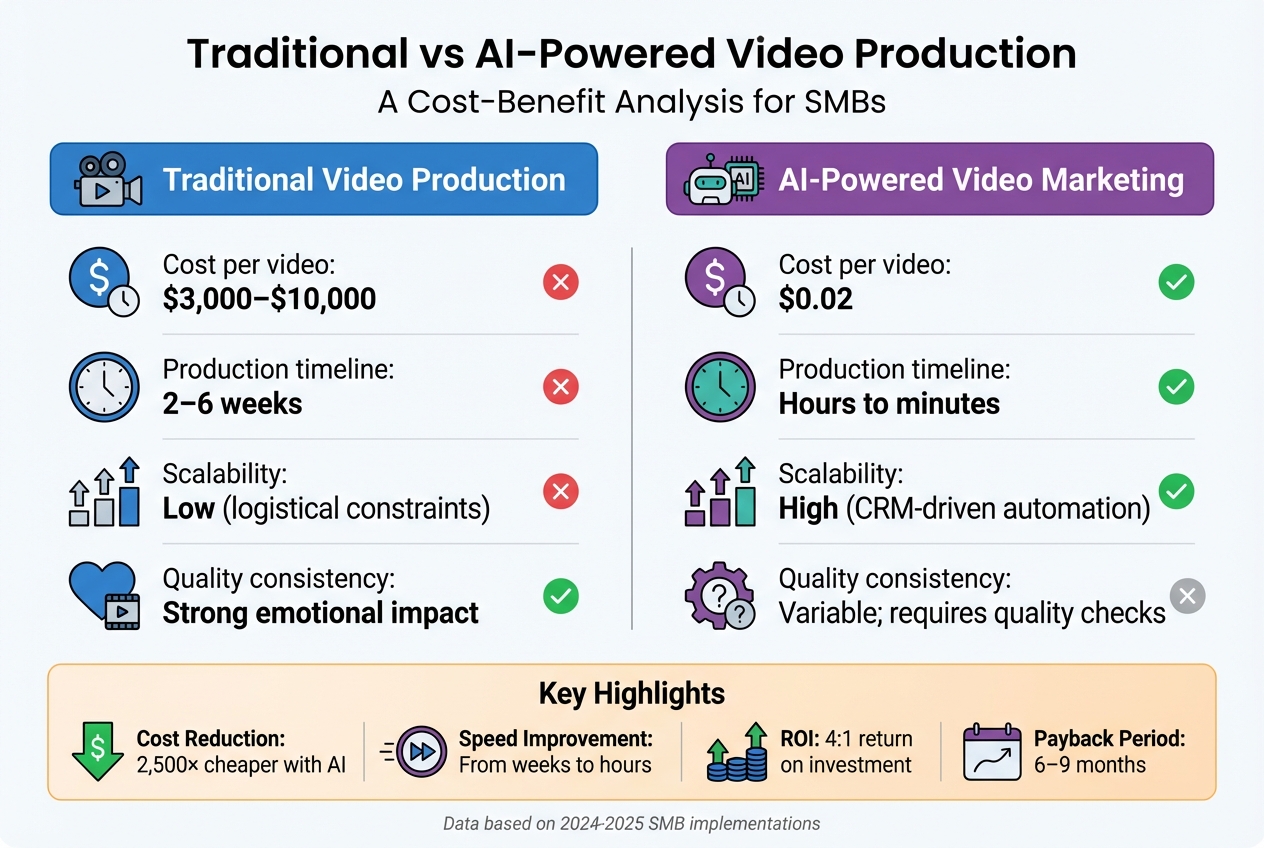
AI vs Traditional Video Production: Cost, Speed, and Scalability Comparison for SMBs
Small and medium-sized businesses (SMBs) often encounter unique hurdles when integrating AI into their video marketing strategies. For example, 37% of marketing teams struggle with limited AI knowledge, leading to deployment delays of 3–6 months. But the technical challenges don’t stop there. High-definition video rendering demands 3–5× more bandwidth than static content, often surprising SMBs with unforeseen infrastructure expenses. Additionally, 67% of deployments face delays due to CRM data mapping issues, while 45% encounter mismatches in field alignment, requiring technical corrections.
There’s also the issue of quality. 30% of initial AI video implementations experience avatar instability, leading to inconsistent visuals or even "hallucinations" - where incorrect information sneaks into the automated content. If left unchecked, these errors can harm a brand’s reputation.
Balancing Cost and Quality
AI video tools come in a wide price range, from $5.99/month for basic platforms to $112–$300/month for mid-tier options, and upwards of $120,000–$250,000/year for enterprise solutions. However, beyond the subscription fees, ensuring authentic and high-quality content is critical.
Research highlights that template-based AI systems outperform generative AI for SMBs, with 63% fewer rendering errors and 70% higher success rates in deployment. A real-world example? In 2024, Jewell Unlimited used the Hour One platform to create 100 training videos in just 4 hours - a task that previously took 5 days of manual effort. This demonstrates how the right platform can save time while maintaining quality.
For SMBs operating on monthly budgets between $1,000 and $5,000, experts suggest a hybrid spending approach: allocate 60% to a core integrated platform for consistency and 25% to specialized generative AI for unique, high-impact projects. This strategy allows businesses to maintain creative control for storytelling while letting AI handle repetitive, high-volume tasks. A "human-in-the-loop" workflow - where your team oversees narrative and strategy while AI handles production - ensures the best of both worlds.
| Feature | Traditional Video Production | AI-Powered Video Marketing |
|---|---|---|
| Cost per video | $3,000–$10,000 | Around $0.02 |
| Production timeline | 2–6 weeks | Hours to minutes |
| Scalability | Low (logistical constraints) | High (CRM-driven automation) |
| Quality consistency | Strong emotional impact | Variable; requires quality checks |
Once SMBs strike the right balance between cost and quality, the next step is addressing technical and resource challenges for smoother implementation.
Addressing Technical and Resource Limitations
The good news? SMBs no longer need an in-house data science team to leverage AI video marketing. Tools like Vidyard come with pre-built CRM integrations that simplify technical processes, while platforms like Hour One offer ready-made templates that eliminate the need for complex prompt engineering.
To minimize risks, phased rollouts are a smart choice. Gradually introducing AI video tools - starting with a single use case, like sales outreach - can reduce implementation risks by 51% compared to launching everything all at once. For instance, in 2024, ReviewThatPlace.com used Vidyard's AI Avatars to personalize sales proposals, resulting in a 760% boost in proposal engagement. This step-by-step approach allowed them to refine their strategy without overwhelming their resources.
For SMBs lacking technical expertise, working with specialized consultants can be a cost-effective solution. BrandMultiplier.ai's Narrative OS is one such option, helping businesses embed their brand story into AI systems while tracking key metrics like customer acquisition cost (CAC), deal speed, and lifetime value (LTV). This approach avoids the pitfalls of juggling multiple tools and ensures a cohesive brand message.
Finally, establish a manual review process to catch rendering errors or factual inaccuracies before content goes public. Periodic CRM audits can also help maintain data accuracy. As Anuj Kapoor, Assistant Professor of Marketing at the University of Missouri, puts it:
"Managers should view GenAI as a production enabler, not a replacement for human creativity".
The most successful SMBs treat AI as a tool to amplify their team’s abilities, not as a standalone solution.
What's Next in AI-Driven Video Marketing for SMBs
AI video marketing is no longer just a buzzword - it's becoming the standard for creating engaging content. Industry experts predict that AI-powered, highly personalized advertising will drive major growth across digital platforms. For small and medium-sized businesses (SMBs), two trends stand out: immersive AR/VR experiences and self-service platforms that simplify the process of creating professional-quality videos. As of 2025, 55–60% of SMBs were already leveraging AI in some capacity, and adoption rates are climbing fast. To stay competitive, SMBs need to gear up for these advancements in video marketing.
AR/VR Integration for Immersive Video Experiences
Augmented reality (AR) and virtual reality (VR) are no longer confined to gaming - they’re making their way into marketing. AI is enabling immersive, interactive video experiences where customers can explore products in virtual environments. Imagine a video where viewers don’t just watch a product demo but can interact with 3D models, test features, and make purchase decisions - all within the video itself.
The tech behind this is evolving quickly. AI-generated videos now offer ultra-smooth motion and realistic physics, essential for creating believable AR/VR environments. Tools like Neural Radiance Fields (NeRF) and platforms such as Tavus’s Phoenix are expected to deliver hyper-realistic avatars and environments in the next 18–24 months. This means SMBs won’t need a blockbuster budget or a production team to create high-quality, interactive content.
That said, there’s a practical side to consider. AR/VR experiences require higher bandwidth to ensure smooth interactions. SMBs should start planning upgrades to their infrastructure, such as optimizing content delivery networks (CDNs) or allocating budgets for increased hosting costs. The benefits? AI will soon be able to predict customer intent, allowing businesses to send personalized AR/VR video outreach before potential customers even start their research. These tools not only boost engagement but can also improve customer acquisition costs (CAC) and lifetime value (LTV) metrics for SMBs.
Self-Service Platforms for Easier SMB Adoption
Creating high-quality videos is becoming easier than ever, thanks to self-service platforms like Canva, CapCut, and Descript. These tools eliminate the need for technical skills, offering features like advanced editing, platform-specific optimization, and smart trimming - all tailored for small teams. What used to require a full production crew is now accessible to SMBs with limited resources.
The stats speak for themselves: 96% of social media professionals already incorporate AI into their workflows. Platforms like Idomoo’s "Lucas" let SMBs generate polished, on-brand videos from simple text prompts or website content - no production team needed. In fact, 84% of business leaders have shown interest in AI-driven text-to-video tools.
These platforms are designed with simplicity in mind. For instance, Canva’s "Magic Design" feature can transform raw photos or video clips into professional-quality videos with transitions and music automatically. Similarly, HeyGen offers avatars with multi-language lip-sync capabilities, and CapCut provides auto-subtitles and smart trimming for short-form content.
"Even solo creators and small businesses can produce professional videos without having to hire a large production team. AI tools make advanced editing accessible."
- Metricool
For SMBs on a tight budget, starting with templates is a smart move. Tools like Descript and HeyGen allow businesses to maintain a consistent posting schedule without breaking the bank. AI can handle repetitive tasks like trimming clips, adding captions, and reformatting videos for various social platforms. This frees up teams to focus on storytelling and strategy - the creative aspects that AI can’t fully replicate. These self-service tools also integrate seamlessly with existing CRM systems, streamlining the production of personalized content.
Looking ahead, AI video tools are heading toward full automation. Future advancements will include real-time voice and avatar generation, as well as seamless CRM integration, eliminating the need for manual scripting. For SMBs, this means scaling personalized video campaigns without needing to expand their teams. The time to start experimenting with these platforms is now, so you’re ready when these cutting-edge features become widely available.
Key Takeaways for SMBs
AI-powered personalized video marketing offers a cost-effective way for small and medium-sized businesses (SMBs) to achieve measurable growth. By using AI video platforms, SMBs can cut traditional production costs by over 2,500×. Pairing personalized videos with your CRM can also significantly improve conversion rates.
Starting small is key. Focus on impactful areas like email outreach or meeting follow-ups, where personalized videos can increase reply rates by up to 5x. Keep your videos short - under 60 seconds - to maintain a 65% engagement rate through to the end. Platforms like Hour One and D-ID offer affordable pricing, ranging from $5.99 to $112 per month, making it easy for SMBs to experiment without a significant upfront investment. These cost savings and performance boosts provide a solid foundation for growth.
To maximize results, align your video strategy with your brand's story. Instead of creating isolated pieces of content, aim for a cohesive narrative that ties together your sales, marketing, product, and leadership efforts. When your videos consistently reflect your brand's message, you're not just improving engagement metrics - you’re enriching the entire customer experience, from initial contact to long-term loyalty.
The numbers speak for themselves. SMBs that adopt AI video strategies report a 4:1 return on campaign investments, with payback periods typically ranging from 6 to 9 months. For example, in February 2025, Goldcast demonstrated how a 45-minute interview could be transformed into 10 unique assets using AI, producing 5x more content while reducing production time by 75% at a cost of just $720. This kind of efficiency allows your team to focus on strategy and creativity, the key drivers of lower customer acquisition costs (CAC) and higher lifetime value (LTV).
For the best results, integrate AI video personalization into a broader strategic framework. Start by cleaning up your CRM data, use template-based systems, and ensure every video reinforces your brand message. By 2025, 55% of SMBs were already using AI marketing tools. This rapid adoption highlights the competitive edge for businesses that act quickly and execute well. With these insights, SMBs can incorporate AI personalization into their growth strategies to consistently lower CAC and increase LTV.
FAQs
What CRM data do I need for video personalization?
To make videos feel personal and impactful, you'll need to tap into CRM data. This includes details like customer names, preferences, purchase history, and engagement metrics. With this information, you can create content that speaks directly to each viewer, making it more relevant and increasing engagement.
How can I avoid AI video errors and protect my brand?
To reduce errors in AI-generated videos and protect your brand's reputation, stick to platforms that are dependable and thoroughly tested. Using template-based systems can often help minimize rendering problems. Make sure to review all content carefully before it goes live. Being open about the use of AI in your processes can foster trust with your audience. At the same time, ethical practices - such as safeguarding data privacy and steering clear of misleading content - are essential for avoiding potential harm to your brand. Consistently monitoring performance and making real-time adjustments can help you catch and address issues early, ensuring both quality and credibility.
Where should I start with AI videos on a small budget?
Kick things off with budget-friendly AI video tools that make it easier to create content while keeping costs low. Start small by focusing on short, platform-specific videos - those under 60 seconds tend to grab attention and are more affordable to produce.
Look for tools that offer features like batch creation and customizable templates. These can help you produce multiple videos quickly without sacrificing quality. Many platforms now provide easy-to-use solutions that let you create professional-looking videos, even if you're new to video marketing. This way, you can dive into AI video marketing without breaking the bank.
Ready to transform your brand story?
Schedule a free diagnostic to see how we can help.
Schedule The Diagnostic