
AI-Powered Email Campaigns: Case Studies
AI-Powered Email Campaigns: Case Studies
AI is transforming email marketing for small and medium-sized businesses (SMBs) by offering personalized, data-driven strategies that outperform traditional methods. Here’s what you need to know:
- HubSpot achieved an 82% increase in conversion rates by using AI to analyze user behavior and tailor content.
- A UK retail brand doubled its open and click rates using predictive analytics.
- An e-commerce company boosted email revenue by 273% in 12 months with AI-driven RFM segmentation.
- AI is helping businesses optimize send times, personalize content, and automate workflows, saving time and increasing engagement.
These real-world examples show how AI can improve email performance across industries, turning generic campaigns into precise, customer-focused strategies.
AI Email That Converts - Without Sounding Like a Robot | INBOUND 2025
sbb-itb-63525a7
Case Study 1: Pharmaceutical SMB Improves Patient Engagement
A mid-sized pharmaceutical company faced a challenge: their broad, one-size-fits-all messaging wasn’t connecting with patients on an individual level. This lack of personalization meant they were missing opportunities to truly address patient needs.
How AI Personalization Boosted Email Effectiveness
To tackle this, the company adopted an AI-driven approach to analyze behavioral intent. Instead of relying on generic demographic data, they began tracking detailed on-site behaviors. This allowed them to pinpoint individual purchase intent - distinguishing between patients actively researching treatments and those casually browsing.
The AI system went a step further by identifying potential "Upsell Opportunities." For instance, it detected when new customers, after completing their first refill, explored educational content. These customers received tailored follow-up emails encouraging them to engage further. What’s more, the segmentation was dynamic, refreshing daily to reflect the latest patient behaviors.
Results and Metrics
This shift to AI-powered personalization transformed their email strategy. Emails became more than just mass communications - they felt like meaningful, one-on-one conversations. The results were hard to ignore: targeted recovery flows converted two-thirds of high-intent website visitors who typically browsed anonymously. By focusing on each patient’s specific needs, the company not only improved engagement but also demonstrated how AI can create similar opportunities across other industries.
Case Study 2: E-Commerce SMB Increases Revenue with AI Personalization
Between May and December 2025, a premium gift e-commerce brand faced a tough challenge: low purchase frequency. With an occasion-driven business model, most customers shopped only once or twice a year for events like birthdays, anniversaries, or holidays. This made traditional loyalty programs less effective for driving repeat business.
AI Recommendation Engines at Work
To tackle this, the company introduced a proprietary segmentation system based on RFM (Recency, Frequency, Monetary) and CLV (Customer Lifetime Value) metrics. Powered by Claude AI and integrated with their Klaviyo platform, this system analyzed browsing and purchase behaviors to uncover product affinities. For example, it identified patterns like customers starting with seasonal accessories and later purchasing core gift items.
The AI system automated several processes, including browse and cart abandonment flows and quiz-based product recommendations. It also optimized send times by analyzing factors like historical engagement, device usage, and time zones to boost open and click rates. Additionally, the AI maintained a library of high-performing content, dynamically adjusting subject lines and send times to re-engage users who hadn’t opened previous emails.
These tailored optimizations laid the groundwork for notable improvements in both revenue and customer retention.
Revenue and Retention Results
The use of AI transformed occasional purchases into steady revenue streams, showcasing the power of personalized email marketing. Over seven months, the brand’s email revenue skyrocketed from $346,000 to $1.29 million - a 273% increase. Email revenue attribution also surged, rising from 10.8% to about 30% of total revenue. By December, automated email flows alone contributed 81% of that month’s email revenue.
This case highlights how AI-driven personalization can address the challenges of low-frequency purchase models by turning sporadic buyers into reliable sources of revenue.
Case Study 3: Retail SMB Improves Audience Segmentation
Willow Tree Boutique, a women’s clothing retailer based in Alabama, faced a challenge familiar to many small and medium-sized businesses: ineffective audience segmentation. Their outdated method relied on basic rules, like "purchased in the last 30 days", which led to mismatched product recommendations. For instance, budget-conscious customers received promotions for luxury items, while high-value shoppers were targeted with everyday basics. This approach failed to reflect the nuances of customer behavior and spending habits.
AI-Powered Audience Analysis
In mid-2023, Jade Richardson, an email strategist from Go Fish digital agency, teamed up with Willow Tree Boutique to address the issue. By using Klaviyo's predictive analytics, they revamped the retailer's segmentation strategy. The AI analyzed historical purchase data to predict future buying patterns, enabling the creation of highly specific customer groups. For example, one segment targeted "big spenders" with a predicted customer lifetime value (CLV) exceeding $500, ensuring premium campaigns reached the right audience.
This AI-driven system not only automated over 20 hours of manual work each week but also updated audience segments nightly, using real-time browsing and purchase behavior. The result? A shift from generic messaging to personalized, data-backed campaigns. As Jade Richardson explained:
"Our improved segmentation drove revenue gains and deepened insights into our customers." - Jade Richardson, Email Strategist, Go Fish
Performance Results
By replacing broad, one-size-fits-all emails with tailored campaigns, Willow Tree Boutique saw impressive results. Over six months, email revenue increased by 53.1% after implementing AI-powered segmentation. Within just 90 days, predictive segments accounted for 17.1% of all revenue attributed to Klaviyo. The impact was particularly evident during the 2023 Black Friday Cyber Monday period, which became the boutique’s most successful to date. AI-identified segments ensured that product offers perfectly aligned with customer value, turning email marketing into a powerful revenue driver.
This case highlights how AI can transform traditional email strategies, enabling businesses to achieve both personalization and scale with measurable success.
Case Study 4: Service-Based SMB Increases Bookings with AI Automation
A small legal advisory firm in Chicago struggled with delayed follow-ups and generic outreach, which hurt their ability to convert leads. Their reliance on a manual email process meant responses were slow, often leading to lost opportunities as prospects moved on before hearing back.
Client Journey Mapping and Automation
To tackle these challenges, the firm turned to AI-powered journey orchestration to overhaul its email strategy. The AI system analyzed each prospect's business URL and company data to gain insights into their industry. It then connected specific actions, like viewing service pages or downloading resources, to the prospect's unique business needs. This allowed the firm to deliver personalized, one-to-one messaging based on the "job-to-be-done" for each lead.
Next, they designed multi-step campaigns triggered by real-time actions. For instance, if a prospect downloaded a compliance guide, the AI would send a customized follow-up addressing their specific industry challenges. Similarly, if someone visited the "regulatory audit" page but didn’t book a consultation, the system initiated a targeted email sequence to address common concerns about audit preparation. This real-time, tailored approach significantly improved engagement and conversion rates.
Open Rates and Booking Results
The personalized and timely follow-ups had a direct impact on client engagement. Automated journey orchestration not only boosted email open rates but also freed up consultants' time by reducing the need for manual follow-ups. This allowed them to focus more on serving clients. With more relevant and prompt messaging, the firm saw a noticeable increase in consultation bookings, proving the effectiveness of their AI-driven strategy.
Common AI Techniques and Performance Comparison
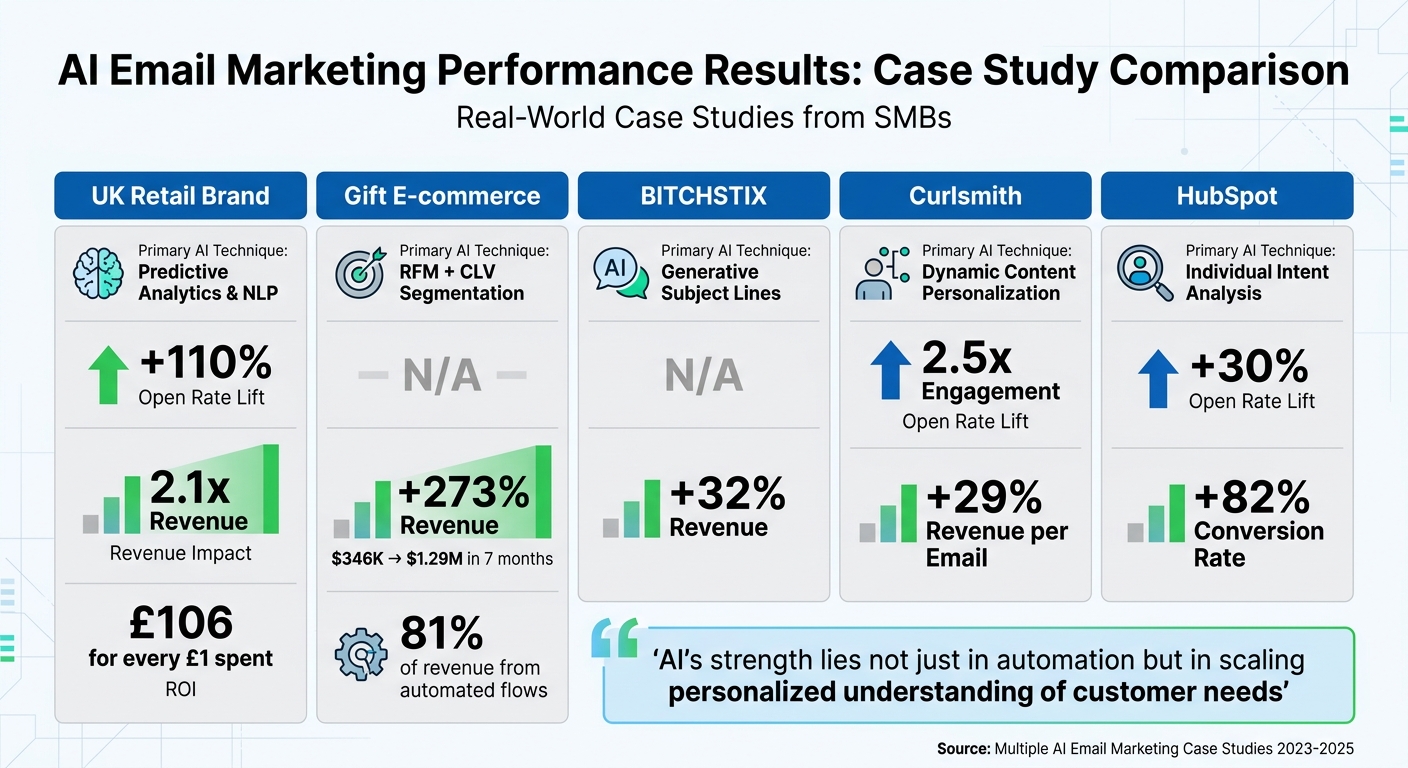
AI Email Marketing Performance Results Across 5 Case Studies
The examples above showcase how various AI techniques can be applied to achieve impressive results across different industries.
AI Techniques That Delivered Results
Several core AI strategies played a pivotal role in driving success in these case studies. Predictive analytics was key for send-time optimization, leveraging historical data like open rates, device preferences, and time zones to ensure emails were sent when recipients were most likely to engage. Natural Language Processing (NLP) helped create and test subject line variations that aligned with brand identity while maximizing clarity and performance.
Moving beyond basic segmentation, hyper-personalization through intent analysis examined individual user behaviors - such as pages visited or specific downloads - to recommend highly relevant content from a curated library. Another technique, dynamic behavioral segmentation, utilized RFM (Recency, Frequency, Monetary) and CLV (Customer Lifetime Value) models to create adaptive segments that updated automatically based on live user activity, eliminating the need for outdated manual rules. Lastly, automated flow optimization improved standard email journeys, such as cart recovery and browse abandonment, by adjusting triggers, incentives, and messaging in real time based on urgency and customer value.
"AI did not replace our team. It freed them to focus on strategy." - Fabio Pontes, UK Retail Case Study
Shifting from traditional group-based segmentation to AI-powered personalized strategies proved highly effective. Traditional methods categorized leads by broad attributes, such as "marketing professionals", whereas AI systems identified specific needs, like a manager preparing for a product launch. This one-to-one approach consistently delivered better results compared to manual segmentation across various industries.
The impact of these techniques is clearly reflected in the performance metrics below.
Performance Metrics Comparison
The numbers speak volumes. HubSpot saw an 82% increase in conversion rates and a 30% improvement in open rates by focusing on individual user intent. A UK retail brand experienced a 110% lift in open rates (from 14.2% to 29.8%) and more than doubled click rates, achieving an email ROI of £106 for every £1 spent. BITCHSTIX reported a 32% revenue boost thanks to AI-generated subject lines, while Curlsmith recorded a 29% increase in revenue per email and a 2.5x jump in engagement rates. Meanwhile, a premium gift e-commerce brand grew email revenue by a staggering 273%, from $346,000 to $1.29 million, within just 12 months using AI-driven RFM segmentation.
| Case Study | Primary AI Technique | Open Rate Lift | Revenue or Conversion Lift |
|---|---|---|---|
| UK Retail Brand | Predictive Analytics & NLP | +110% | 2.1x Revenue |
| Gift E-commerce | RFM + CLV Segmentation | N/A | +273% Revenue |
| BITCHSTIX | Generative Subject Lines | N/A | +32% Revenue |
| Curlsmith | Dynamic Content Personalization | 2.5x Engagement | +29% Revenue/Email |
| HubSpot | Individual Intent Analysis | +30% | +82% Conversion |
These results highlight that AI's strength lies not just in automation but in scaling personalized understanding of customer needs. The most effective implementations combined multiple techniques, maintained human oversight to ensure brand consistency, and focused on meaningful metrics like revenue rather than superficial ones.
These insights provide a roadmap for applying similar strategies with advanced tools like Narrative OS.
How to Apply These AI Email Strategies with BrandMultiplier.ai
These case studies highlight how AI can elevate email campaigns from generic and uninspired to personalized, brand-aligned communication. For small and medium-sized businesses (SMBs) looking to achieve similar results without the need for a dedicated data science team, BrandMultiplier.ai provides a structured solution that blends brand storytelling with performance-driven marketing.
Using Narrative OS for AI-Powered Email Campaigns
Narrative OS acts as a Growth Operating System, transforming your brand's story into tailored, AI-driven email campaigns. By analyzing your website, it identifies your core mission and pinpoints each user's specific needs based on their real-time behaviors.
The system includes a Memory layer that deeply understands your brand’s voice, ensuring all content reflects your unique tone. Tools like Voice Profile and Voice Fidelity Gates ensure that the AI-generated content stays consistent with your brand identity. Companies using this approach have seen impressive results, including a 30%+ reduction in customer acquisition costs and a 35%+ increase in deal cycle speed within six months.
To enhance personalization, the platform uses RFM (Recency, Frequency, Monetary) and CLV (Customer Lifetime Value) models for segmentation. It relies on vector databases to match the ideal content from your existing library to each user’s specific goals. Features like predictive send-time optimization and AI-generated subject lines ensure maximum engagement without requiring manual effort.
"We extract what's in your head and build the B2B narrative infrastructure that makes it travel without you - so your team closes with founder-level conviction, without founder dependency." - BrandMultiplier.ai
Performance tracking focuses on key metrics such as CAC (Customer Acquisition Cost), deal speed, and lifetime value, rather than vanity metrics like impressions. The system also offers quarterly adjustments based on real-world performance data and a Daily Optimization Dashboard to monitor critical metrics over time.
With this AI-powered framework, businesses can quickly move from strategy to execution.
How to Get Started with BrandMultiplier.ai
Getting started with BrandMultiplier.ai is simple, thanks to its clear and structured onboarding process. The system follows a pilot-to-scale methodology, which tests and validates data flows before expanding to your full email program. SMBs typically begin with a 30-minute diagnostic session to determine whether their challenges stem from structural issues or talent gaps. This is followed by a 3-hour "Rumble" session, where the team extracts your founder's unique sales insights and unspoken value propositions.
The process unifies data from e-commerce events, on-site behavior, and historical email performance into single customer profiles, while adhering to consent standards. Strategies are first tested on high-impact journeys, such as cart recovery or browse abandonment, before scaling across all campaigns. The entire system can be implemented within 75 days, with pricing ranging from $7,500 to $25,000 per month, depending on the level of integration.
BrandMultiplier.ai also offers a 30-day checkpoint, allowing businesses to exit and only pay for work completed if they don’t see measurable value. Additionally, the company provides an outcome guarantee: if agreed-upon results aren’t achieved during the pilot, they continue working at no extra cost until they are. With a 75% retention rate beyond the initial engagement, the methodology has proven its ability to drive revenue growth and reduce customer acquisition costs.
Conclusion
AI-driven email marketing has become a game-changer for small and medium-sized businesses (SMBs), proving essential for staying competitive. HubSpot's AI strategy, for example, led to an impressive 82% increase in conversions.
The case studies discussed highlight one critical takeaway: the evolution from broad audience segmentation to pinpointing individual customer intent. This shift has driven measurable success. Brands like Curlsmith saw a 29% boost in revenue per email, while Albato achieved open rates consistently above 70%.
"AI's real power in marketing isn't just automation - it's understanding individual customer needs at scale." - Kipp Bodnar, CMO, HubSpot
For SMBs looking to adopt AI, the roadmap is clear. Start with high-impact campaigns like cart abandonment, allow at least 60 days for AI systems to fine-tune their performance, and ensure human oversight to maintain brand identity. With 75% of marketers now viewing AI as crucial for email success and 72% of consumers favoring personalized content, the focus has shifted from questioning AI's importance to determining how quickly it can be implemented.
The businesses that succeed are those that embrace AI as a collaborative tool, freeing up teams to focus on creativity and innovation.
FAQs
What data is needed to start using AI for email personalization?
To make the most of AI for email personalization, start by collecting detailed customer data. This includes basic information like company size, industry, and technology stack, as well as behavioral insights such as browsing activity, purchase history, and email engagement metrics (like opens and clicks). Don’t forget to track trigger events, such as recent funding rounds or new hires.
The key here is quality. The richer and more accurate your data, the better AI can craft personalized, meaningful content that connects with each recipient. This approach not only makes your emails more engaging but also boosts the overall performance of your campaigns.
How long does it take AI-driven email optimization to show results?
AI-powered email optimization can show noticeable results in just three months. Real-world case studies highlight revenue increases ranging from 29% to an impressive 760% within this timeframe. The outcomes depend on various factors, including the campaign's objectives, the target audience, and how well the strategies are executed.
How do I keep AI-generated emails on-brand?
To keep AI-generated emails aligned with your brand, start by training your AI tools with your brand voice, style guidelines, and messaging standards. Make it a habit to update these tools with your latest brand assets, ensuring they reflect any changes or updates.
Consistency is key, so monitor the AI's outputs regularly to ensure they match your brand's tone. Additionally, leverage AI to analyze performance data. This can help you fine-tune your messaging so it resonates with your audience while staying true to your brand identity. By treating this as an ongoing process, you can ensure your email content feels genuine and stays consistent with your brand's personality.
Ready to transform your brand story?
Schedule a free diagnostic to see how we can help.
Schedule The Diagnostic