
AI-Powered Personalization: Case Studies for SMBs
AI-Powered Personalization: Case Studies for SMBs
AI-driven personalization is helping small and medium-sized businesses (SMBs) achieve big results without large budgets or teams. By analyzing customer data like purchase history and browsing habits, AI automates tasks such as content creation, email segmentation, and product recommendations. The result? Increased customer retention, higher sales, and better marketing ROI.
Key Takeaways:
- Boost in Customer Retention: Businesses using AI report retention rates of up to 85%, compared to the industry average of 30-40%.
- Improved Email Marketing: Revenue per email recipient grows by 21%-29% with AI-driven personalization.
- Higher Ad ROI: AI-powered campaigns deliver up to a 400% increase in return on ad spend.
Case Highlights:
- Agency Pure: Used AI to personalize email newsletters, increasing engagement rates significantly.
- Solo Consultant: Implemented an AI sales assistant to qualify leads 24/7, cutting response times to 30 seconds and tripling lead qualification rates.
- Melinda Maria (E-Commerce): Leveraged AI for customer reactivation, achieving a 10% win-back rate and generating $150,000 in revenue within four months.
AI tools like rasa.io, OpenAI, and Remarkable AI make these results possible by automating processes and delivering personalized experiences at scale. SMBs can start small with tools that integrate into existing platforms like Shopify or Klaviyo, focusing on high-impact areas like abandoned cart recovery or win-back campaigns.
Personalization isn’t just for big brands anymore - AI is leveling the playing field, helping SMBs grow faster and smarter.
Case Study: Agency Pure's AI Email Personalization
The Challenge: Low Engagement Rates
Agency Pure faced a tough hurdle with its email newsletters. Despite having 2,300 subscribers, engagement was lackluster. The agency simply didn’t have the time or resources to sift through subscriber data and craft tailored content for each individual. On top of that, leadership was cautious about putting more effort into email marketing, fearing it would just add to the noise in already cluttered inboxes.
This situation called for a smarter, automated solution.
The Solution: AI-Driven Content Customization
In January 2022, Agency Pure turned to the rasa.io platform to solve their problem. This AI-powered tool took over the heavy lifting, analyzing metrics like open rates, click-through rates, and user interests. It then used this data to deliver personalized content to each subscriber. The more emails it sent, the smarter it became, constantly learning and improving its recommendations.
Emily Dowd, Marketing Coordinator at rasa.io, summed it up perfectly: the platform provided "one-on-one attention" on a scale that would be impossible to achieve manually - even with a dedicated data analyst.
The Results: Higher Engagement and Retention
The results were quick and impressive. Open and click-through rates began climbing almost immediately and kept improving as the AI fine-tuned its understanding of subscriber preferences.
"The way rasa.io's AI algorithm connects businesses with their audiences is 'irresistible.'"
- Tarik Sedky, Founder and President, Agency Pure
sbb-itb-63525a7
Case Study: Independent Consultant's AI Sales Assistant
The Challenge: Limited Capacity for Lead Engagement
For solo consultants, managing every website inquiry quickly became overwhelming. Each lead required repetitive manual responses and time-consuming assessments to gauge their seriousness. To make matters worse, these inquiries came in at all hours - late nights, weekends, holidays - making timely responses impossible. As a result, the total lead-to-booking time stretched to 7 to 14 days.
On top of that, sales representatives spend 65% of their time on administrative tasks instead of selling. For a one-person operation, this inefficiency was simply unsustainable.
The Solution: AI-Powered Lead Qualification
To tackle these delays, the consultant implemented an AI-driven system. Using n8n, they integrated OpenAI with communication tools and Google Calendar. This AI-powered sales assistant worked 24/7, responding to leads in 30 seconds and using Natural Language Processing to ask smart qualifying questions based on BANT criteria (Budget, Authority, Need, and Timeline).
The system also handled scheduling across time zones, automatically syncing appointments to the calendar and logging all interactions into the CRM. This eliminated the need for any manual data entry.
The Results: Productivity and Conversion Boost
The impact was immediate. Response times dropped from 4.2 hours to under 30 seconds, and follow-up rates soared from 23% to 100%. The sales cycle was reduced from 45 days to 28 days, while the lead qualification rate nearly tripled - from 12% to 34%.
Within just three months, the consultant experienced a 40% increase in qualified meetings booked. The AI assistant saved over 4 hours daily that had previously been spent on administrative tasks. With instant responses, conversion rates could improve by up to 400%, ensuring every lead received immediate attention, no matter the time of day.
This case highlights how automation enables solo professionals to handle leads with speed and accuracy, creating opportunities for growth that were previously out of reach.
Case Study: E-Commerce Retailer's Customer Reactivation with AI
The Challenge: High Churn Rates
Melinda Maria, a jewelry brand, struggled with a familiar issue: customers would make a purchase and then disappear. Traditional reactivation emails typically result in win-back rates of less than 1%. The brand needed a more effective way to pinpoint shoppers who were at risk of leaving and re-engage them before it was too late.
The Solution: AI-Driven RFM Analysis and Automation
In 2024, Melinda Maria teamed up with Remarkable AI to implement a system that treated each customer as a unique individual. The AI platform combined data from Shopify order histories, Klaviyo browsing behaviors, and Gorgias customer service interactions to build detailed profiles for every shopper. Using RFM analysis - an approach that evaluates Recency, Frequency, and Monetary value - the system identified customers who had made purchases within the past 90 days but had recently become inactive. Instead of sending generic emails, the platform delivered personalized messages with product recommendations and, when appropriate, tailored discount offers.
"Our strategy is loyalty over discounts. Remarkable AI helps us re-engage customers through one-to-one communication that feels authentic and drives long-term relationships." - Chad Serrano, Director of Digital, Melinda Maria
The Results: Reduced Churn and Increased Lifetime Value
In just four months, Melinda Maria saw a 10% win-back rate - ten times the industry average. This effort generated over $150,000 in revenue from repeat purchases and increased customer lifetime value by 20% among returning shoppers. By prioritizing personalized engagement over widespread discounts, the brand not only strengthened customer relationships but also safeguarded its profit margins. This case highlights how AI-powered reactivation strategies can bring back customers in a way that’s both effective and financially rewarding, illustrating the potential for AI to drive measurable growth for small and medium-sized businesses.
BrandMultiplier.ai's Narrative OS: Scalable Personalization for SMB Growth
The Approach: Neuroscientific Storytelling Architecture
BrandMultiplier.ai's Narrative OS kicks off with the founder's personal story at its core. It all begins with the "Rumble" phase - an intense process designed to distill the founder's insights into a structured 5-phase storyline. This approach draws on findings from 38 neuroscience studies. Instead of focusing solely on operational tweaks, this method integrates cognitive science into brand storytelling to achieve a level of personalization that stands out. The system is designed to trigger oxytocin for trust-building, synchronize neural coupling for connection, and use a cortisol-to-dopamine sequence to make messages 22 times more memorable. This storytelling foundation sets the stage for AI-powered content delivery across all customer interactions.
The Implementation: AI-Driven Personalization Across Channels
Unlike traditional agencies that deliver static documents, Narrative OS installs a dynamic, living system that embeds the founder's story into AI tools across major channels. The system uses Voice Fidelity Gates to ensure every piece of content mirrors the founder's tone and authenticity. Whether it’s a LinkedIn post, an email, or a sales pitch, the brand's voice remains consistent. Beyond content creation, the program includes Fluency Certification for teams, enabling them to articulate the brand's value with ease. A Daily Optimization Dashboard also tracks performance in real time, allowing for constant fine-tuning.
The Measurable Impact: CAC, Deal Speed, and LTV
SMBs adopting Narrative OS have seen impressive results. On average, businesses report a 30% reduction in customer acquisition cost (CAC) within six months, a 35% faster deal cycle, and a 75% client retention rate beyond initial engagements. For example, Tria Beauty achieved a 63% year-over-year increase in website revenue and a staggering 606% rise in referral revenue under COO MinJung Song. Similarly, Apto Solutions saw a 41% year-over-year revenue boost after refining their marketing strategies with this narrative-driven approach.
"We extract what's in your head, and build the system that makes it travel without you - so your team closes with founder-level conviction, without founder dependency." - BrandMultiplier.ai
These results highlight the power of Narrative OS and set the foundation for actionable insights in the next section.
How 3 Brands Used AI To Personalize Content At Scale And Won
Key Takeaways and Lessons for SMBs
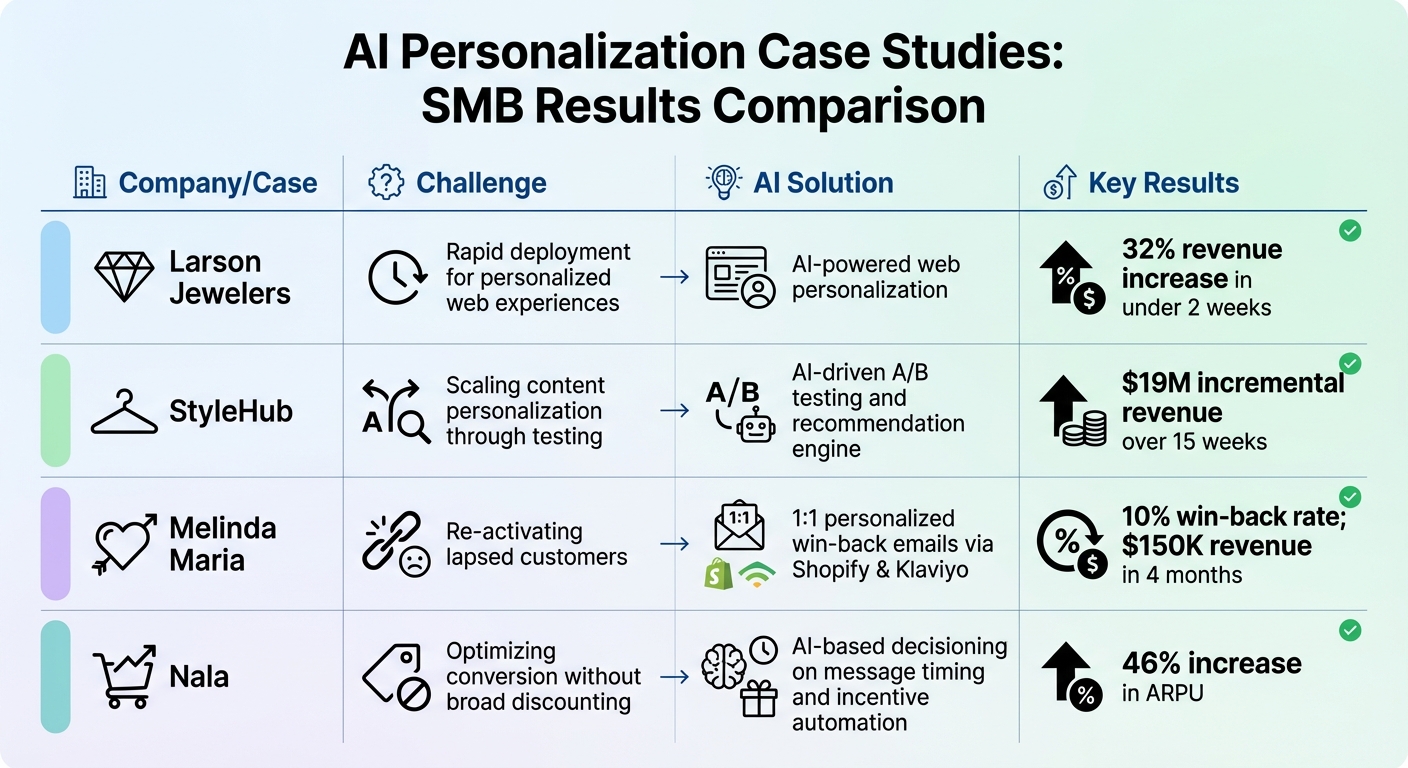
AI Personalization Results: 4 SMB Case Studies Comparison
Comparing the Case Studies
| SMB/Case | Challenge | AI Tool/Method | Key Metrics/Results |
|---|---|---|---|
| Larson Jewelers | Rapid deployment for personalized web experiences | AI-powered web personalization | 32% revenue increase in under two weeks |
| StyleHub | Scaling content personalization through testing | AI-driven A/B testing and recommendation engine | $19M incremental revenue over 15 weeks |
| Melinda Maria | Re-activating lapsed customers | 1:1 personalized win-back emails via Shopify & Klaviyo | 10% win-back rate; $150K revenue in 4 months |
| Nala | Optimizing conversion without broad discounting | AI-based decisioning on message timing and incentive automation | 46% increase in ARPU |
Actionable Insights for SMBs
The table above highlights how small and medium-sized businesses (SMBs) are using AI to tackle unique challenges and achieve impressive results. These case studies reveal how AI can transform SMB marketing, offering powerful tools to deliver personalized experiences without requiring large teams or big budgets. AI acts as a force multiplier, allowing small teams to scale efforts in areas like lead qualification, customer segmentation, and content creation.
To get started, focus on quick wins that provide immediate impact. High-value automated flows, such as abandoned cart recovery, welcome sequences, or win-back campaigns, are excellent starting points. For instance, in September 2025, Larson Jewelers implemented AI-powered web personalization in just two weeks, leading to a 32% revenue boost from optimizing homepage banners alone. Similarly, StyleHub ran 15 A/B tests over 15 weeks, generating $19 million in additional annual revenue.
Use the data you already have to train your AI models. Platforms like Shopify, Klaviyo, or even customer quizzes can provide a treasure trove of insights. Melinda Maria's success with win-back campaigns demonstrates how integrating existing customer data can significantly improve results.
Another key takeaway: focus on loyalty, not discounts. AI can help identify which customers need incentives to convert, protecting your profit margins. For example, Nala, an Australian intimates brand, used AI to automate decisions on message timing and incentive application. This approach resulted in a 46% increase in average revenue per user while keeping discount levels steady.
"You don't have to convince anyone in ecommerce how massive a 46% increase in ARPU is. Especially when our discount percentages have remained essentially the same." - Phil de Winter, Co-Founder of Nala
Finally, choose AI solutions that integrate seamlessly with your current tech stack. Many modern AI platforms offer one-click integrations, reducing the need for a large IT team and enabling rapid deployment. Rigorous testing, such as AI-driven A/B testing, should guide your decisions to ensure measurable growth. By implementing these strategies, SMBs can unlock significant opportunities for growth and efficiency.
FAQs
What customer data do I need to start AI personalization?
To kick off AI personalization, start by gathering customer data - this includes things like purchase history, browsing habits, engagement metrics, and stated preferences. Pair this with data from sources such as email interactions, website activity, and loyalty programs. When combined, these insights help build detailed customer profiles. These profiles empower AI to anticipate customer preferences, automate communication, and provide personalized experiences on a large scale.
Which campaign should an SMB automate first for quick wins?
SMBs can kick things off by automating personalized email or outreach campaigns. Take Melinda Maria, for example - they managed to achieve a 15x return on ad spend (ROAS) while strengthening customer loyalty, all through personalized emails. The best part? They did it without offering discounts. This strategy not only delivers quick, measurable results but also builds deeper connections with customers.
How can I measure if personalization improves CAC, LTV, or retention?
To understand how personalization affects Customer Acquisition Cost (CAC), Lifetime Value (LTV), or retention, start by monitoring key metrics both before and after rolling out AI-driven strategies. Pay attention to shifts in customer acquisition costs, average revenue per customer, or order values, as well as increases in repeat purchase rates. Metrics such as conversion rates, cart recovery rates, and sales growth offer valuable insights into how personalization contributes to long-term improvements.
Ready to transform your brand story?
Schedule a free diagnostic to see how we can help.
Schedule The Diagnostic