

AI-Powered Personalization for Startups
AI-Powered Personalization for Startups
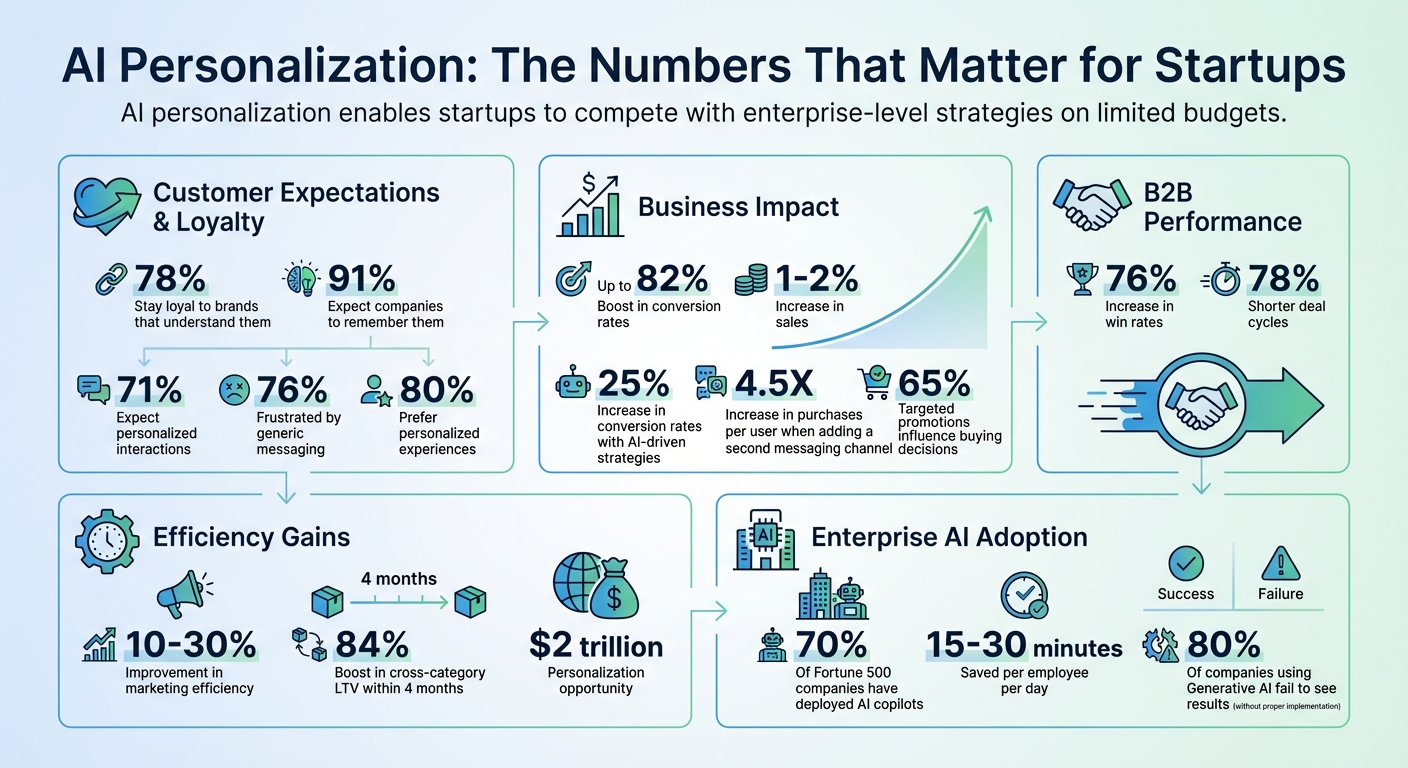
AI personalization is a game-changer for startups looking to grow without large teams or budgets. It helps deliver tailored customer experiences by analyzing real-time behavior, boosting conversion rates by up to 82%, and increasing sales by 1–2%. Startups can use AI to create personalized content, segment niche audiences, and predict customer behavior - all without the need for expensive tools or large data teams.
Key Points:
- Why it matters: 78% of customers stay loyal to brands that understand them, but startups often lack the resources to meet these expectations.
- AI's role: AI replaces basic demographic targeting with real-time, intent-based insights, enabling startups to deliver relevant, personalized experiences.
- Results: Companies using AI see higher conversions, lower customer acquisition costs, and improved customer lifetime value.
AI personalization allows even small teams to compete with enterprise-level strategies by automating content creation, refining audience segmentation, and predicting customer needs - turning limited resources into growth opportunities.
AI Personalization Impact: Key Statistics for Startup Growth
AI personalization strategies that work
sbb-itb-63525a7
Common Personalization Challenges for Startups
The idea of AI-powered personalization is appealing, but for startups, turning that idea into reality often comes with three big hurdles. These challenges are rooted in both structural and operational limitations.
Limited Budgets and Tools in Early-Stage Companies
The toughest obstacle? Money and expertise. Startups are grappling with tight budgets and a tough funding environment, which makes investing in large-scale AI solutions nearly impossible. Hiring skilled data scientists to create advanced personalization systems is often out of reach. Many founders mistakenly believe that personalization requires expensive customer data platforms (CDPs) and complex data infrastructures. This misconception often leads to "personalization theater", where companies settle for superficial efforts like adding a customer’s name to an email and calling it personalization.
Here’s the reality: strategies designed for large enterprises with big budgets and full-fledged marketing teams don’t translate well to startups operating with limited tools and resources. While 91% of consumers expect companies to remember them, startups often struggle to meet those expectations due to resource constraints.
| Personalization Layer | Startup Approach (Low Budget) | Enterprise Approach (High Budget) |
|---|---|---|
| Data | Progressive profiling & CRM signals | Massive data lakes & CDPs |
| Content | Modular component libraries | Large creative teams & agencies |
| Segmentation | Intent-based (5-10 segments) | Micro-segmentation (50+ segments) |
| Talent | AI partnerships & GTM engineering | In-house data science departments |
Without the funds for advanced tools, startups need to rethink their approach to personalization - and that starts with how they define and target their audience.
Understanding and Segmenting Niche Audiences
One of the biggest challenges for startups is identifying and segmenting niche audiences effectively. Relying on broad demographic categories like industry, job title, or company size often falls short because these don’t necessarily reflect what drives buying behavior. Positioning expert April Dunford explains it well:
"The best segments group people by the problem they're trying to solve - not demographics".
With 71% of consumers expecting personalized interactions and 76% frustrated by generic messaging, startups need to create a minimum viable data profile. This involves collecting firmographic, behavioral, intent-based, and self-reported data to fine-tune their targeting. Progressive profiling - gathering data gradually over time - is a key tactic here, but many startups haven’t implemented it effectively. AI-powered analytics can help transform these challenges into actionable insights, but only if the foundational data strategy is in place.
Maintaining Consistent Messaging During Rapid Growth
Resource limitations and audience segmentation aren’t the only hurdles. Startups also face the challenge of keeping their messaging consistent as they scale. After finding product-market fit, rapid growth often leads to fragmented communication across different channels and teams. Growth expert Elena Verna highlights the core issue:
"Meaningful personalization requires knowing three things: Who someone is, Why they came to you, What they're trying to accomplish".
But when a startup is doubling its team size every quarter or launching new products, maintaining this clarity becomes a major challenge. For example, in 2025, a North American retailer successfully integrated legacy systems with modern marketing tools, which resulted in an additional $150 million in value. This shows the potential of aligning technology and strategy, even during periods of rapid change.
The solution isn’t just about adopting better tools - it’s about building systems that grow with the company. By focusing on scalable revenue systems rather than relying on manual, one-off campaigns, startups can avoid the pitfalls of inconsistent messaging and sustain their personalization efforts as they expand. Without this foundation, startups risk falling into a cycle of generic messaging that doesn’t convert or overly personalized campaigns they can’t maintain.
How AI Improves Personalized Positioning
AI is changing the game for startups, offering smarter ways to understand and connect with their audiences. By moving beyond traditional methods, AI uses real-time data to craft strategies that resonate with individual customers. This shift from broad, static approaches to precise, dynamic ones is reshaping how startups position themselves in the market.
AI-Driven Audience Segmentation
Traditional segmentation relies on basic categories like age, gender, or job title. AI takes it further by analyzing behaviors such as scroll depth, dwell time, and search patterns. This deeper dive uncovers what customers truly need in the moment, revealing smaller "microcommunities" that share similar intentions, even if they differ demographically.
For instance, AI can identify customers who are "discount-sensitive" versus those motivated by loyalty or exclusivity using propensity modeling. This means you can stop offering discounts to people who would’ve paid full price anyway. The numbers back it up: 80% of consumers prefer personalized experiences, and AI-driven strategies can increase conversion rates by as much as 25%.
AI also speeds up feedback loops, allowing startups to refine their niche positioning in days rather than months. Additionally, AI-powered competitive analysis identifies overlooked opportunities, giving startups an edge in crowded markets.
Real-Time Content Adaptation Across Channels
Once audiences are segmented, AI takes personalization to the next level by adapting content in real time. For example, AI can adjust banners, product recommendations, and calls-to-action based on a user’s live browsing behavior. This isn’t just about adding a personal touch - it’s about aligning with the customer’s current mindset.
AI ensures messaging remains consistent across channels. If someone researches "enterprise security" on your site, they’ll see related content in their email, ads, and mobile app. Adding a second messaging channel alone can boost purchases per user by 4.5 times. AI also reduces cart abandonment by detecting exit intent and triggering timely offers, like free shipping or discounts.
For B2B startups, AI simplifies complex tasks like tailoring dashboards, onboarding flows, or creating on-brand content variations. It adjusts tone and messaging to fit individual preferences while keeping the brand voice consistent. The payoff? 78% of customers return to brands that understand them.
Predictive Analytics for Customer Behavior
Predictive analytics shifts positioning from reactive to proactive. Instead of waiting to see what customers do, AI predicts their next move using historical and live data. Startups can then deliver the right offer at the perfect moment, maximizing ROI.
AI models calculate things like "promo propensity" (likelihood to buy with a discount) and "content propensity" (likelihood to engage with specific messaging). This helps startups maintain profit margins while driving conversions. For B2B companies, predictive analytics boosts win rates by 76% and shortens deal cycles by 78%. AI can also flag at-risk customers by spotting subtle behavioral changes, giving businesses a chance to act before losing high-value clients.
"AI transforms brand strategy from reactive to predictive." - Josh Weaver, Brand Strategist
Timing is everything, especially when the biggest competitor is often customer inaction. Predictive analytics identifies those critical moments - like a "2 AM crisis" - to ensure your brand is top of mind. With personalization representing a $2 trillion opportunity, startups that embrace predictive analytics can achieve better timing, relevance, and results.
Using BrandMultiplier.ai for AI-Powered Personalization
BrandMultiplier.ai simplifies the personalization process for startups by using AI to embed key customer insights into company-wide strategies. This approach builds on earlier strategies by turning audience data into actionable plans.
Rumble Discovery Workshops for Audience Research
The personalization journey starts with the Rumble Discovery Workshop. Instead of leaning on outdated demographic data, these workshops dive into behavioral patterns and psychological triggers. Using AI-driven tools, BrandMultiplier.ai speeds up the feedback process, reducing what typically takes months into just weeks. By leveraging AI segmentation methods, these workshops uncover detailed insights into micro-segments, such as late-night browsing habits, content preferences, or sensitivity to pricing. Techniques like k-means clustering group customers based on patterns like seasonal buying behavior or preferences for premium products.
This research directly supports scalable positioning strategies, ensuring your brand stays top-of-mind when customers face urgent needs - like a "2 AM crisis" where they’re searching for immediate solutions. AI-powered social listening further sharpens this process by identifying market gaps and emerging trends before they become mainstream, helping startups position themselves effectively. To make these segments practical, they should generally represent at least 2–3% of your overall customer base.
Building Narratives with Neuroscientific Frameworks
Once audience insights are clear, BrandMultiplier.ai uses neuroscientific principles to create messaging frameworks. These frameworks focus on understanding the deep psychological triggers that drive purchasing decisions. AI tools reveal motivations such as convenience versus sustainability or exclusivity versus affordability, helping shape messages that connect on a deeper level than traditional demographic data ever could.
The system generates multiple content variations, but human oversight ensures the messaging stays true to your brand's essence and emotional tone. Without this balance, many companies - nearly 80% of those using Generative AI - fail to see meaningful results because they don’t move past initial experiments. These well-crafted narratives are then unified across the organization using the Narrative OS.
Deploying Narrative OS Across Your Organization
Narrative OS is BrandMultiplier.ai's Growth Operating System, designed to align your brand’s story across all departments - leadership, sales, product, and marketing. For marketing teams, it ensures consistency across emails, social media, and websites while enabling personalization tailored to individual psychological drivers. Sales teams gain tools like intent detection, which interprets subtle signals, such as how long someone lingers on a page, to provide timely nudges.
Leadership benefits from predictive insights, spotting market trends and shifts in consumer psychology before they become widespread. By syncing all teams around a unified narrative, startups can achieve measurable improvements in metrics like customer acquisition cost (CAC), deal speed, and customer lifetime value (LTV). Narrative OS doesn’t just implement your story - it measures its impact in real time, optimizing it every quarter. This ongoing refinement sets successful startups apart from the 70% of Fortune 500 companies that have deployed AI copilots, helping employees reclaim 15–30 minutes of their day.
Measuring ROI from AI Personalization
Understanding the return on investment (ROI) from AI personalization comes down to its impact on key business metrics. For startups, this means keeping a close eye on customer acquisition costs (CAC), customer lifetime value (LTV), and sales cycle length. Here's how AI personalization addresses challenges in these areas.
Reducing Customer Acquisition Costs with AI
AI helps cut CAC by ensuring marketing budgets are spent on leads most likely to convert. This is achieved through propensity scoring, which ranks leads based on their likelihood to make a purchase. For example, AI can guide you to reserve high-cost channels like SMS for high-propensity leads while using more affordable options, like email, for others. This targeted strategy can improve marketing efficiency by 10–30%.
To measure the impact, use A/B/n testing with randomized control groups. Compare results from a group receiving generic messaging to those from groups receiving personalized content. This method highlights the "incremental lift" - the added conversions driven by AI personalization. For instance, you could test this on a specific journey, like abandoned cart recovery, and see measurable results within 30–60 days.
Beyond reducing acquisition costs, AI personalization plays a big role in fostering long-term customer loyalty.
Increasing Customer Lifetime Value
AI-powered personalization doesn’t just attract customers - it keeps them engaged. For instance, retail and eCommerce brands that integrate a second messaging channel report 4.5X increases in purchases per user. Additionally, 65% of customers say targeted promotions influence their buying decisions. However, to truly understand LTV, you need to go beyond surface-level metrics like clicks and opens and focus on actual revenue impact.
A user-centric approach works best here. AI models can predict each customer's next best action, driving more meaningful interactions. For example, AI decision engines have delivered an 84% boost in cross-category LTV within just four months. To measure this, track metrics like retention rates, purchase frequency, and cross-category purchases. Use data-driven attribution models to credit every interaction in the customer journey - not just the final click. This feedback loop continuously refines the AI's ability to drive higher LTV.
Shortening Sales Cycles with AI Personalization
AI doesn’t just enhance customer experiences - it also speeds up the sales process. By analyzing user behavior, such as repeated product comparisons or search refinements, AI can detect intent and prompt timely interventions while the customer is still engaged.
Predictive next-best-action engines play a key role here. They suggest the most effective next step, whether it’s inviting a teammate or connecting a data source, to move the customer closer to conversion. AI also identifies friction points, like overly complicated filters or long comparison processes, and simplifies them in real time to prevent abandonment. These improvements can increase total sales by 1–2% and boost margins by 1–3%. To gauge success, track metrics like time-to-activation, trial-to-paid conversion rates, and average deal velocity. These numbers will reveal how AI personalization accelerates your sales cycle.
Conclusion
AI-powered personalization tackles some of the biggest hurdles startups face: tight budgets, scattered audience data, and the challenge of scaling without expanding teams. By shortening feedback cycles from months to just weeks, AI shifts brand strategy from reactive guesswork to proactive intelligence. It enables real-time validation of positioning and helps spot emerging market trends before they become widespread.
The impact on business performance is undeniable. Companies leveraging AI-driven personalization report noticeable boosts in conversion rates, sales, and profit margins. In fact, 78% of customers are more likely to stay loyal to brands that show they truly understand their needs through personalization. This creates a lasting edge over competitors, as the advantage stems from continuously learning from your unique customer data. This shift represents a fundamental change in how startups approach market positioning.
"Now? AI can surface the insights that actually move metrics in weeks, not fiscal quarters." - Josh Weaver, Brand Strategist
The move from traditional demographic segmentation to intent-based targeting eliminates the guesswork of relying on static factors like job titles or company size. Instead, AI enables responses to specific behavioral signals that reliably predict conversions. Pair this with modular content scaling, and even small teams can compete with enterprise-level marketing budgets. By automatically generating thousands of personalized variations from a single content library, startups can achieve personalization at scale. These refined methods empower immediate, data-driven decisions.
To get started, startups should focus on high-impact pages, group audiences by problems rather than personas, and track the metrics that matter most - CAC (Customer Acquisition Cost), LTV (Lifetime Value), and sales velocity. Startups that embrace this approach not only grow faster but also build competitive advantages that strengthen over time.
FAQs
How can startups use AI for personalization without spending a lot of money?
Startups can make AI-powered personalization work without breaking the bank by leveraging the data they already have - things like customer behaviors, click patterns, and purchase history. Start small by focusing on areas that can deliver the biggest impact, such as product pages, shopping carts, or email campaigns. Even minor personalized tweaks in these spots can significantly boost engagement.
Opt for tools that come with built-in AI capabilities, such as automated content recommendations or rule-based messaging. These tools are designed to simplify implementation, meaning you won’t need a dedicated data science team to get started. Plus, they’re flexible enough to grow with your business. By experimenting with small adjustments and fine-tuning based on performance, startups can see real growth without pouring huge amounts of money into AI infrastructure.
What are the main advantages of using AI for audience segmentation?
Using AI for audience segmentation gives startups two key advantages.
First, it allows for real-time segmentation that adapts as customer behaviors shift. This means you can fine-tune your target groups on the fly, ensuring your marketing efforts remain relevant. The result? You can pinpoint high-value customers, reduce churn, and spot new growth opportunities more effectively.
Second, AI enables personalization at scale. By processing massive amounts of data, AI can craft messages and experiences tailored to individual preferences and actions. This kind of precision leads to higher engagement and better conversion rates, giving your startup a measurable edge. In short, AI makes audience targeting smarter, faster, and more effective.
How can AI ensure consistent messaging as startups scale quickly?
AI plays a key role in maintaining consistent messaging during periods of rapid growth. By analyzing real-time customer data, it dynamically adjusts communications across various channels. Using behavioral insights - like purchase history and engagement patterns - AI crafts personalized messages that align with the brand’s voice, even as the audience expands.
Through data integration and ongoing strategy refinement, AI empowers startups to deliver messaging that feels relevant and tailored. This approach helps businesses maintain a unified brand identity across platforms like email, SMS, and social media, ensuring they connect meaningfully with their growing customer base.
Ready to transform your brand story?
Schedule a free diagnostic to see how we can help.
Schedule The Diagnostic