

AI Segmentation Success Stories for SMBs
AI Segmentation Success Stories for SMBs
Using AI for demographic segmentation is helping small and medium-sized businesses (SMBs) save money, increase revenue, and improve marketing efficiency. Here’s what you need to know:
- 91% of SMBs using AI report revenue growth, and 86% see higher profit margins.
- AI reduces Customer Acquisition Costs (CAC) by 40% and improves ad campaign efficiency by 3x.
- Personalized messaging driven by AI boosts conversion rates by 40%.
- Over half of SMBs (53%) now use AI, with 82% saying it’s critical for staying competitive.
Four case studies show how SMBs are using AI to achieve results:
- Marleylilly: Doubled conversion rates and cut ad spend by targeting high-value customers based on age and location.
- True Botanicals: Boosted customer lifetime value by 27% using income and gender segmentation for personalized campaigns.
- TechVantage: Doubled its win rate and shortened sales cycles by targeting leads based on industry and company size.
- Rocket: Reduced churn by 40% and increased orders by 65% through family demographic segmentation.
AI-driven segmentation replaces outdated manual methods by analyzing real-time data like purchase history, browsing habits, and customer behavior. Tools like BrandMultiplier.ai help SMBs refine their targeting and maximize ROI. To get started, ensure your customer data is clean and allocate your budget wisely: 70% to proven campaigns, 20% to new audiences, and 10% to seasonal efforts.
AI isn’t just for big companies anymore - it’s a game-changer for SMBs with limited resources.
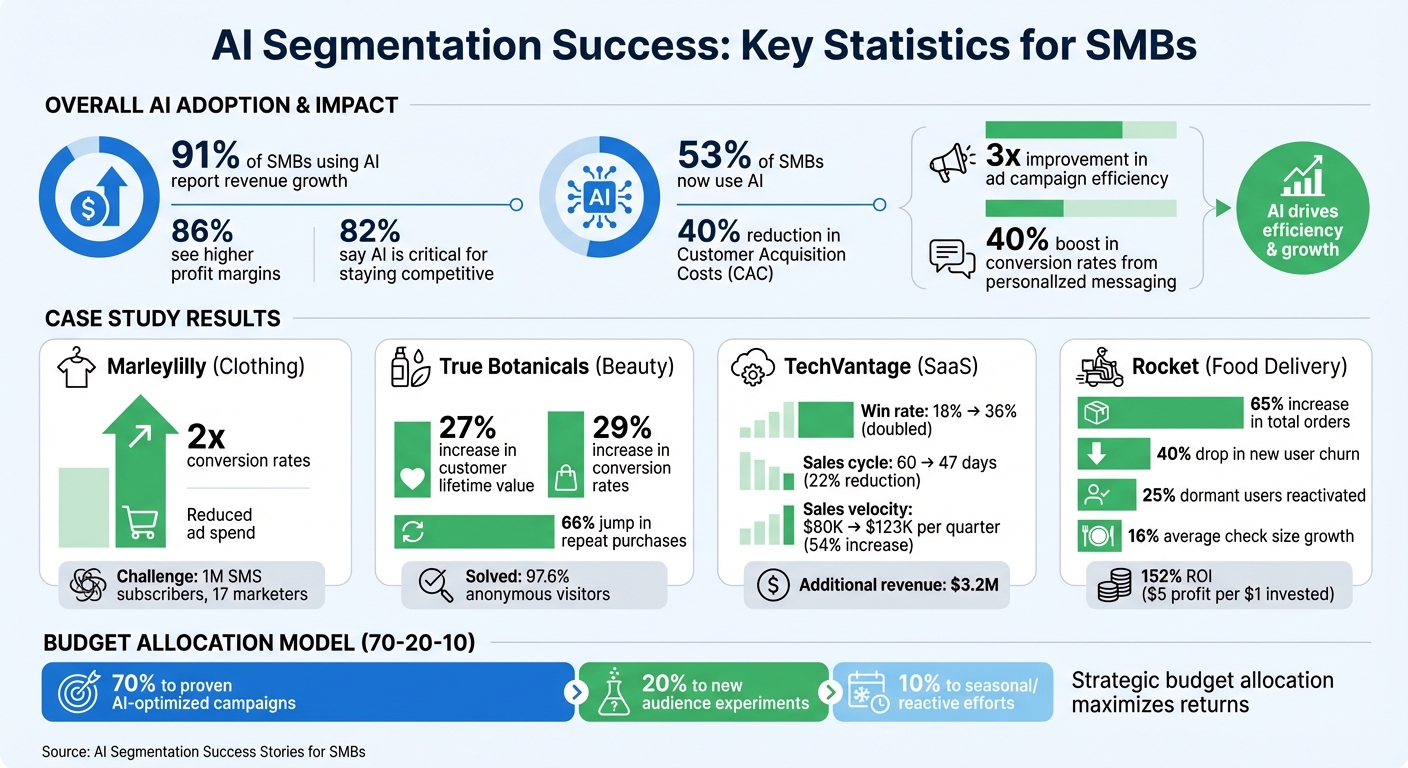
AI Segmentation Impact on SMB Revenue and Marketing Efficiency
AI That Pays for Itself: How SMBs Can Save Time & Boost Growth
sbb-itb-63525a7
Case Study 1: Clothing Retailer Cuts Costs with Age and Location Targeting
Marleylilly, an online apparel retailer based in the U.S., faced a daunting task: managing engagement with one million SMS subscribers using a lean team of just 17 marketers. Crafting and scheduling thousands of personalized messages manually was simply impossible. As Elizabeth Pingry, Director of Marketing at Marleylilly, put it:
"The AI tool encapsulated the scale of our challenge - no marketer could individually craft and schedule that many messages".
This challenge highlighted the growing reliance on AI-driven segmentation tools in modern marketing.
In September 2024, Marleylilly adopted AI-powered tools from Attentive for send-time optimization and audience segmentation. These tools analyzed individual behavior patterns, such as identifying "moms" who were most active during school pickup hours, and automatically sent messages at the moments when shoppers were most likely to engage. This marked a significant improvement over their previous method of sending generic campaigns at random times.
The AI also filtered out shoppers with a low likelihood of making a purchase, allowing Marleylilly to focus its marketing budget on high-value customer segments. By continuously refining target audiences based on behavior, the system minimized wasted spending and maximized efficiency.
The results were striking. Marleylilly saw conversion rates for AI-timed messages double, all while reducing overall ad spend by cutting out low-value segments. This case highlights how even small-to-midsize businesses can use automation to achieve impactful results with limited resources.
Case Study 2: Beauty Brand Grows Customer Value with Income and Gender Segmentation
True Botanicals, a skincare company, faced a major challenge: 97.6% of their website visitors were anonymous, making it nearly impossible to tailor their marketing efforts effectively. Without knowing their audience, the brand was essentially marketing in the dark. To solve this, they turned to a data-driven strategy.
The brand adopted AI-powered predictive segmentation to analyze visitor behavior. This technology identified "Pricing Groups" (representing income levels) and "Category Intent" based on the visitor's first session. With this information, True Botanicals could segment shoppers into categories like high-income luxury buyers or budget-conscious customers, all without waiting for a purchase to occur.
Using these insights, the brand crafted tiered product recommendations and personalized email campaigns for each group. For example, high-income shoppers received messages highlighting premium formulations and exclusive collections, while mid-market customers were shown value bundles and subscription options. The AI also used conjoint analysis to determine which product features mattered most to customers, helping the brand fine-tune its pricing strategies.
This personalized approach led to impressive results. True Botanicals saw a 27% boost in customer lifetime value by creating tailored customer journeys driven by AI insights. Tran Wu, Senior Director of Integrated Marketing and Ecommerce at True Botanicals, shared:
"As a brand we've always had anecdotal evidence based on customer feedback on endorsements but to have clear cohort analysis showing exactly which celebrity messaging gets through with customers was a game changer".
The benefits didn’t stop there. The brand experienced a 29% increase in conversion rates for high-intent users, along with a 66% jump in repeat purchases through loyalty strategies that focused on "surprise and delight" moments.
Case Study 3: SaaS Company Speeds Up Sales with Industry and Company Size Targeting
TechVantage, a marketing automation company generating $12 million in annual recurring revenue, faced a tough challenge: its lead qualification process was holding back sales. By mid-2024, the company’s win rate had stalled at 18%, and the sales cycle dragged on for 60 days. This inefficiency stretched the sales team thin, as they spent too much time on unqualified leads.
Rebecca Martinez, the company’s VP of Sales, shared her frustration:
"We were chasing numbers... I saw our top reps exhaust themselves on unqualified deals, while genuinely interested prospects got ignored because they didn't fit our broken qualification criteria".
Adding to the problem, 38% of their Salesforce records lacked key details - like loss reasons and budget information - making it impossible to train an AI model effectively. James Park, Head of Revenue Operations, and his team spent 40 hours cleaning up 2,400 historical deals. Reflecting on the experience, Park noted:
"We wasted 2 weeks because our historical data was a mess. If I did it again, I'd clean data 3 months before buying AI tools - so we're ready to deploy on Day 1".
Once the data was cleaned and ready, TechVantage implemented an AI-powered lead scoring system. The AI analyzed past wins and losses, using firmographics (like company size and industry) and behavioral signals to prioritize leads. Unlike their previous one-size-fits-all approach, the AI identified mid-market companies in industries like healthcare tech and financial services as high-potential opportunities. To test its effectiveness, the team rolled out the platform with 10 sales reps.
The results were game-changing. By early 2025, TechVantage had doubled its win rate from 18% to 36% and shortened the average sales cycle from 60 to 47 days - a 22% reduction. Sales velocity per rep surged from $80,000 to $123,000 per quarter, a 54% increase. This boost translated into an additional $3.2 million in revenue, all without expanding the sales team. The AI allowed the team to zero in on high-value deals, making their efforts more efficient and impactful.
Case Study 4: Food Delivery App Reduces Churn with Family Demographic Segmentation
Rocket, a global food delivery app with over 1 million users, faced a tough challenge in 2020: keeping customers engaged. To dig deeper into customer behavior and understand not just what people were ordering but why, the company turned to AI-driven segmentation. Sajith Don, Director of E-commerce, shared a key insight:
"Don found that the occasion, as well as the larger context of the meal, such as a quick breakfast pick-up on the way to work or a large dinner delivered at home for the entire family, drove how customers transacted and were critical for the segmentation exercise to be effective."
This insight became the foundation of Rocket's success, showing how AI segmentation can redefine customer engagement.
Rocket used an AI-powered segmentation strategy built on a real-time Customer Data Platform. This platform analyzed data like order history, cuisine preferences, average check size, and order timing. Through this process, Rocket identified 15 specific dining occasions, with dinner and late-night meals making up a whopping 60% of total revenue. By enriching this data with household indicators - such as frequent family bundle orders or kids' meals - and using average check size as an income-level proxy, the AI created microsegments based on household size and parental status.
The results were nothing short of impressive. Between January and December 2020, Rocket saw a 65% increase in total orders and a 40% drop in new user churn. The campaign also reactivated 25% of dormant users with personalized push notifications, grew the average check size by 16%, and boosted customer lifetime value by 12%. Altogether, Rocket achieved a 152% ROI, generating $5.00 in profit for every $1.00 invested - all without increasing media spend.
The strategy worked across every stage of the customer lifecycle. New users who hadn't placed an order within 90 days received nudges to encourage their first purchase. Meanwhile, loyal customers - those who ordered from the same restaurant three times in three months - got personalized discounts. For at-risk customers, AI-driven RFM (Recency, Frequency, Monetary) scoring helped identify them, and tailored incentives based on dining occasions brought them back. As Don explained:
"CleverTap's Behavior Analytics & RFM Segmentation has been transformative for our customer engagement strategy. We gained invaluable insights into our app customers' behaviors, allowing us to craft strategy & drive highly targeted campaigns."
Rocket’s success story is another example of how AI can help businesses fine-tune their customer targeting and boost engagement. For food delivery services, moving beyond generic messaging to focus on dining contexts - like solo lunches or family dinners - can create offers that build loyalty. This approach proves that understanding the why behind purchases is key to driving lasting customer relationships.
Key Lessons and How BrandMultiplier.ai Helps SMBs Apply AI Segmentation
Recent case studies reveal how AI-driven segmentation can dramatically improve marketing efficiency. For example, Sarah's Sourdough Studio saw its customer acquisition cost (CAC) drop from $37 to $18 while customer lifetime value (CLV) increased from $89 to $127 in August 2025. A New York-based B2B agency achieved a 36% increase in sales-ready leads and reduced proposal turnaround time by 60%. Meanwhile, a premium gift brand boosted email revenue by an impressive 273%, jumping from $346,000 to $1.29 million. These successes highlight the shift from broad, one-size-fits-all campaigns to highly targeted, data-driven strategies, paving the way for deeper customer engagement.
The takeaway? AI allows SMBs to move past guesswork, helping them pinpoint high-value audiences based on real-time behaviors. Instead of casting a wide net, businesses can focus their efforts where they matter most, leading to substantial improvements in both efficiency and results.
BrandMultiplier.ai's Narrative OS takes this concept further by integrating a neuroscientific framework into custom AI tools. This system doesn’t just identify key customer segments - it ensures every interaction is tailored to drive both conversions and long-term loyalty. By continuously measuring metrics like CAC, deal speed, and lifetime value (LTV), it bridges the gap between branding and performance marketing, creating a unified strategy that resonates with customers.
For SMBs looking to achieve similar results, a practical starting point is the 70-20-10 budgeting model: dedicate 70% of your marketing spend to proven AI-optimized campaigns, 20% to experimenting with new audiences, and 10% to seasonal or reactive efforts. To maximize AI’s potential, ensure your customer data is clean, accurate, and well-tracked, as high-quality information is the foundation of effective AI marketing.
As Julia, the founder of a home décor brand, succinctly put it:
"AI didn't replace my team. It amplified them."
FAQs
What customer data do I need to start AI segmentation?
To start with AI segmentation, you'll need to gather key customer data. This includes details like demographics, purchase history, online behavior, and social media activity. With this information, you can create well-defined and actionable segments that align with your audience's needs.
How quickly can AI segmentation improve CAC and conversions?
AI segmentation has the potential to drive noticeable improvements in customer acquisition costs (CAC) and conversion rates in a relatively short time - sometimes within weeks or a few months. For example, case studies have shown results like a 31% revenue increase over several months and a significant jump in conversions. While outcomes can vary based on how well the system is implemented and optimized, many small and medium-sized businesses (SMBs) experience quick wins by using AI to generate audience-specific insights.
How do I measure ROI from AI segmentation?
Measuring ROI from AI segmentation involves tracking metrics that directly reflect the impact of targeted campaigns. These can include revenue growth, higher conversion rates, or improved operational efficiency.
For instance, some businesses have seen remarkable results, such as achieving a 15x ROI or experiencing a 31% increase in revenue. These examples highlight how effective segmentation can drive noticeable improvements in financial performance.
Ready to transform your brand story?
Schedule a free diagnostic to see how we can help.
Schedule The Diagnostic