
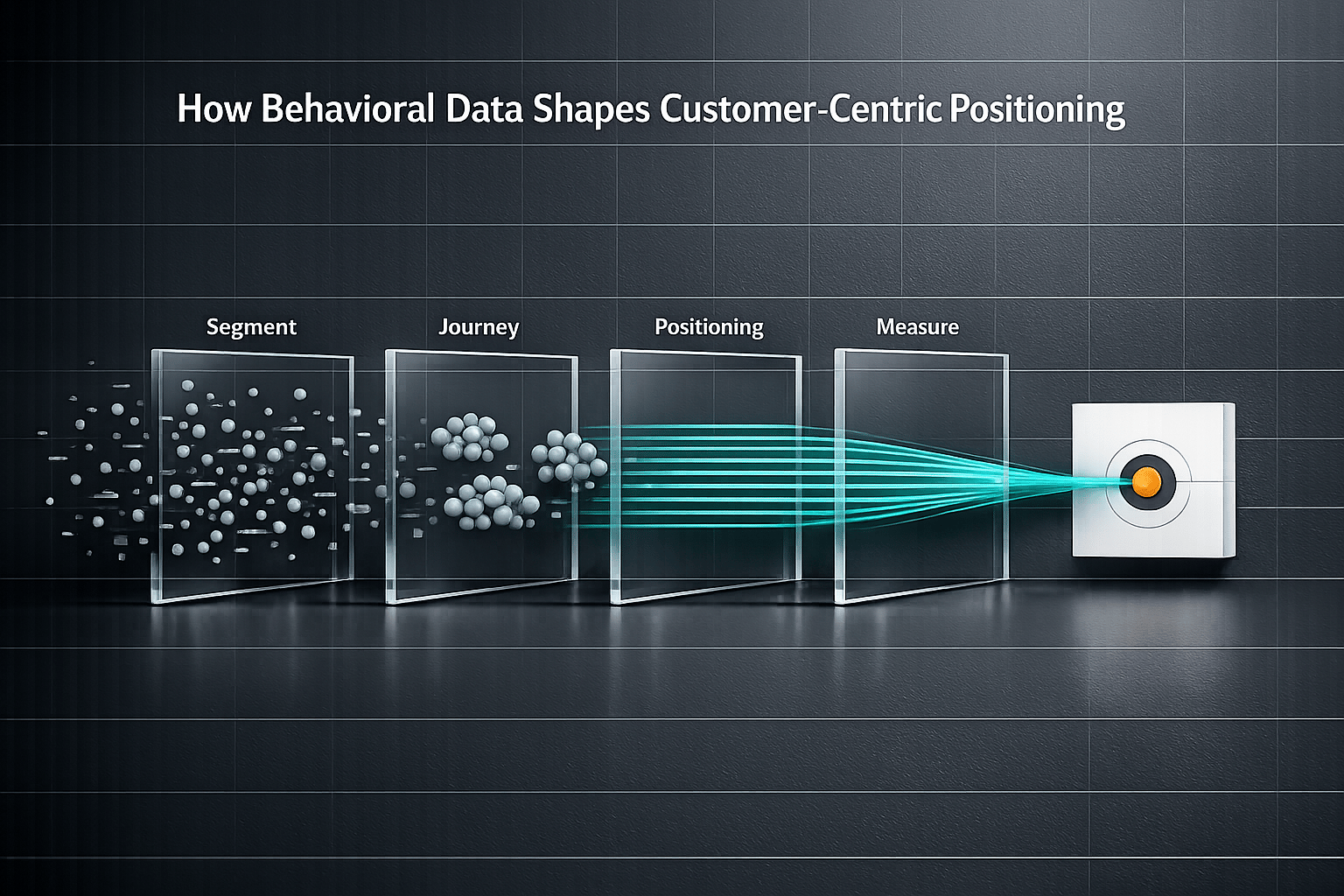
How Behavioral Data Shapes Customer-Centric Positioning
How Behavioral Data Shapes Customer-Centric Positioning
Behavioral data reveals what your customers actually do, not just what they say. This data - like clicks, purchases, or feature usage - helps businesses create more personalized experiences, boosting conversion rates by 10-30%. For example, Calm increased user retention threefold by analyzing behavioral trends, while other companies improved retention by over 30% using targeted strategies.
Here’s how to use behavioral data effectively:
- Track key actions: Monitor website visits, app usage, and purchase behavior.
- Segment based on patterns: Group customers by actions like purchase frequency or feature adoption.
- Map insights to customer journeys: Align behaviors with stages like awareness or decision-making.
- Create tailored messages: Focus on actions, not demographics, for personalized outreach.
- Measure results: Use metrics like retention rates, conversion rates, and customer lifetime value.
Behavioral data offers a clear path to understanding customer intent and improving outcomes. By focusing on actions, you can refine your strategy and drive measurable success.
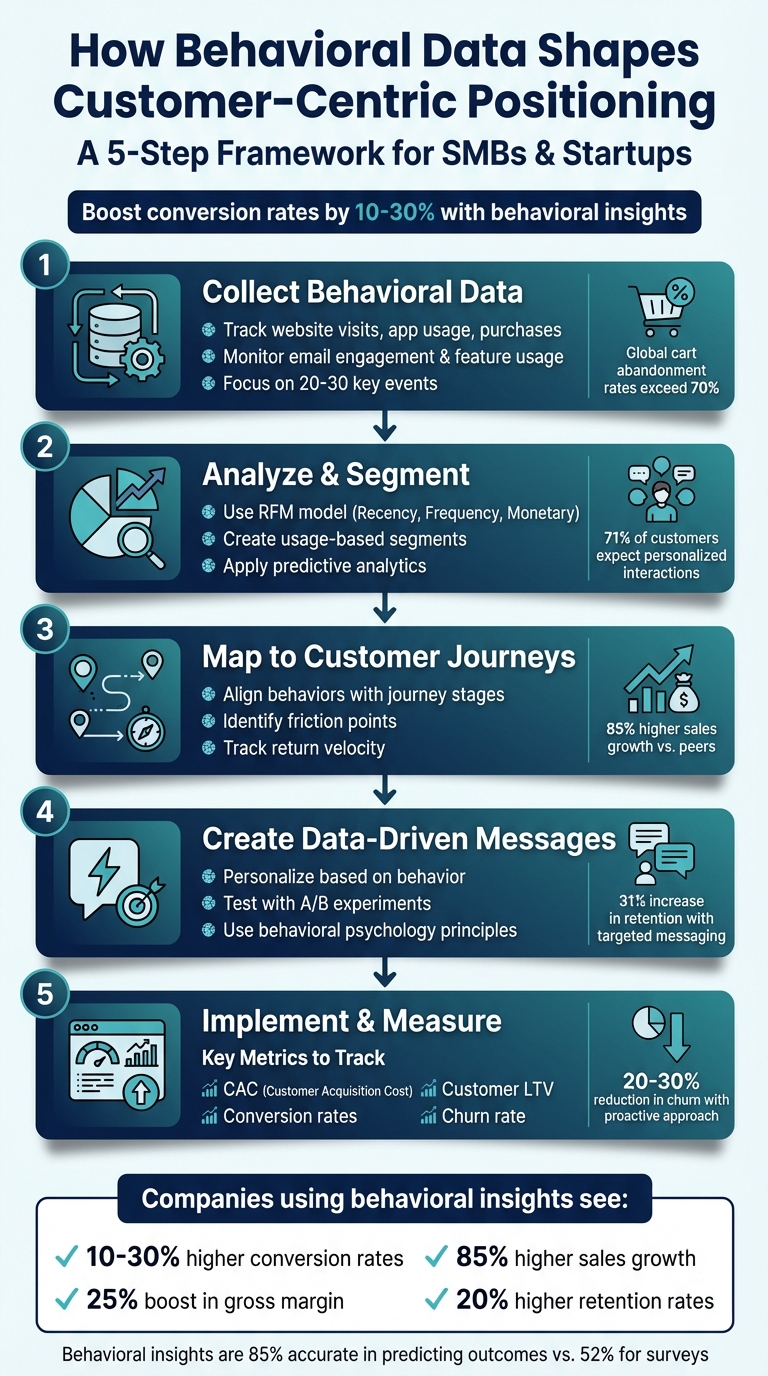
5-Step Framework for Using Behavioral Data in Customer Positioning
14 l Understanding Customer Behaviour and Segmentation in Marketing
sbb-itb-63525a7
Step 1: Collect Behavioral Data from Customer Touchpoints
Building a customer-focused strategy starts with first-party data - the kind of information you gather directly from your websites, apps, and marketing channels. This data reflects actual customer actions, not just what they say they might do. As KISSmetrics Editorial explains:
"The best predictor of future behavior is past behavior. Not demographics, not stated intentions, not survey responses – actual observed behavior".
Here’s how to pinpoint, track, and make the most of these data sources.
Identify Your Primary Data Sources
Customers leave behind a trail of behavioral signals as they interact with your brand. These signals can come from various touchpoints:
- Websites and mobile apps: Track metrics like page views, clicks, scroll depth, and session duration to uncover what works and what doesn’t.
- Email campaigns: Engagement metrics, such as open rates and click-through rates, reveal how well your messaging resonates.
- E-commerce platforms: Monitor product views, add-to-cart events, and purchase history. This is especially critical considering global cart abandonment rates exceed 70%.
- Product feature usage: Identify which features users are actively engaging with and which they’re ignoring.
- Customer support interactions: These can provide qualitative insights into customer satisfaction and areas of frustration.
- Social media engagement: Track likes, comments, and shares to gauge brand loyalty and sentiment.
For example, in April 2022, Under Armour Connected Fitness analyzed their mobile app data and found that their race training plans weren’t performing as expected. By redesigning these plans to cater to a broader range of user goals, they tripled the usage of training plans among paid users and significantly boosted retention.
Once you’ve identified these data sources, the next step is to implement tools and systems that can effectively track and capture this information.
Use Tracking Tools and Technologies
To avoid being overwhelmed by data, focus on 20–30 key events - such as completing onboarding, making a purchase, or starting a specific feature. Here are some tools to help:
- Heatmaps (e.g., Hotjar, Crazy Egg): Visualize where users click, scroll, or pause on your site.
- Session recorders (e.g., Smartlook): Watch user interactions in real-time to identify friction points.
- Product analytics platforms (e.g., Amplitude, KISSmetrics): Track feature adoption, retention trends, and churn signals.
- CRM systems: Tie behavioral data to individual customer profiles for a complete view across devices and platforms.
Before diving into tracking, ensure your practices comply with GDPR and CCPA privacy laws. Also, establish a clear data taxonomy - a consistent naming convention for events and properties. This step is crucial for keeping your data organized and actionable across teams. A solid taxonomy ensures you can extract insights quickly and reliably.
Step 2: Analyze Behavioral Data to Define Customer Segments
Transform the behavioral data you've gathered into actionable customer segments based on what people do, rather than who they are. As Jack Browning from Northbeam explains:
"What customers say about themselves matters less than what they actually do".
Focusing on actions instead of demographics means moving past static details like age or location. Behavioral segmentation dives into activities - such as purchases, logins, feature usage, and engagement trends - which often reveal purchase intent more clearly. For instance, a customer who visits your pricing page three times in one week shows stronger buying intent than someone who simply matches a persona profile.
Segment Customers by Behavioral Patterns
Start by identifying the behavioral traits that drive customer decisions. One proven method is the RFM model (Recency, Frequency, Monetary), which categorizes customers based on how recently they purchased, how often they buy, and their total spending . This method helps you pinpoint high-value customers and spot those who might need re-engagement.
Other segmentation strategies include:
- Usage-Based: Group users into heavy, regular, light, or inactive categories based on how often they interact with your product.
- Lifecycle Stage: Tailor your messaging to where customers are in their journey, such as new users, active users, at-risk customers, or churned accounts.
- Benefits Sought: Segment customers by their priorities, like preferring low prices over premium quality or vice versa .
For smaller businesses, simple rule-based segments can often outperform more complex machine learning models. For example, a straightforward rule like "3+ support tickets in 30 days = high risk" can help identify 80–90% of at-risk accounts. Start with a few impactful variables, such as last purchase date, last login, and support ticket volume, to avoid over-complicating your segmentation. After all, 71% of customers expect personalized interactions, and 76% report frustration when those expectations aren't met.
| Segmentation Type | Key Variables to Track | Business Application |
|---|---|---|
| Purchase Behavior | Recency, Frequency, Monetary (RFM) | Identifying high-value customers and win-back opportunities |
| Usage Rate | Login frequency, feature adoption | Differentiating power users from at-risk customers |
| Engagement Depth | Time on site, content shares, API usage | Measuring product-market fit and expansion potential |
| Occasion-Based | Seasonal patterns, renewal dates | Timing outreach for renewals or promotions |
By refining your segments around real behaviors, you can align your strategies with what customers actually need. Once you've established these segments, the next step is to leverage predictive analytics to anticipate future actions.
Use Predictive Analytics for Deeper Insights
Take your segmentation further by employing predictive analytics to identify which customer groups are likely to take specific actions, such as activating a feature or churning. This allows you to address potential issues or opportunities before they fully materialize.
Predictive analytics can uncover trends and correlations. For example, customers approaching 90% of their plan limits could be targeted with timely upgrade offers. Similarly, a daily user who suddenly stops logging in for three days might signal an early churn risk. By establishing a normal usage baseline for each customer, you can act quickly when deviations occur.
To fully utilize predictive insights, ensure your data flows seamlessly across your systems. Avoid relying on manual CSV exports, as outdated data can weaken the effectiveness of your behavioral segments. Tools like Amplitude offer free plans for behavioral segmentation and analytics, making these capabilities accessible even for smaller teams .
Step 3: Map Behavioral Insights to Customer Journeys
After segmenting customers based on their actions, the next step is to connect those behaviors to their actual journey. Traditional customer journey maps often rely on assumptions about how people should move through the funnel. But behavioral data shows a different story - real customer journeys rarely follow a straight line. As Gartner aptly states:
"Assumptions don't drive outcomes - actions do."
Customers skip stages, enter at unexpected points, and take unpredictable paths . Your job is to track these patterns and adjust your messaging to meet them where they are. This step lays the groundwork for delivering more tailored, stage-specific communication in the next phases.
Align Data with Journey Stages
Each behavior reflects a specific stage of intent. For example:
- During the awareness stage, look at organic search terms or blog engagement to gauge interest. A user scrolling through an in-depth article on retention strategies is signaling genuine curiosity.
- In the consideration stage, monitor time spent on feature pages, video views, or usage of comparison tools.
- For the decision stage, focus on high-intent actions like multiple visits to the pricing page, using an ROI calculator, or clicking "add to cart".
Companies that prioritize behavioral insights see impressive results - over 85% higher sales growth and a 25% boost in gross margin compared to their peers. The secret? Aligning messaging with customer behavior. For instance, if someone abandons their cart after checking shipping costs, you could send a discount offer for shipping. Or, if a customer hesitates after reviewing product sizes, a sizing guide might help them move forward. This kind of personalization can increase conversion rates by up to 30% when journeys adapt in real time.
Address Pain Points and Boost Engagement
Once you’ve identified key stage signals, dig deeper to uncover obstacles. Behavioral indicators like rage clicks, mid-form drop-offs, or repeated navigation returns can highlight friction points that surveys often miss .
For example, if users linger on your return policy page, you might trigger a proactive chat to address their concerns. As Forrester explains: "Behavioral insights allow brands to pinpoint the 'moments of truth' - key decision points where subtle shifts in UX or messaging can change the outcome".
Brands using journey analytics often see up to 20% higher retention rates and a 10–15% increase in customer lifetime value. Plus, about 80% of customers say they value the overall experience as much as the product or price.
Another important metric is "return velocity", which measures how quickly users come back after their first visit. Visitors returning within four hours often show much stronger intent to convert than those who return after 48 hours. Use this insight to prioritize follow-ups or retargeting for highly engaged users.
Step 4: Create Data-Driven Positioning Messages
Using the insights from your journey mapping, focus on creating messages that align with actual customer behavior. This approach shifts the emphasis from traditional demographics like age or job title to what users are actually doing with your product. Why? Because behavior consistently provides a clearer picture than self-reported data. And with 71% of customers expecting personalized interactions and 76% feeling frustrated when brands miss the mark, getting this right is essential. Once you’ve identified these behaviors, the next step is to craft and test messaging tailored to them.
Develop Personalized Messaging
The key to effective messaging lies in tailoring it to specific behaviors. For instance, high-intent users - those frequently visiting your pricing page or abandoning a cart - respond better to urgency-driven messaging that incorporates social proof. On the other hand, early-stage users who are just beginning their onboarding journey need educational content that guides them toward discovering your product’s value, or their "aha moment".
Here’s a real-world example: In October 2024, Nitin Kartik, CEO of Caribou Strategic, reported a 31% increase in retention after his team revamped trial messaging based on behavioral insights. They noticed that free trial users often lacked serious purchase intent. By switching to a discounted trial and pairing it with emotionally resonant messages that clearly outlined the product’s value, they attracted a more qualified user base.
Another effective strategy involves pinpointing your product’s "aha moment" - the action most closely tied to long-term customer value. For example, in October 2025, a SaaS company discovered that users who stopped engaging with "Feature X" within two weeks were 60% more likely to churn. To address this, they sent targeted emails emphasizing the feature’s benefits and introduced an in-app tutorial. Within 30 days, the "at-risk" users who received these nudges showed a 22% higher retention rate and were 35% more likely to upgrade to paid plans.
Behavioral psychology can also enhance your messaging. Use principles like loss aversion and the endowment effect to make your messages more impactful. For example, remind users of the content or reports they’ve already created on your platform - this taps into the endowment effect, making them less likely to leave. Similarly, emphasize what they stand to lose by leaving instead of what they gain by staying, leveraging loss aversion to drive action. Once your messages are tailored, test them thoroughly to ensure they deliver results.
Test and Optimize Your Positioning
To ensure your behavioral insights are effective, validate them through A/B testing to find the most impactful value propositions. Combine this with qualitative methods like sentiment analysis, focus groups, and surveys to understand how customers perceive your messaging.
Keep your data current by using rolling time windows. For example, define a segment as "users who logged in three times in the last seven days" instead of relying on outdated behavior. This helps keep your messaging relevant and aligned with the customer journey. Be cautious, though - over-segmenting can lead to sample sizes too small for meaningful testing.
Track key metrics like brand awareness, market share, and sales growth tied to specific positioning changes. Use platforms like Facebook Ads to sync behavioral cohorts (e.g., "cart abandoners") and deliver highly personalized retargeting campaigns. Compare the performance of these segmented campaigns against non-segmented ones to measure their effectiveness.
Step 5: Implement and Measure Positioning Impact
Now it’s time to bring your positioning strategy to life and see how it performs in the real world. Execution is where the insights you’ve gathered start to deliver results. The trick? Stay consistent across all channels while keeping an eye on the metrics that truly matter. Everything should align seamlessly with your broader strategy for ongoing improvement.
Deploy and Test Positioning Across Channels
To implement your positioning effectively, you need to validate it with three key groups:
- Existing customers: Does it align with their experience of your product or service?
- Prospects: Does it differentiate you from competitors?
- Internal teams: Can they clearly explain and sell it?
Without this alignment, Marketing might attract the wrong audience, while Sales wastes time chasing leads that don’t fit your offering.
Use event-driven campaigns to test your messages in real-world scenarios. For example, you could set up automated responses for situations like cart abandonment, onboarding drop-offs, or underused features. While your core message should remain consistent, tailor it to fit each channel. For instance, dynamic ad creatives can retarget users based on behaviors such as "time since last visit".
To keep everyone on the same page, create a visual one-pager or a positioning narrative. This document should serve as the ultimate reference point for all touchpoints, ensuring your messaging is consistent across social media, email, and ads. Internal teams should also use it to articulate who your audience is and what makes your product or service stand out.
Track KPIs to Measure Success
Your earlier work on segmentation and journey mapping will help you track the right metrics. Focus on KPIs that directly tie your positioning to business outcomes. Some key metrics include:
- Revenue KPIs: Year-over-year revenue growth, return on ad spend (ROAS), average order value (AOV), and conversion rates.
- Retention and loyalty metrics: Churn rate, customer retention rate, and net revenue retention (NRR), which reflects how well you’re retaining and growing customer accounts.
Don’t overlook efficiency metrics like customer acquisition cost (CAC), sales cycle length, and time-to-value. Strong positioning can lead to a 29% increase in sales and boost conversion rates by 10% to 30%.
Dive into behavioral data for deeper insights. Metrics like login frequency, feature adoption, and whether users hit their "aha moment" are 85% accurate in predicting outcomes - far more reliable than survey-based scoring, which only hits 52% accuracy. Real-time triggers can alert you to changes, such as a 30% drop in active users or customers nearing their plan limits. Proactive teams using these metrics can reduce gross churn rates by 20% to 30% compared to reactive approaches.
Tools like BrandMultiplier.ai's Narrative OS can refine your approach by analyzing how your story impacts metrics like CAC, deal speed, and customer lifetime value (LTV). This allows for continuous adjustments, quarter after quarter.
"Customer lifetime value is the most important metric for a customer-centric business." - Lexer
Finally, establish behavioral baselines to catch early warning signs. For example, if a customer who usually logs in twice a week suddenly skips ten days, that’s a red flag for churn. Validate your segmentation by checking whether your "at-risk" groups actually churned. If they didn’t, it’s time to tweak your rules and test again.
How BrandMultiplier.ai Tools Deliver Results
BrandMultiplier.ai provides a streamlined way to turn behavioral insights into actionable strategies. Its Narrative OS is specifically designed for SMBs and funded startups, helping them move from founder-driven sales to a repeatable, scalable system that drives results.
The journey begins with the Rumble discovery workshop, a focused three-hour session that identifies the exact triggers and insights founders use to close deals. Instead of relying on generic messaging, this workshop uncovers the specific language and logic that resonates with customers. These insights are then structured using a 5-Phase Storyline methodology backed by 38 peer-reviewed neuroscience studies. This method taps into neurochemical responses - like oxytocin for building trust and dopamine for improved memory - making your narrative 22 times more effective than relying on facts alone.
The results speak for themselves. Companies using Narrative OS have reported a 30% decrease in customer acquisition costs (CAC) within six months and a 35% faster deal cycle. For instance, Accenture implemented Narrative OS across 20 pitch teams over a year, boosting win rates from 54% to 88% and generating over $1 billion in new revenue. Similarly, Tria Beauty saw website revenue grow by 63% year-over-year, with referral revenue skyrocketing by 606% after aligning their narrative.
One standout feature is the Tune phase, a quarterly optimization process that focuses on measurable outcomes like CAC, deal velocity, and customer lifetime value (LTV). A Daily Optimization Dashboard tracks narrative performance in real time, enabling companies to refine their messaging continuously.
As BrandMultiplier.ai explains:
"We capture your insights and build the B2B narrative infrastructure that makes it travel without you - so your team closes with founder-level conviction, without founder dependency."
This system equips teams with the tools to operate with the same confidence as founders, eliminating founder dependency. For SMBs, where 70% of first sales hires fail, this approach transforms behavioral insights into a sustainable, scalable system that delivers long-term success.
Conclusion
The steps outlined in this guide provide a clear, data-driven framework for turning customer behavior into actionable strategies. By following these five key steps - gathering data from customer interactions, analyzing it to define segments, aligning insights with customer journeys, crafting targeted messages, and implementing measurable strategies - SMBs and startups can move away from guesswork and focus on observable actions. As Darshil Gandhi, Director of Product Marketing at Amplitude, explains:
"Behavioral segmentation shifts marketing from assumptions to observable action".
When your positioning reflects how customers actually behave - not just what they claim - you uncover those critical "aha moments" that foster retention and guide users toward meaningful actions. This ensures your efforts are focused on the segments that offer the highest customer lifetime value.
For SMBs and startups operating with tight budgets and high stakes, behavioral data becomes a real-time snapshot of user intent. It pinpoints where users drop off in your funnel, highlights the features that build loyalty, and identifies customers primed for expansion. Instead of relying on static demographics, create behavioral cohorts rooted in actual product usage.
Focus on tracking metrics that matter most - CAC, conversion rates, deal velocity, and customer LTV - and establish a quarterly review process to adapt your positioning as customer behaviors evolve. By grounding your strategies in behavioral insights, you create a scalable system that drives measurable growth. Use these tools to refine your approach and achieve lasting success.
FAQs
What behavioral events should I track first?
Tracking behavioral events is a great way to uncover customer intentions and gauge their level of engagement. Pay attention to key actions like page visits, feature usage, email opens, how often they log in, and how recently they've been active. These data points can give you a clearer picture of behaviors such as renewal likelihood, potential churn, or opportunities for account expansion. By analyzing these patterns, you can fine-tune your strategies and make decisions based on solid data. Identifying these trends early is crucial for staying ahead and responding effectively.
How do I turn behaviors into useful customer segments?
To build customer segments that lead to real action, start by diving into data like website activity, purchase records, and engagement patterns. Look for trends - maybe how often customers buy or how they react to specific campaigns. Use frameworks like RFM analysis (Recency, Frequency, Monetary value) or categorize customers by their lifecycle stages to make predictions more accurate.
It’s important to keep these segments fresh by updating them regularly. Once you have these groups, you can tailor marketing messages and product offerings to match their needs. This approach not only strengthens customer loyalty but also increases their overall lifetime value.
How can I prove behavioral positioning improved revenue?
To show how behavioral positioning has boosted revenue, focus on tracking key metrics shaped by customer behavior. These include conversion rates, deal velocity, and Customer Acquisition Cost (CAC). Dive deeper by using predictive models to examine customer actions, such as upgrades or renewals. For a clear picture, compare these metrics from before and after implementing behavioral strategies. This will help you measure the impact on revenue, including gains in sales and improvements in customer lifetime value (LTV).
Ready to transform your brand story?
Schedule a free diagnostic to see how we can help.
Schedule The Diagnostic