

Top Challenges in Bridging Brand and Performance Marketing
Top Challenges in Bridging Brand and Performance Marketing
SMBs often struggle to balance brand marketing (long-term trust) with performance marketing (short-term results), leading to missed growth opportunities and wasted budgets. Here's why integrating both is critical:
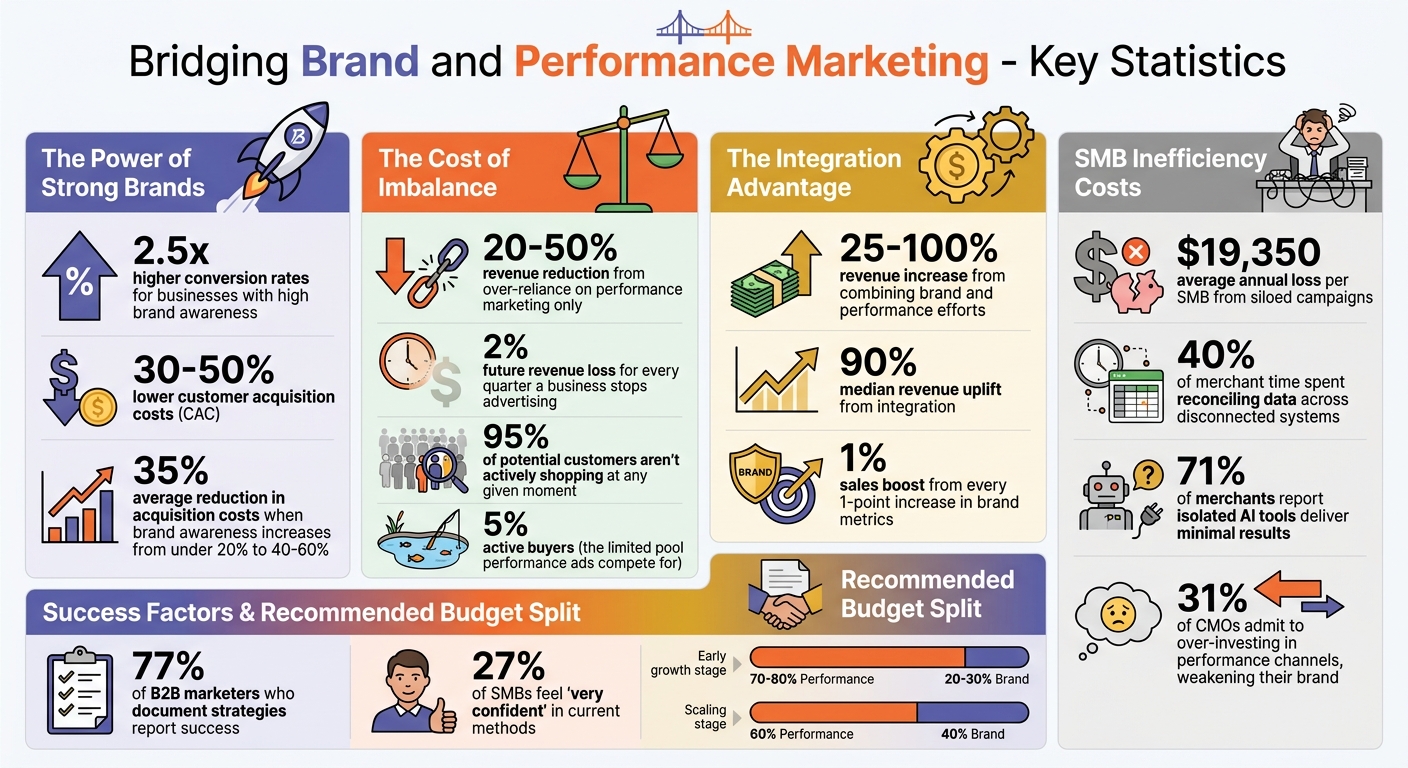
- Stronger brands drive better results: Businesses with high brand awareness see 2.5x higher conversion rates and 30%-50% lower customer acquisition costs (CAC).
- Over-reliance on performance marketing hurts: Focusing only on short-term tactics can reduce revenue by 20%-50%.
- Integration boosts growth: Combining brand and performance efforts can increase revenue by 25%-100%, with a median uplift of 90%.
Key challenges include:
- Conflicting metrics: Brand focuses on awareness and sentiment; performance prioritizes conversions and ROAS.
- Short-term vs. long-term priorities: Tight budgets push SMBs toward quick wins, sidelining brand-building.
- Messaging conflicts: Emotional storytelling often clashes with direct sales tactics.
- Team silos: Misaligned goals and separate workflows hinder collaboration.
Solution: Unify metrics, align team goals, and maintain consistent messaging across campaigns. Tools like shared dashboards and cross-functional teams can help SMBs achieve sustainable growth by integrating both strategies.
Brand vs Performance Marketing: Key Statistics and ROI Impact for SMBs
Balancing Brand and Performance to Create Marketing Magic [Webinar]
sbb-itb-63525a7
Challenge 1: Conflicting Metrics and KPIs
Small and medium-sized businesses (SMBs) often struggle to balance the demands of building a strong brand for the future with the need to show immediate performance results.
Why Brand and Performance Measure Different Outcomes
Performance marketing thrives on hard numbers that deliver quick feedback. Marketers in this space focus on metrics like Cost Per Acquisition (CPA), Return on Ad Spend (ROAS), click-through rates, and conversions - data that directly ties to revenue. Brand marketing, however, deals with softer metrics like brand awareness, customer sentiment, Net Promoter Score (NPS), and share of voice. These metrics gauge how people perceive your brand and whether they’ll recall it when making a purchase.
The challenge lies in the timelines these metrics represent. Performance data captures short-term wins - what’s happening right now. Brand metrics, on the other hand, reflect the long-term payoff of trust and recognition, which can take months or even years to develop. When the CFO demands proof that marketing efforts are working, performance metrics offer immediate answers. Brand metrics, however, require patience and a belief in their eventual value.
Here’s a striking example: Companies with strong brand awareness see conversion rates that are 2.5 times higher than those of lesser-known competitors. Increasing brand awareness from under 20% to a moderate level (40-60%) can cut acquisition costs by 35% on average. Yet, when reporting systems keep brand and performance data separate, these cost-saving connections are often overlooked.
How Separate Reporting Hides the Full Picture
When brand and performance metrics live in separate dashboards, it’s easy to miss how interconnected they are. Brand awareness does more than just improve how people feel about your company - it also reduces the cost of performance marketing.
"Show me a company with runaway demand gen costs and I'll show you a company with limited brand awareness." - Joe Chernov, CMO at All-in-One
The problem with siloed reporting is that it hides these relationships. Performance teams may see rising CPAs and assume their ads aren’t effective. Meanwhile, the brand team might notice improving sentiment scores but have no way to prove their impact. The reality - that brand investments are making performance marketing more efficient - gets lost in translation.
This disconnect can lead to dangerous decisions. CFOs may cut brand budgets because they can’t see the immediate return, which ironically drives performance costs even higher. Unified reporting solves this by showing the full picture, enabling smarter, faster decisions that benefit both short-term performance and long-term brand growth.
Challenge 2: Short-Term vs. Long-Term Priorities
Why SMBs Focus on Quick Wins
For many small and medium-sized businesses (SMBs), the struggle between short-term gains and long-term growth is all too real. With tight budgets, SMBs often lean heavily on performance marketing. Why? Because it delivers what finance teams want: clear, immediate results. In times of economic uncertainty, every dollar spent on marketing has to show its value right away - there’s little room for strategies that take months or years to pay off.
Performance marketing is all about fast, measurable wins. Brand building, on the other hand, is more of a long-term investment. It’s like planting seeds that grow into something valuable over time. Unfortunately, many businesses see these two approaches as mutually exclusive. With limited resources and shrinking margins, branding often gets sidelined simply because it’s harder to measure its impact.
Startups feel this pressure even more intensely. They need to show quick sales and profitability to keep investors happy. Naturally, performance marketing becomes the go-to choice. The problem isn’t with performance marketing itself - it’s that relying on it alone eventually limits growth potential.
This overemphasis on short-term wins often comes back to bite businesses, especially when brand building is pushed aside.
What Happens When You Skip Brand Building
Here’s a key stat to consider: 95% of potential customers aren’t actively shopping at any given moment. If you focus only on performance ads, you’re competing for a small 5% of active buyers. And that limited pool? It gets expensive fast. Without investing in your brand, the cost of acquiring new customers starts climbing, leading to diminishing returns.
The data paints a clear picture. For every quarter a business stops advertising, it risks losing about 2% of its future revenue. Meanwhile, over-reliance on performance marketing can lead to audience fatigue. People get tired of seeing the same direct-response ads, and without a strong emotional connection to your brand, trust starts to erode. In the end, you’re stuck in a cycle of spending more to achieve less, while competitors with well-established brands pull ahead without breaking the bank.
These challenges highlight why businesses need a balanced approach - one that blends short-term performance with long-term brand building. This balance is key to creating sustainable growth and avoiding the pitfalls of focusing too heavily on one side of the equation.
Challenge 3: Messaging and Creative Conflicts
Mixing Emotional Stories with Direct Calls-to-Action
Blending emotional storytelling with direct calls-to-action can feel like trying to mix oil and water. On one hand, brand narratives aim to build trust and create lasting emotional connections, helping people remember your business. On the other hand, direct calls-to-action are all about driving immediate sales. These two approaches often clash because they serve different purposes.
Think about it: if you watch a heartfelt video about a company's mission and values, only to be hit with a "Buy Now - 50% Off Today Only!" message right after, it feels jarring. This abrupt shift can make the entire interaction seem cold and transactional, undermining the trust you’re trying to build .
In fact, 31% of chief marketing officers have admitted to over-investing in performance channels, ultimately weakening their brand. When performance ads ignore the foundation of brand positioning, marketing efforts become more expensive and less effective because they lack the trust a strong brand creates.
The solution isn’t about choosing one over the other. Instead, the most effective strategies treat branding as a "force multiplier" for performance. Storytelling helps generate demand at the top of the funnel, while performance tactics capture that demand further down. To make this work, every performance ad should reflect your brand’s core identity, and every brand campaign should include easy ways for customers to take action. Whether it’s a 60-second brand film or a 6-second retargeting ad, consistency is key.
When these elements are out of sync, it not only confuses customers but also risks eroding their trust, a topic explored further in the next section.
How Aggressive Performance Ads Damage Brand Trust
The tension between storytelling and sales becomes even more pronounced when performance ads get too pushy. Overloading your audience with constant promotions - think never-ending discounts, countdown timers, or “last chance” offers - can make your brand seem more like a discount shop than a trustworthy partner. People are growing increasingly skeptical of this kind of "fake urgency" and gravitate toward brands that prioritize honesty and authenticity .
When consumers begin ignoring or actively avoiding your ads, you’ve likely hit the "performance plateau." At this stage, increasing ad spend fails to deliver meaningful results. Without trust, every sale becomes harder to earn and more expensive to achieve.
However, balanced strategies can make a huge difference. Studies show that integrating storytelling into direct-response ads can increase revenue by 25% to 100%, with a median uplift of 90%. The key is to ensure that even your most sales-focused ads reflect your brand’s voice and values. A consistent message across both brand-building efforts and performance campaigns creates a multiplier effect. When people trust your brand, they’re more likely to engage with your ads, which leads to higher conversion rates and lower costs.
Challenge 4: Team Silos and Misalignment
Internal misalignments can derail marketing efforts just as much as conflicting metrics or tactical differences.
The Gap Between Brand and Performance Teams
The problem isn't just that strategies differ - it’s that teams often operate in isolation. Brand teams focus on building awareness and improving sentiment, while performance teams zero in on metrics like CAC (Customer Acquisition Cost) and ROAS (Return on Ad Spend). The missed opportunity? Few teams work to integrate brand and performance efforts, even though brand awareness can significantly boost the effectiveness of performance ads.
This disconnect leads to operational inefficiencies. For example, merchants spend 40% of their time reconciling data across disconnected systems, which often results in duplicate hires and redundant software costs. Agencies and software licenses get duplicated, and 71% of merchants report that isolated AI tools deliver minimal results.
When one team promotes a specific value proposition through email while another communicates something entirely different on social media, it creates confusion. This inconsistency not only damages trust but also signals a lack of coordination. On top of that, customer data often ends up siloed in separate systems, making it harder to track the buyer journey. The outcome? Missed opportunities and lower conversion rates across the board.
"Our jobs are hard enough without splitting Team Marketing into armed camps. Sure we have different skills, but we kick in the same direction." - Addy Smith, Client Performance Director, Velocity Partners
How Conflicting Incentives Keep Teams Apart
Diverging goals and incentives further widen the gap between teams. Brand teams are typically rewarded for improving awareness and sentiment, while performance teams are incentivized to hit ROAS targets and reduce acquisition costs. These conflicting goals discourage collaboration.
The way metrics are measured adds fuel to the fire. Performance marketing offers immediate results - you can track yesterday’s ROAS or today’s CPA. In contrast, brand marketing relies on long-term metrics like Net Promoter Score or awareness, which are harder to connect directly to revenue. When budgets tighten, businesses often prioritize short-term metrics, even if it undermines long-term growth.
Fast-growing SMBs often face another hurdle: "shadow workflows." These are informal processes where knowledge gets buried in personal spreadsheets or email threads. When employees leave, this institutional knowledge disappears, making it tough to maintain consistency. Solving this issue requires more than better communication. Teams need shared KPIs that align everyone around revenue goals instead of individual metrics, along with unified systems that provide visibility into how every role contributes to the overall strategy.
Closing these organizational gaps is just as important as syncing up metric systems. Aligning incentives and creating unified data systems are critical steps toward building a cohesive and effective marketing strategy.
How to Bridge the Gap: Practical Solutions
Tackling the challenges of misaligned metrics, short-term thinking, and team silos takes practical steps and a commitment to integration. The divide between brand and performance can be closed with the right approach.
Use Shared Metrics and Reporting Systems
Start by unifying your dashboards to get a clear view of how brand and performance efforts interact. One key metric to track is the CLV-to-CAC ratio (Customer Lifetime Value to Customer Acquisition Cost). This metric reflects both the efficiency of your acquisition strategies and the quality of the customers you're acquiring.
Another helpful indicator is branded search volume - when people search for your company name instead of generic terms, it’s a sign that brand campaigns are driving awareness and intent. This also makes performance ads more effective. Research even shows that a 1-point increase in brand metrics can lead to a 1% boost in sales.
To measure the true impact of brand activities on performance, use incrementality testing like geo-tests or holdout experiments. These methods go beyond last-click attribution to reveal how brand awareness improves conversion rates.
"Show me a company with runaway demand gen costs and I'll show you a company with limited brand awareness." - Joe Chernov, CMO, All-in-One
This kind of unified insight sets the stage for better collaboration.
Build Cross-Team Collaboration
Once reporting systems are aligned, it becomes easier to unify team goals. Shift your structure toward shared objectives rather than siloed functions. For example, create integrated "channel teams" where members are responsible for both brand and performance outcomes across platforms like social media, search, or video. This breaks down the barriers that keep teams working in isolation.
To kickstart alignment, try a 90-day integration sprint. During this period, focus on syncing analysis, refining attribution models, and coordinating campaign launches. Use a unified creative brief for every project - this document should outline brand pillars, target audiences, and key performance indicators for both teams.
Set up regular feedback loops to ensure performance data informs brand strategies and vice versa. This approach works: 77% of B2B marketers who document their strategies report success, yet only 27% of SMBs feel "very confident" in their current methods. Clearly, there’s room for improvement.
Balance Quick Tests with Brand Consistency
You don’t have to choose between rapid experimentation and brand consistency. Instead, combine them. Develop flexible creative assets, like turning a 60-second brand video into shorter cuts for social media. This allows you to stretch your budget while maintaining a consistent message.
At the same time, set clear brand guidelines. Define rules for logo usage, tone, and core messaging that performance tests must adhere to. Within those boundaries, experiment aggressively with headlines, calls-to-action, and audience targeting. Monitor operational metrics like CPA daily, review creative performance weekly, and assess brand health monthly.
If you’re in an early growth stage, consider starting with a 70/30 or 80/20 split between performance and brand budgets to prioritize cash flow. As you scale, shift toward a 60/40 balance. This mix has been shown to drive up to a 90% revenue increase, while over-reliance on performance marketing alone can cut revenue returns by 20% to 50%.
"The brand versus performance debate is a false dichotomy that holds marketing back. Every brand investment should be measured on commercial outcomes, and every performance campaign should build equity." - Jon Evans, System1 Group CMO
For a more structured approach, tools like BrandMultiplier.ai offer Narrative OS. This system helps you codify your brand story, align it across teams, and integrate it into AI-driven strategies. It tracks how your story affects CAC, deal speed, and LTV, then optimizes it continuously.
Conclusion
Bridging the gap between brand and performance marketing isn't just a theoretical challenge - it’s a financial one. For small businesses, the cost of fragmented, inefficient marketing efforts adds up quickly, with the average SMB losing about $19,350 each year due to siloed campaigns and misaligned strategies. That’s money that could be driving growth instead of being wasted on disconnected efforts.
Here’s the reality: integration isn’t a luxury anymore - it’s a necessity. Businesses with strong brand awareness see conversion rates soar to 2.5 times those of lesser-known competitors. Plus, solid brand equity can slash customer acquisition costs (CAC) by 30–50%. Companies that embrace a balanced approach to brand and performance marketing often experience revenue growth ranging from 25% to 100%, with a median increase of 90%. On the flip side, relying too heavily on performance marketing alone can shrink revenue returns by 20–50%.
"The brand versus performance debate is a false dichotomy that holds marketing back. Every brand investment should be measured on commercial outcomes, and every performance campaign should build brand equity."
– Jon Evans, System1 Group CMO
The solution lies in unifying efforts. This means adopting tools like shared dashboards, aligning team goals, and maintaining creative consistency. Metrics such as the CLV-to-CAC ratio and branded search volume can help track both short-term performance and long-term brand health. Building cross-functional teams with shared incentives and balancing rapid experimentation with brand guidelines ensures that growth doesn’t come at the expense of identity.
For SMBs looking to break free from the outdated "brand vs. performance" mindset, platforms like BrandMultiplier.ai offer a practical way forward. Their Narrative OS system helps businesses codify their brand story, align teams, and measure the impact of these efforts on CAC, deal speed, and lifetime value (LTV) in real time. By integrating brand and performance strategies, companies set themselves up for growth that lasts.
FAQs
How do I connect brand metrics to revenue?
Measuring the link between brand efforts and revenue means looking at how branding influences customer actions and long-term financial outcomes. To do this, track key brand health indicators - like awareness, perception, and loyalty - alongside performance metrics such as customer acquisition cost (CAC) and conversion rates.
When these metrics are aligned, it becomes clear how building trust and recognition around your brand can lead to higher conversions, lower acquisition costs, and noticeable revenue growth. This approach makes it easier to show stakeholders the return on investment (ROI) of your branding initiatives.
What budget split should an SMB use for brand vs. performance?
The right balance between brand and performance marketing for small and medium-sized businesses (SMBs) depends on factors like your business objectives, current market conditions, and where you are in your growth journey.
A common approach? Start by allocating 60-70% of your budget to performance marketing (think paid ads and direct response campaigns) and 30-40% to brand-building efforts (like content marketing and social media presence).
But here's the key: this isn't a set-it-and-forget-it strategy. Keep an eye on metrics like Customer Acquisition Cost (CAC), conversion rates, and Lifetime Value (LTV). These numbers will help you tweak your budget as your business needs evolve.
How can I keep ads conversion-focused without hurting trust?
To create ads that drive conversions while maintaining trust, prioritize genuine and transparent messaging that reflects your brand's core values. Stay away from manipulative or over-the-top claims that could damage your credibility.
Use elements like storytelling, clear value propositions, and consistent branding to build trust. Be upfront about things like offers, how data is used, and the purpose of your ad. When consumers feel respected, it creates a smoother experience that encourages conversions without sacrificing trust.
Ready to transform your brand story?
Schedule a free diagnostic to see how we can help.
Schedule The Diagnostic