
Brand Positioning vs. Brand Identity: Key Differences
Brand Positioning vs. Brand Identity: Key Differences
Brand positioning and brand identity are the cornerstones of building a recognizable and effective brand. Here's what you need to know:
- Brand positioning is about defining your place in the market - what makes you different and why customers should choose you.
- Brand identity is the visual and verbal expression of that position - logos, colors, typography, and messaging.
The sequence is critical: positioning comes first. Without it, your identity risks being ineffective, no matter how polished it looks. Positioning sets the strategy, while identity brings it to life. Together, they drive trust, recognition, and loyalty.
Quick Comparison
| Aspect | Brand Positioning | Brand Identity |
|---|---|---|
| Focus | Market differentiation | Visual and emotional representation |
| Purpose | Define unique value | Build recognition and trust |
| Key Elements | Target audience, USP, competitors | Logo, colors, typography, tone |
| Control | Influenced by market perception | Fully controlled by the business |
| Goal | Be the top choice in your category | Be instantly recognizable |
Aligning these two elements ensures your brand resonates with your audience and stands out in a competitive market. Start with positioning to define your strategy, then build an identity that reflects it.
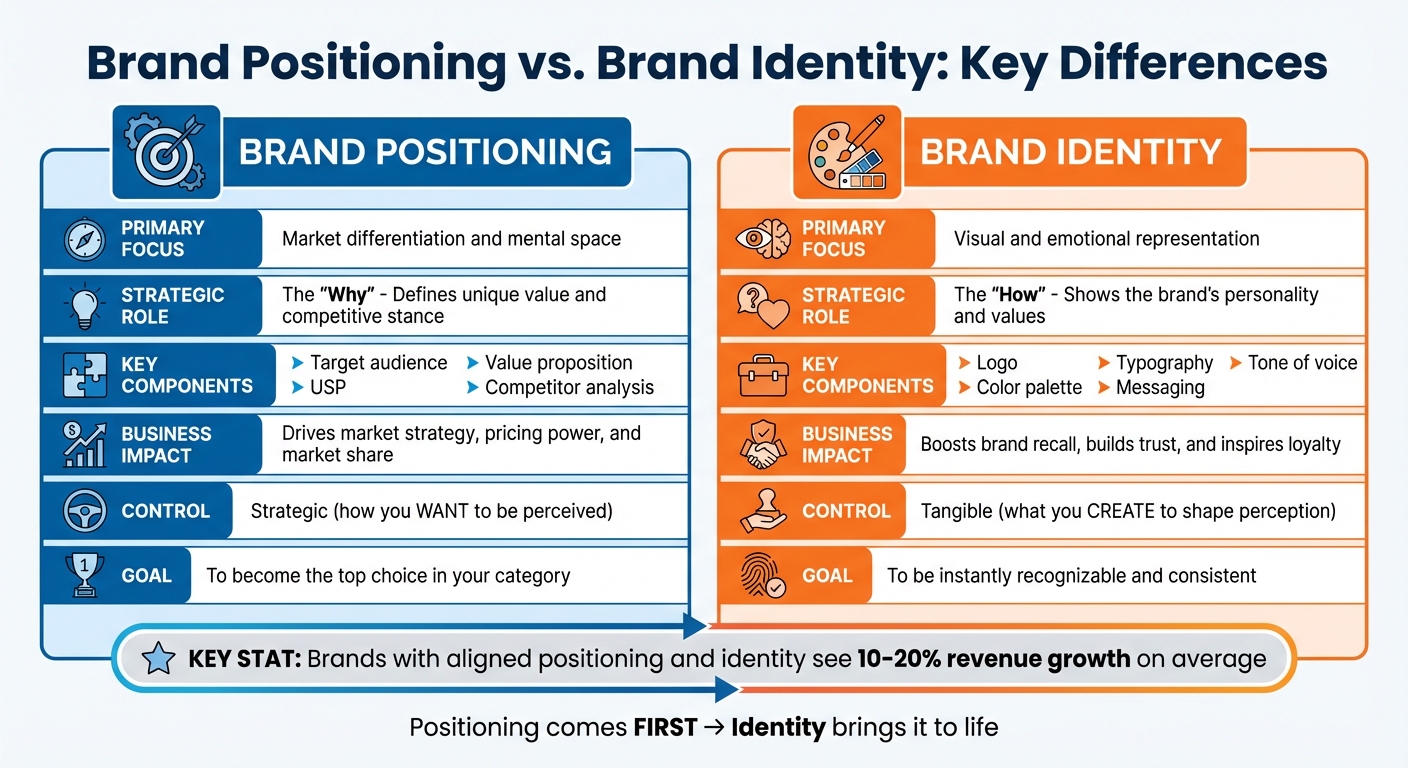
Brand Positioning vs Brand Identity: Key Differences Comparison Chart
The difference between brand image, identity and positioning
sbb-itb-63525a7
Quick Comparison: Brand Positioning vs. Brand Identity
Here's a quick breakdown of how brand positioning and brand identity differ. While both are essential for creating a strong brand, they serve distinct roles in your strategy.
Brand positioning defines your competitive edge - where you fit in the market and what sets you apart. On the other hand, brand identity is how you visually and verbally bring that positioning to life. Think of positioning as your strategic foundation and identity as the creative execution that makes your brand tangible and memorable.
"Positioning permeates the fabric of a company... Marketers should adopt positioning as their fifth 'P'."
This quote highlights that positioning isn't just another marketing tactic - it's a core part of your business strategy.
Comparison Table
| Aspect | Brand Positioning | Brand Identity |
|---|---|---|
| Primary Focus | Market differentiation and mental space | Visual and emotional representation |
| Strategic Role | The "Why": Defines unique value and competitive stance | The "How": Shows the brand's personality and values |
| Key Components | Target audience, USP, value proposition, competitor analysis | Logo, color palette, typography, tone of voice, messaging |
| Business Impact | Drives market strategy, pricing power, and market share | Boosts brand recall, builds trust, and inspires loyalty |
| Control | Strategic (how you want to be perceived) | Tangible (what you create to shape perception) |
| Goal | To become the top choice in your category | To be instantly recognizable and consistent |
Both positioning and identity are essential, and skipping one undermines the other. For instance, jumping straight into logo design without clear positioning is like trying to build a house without a solid blueprint. The next sections will dive deeper into each concept, showing how they work together to create a cohesive brand strategy.
What is Brand Positioning?
Brand positioning is all about carving out a distinct and meaningful place in your customer’s mind. It’s the process of defining what makes your business stand out from competitors and why someone should choose you. Marketing expert Philip Kotler explains it as:
"the act of designing the company's offering and image to occupy a distinctive place in the mind of the target market".
Think of it as claiming your unique spot in a crowded marketplace - a space that no one else can occupy.
This positioning serves as a strategic guide for your business. It influences everything - pricing, product development, and how you communicate your value. As marketing strategist Michael Richarme describes:
positioning should be considered the "fifth P" of marketing, working alongside Product, Price, Place, and Promotion to permeate the fabric of a company.
Without clear brand positioning, businesses risk sending mixed messages and wasting marketing dollars.
The benefits are measurable. Brands with consistent positioning often see revenue growth of 10% to 20% on average.
Key Elements of Brand Positioning
Four essential elements form the backbone of any strong brand positioning:
- Target Audience: Understand precisely who you’re speaking to by identifying their challenges and motivations . Success doesn’t come from appealing to everyone - it’s about being the perfect fit for a specific group.
- Competition: Determine the 3 to 5 businesses your customers see as alternatives. Study their strengths, weaknesses, and market positions to uncover opportunities instead of simply copying what they do .
- Value Proposition: This is your unique benefit - what sets you apart and makes you better. It could be extreme convenience, unbeatable pricing, exceptional quality, or a combination of factors. For example, when Dollar Shave Club launched in 2011, it focused on low price and convenience, contrasting with Gillette’s premium pricing and high-tech features. Their viral YouTube campaign made this crystal clear, leading to Unilever acquiring the company for $1 billion by 2016.
- Positioning Statement: This concise internal document (usually one paragraph) outlines your target audience, category, unique benefit, and proof. It acts as your North Star, guiding decisions across the organization .
How Brand Positioning Shapes Market Strategy
A well-defined position reshapes how you approach the market. Tools like perceptual mapping can help you visually analyze competitors (e.g., plotting them on a price versus quality scale) to identify unoccupied opportunities. Instead of battling industry leaders head-on, you can claim a space that’s distinctly yours.
Take BMW’s “Ultimate Driving Machine” campaign from the 1980s as an example. BMW carved out a niche that combined luxury and performance - offering more luxury than performance cars and more performance than traditional luxury vehicles. This unique position essentially created its own category.
Clear positioning also simplifies internal decision-making. Knowing exactly where you stand in the market makes choices about product features, pricing, and marketing channels faster and more cohesive . For instance, United Airlines’ “Good Leads The Way” campaign (2022–2024) under CEO Scott Kirby and Head of Global Advertising Maggie Schmerin revamped the airline’s customer communication strategy. A 35-person social media team was established, and by 2024, the results were striking: premium revenue rose by 10%, corporate revenue grew by 7%, and basic economy revenue increased by 20% year-over-year. This repositioning created a clear framework for every customer interaction.
When your brand position is clear, it accelerates customer decisions. People instantly understand whether your business aligns with their needs - and that clarity drives growth. Up next, we’ll dive into how brand identity visually and emotionally reinforces this strategic positioning.
What is Brand Identity?
Brand identity is how your brand comes to life visually, verbally, and experientially. As branding expert Marty Neumeier explains:
"Brand identity is the outward expression of a brand, including its trademark, name, communications, and visual appearance."
Think of it as your brand’s uniform - it’s what makes your strategic positioning visible and tangible. While positioning defines what sets you apart, identity shows how that uniqueness is expressed through design and communication. This blend of elements creates the foundation for how your brand is perceived.
Brand identity can be broken down into three layers: visual (logos, colors, typography), verbal (tone of voice, taglines), and experiential (customer service, digital interfaces). Each component sends a message - blue tones suggest trust, bold fonts convey authority, and script fonts evoke elegance. When these elements align consistently, they turn abstract ideas into concrete impressions in the minds of your customers.
The financial power of a strong brand identity is undeniable. Take Apple, for instance. Its sleek, innovation-driven identity contributed to a brand valuation of $241.2 billion in 2024. Similarly, Nike’s identity, rooted in performance and inspiration, was valued at $39.1 billion. But identity can also misfire. Tropicana’s 2009 redesign is a well-known cautionary tale. By replacing its iconic orange-and-straw imagery with a minimalist glass of juice, the brand lost its emotional connection with customers. The result? A 20% drop in sales within two months, costing the company $130 million and forcing a return to the original design.
Core Components of Brand Identity
Key elements of brand identity include the logo, color palette, typography, tone of voice, and experiential touchpoints.
- Logos: These are your visual signature, instantly recognizable at any size, from a tiny favicon to a massive billboard.
- Color Palette: Typically made up of three to five primary and secondary colors, it creates an emotional shortcut. For example, red evokes energy and excitement, while blue builds trust.
- Typography: This is your brand’s “voice in print,” setting the tone for how your message is visually communicated.
Verbal elements are just as important. Your brand voice and tone define how you communicate - whether that’s casual and witty or formal and authoritative. A tagline can encapsulate your entire value proposition in a few memorable words, like Nike’s “Just Do It.”
Experiential aspects bring your brand to life. From customer service protocols to digital usability and employee interactions, these are the touchpoints where your brand promises become real. A great example is Lush Cosmetics. To emphasize its “fresh, handmade, cruelty-free” ethos, Lush uses minimal packaging and includes stickers with cartoon illustrations of the employees who made each product. This approach underscores the brand’s commitment to transparency and human connection. Together, these elements ensure your brand identity resonates with your audience and reflects your positioning.
How Brand Identity Affects Customer Perception
A consistent brand identity across all touchpoints builds trust and reinforces your positioning. Brands that maintain this consistency see revenue growth of 10% to 20% on average. On the flip side, inconsistent use of colors and fonts can erode trust by as much as 50%.
Identity fosters recognition and emotional connections, helping customers make faster decisions. In fact, over 80% of consumers prefer buying from brands that align with their values. A strong identity can also boost customer engagement and satisfaction. Maggie Schmerin, United Airlines’ Head of Global Advertising, highlighted this shift:
"Gone are the days when we just have two big advertising pushes a year. We're all about how we can be relevant and do a better job in social media and advertising."
Brand Positioning vs. Brand Identity: Main Differences
Let’s dive into how brand positioning and brand identity differ in practice, even though they work hand-in-hand to shape a brand.
Positioning is all about strategy - it’s the unique spot you want to claim in your customers’ minds. Identity, on the other hand, is the toolkit you use to express that strategy. Think of positioning as your brand’s reputation, while identity is the uniform you wear to showcase it.
The sequence here is critical. Positioning comes first - it’s the foundation. Without a clear positioning strategy, your identity becomes little more than decoration. Before you decide on colors, fonts, or tone of voice, you need to know where you’re competing and how you plan to stand out. That’s why strategy always leads, and creative execution follows.
Another key distinction lies in control. You have complete authority over your brand identity - you choose the logo, colors, and messaging. But positioning? That’s shaped by market perceptions. While you can influence it, positioning is ultimately built through customer experiences, competitor moves, and every interaction people have with your brand. It’s a dynamic, evolving perception that you guide but can’t fully dictate.
Detailed Comparison Table
| Aspect | Brand Positioning | Brand Identity |
|---|---|---|
| Primary Focus | Market strategy and competitive space | Creative execution and sensory expression |
| Strategic Purpose | Differentiation and competitive advantage | Recognition and emotional engagement |
| Core Elements | Target audience, value proposition, competitors | Logo, colors, typography, tone of voice |
| Implementation | Strategic planning and market research | Design and creative development |
| Measurement | Market share and sales performance | Brand recall and customer loyalty |
| Control Level | Influenced by perceptions and competitors | Fully controlled by the company |
| Analogy | Reputation or handshake | Uniform or style |
When positioning and identity work in harmony, they build trust and credibility with customers. But when they clash - like when a premium brand uses visuals that feel cheap - it creates confusion and weakens the brand’s credibility.
Why Positioning Comes First
Positioning as the Foundation
Brand positioning is the cornerstone of any successful branding effort. It’s the strategic answer to one vital question: Why does your business matter in the marketplace? Without this clarity, your brand risks being directionless and ineffective.
Positioning serves as the guiding force for everything - design, messaging, and even the channels you use to connect with your audience. Take the example of a small retail brand in Hamilton, Ontario. In 2025, they partnered with Visual Branding and prioritized updating their core strategy before touching any visual elements. The result? A 40% boost in social engagement and a 25% increase in customer retention.
"Branding begins with strategy – not design." - Pepper Content
Your positioning defines the promise you make to your customers and sets you apart from competitors. With a strong foundation, your brand can confidently evolve to meet the demands of new markets or audiences without losing its essence. On the flip side, skipping this step can leave your brand vulnerable - weak, scattered, and ultimately ineffective.
A poorly defined positioning not only weakens your strategy but also leads to missteps in how your brand looks, feels, and operates.
Problems with Misaligned Branding
When businesses jump straight to creating logos, color schemes, and other visuals without first clarifying their market position, things can go sideways fast. One common issue is muddled positioning - when a brand tries to be everything to everyone, leaving customers confused about its core message.
Without clear positioning, teams across departments often end up misaligned. This misalignment can affect everything from packaging and content to customer service decisions. Worse, it directly impacts the bottom line: businesses risk losing 9.5% of revenue when poor customer experiences stem from a lack of brand clarity.
"If the foundation isn't strong, cracks will start showing up everywhere else." - Pepper Content
Consider this: nearly 95% of new product launches fail annually, often because companies overlook essential steps like market research and defining their positioning. On the flip side, brands with consistent positioning enjoy a major advantage - 61% of consumers are willing to pay more for a brand they trust.
Even the most visually stunning design can’t compensate for weak positioning. Without a solid foundation, those efforts simply won’t deliver results.
Aligning Brand Positioning and Brand Identity with AI Tools
How AI Streamlines Branding
AI-powered platforms make it easier to connect your brand's strategic positioning with its identity. Instead of spending weeks trying to turn abstract ideas into concrete visuals and messaging, these tools automate the process while ensuring consistency across all customer touchpoints.
The real strength of AI lies in its ability to make sure your "why" aligns seamlessly with your "how." For instance, if your brand positions itself as a premium service provider, AI ensures that your logo, tone of voice, and messaging reflect that high-end image - eliminating any potential disconnect between strategy and execution. In fact, over 60% of marketers are already leveraging AI to craft more compelling brand narratives.
"Positioning is the reputation you want to earn. Identity is the uniform you wear to prove you deserve it." - Stuart L. Crawford, Creative Director, Inkbot Design
AI also offers real-time competitor analysis, helping small and medium-sized businesses (SMBs) identify untapped opportunities in the market. For smaller teams, this means faster, data-driven decisions, removing the guesswork around whether your brand identity supports your strategy. With AI, every creative decision is rooted in your brand's core positioning.
Solutions for SMBs
AI tools tailored for SMBs make it easier to turn insights into action. Platforms like BrandMultiplier.ai focus on bridging the gap between positioning and identity. Its Narrative OS system takes your strategy and integrates it into AI tools that align all your messaging. Similarly, Rumble's discovery workshops simplify the process of defining your unique value proposition and translating it into consistent branding across all channels.
These aren't cookie-cutter solutions - they're customizable playbooks designed to help your team maintain brand consistency as you grow. This means even non-creative staff can produce materials that stay on-brand without needing constant oversight, while leadership can rest assured that every piece reflects the company's core strategy.
| Plan Name | Price | Description |
|---|---|---|
| Brand Builder | $4,995/mo | Lays the foundation for a strong brand strategy and value proposition. |
| GTM Rocket Fuel | $9,995/mo | Focuses on go-to-market strategies with clear, scalable messaging. |
| Growth Engine | $14,995/mo | Offers a comprehensive approach to expanding market share and building loyalty. |
When your positioning and brand identity are in sync, it builds trust and encourages repeat business. This alignment not only enhances customer loyalty but also drives measurable results like higher willingness to pay and improved repeat purchase rates. It's a strategy that directly impacts your bottom line.
Conclusion: Key Takeaways
Brand positioning and brand identity play distinct but interconnected roles. Positioning defines where your business stands in the market and why customers should choose you over competitors. Identity, on the other hand, is how you bring that strategy to life through visuals, messaging, and every interaction with your audience. When these two elements align, businesses can see up to a 23% boost in revenue and achieve price premiums of 20%-40%. This alignment doesn't just enhance credibility - it directly impacts profitability.
The order in which you approach these elements is crucial. Positioning must always come first. As mentioned earlier, positioning lays the groundwork for all creative decisions. Without it, you might end up with a sleek logo or an eye-catching campaign that fails to represent your strengths or sets unrealistic expectations. When customer experiences fall short of the promises made, trust takes a serious hit.
For small and mid-sized businesses (SMBs) competing with larger brands, this alignment can be a game-changer. With 87% of customers preferring brands that align with their personal values, your positioning and identity need to consistently communicate those shared values. This isn’t just about looking polished - it’s about earning the trust that keeps customers coming back and strengthens loyalty over time.
Next Steps for SMBs
To put these insights into action, start by evaluating your current branding. Take a close look at how well your market strategy aligns with your visual and verbal identity. Ask yourself: Does your logo, website, and social media presence accurately reflect your market position? If you’re positioning your business as a premium service provider, does every customer touchpoint reinforce that image? A SWOT analysis can help identify gaps and opportunities.
You might also consider using AI-powered tools to streamline the process of aligning strategy with execution. Platforms like BrandMultiplier.ai's Narrative OS system can help you codify your positioning and ensure it’s consistently applied across all marketing efforts. Automation tools like these save time while keeping your branding cohesive, which is essential for growth. And the payoff is substantial - companies with strong brand loyalty enjoy profit margins up to 60% higher than their competitors.
FAQs
Why is brand positioning more important than brand identity?
Brand positioning plays a key role in defining what your brand represents and carving out its unique place in the market. It shapes how people perceive your business by pinpointing your target audience, highlighting what sets you apart, and clarifying your value proposition. This strategy influences critical decisions - like pricing, messaging, and product development - helping your brand connect with customers and stand out from the competition.
Meanwhile, brand identity - things like your logo, color palette, and tone of voice - acts as the visual and emotional reflection of your positioning. But without a solid positioning strategy, even the most polished identity can feel directionless or fail to resonate with your audience. Positioning explains why your brand matters, while identity communicates how that story is shared. In short, positioning lays the groundwork for building a brand that truly connects.
How can small businesses align their brand positioning with their brand identity effectively?
To connect your brand positioning with your brand identity, start by establishing a clear positioning framework. This means understanding your target audience, pinpointing their needs, and defining how your brand uniquely addresses those needs. A well-crafted positioning statement serves as the cornerstone, showcasing your brand’s distinct value and guiding all identity decisions.
From there, your brand identity should bring that strategy to life - both visually and emotionally. Think about elements like your color palette, typography, logo, and tone of voice. Each of these should be purposefully chosen to reflect your brand’s promise. For instance, if your brand aims to convey a premium feel, opt for elegant colors and sleek, sophisticated fonts to reinforce that perception.
Here’s how to ensure everything aligns:
- Write a clear and concise positioning statement
- Match identity elements to support your positioning
- Test your messaging and visuals with your target audience
- Incorporate these guidelines across all marketing materials
When these pieces come together seamlessly, you create a unified and memorable brand experience - one that stands out and helps your business grow.
What mistakes do businesses make when creating a brand identity without clear positioning?
A mistake many businesses make is diving straight into designing logos, selecting colors, or choosing typography without first defining what sets them apart in the market. Skipping this critical step often results in a brand identity that feels disjointed, misaligned with the company’s true value, and unable to connect with the intended audience.
Another common misstep is confusing brand identity with brand image and focusing only on aesthetics. While a visually appealing logo might grab attention, it doesn’t guarantee a meaningful or lasting impression. This approach often leads to trendy or generic designs that lack a strategic backbone, resulting in inconsistent messaging and a weak emotional connection with customers.
Lastly, some businesses fail to align their brand identity with key audience insights or gaps in the competition. Without a deep understanding of their audience’s needs and challenges, branding efforts can feel random and fail to draw in or retain the right customers. A well-crafted brand identity should be a deliberate and strategic reflection of the company’s promise to its audience.
Ready to transform your brand story?
Schedule a free diagnostic to see how we can help.
Schedule The Diagnostic