
How to Build a Brand Strategy for Small Business Growth
How to Build a Brand Strategy for Small Business Growth
Want to grow your small business? Start with a clear brand strategy.
Here’s why it matters:
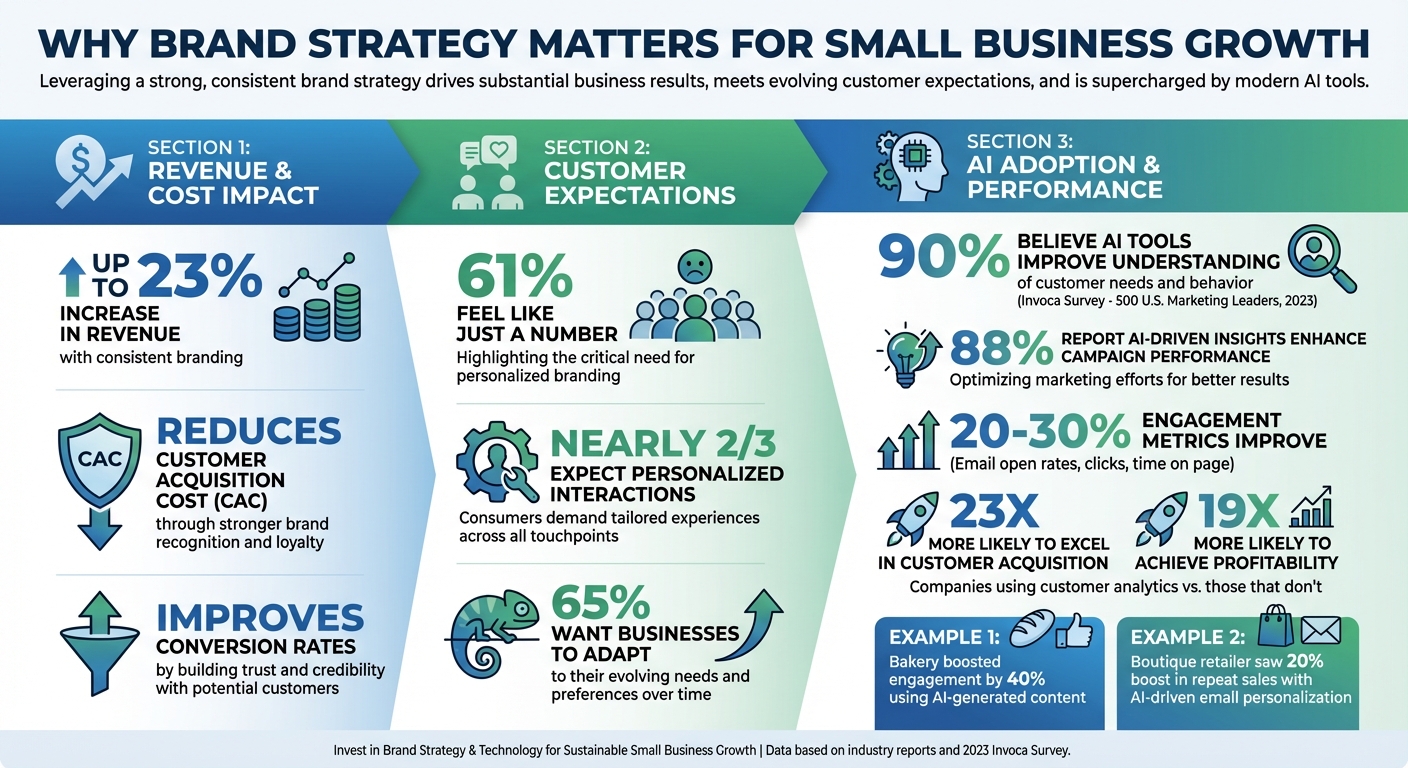
- Revenue boost: Consistent branding can increase revenue by up to 23%.
- Lower costs: A strong brand reduces customer acquisition costs (CAC) and improves conversion rates.
- Customer loyalty: 61% of customers feel like just a number - branding makes interactions personal and meaningful.
- AI advantage: Tools now simplify branding, making it faster and more affordable for small businesses.
This guide shows how to:
- Align business goals with branding.
- Use AI to define your audience and craft a compelling narrative.
- Implement your brand strategy across channels.
- Measure and optimize results for growth.
Let’s break it down step-by-step.
Key Brand Strategy Statistics for Small Business Growth
Set Business Goals and Build Your Brand Foundation
Connect Business Goals to Brand Objectives
Start with clear, measurable targets. For example, aim to increase annual revenue from $500,000 to $750,000 or reduce customer acquisition costs (CAC) from $80 to $60 within 12–24 months. Each target should tie directly to a brand objective that enhances engagement and boosts conversions. If reducing CAC is your goal, your brand messaging should clearly communicate value, helping prospects self-qualify before reaching out. To improve conversion rates from 2.5% to 3.5%, your positioning must immediately resonate with your ideal audience.
"The mistake people make is thinking the story is just about marketing. No, the story is the strategy. If you make your story better you make the strategy better."
- Ben Horowitz, Co-Founder, Andreessen Horowitz
This alignment ensures your efforts are focused and effective. Take the Doctor Dance project as an example. Revenue analysis revealed keynote speaking as the primary income driver. By concentrating on this core offering and streamlining messaging, the team avoided spreading resources thin and achieved growth.
Once your goals are set, the next step is to define the core elements that shape your brand identity.
Define Core Brand Elements
With your objectives in place, it's time to outline the essentials: your ideal customer profile, value proposition, positioning, and tone of voice. Start by creating a detailed profile of your ideal customer, including demographic, firmographic, and psychographic characteristics tailored to the U.S. market. Use tools like your CRM, Google Analytics, and customer surveys to gather insights.
Your value proposition should follow a simple formula: "We deliver [benefit] to [customer] by [unique method]." This clarity ensures your brand strategy aligns with measurable growth goals.
Positioning is what sets your brand apart. Make sure your tone of voice reflects how your best customers communicate, and adapt your messaging to align with U.S. business norms, emphasizing clear and measurable ROI.
Use AI Tools to Build Brand Foundations
After defining your brand essentials, use AI tools to fine-tune your strategy and speed up results. AI can condense what would typically take months into just a few weeks. Analyze customer emails, reviews, and CRM data with AI to uncover shared pain points, language patterns, and objections. These insights help sharpen your brand positioning and prevent diluted messaging, enabling a focused and effective relaunch.
A 2023 Invoca survey of 500 U.S. marketing leaders found that 90% believe AI tools improve their understanding of customer needs and behavior, while 88% report that AI-driven insights enhance campaign performance. For small businesses, this creates a level playing field. Tools like BrandMultiplier.ai's Narrative OS can consolidate your brand elements into a cohesive framework, refining positioning statements and enabling growth without requiring a large team.
Identify and Segment Your Target Audience with AI
Gather and Prepare Customer Data
Start by pulling together data from various sources like website analytics tools (e.g., Google Analytics), CRM systems, transaction records, social media platforms, and customer service logs. The key here is to prioritize data quality. That means cleaning up your data - removing duplicates, standardizing formats, and ensuring everything is accurate. Why does this matter? Because nearly two-thirds of consumers expect personalized interactions, and 65% want businesses to adapt to their evolving needs. Without clean, reliable data, meeting those expectations becomes nearly impossible.
Transparency is equally important. Let your customers know what data you’re gathering and why. Give them control over their information - it builds trust and ensures ethical practices. Once your data is cleaned and unified, you’re ready to let AI step in and help you segment your audience with precision.
Segment Audiences with AI
Traditional audience segmentation relies on static demographic groups, but AI takes it to the next level. It dives deeper, analyzing behaviors, psychographics, and real-time interactions to uncover patterns that you might not notice otherwise. Plus, AI doesn’t stop there - it continuously adjusts segments as new data rolls in, keeping your targeting sharp and relevant.
One of AI’s standout abilities is identifying micro-segments - those small, high-value groups that traditional methods often miss. It can even predict future actions, offering insights that help you engage with each segment proactively. For small businesses, this means you can reach the right audience at just the right time, without needing a large marketing team. These refined segments lay the groundwork for creating detailed customer journeys.
Map Customer Journeys with AI Insights
Once your audience is segmented, AI can help you understand the unique paths your customers take. By analyzing both qualitative and quantitative data, AI algorithms - using tools like clustering, neural networks, and natural language processing - highlight patterns and predict behaviors.
With these insights, you can build actionable personas based on real customer behaviors rather than guesswork. From there, map out the key touchpoints, challenges, and decision-making triggers for each segment. To ensure accuracy, validate these findings through customer feedback and testing. This approach helps you create a customer journey map that truly reflects your audience’s needs and expectations.
Create Your Brand Narrative Using AI Insights
Build Your Brand Narrative
Turn customer insights into a story that truly defines your brand. A strong brand narrative goes beyond just a catchy tagline or a polished mission statement. It’s the full picture of who you are, what you stand for, and why your customers should care. To craft this, focus on four key elements: a core promise, proof points, emotional connections, and strategies to address objections.
Take Doctor Dance as an example. This small business, which specializes in team building through dance, uncovered through customer insights that HR teams and event planners were actively searching for unique conference speakers who could deliver transformative experiences. Using that knowledge, they built their narrative around the promise to "unlock team potential through dance." They backed it up with tangible proof points, like measurable revenue growth from keynote speaking engagements. To counter objections - like concerns over whether dance is “professional” - they showcased improved engagement metrics. And they tapped into emotional connections by highlighting the joy and transformation that dance brings to teams. This thoughtful approach allowed them to completely relaunch their brand in just a few months.
These components form the backbone of a consistent, AI-enhanced brand message.
Optimize Messaging with AI
Once your narrative is in place, AI can help you refine and test it across all platforms. By analyzing how your messaging performs with different audience segments, AI pinpoints which phrases, benefits, and proof points resonate most. Tools like ChatGPT can generate multiple versions of your messaging for A/B testing, while platforms like Google Analytics track how audiences respond. For instance, a bakery used AI-generated Instagram captions to experiment with recipe storytelling styles. By tailoring their language to better match customer preferences, they boosted engagement by 40%.
But it’s not just about creativity - it’s about consistency, too. AI-powered tools like Zapier, Meta Advantage+, and social media platforms like Ocoya and Sprout Social allow you to roll out your narrative seamlessly across ads, emails, and posts, all while keeping your tone and message aligned. The trick is to use AI to handle the heavy lifting of scaling and testing while ensuring a human touch keeps your brand voice genuine.
"The mistake people make is thinking the story is just about marketing. No, the story is the strategy. If you make your story better you make the strategy better."
- Ben Horowitz, Co-Founder, Andreessen Horowitz
Codify Your Narrative with BrandMultiplier.ai
Once your narrative and messaging are polished, the next step is locking it into a system that ensures consistency everywhere. This is where BrandMultiplier.ai’s Narrative OS comes in. It uses a data-driven framework to organize your brand story into its essential parts - like promises, proof points, emotional hooks, and objection-handling strategies - so you can deploy them consistently across all touchpoints. This system helps align your messaging with critical metrics such as customer acquisition costs (CAC), deal speed, and lifetime value (LTV).
The results speak for themselves. Companies leveraging AI for personalization and narrative optimization have seen engagement metrics - like email open rates, clicks, and time spent on page - improve by 20–30%. Research from McKinsey shows that businesses that heavily use customer analytics are 23 times more likely to excel in customer acquisition and 19 times more likely to achieve profitability. BrandMultiplier.ai combines the speed and precision of AI with the strategic insight of human expertise. While AI handles the testing and scaling, human strategists ensure your narrative stays emotionally engaging and aligned with your goals. The outcome? A brand story that not only connects with your audience but also drives real, measurable growth.
Implement Your Brand Strategy Across All Channels
Execute Across Key Channels
Once you've nailed down your brand narrative, the next step is to bring it to life across every customer interaction. Whether it's your website, email campaigns, social media platforms, or even product packaging, the story you tell needs to stay consistent. It’s not just about showing up - it’s about ensuring your message aligns with the format and audience of each channel.
Start by identifying your primary touchpoints. For many U.S. small businesses, this often includes key areas like the homepage, landing pages, email campaigns targeting both leads and existing customers, visually focused platforms like Instagram and Facebook, professional spaces like LinkedIn, and SMS messaging for timely updates. While each channel might require tweaks to fit its specific format, your core message should remain steady.
A successful omnichannel strategy powered by AI relies on four key elements: unified customer data, seamless integration across platforms, consistent messaging, and real-time responsiveness. When these pillars work together, your customers experience your brand as one cohesive story instead of a collection of disconnected pieces. This harmony builds on your refined narrative and audience insights, making your brand feel unified and reliable.
Create and Manage Content with AI
AI can take over much of the heavy lifting when it comes to creating and distributing content, freeing you up to focus on the bigger picture. For instance, AI-powered tools can manage content calendars, automatically scheduling posts, emails, and campaigns across multiple platforms - all while maintaining your brand’s voice. This ensures that the story you’ve developed remains both consistent and impactful.
The best results come from combining AI’s efficiency with human creativity. AI can help overcome challenges like creative fatigue, time-consuming research, and inconsistent messaging. It might draft blog posts, social media updates, or email content based on your brand guidelines, but the human touch remains critical. Your team can review and refine these drafts to ensure they resonate with your audience. This partnership between AI and human insight expands your creative capabilities without sacrificing authenticity.
That said, maintaining brand consistency with AI requires clear rules. Establish guidelines for tone, messaging, and visual identity, and use AI tools that help enforce these standards automatically. Strong governance ensures your brand remains cohesive, which can significantly impact revenue. AI isn’t here to replace your team - it’s here to support them by handling repetitive tasks, so you can focus on strategy and emotional connection.
Unified vs. Fragmented Brand Approach
With your AI-driven narrative and content processes in place, the next step is to unify your brand’s presentation. A fragmented approach often results in mismatched visuals - like outdated logos or clashing color schemes - and inefficient processes due to limited resources or disorganized asset management. On the other hand, a unified, AI-powered system centralizes your brand assets, automates content creation and adaptation, enforces brand standards, and enables smooth multi-channel execution.
| Aspect | Fragmented Approach | Unified AI-Powered Approach |
|---|---|---|
| Time Investment | High manual effort | Streamlined through AI-driven automation |
| Brand Consistency | Inconsistent messaging and visuals | Cohesive narrative and visual identity |
| Customer Experience | Disconnected touchpoints | Seamless, recognizable experience |
| Customer Acquisition Cost | Higher due to inefficiencies | Lower with precise, personalized engagement |
| Revenue Impact | Missed opportunities | Drives growth with optimized messaging |
AI also changes the way you measure success. Instead of just looking at past trends, it enables predictive insights - like forecasting customer lifetime value. This proactive approach ensures that every dollar you invest leads to measurable growth, thanks to smarter, more integrated channel strategies.
sbb-itb-63525a7
Measure, Optimize, and Scale Your Brand Growth
Track Key Growth Metrics
Keeping an eye on the right metrics is essential for connecting your brand strategy to revenue. Focus on key indicators like Customer Acquisition Cost (CAC), conversion rates, and Lifetime Value (LTV). CAC shows how much you're spending to gain each new customer, though many small businesses find this tricky to calculate effectively. Conversion rates help you understand how well leads are turning into customers, and LTV reveals the long-term revenue generated by each customer.
By working to lower CAC, improve conversion rates, and increase LTV, you can pinpoint what’s working and where adjustments are needed. Tracking these metrics not only validates your strategy but also guides targeted improvements, allowing for real-time adjustments that keep your brand on track.
Use AI for Continuous Optimization
AI takes your brand strategy to the next level by turning it into a process of constant refinement. It processes real-time data and customer feedback, allowing campaigns to adapt instantly. This technology helps you stay ahead by analyzing shifts in customer sentiment, competitor moves, and consumer behavior.
With these insights, you can quickly see which messages resonate with specific customer segments and which channels are delivering the best results. Instead of relying on outdated reports, AI empowers you to respond immediately to market changes. This ongoing optimization paves the way for scalable growth.
Scale with Narrative OS
Narrative OS brings your brand’s story together across leadership, sales, product, and marketing. Using AI, it tracks key metrics like CAC, deal speed, and LTV while ensuring consistent messaging across every channel. This system enables small businesses to scale effectively by automating repetitive tasks, personalizing content, and fine-tuning campaigns in real time.
Branding Masterclass: How to Create a Brand Strategy for Your Business
Conclusion
Crafting an impactful brand strategy hinges on precision and consistency. By aligning your business goals with your brand identity, leveraging AI to deeply understand your audience, and maintaining a cohesive narrative across all channels, small businesses can hold their own - even against larger competitors.
Here’s an example: a boutique retailer saw a 20% boost in repeat sales by using AI-driven email personalization. This demonstrates how even modest investments in AI can deliver tangible results.
Tools like BrandMultiplier.ai's Narrative OS simplify the process by consolidating your brand strategy. It brings leadership, sales, product, and marketing efforts under one roof, codifies your brand story, and tracks essential metrics like CAC, deal speed, and LTV. Instead of juggling disconnected tools, this unified system delivers measurable results - often within just 60 days.
To wrap it up, revisit your business goals, harness AI insights, and ensure every customer interaction reflects a unified narrative. With the right tools and strategies in place, your small business can achieve growth that once seemed out of reach for companies without enterprise-level budgets.
FAQs
How can small businesses use AI tools to create an effective brand strategy?
AI tools give small businesses the ability to build effective brand strategies by analyzing customer data and spotting market trends. These tools can help businesses pinpoint their target audiences, anticipate what customers want, and tailor their messaging to connect on a deeper level. With AI, companies can simplify their research process, gain valuable insights, and make decisions based on solid data to strengthen their brand's position.
On top of that, AI can refine marketing campaigns, assess brand sentiment, and enable more accurate audience segmentation. This leads to stronger customer connections, better loyalty, and a consistent brand image across all platforms.
What are the most important metrics to track for a successful brand strategy?
To evaluate how well your brand strategy is performing, it's crucial to track metrics that highlight growth, customer engagement, and how your brand is perceived. Start with the basics: revenue, profit margin, and market share. These give you a clear picture of your overall business health.
Beyond that, dive into metrics like customer lifetime value (CLV), brand awareness, brand sentiment, and Net Promoter Score (NPS). These numbers reveal how your audience feels about your brand and how deeply they connect with it.
For a more detailed view, keep an eye on customer satisfaction (CSAT), social media mentions, and search volume. These indicators can show how effectively your brand is engaging with its target audience. Together, these metrics provide the insights you need to fine-tune your strategy and achieve impactful results.
How can a strong brand strategy help lower customer acquisition costs?
A well-crafted brand strategy can significantly reduce the costs of gaining new customers by building trust and recognition with your audience. When your brand is clearly defined and strikes a chord with your customers, it fosters loyalty and inspires word-of-mouth referrals - two highly effective and budget-friendly ways to grow your customer base.
On top of that, a consistent and recognizable brand streamlines your marketing efforts. People are far more likely to engage with a brand they know and trust, which means you won’t need to rely as heavily on pricey ad campaigns or extensive outreach. Over time, this approach not only strengthens customer loyalty but also brings down the overall cost of acquiring new customers.
Ready to transform your brand story?
Schedule a free diagnostic to see how we can help.
Schedule The Diagnostic