
CAC vs. LTV: Balancing Key Metrics
CAC vs. LTV: Balancing Key Metrics
When running a business, understanding Customer Acquisition Cost (CAC) and Customer Lifetime Value (LTV) is essential for sustainable growth. CAC measures how much you spend to get a new customer, while LTV shows how much revenue a customer generates over their lifetime. Together, these metrics help you decide if your marketing and sales efforts are profitable.
Here’s the key takeaway:
- A healthy LTV:CAC ratio is typically 3:1 - you earn $3 for every $1 spent on acquiring customers.
- Ratios below 1:1 mean you’re losing money, while ratios above 5:1 might indicate underinvestment in growth opportunities.
Why it matters:
- High CAC without matching LTV can drain resources.
- Improving LTV allows you to spend more on acquiring customers profitably.
- Monitoring these metrics helps balance growth and efficiency.
This guide explains how to calculate, interpret, and improve CAC and LTV, ensuring your business stays on the path to profitability.
How to Calculate CAC & LTV | The 2 Key Metrics for Growth
sbb-itb-63525a7
Understanding CAC: The Cost of Customer Acquisition
Tracking your customer acquisition costs (CAC) is crucial for understanding how efficiently your business is spending on growth. It’s a key metric for evaluating whether your sales and marketing efforts are hitting the mark or veering into overspending territory.
How to Calculate CAC
The formula is simple: take your total sales and marketing expenses and divide them by the number of new customers acquired during the same time period. For example, if you spent $50,000 on advertising, salaries, and tools in Q1 and brought in 500 new customers, your CAC would be $100 ($50,000 ÷ 500).
Consistency in time periods is critical. Many businesses calculate CAC monthly or quarterly to spot trends early. For companies with longer sales cycles, annual calculations might be more practical.
Once you’ve nailed down the time frame, make sure all relevant expenses are included.
What Goes Into CAC
To get an accurate CAC, you need to account for all customer-facing costs - not just the obvious ones like ad spend. Here’s a breakdown of what to include:
| Expense Category | What to Include |
|---|---|
| Advertising & Media | PPC campaigns, social media ads, trade show fees, and even billboards |
| Personnel | Salaries, benefits, commissions, and bonuses for your sales and marketing teams |
| Creative & Content | Costs for design agencies, video production, and internal content creation |
| Technology & Tools | CRM systems, marketing automation platforms, and analytics software |
| External Services | SEO agencies, consultants, and freelance marketers |
As Khozema Shipchandler, CEO of Twilio, points out:
"A customer acquisition cost shouldn't be measured independently. It needs to be measured in relation to customer lifetime value. This has become a top priority for CFOs as the digitization of business has forced businesses to build direct relationships with their customers."
Warning Signs of High CAC
Keep an eye on these red flags to avoid costly inefficiencies:
- Rising CAC outpacing revenue growth. If you’re spending more to acquire each customer without a matching boost in their value, your marketing is becoming less efficient. A declining LTV to CAC ratio - especially if it dips below 3:1 - is a clear sign of overspending.
- An LTV to CAC ratio below 1.0. This indicates you’re spending more to acquire customers than they’ll ever bring in revenue. Essentially, you’re losing money with every new customer.
- A long payback period. Even if your LTV looks healthy, a CAC that takes 18 months or more to recover can strain cash flow. For B2B businesses targeting small to mid-sized clients, aim to recoup CAC within 12 months. Faster payback means more capital available to reinvest in growth.
Understanding LTV: The Value of Long-Term Customers
CAC (Customer Acquisition Cost) tells you how much you're spending to bring in new customers, but Customer Lifetime Value (LTV) reveals the total revenue a customer generates over their relationship with your business. Knowing this metric is crucial - it helps you decide how much you can spend on acquiring customers while staying profitable. Let’s break down how to calculate and use this metric effectively.
How to Calculate LTV
The formula for calculating LTV depends on your business model:
-
For SaaS and subscription businesses:
Use this formula:
LTV = (ARPU × Gross Margin %) / Monthly Churn Rate.
For example, if your ARPU (Average Revenue Per User) is $100, your gross margin is 80%, and your churn rate is 5%, then:
($100 × 0.80) / 0.05 = $1,600. -
For general businesses and ecommerce:
Use this formula:
LTV = (Average Purchase Value × Average Purchases Per Year) × Average Customer Lifespan.
For instance, if a customer spends $50 per order, makes four purchases a year, and stays with you for three years, then:
$50 × 4 × 3 = $600.
How to Increase LTV
Boosting LTV allows you to spend more on acquiring customers without cutting into profits. Here are the three main areas to focus on:
- Increase average order value: Encourage customers to spend more per transaction through upselling or bundling products.
- Raise purchase frequency: Use personalized campaigns and loyalty programs to encourage repeat purchases.
- Extend customer lifespan: Retention is the key driver here. High churn - often caused by poor onboarding or weak customer support - can drastically lower LTV. In fact, 95% of customers say the quality of customer support impacts their loyalty.
Proactive customer success programs can help retain customers longer, while upselling and cross-selling can increase ARPU without additional acquisition costs. Adjusting pricing strategies for new customers while keeping churn under control is another way to improve LTV.
Additionally, segmenting your customer base to identify high-value groups lets you focus on acquiring similar customers. Using behavioral and transaction data to create personalized campaigns can further encourage repeat purchases and engagement. These strategies not only enhance revenue per customer but also provide insights for smarter business decisions.
How LTV Guides Business Decisions
When paired with CAC, LTV becomes a powerful tool for shaping budgets and growth strategies. It sets the ceiling for how much you can afford to spend on acquiring customers while staying sustainable. The rule of thumb? LTV should exceed CAC with a ratio of at least 3:1 - every customer should generate three times what it costs to acquire them. For example, if your LTV is $300, your CAC shouldn’t exceed $100.
Breaking down the LTV:CAC ratio by marketing channel can help pinpoint which efforts deliver the best returns. A ratio below 1:1 means you’re losing money on every customer, while a ratio above 5:1 could suggest you’re not investing enough in growth opportunities.
As Jamie Sullivan and Alex Immerman from Andreessen Horowitz explain:
"Higher LTV:CAC → higher margins → higher valuation."
LTV also influences your payback period - the time it takes to recover your customer acquisition costs. For top-performing subscription businesses, a payback period of less than six months is ideal. A shorter payback period frees up cash to reinvest in acquisition and communication strategies, fueling further growth.
The LTV to CAC Ratio: Measuring Growth Efficiency
LTV to CAC Ratio Benchmarks and Business Health Indicators
What is the LTV to CAC Ratio?
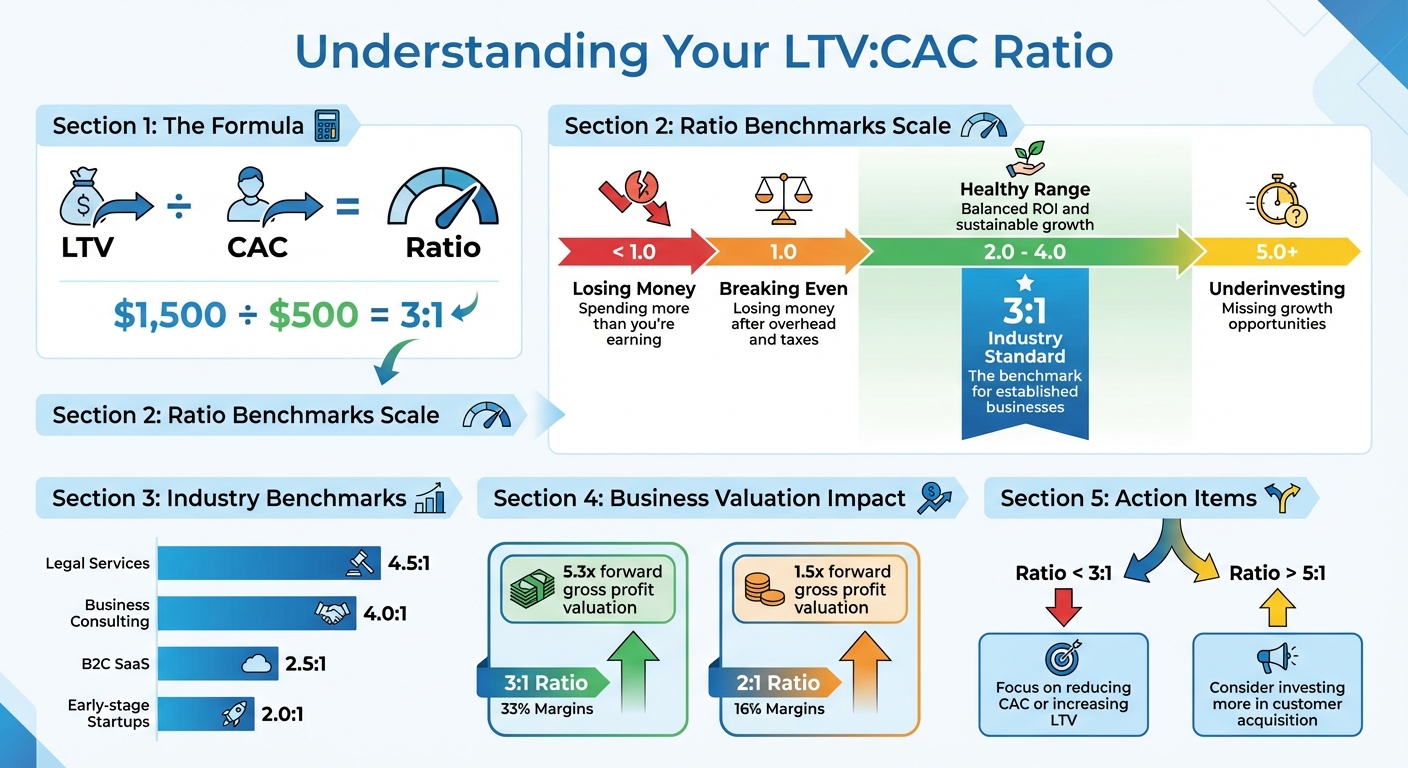
The LTV to CAC ratio is a straightforward calculation: divide your Customer Lifetime Value (LTV) by your Customer Acquisition Cost (CAC). This metric reveals how much return you’re getting from your sales and marketing investments over the lifespan of a customer. Essentially, it’s a way to measure whether your business is growing efficiently.
For example, let’s say your LTV is $1,500 and your CAC is $500. Your ratio would be 3:1, meaning every dollar you spend on acquiring a customer brings in three dollars in value. A ratio like this indicates your acquisition strategy is adding value, not wasting resources.
LTV to CAC Ratio Benchmarks
A 3:1 ratio is often seen as the benchmark for established businesses. It suggests you’re generating three times the value of what it costs to acquire a customer. However, interpreting this ratio depends on where your business stands:
| Ratio Range | What It Means |
|---|---|
| < 1.0 | Spending more than you're earning - essentially losing money. |
| 1.0 | Breaking even on paper, but likely losing money after factoring in overhead and taxes. |
| 2.0 - 4.0 | A healthy range that balances ROI and sustainable growth. |
| 5.0+ | Spending too little on acquisition, potentially missing out on growth opportunities. |
Different industries have their own typical ranges. For instance, legal services average around 4.5:1, business consulting tends to hover near 4:1, and B2C SaaS usually operates closer to 2.5:1. Early-stage startups often see ratios of about 2:1 as they refine their strategies.
As Jamie Sullivan and Alex Immerman from Andreessen Horowitz put it:
"Higher LTV:CAC → higher margins → higher valuation."
To give you an idea of how this translates into business value, companies with a 3:1 ratio (roughly 33% margins) might trade at about 5.3 times their forward gross profit. On the other hand, a 2:1 ratio (around 16% margins) typically trades at just 1.5 times forward gross profit.
Using the Ratio to Make Decisions
The LTV to CAC ratio isn’t just a number - it’s a tool for making smarter decisions about where and how to allocate resources. If your ratio is below 3:1, it’s a red flag that you’re overspending on acquiring customers relative to the value they bring. In this case, it’s worth revisiting your campaigns to identify underperforming areas. You could also focus on increasing LTV by improving customer retention, upselling, or enhancing the overall customer experience.
On the flip side, if your ratio is above 5:1, it might indicate you’re playing it too safe with your marketing spend. This could be a missed opportunity to invest in premium channels that bring in high-value customers.
For a more strategic approach, break down the ratio by acquisition channel or customer segment. This allows you to see which marketing efforts are delivering the best returns. For example, if your content marketing has a 6:1 ratio but your paid ads are only hitting 2:1, you’ll know exactly where to focus your budget. This kind of analysis not only helps you optimize spending but also sets the stage for reducing CAC while increasing LTV.
Balancing CAC and LTV in Marketing Communication
Improving Communication to Lower CAC and Raise LTV
Your messaging strategy plays a huge role in balancing customer acquisition cost (CAC) and lifetime value (LTV). By sharpening your campaigns with precise buyer segmentation, you can lower CAC while boosting LTV. For example, businesses that focus on inbound marketing see a 61% reduction in cost per lead compared to outbound strategies.
Tailoring your messaging to address specific customer pain points not only increases satisfaction but also strengthens long-term loyalty. Incorporating social proof can be a game-changer - products with at least five reviews experience a 270% higher conversion rate than those without. This builds trust faster without inflating your ad budget. Referral programs are another smart move: referred customers tend to have an LTV that’s 16% to 25% higher and convert 3 to 5 times faster than those acquired through paid ads.
Optimizing your marketing channels can also help reduce blended CAC. Take Bare Performance Nutrition (BPN) as an example: in 2024, they generated $900,000 in incremental revenue by reactivating inactive subscribers. They used integrated data to identify high-LTV customers with reactivation potential - all without increasing their ad spend. Even simple changes like promoting annual plans over monthly subscriptions can immediately boost LTV while improving cash flow.
When to Prioritize CAC vs. LTV
Once your messaging is fine-tuned, it’s important to decide whether to focus on lowering CAC or increasing LTV. Here’s how to make the call:
- Lower CAC when your LTV:CAC ratio drops below 2.0 or when your payback period stretches beyond 12–18 months. These are clear signs of unsustainable growth, which can lead to cash flow issues even if your LTV appears solid on paper. A long payback period makes scaling difficult.
- Raise LTV when your ratio climbs to 5.0 or higher. This often means you’re not spending enough on customer acquisition and could be missing out on growth opportunities. High churn rates are another red flag - acquisition efforts won’t drive sustainable revenue if customers leave faster than you can replace them.
"A high CAC LTV ratio can actually be too high... it often indicates that there's still room to spend and earn more on customer acquisition."
- Christine Dzou, Director of Growth Marketing at Gong
Your company’s growth stage also influences this decision. Early-stage startups should focus on acquisition to achieve product-market fit, even if costs are high. Scaling businesses, on the other hand, need to monitor LTV:CAC ratios by channel to allocate resources wisely. For mature companies, the focus should shift to net retention and expansion revenue to maintain a healthy 3:1 ratio. Making these strategic adjustments prepares you to use advanced tools for balancing these metrics.
How AI Helps Balance CAC and LTV
AI-powered tools are revolutionizing how businesses manage CAC and LTV by connecting brand messaging with performance data. For instance, BrandMultiplier.ai's Narrative OS uses a Growth Operating System to translate your strategic narrative into AI-driven insights. This system measures and adjusts the impact of your messaging on CAC, deal speed, and LTV in real time.
Here’s why this matters: 61% of companies are already using AI to enhance customer experience. Those that integrate AI into their strategies report an average 25% increase in customer satisfaction and a 10% boost in revenue. By leveraging predictive analytics, AI can identify high-LTV customer segments before you even spend a dollar, ensuring your marketing dollars are directed toward audiences most likely to convert profitably. AI-driven revenue intelligence can also analyze sales communications to pinpoint messaging patterns that lead to higher-value deals.
A unified analytics approach ties together fragmented data from ad spend, revenue, and retention, giving you a complete view of your "acquisition-to-profitability" journey. This not only improves CAC predictability but also enhances channel-level ROI visibility. By personalizing messaging based on predicted profit margins, AI reduces wasted impressions and cuts CAC significantly. Companies that adopt AI-powered customer journey optimization report an average 25% increase in revenue, 30% improvement in customer satisfaction, and 25% boost in retention.
Conclusion: Growing Through CAC and LTV Balance
Finding the right balance between CAC (Customer Acquisition Cost) and LTV (Lifetime Value) is like steering your business with a reliable compass - it guides you toward sustainable growth. A commonly accepted benchmark is a 3:1 ratio, where customers generate three times their acquisition cost. This is especially important for SMBs and early-stage startups looking to validate their business models.
If your ratio falls below 2:1, it’s a red flag that your acquisition costs are too high to sustain. On the flip side, a ratio above 5:1 might mean you’re not investing enough in growth opportunities. Keeping a close eye on this ratio - broken down by channel, customer segment, and product line - helps you quickly identify and address areas that need improvement.
"LTV:CAC is the single clearest test of whether your growth investments pay off. If LTV is low relative to CAC, scale will destroy value." - Jay Mitchell, Mereo
This metric isn’t just a number - it’s a signal for action. Take the example of HubSpot in 2012. At the time, their LTV/CAC ratio was just 1.7, a concerning figure. Mark Roberge, then SVP of Worldwide Sales and Services, dug into the data and uncovered that high churn rates were tied to misaligned sales incentives. By realigning these incentives, HubSpot reduced their monthly churn from 3.5% to 1.5% and nearly tripled their LTV/CAC ratio in under 18 months.
Modern tools make this balancing act easier than ever. BrandMultiplier.ai's Narrative OS is one such example, offering AI-driven insights that track CAC, deal speed, and LTV in real time. This platform connects your brand strategy with performance marketing, allowing you to fine-tune messaging based on measurable outcomes. The result? Lower acquisition costs and higher customer value - the building blocks of scalable, profitable growth.
FAQs
How can I lower my CAC while increasing my LTV?
Reducing Customer Acquisition Cost (CAC) while increasing Customer Lifetime Value (LTV) is all about targeting the right audience, spending wisely, and getting more value from your existing customers.
Start by focusing on high-value customer segments to make sure every marketing dollar counts. Keep a close eye on campaign performance - cut out underperforming channels and redirect your budget toward strategies that deliver better returns, like referral programs or organic content. To keep your customers coming back, improve their onboarding experience, resolve any pain points quickly, and consider offering tiered pricing or add-ons that increase the average revenue per user.
Striking the right balance between CAC and LTV is essential for long-term growth. When you lower CAC, you free up resources to invest in retention strategies that drive up LTV. On the flip side, a higher LTV gives you more room to spend on acquiring new customers. Tools like BrandMultiplier.ai can make this process easier by using AI to identify key customer segments, optimize your spending, and deliver personalized experiences that improve both CAC efficiency and LTV.
How can I improve my LTV:CAC ratio if it’s below the recommended benchmark?
If your LTV:CAC ratio falls short of the ideal 3:1 benchmark, it’s time to shift your focus toward strategies that boost customer lifetime value (LTV) while trimming customer acquisition costs (CAC). Striking this balance is essential for steady, long-term growth.
Here’s how you can start improving:
- Prioritize high-value customers: Dive into your data to pinpoint the customer segments that consistently generate the most revenue. By zeroing in on these groups, you can naturally increase LTV while lowering the cost per qualified lead.
- Focus on retention: Happy customers stick around longer. Strengthen your onboarding process, offer stellar customer support, and address common pain points to reduce churn. Keeping customers around longer means higher LTV - without spending more to acquire them.
- Optimize your marketing budget: Not all campaigns are created equal. Review your marketing efforts to find underperforming channels, then shift your investment to those delivering better returns. This simple adjustment can significantly lower your CAC.
For an extra edge, consider tools like BrandMultiplier.ai’s “Narrative OS” to create a cohesive brand story across all touchpoints. A unified message can deepen customer engagement, helping you see measurable gains in both LTV and CAC. By implementing these strategies, you’ll be on track to achieve a healthier ratio and support sustainable growth.
How can AI help balance CAC and LTV to drive business growth?
AI plays a key role in helping businesses fine-tune their Customer Acquisition Cost (CAC) and Lifetime Value (LTV) by transforming raw data into meaningful insights. It can pinpoint high-value customer segments, forecast revenue opportunities, and flag areas where spending isn’t delivering results. This allows teams to reallocate budgets more wisely, cutting down on wasted ad spend and driving stronger returns on investment.
Beyond that, AI can model the financial outcomes of various strategies - like tweaking pricing, implementing upselling initiatives, or reducing churn - to identify the best path toward sustainable growth. Tools such as BrandMultiplier.ai’s Narrative OS push this even further by blending strategic storytelling with AI capabilities. These tools continuously evaluate their impact on metrics like CAC, deal velocity, and LTV, ensuring growth stays on track.
Ready to transform your brand story?
Schedule a free diagnostic to see how we can help.
Schedule The Diagnostic