
CAC vs. LTV: Key Metrics for SMB Growth
CAC vs. LTV: Key Metrics for SMB Growth
Want to know if your business is set up for success? It all comes down to two numbers: Customer Acquisition Cost (CAC) and Lifetime Value (LTV). These metrics determine if your customers are generating more revenue than they cost to acquire. Here’s the bottom line:
- CAC: How much you spend to acquire a customer (ads, salaries, tools, etc.).
- LTV: The total revenue a customer brings in during their relationship with your business.
- Ideal Ratio: Your LTV should be at least 3x your CAC (3:1). Anything less can hurt profitability.
Why it matters: If your CAC is higher than your LTV, you’re losing money. For SMBs with tight budgets, tracking these metrics helps you focus on the right marketing channels, improve retention, and scale profitably. Learn how to calculate, compare, and improve these metrics to keep your growth on track.
What is Customer Acquisition Cost (CAC)?
How to Calculate CAC
Customer Acquisition Cost (CAC) refers to the total amount a business spends to attract, engage, and convert a lead into a paying customer. To calculate it, simply divide your total sales and marketing expenses by the number of new customers acquired over a specific time period.
When calculating CAC, it’s essential to include all relevant sales and marketing costs. This means factoring in employee salaries, software subscriptions, content creation costs, professional fees, and general overhead. For example, if your business spends $17,000 to acquire 50 customers, your CAC is $340 per customer. These calculations not only help you monitor your own performance but also allow you to compare your numbers against industry benchmarks.
"Unit economics determine survival. A company with $100 CAC and $150 LTV will eventually die, no matter how fast it grows." – Maestro
CAC Benchmarks by Industry
Knowing your CAC becomes more meaningful when you compare it to industry averages. Here’s a breakdown of typical CAC figures across various sectors:
| Industry | Average CAC | Target LTV:CAC Ratio | Typical Payback Period |
|---|---|---|---|
| B2B SaaS | $239 – $273 | 3:1 – 5:1 | 15–18 months |
| E-commerce | $70 – $84 | 2:1 – 3:1 | 3–6 months |
| B2B Services/Consulting | $410 – $656 | 3:1 – 4:1 | 12–15 months |
| Fintech | $1,450 | 4:1+ | 24+ months |
| Healthcare Tech | $890 | 4:1+ | 18–24 months |
For instance, the median LTV:CAC ratio across 612 B2B SaaS companies is 3.2:1. Additionally, acquisition costs can vary significantly depending on the channel. In B2B SaaS, Thought Leadership SEO has an average CAC of $647 with an impressive ROI of 702%, while Trade Shows have a much higher CAC of $1,442 per customer but a lower ROI of 127%. Organic channels, in general, tend to lower CAC by 40% to 60% compared to paid channels. Having a clear understanding of these benchmarks can guide smarter investment decisions.
Why CAC Matters for SMB Decisions
For small and medium-sized businesses (SMBs), optimizing CAC is essential for long-term growth and profitability. By understanding CAC, SMBs can make smarter decisions about where to allocate their limited budgets. For example, if one marketing channel is significantly more expensive than another, shifting resources could improve efficiency. Referral programs can also be a game-changer - referred customers typically cost $23 less to acquire than non-referred customers.
High CAC often points to deeper issues, such as unclear product messaging or poor market fit. For early-stage SMBs, keeping a close eye on the CAC payback period - the time it takes to recover acquisition costs - is especially important. In fact, for businesses with limited cash flow, the payback period can be a more critical metric than the LTV:CAC ratio.
Lastly, calculating CAC by channel or customer segment is key to avoiding misleading averages. This level of granularity ensures that you’re making data-driven decisions tailored to your specific business needs.
sbb-itb-63525a7
What is Lifetime Value (LTV)?
How to Calculate LTV
Customer Lifetime Value (LTV) estimates the total revenue a customer is expected to bring to your business over the course of their relationship with you. While Customer Acquisition Cost (CAC) measures how much it takes to gain a customer, LTV focuses on the long-term returns they provide. Together, these metrics help businesses plan for sustainable growth.
For subscription-based businesses, LTV is often calculated by dividing the Average Revenue Per User (ARPU) by the monthly churn rate. For example, if a business earns $100 per customer each month and has a 5% churn rate, the LTV would be $2,000. To refine this number, gross margin can be factored in. With an 80% gross margin, the adjusted LTV would drop to $1,600.
For businesses without subscriptions, the formula involves multiplying the average purchase value by the number of repeat transactions and the retention period. Take an HVAC company as an example: they sell a $25,000 system and earn $150 annually in maintenance fees over 15 years. Their LTV would be $27,250.
"Customer lifetime value is an important metric because it represents an upper limit on spending to acquire new customers." – Wikipedia
Understanding churn is essential to making the most of this metric, as it directly affects LTV.
How Churn Affects LTV
Churn rate, or the percentage of customers who stop using your product or service, plays a huge role in determining LTV. Even small reductions in churn can have a dramatic effect. For instance, if the monthly churn rate drops from 10% to 5%, the average customer’s lifetime doubles - from 10 months to 20 months - resulting in double the LTV.
This issue is especially challenging for mobile apps, where churn rates are notoriously high. On average, 60% of users stop using an app after the first month, and 75% leave within three months. For small to medium-sized businesses (SMBs), retaining customers is crucial, as 80% of profits often come from just 20% of their most loyal customers.
High churn also shortens the time available to recoup acquisition costs. This is why even minor improvements in retention can make a big difference in long-term profitability.
How to Increase LTV
To increase LTV, businesses need to focus on keeping customers longer and encouraging them to spend more. Retention strategies are key - think personalized onboarding, excellent customer support, and loyalty programs that make it harder for competitors to lure customers away. For example, Netflix boasts an average subscriber lifetime of 25 months, leading to an LTV of $291.25.
Boosting customer spending is another way to increase LTV. Strategies like upselling and cross-selling can encourage customers to spend more without driving them away. This could mean offering premium tiers, add-ons, or complementary products. However, it’s important to strike a balance - raising prices too aggressively risks higher churn.
Finally, segmenting your customer base allows you to identify which acquisition channels and customer types deliver the highest LTV. By focusing resources on these high-performing areas, SMBs can maximize profitability and ensure they’re investing in the right opportunities.
How to Calculate CAC & LTV | The 2 Key Metrics for Growth
The CAC:LTV Ratio Explained
CAC vs LTV Ratio Guide: What Your Numbers Mean and Actions to Take
What the CAC:LTV Ratio Measures
The CAC:LTV ratio (sometimes written as LTV:CAC) highlights the balance between the cost of acquiring a customer (CAC) and the revenue they generate over their lifetime (LTV). It essentially measures the return on every dollar spent on sales and marketing. For example, if acquiring a customer costs $100 and they bring in $300 over their lifetime, your ratio would be 3:1.
"LTV:CAC essentially measures your total return on sales and marketing spend over the lifetime of a customer relationship." – Alex Wittenberg, COO, airCFO
A 3:1 ratio is often considered the ideal benchmark, meaning every dollar spent should generate three dollars in return. However, a 1:1 ratio, while seemingly breaking even, fails to account for other costs like operations, taxes, and maintenance. On the other hand, ratios above 5:1 might suggest you're being overly cautious with marketing spend, potentially missing out on growth opportunities.
Why This Ratio Matters
For small and medium-sized businesses (SMBs), this ratio serves as a key indicator of profitability and growth potential. It answers a critical question: can you sustain and scale growth, or should you adjust pricing, retention, or acquisition strategies? Investors and venture capitalists also rely heavily on this metric, as a strong ratio signals the potential for predictable revenue growth with additional investment.
Across 612 B2B SaaS companies, the median LTV:CAC ratio is 3.2:1. Interestingly, improving a ratio from 2:1 to 3:1 can nearly triple a company’s valuation. Once a business achieves product-market fit and consistent sales processes, it becomes essential to monitor this ratio monthly.
"Higher LTV:CAC → higher margins → higher valuation." – Jamie Sullivan and Alex Immerman, Partners, Andreessen Horowitz
SMBs should also calculate this ratio separately for individual acquisition channels - like SEO versus paid ads - to identify which methods attract the most valuable customers. This breakdown offers actionable insights, setting the stage for strategies to refine and improve the ratio.
CAC:LTV Ratio Examples
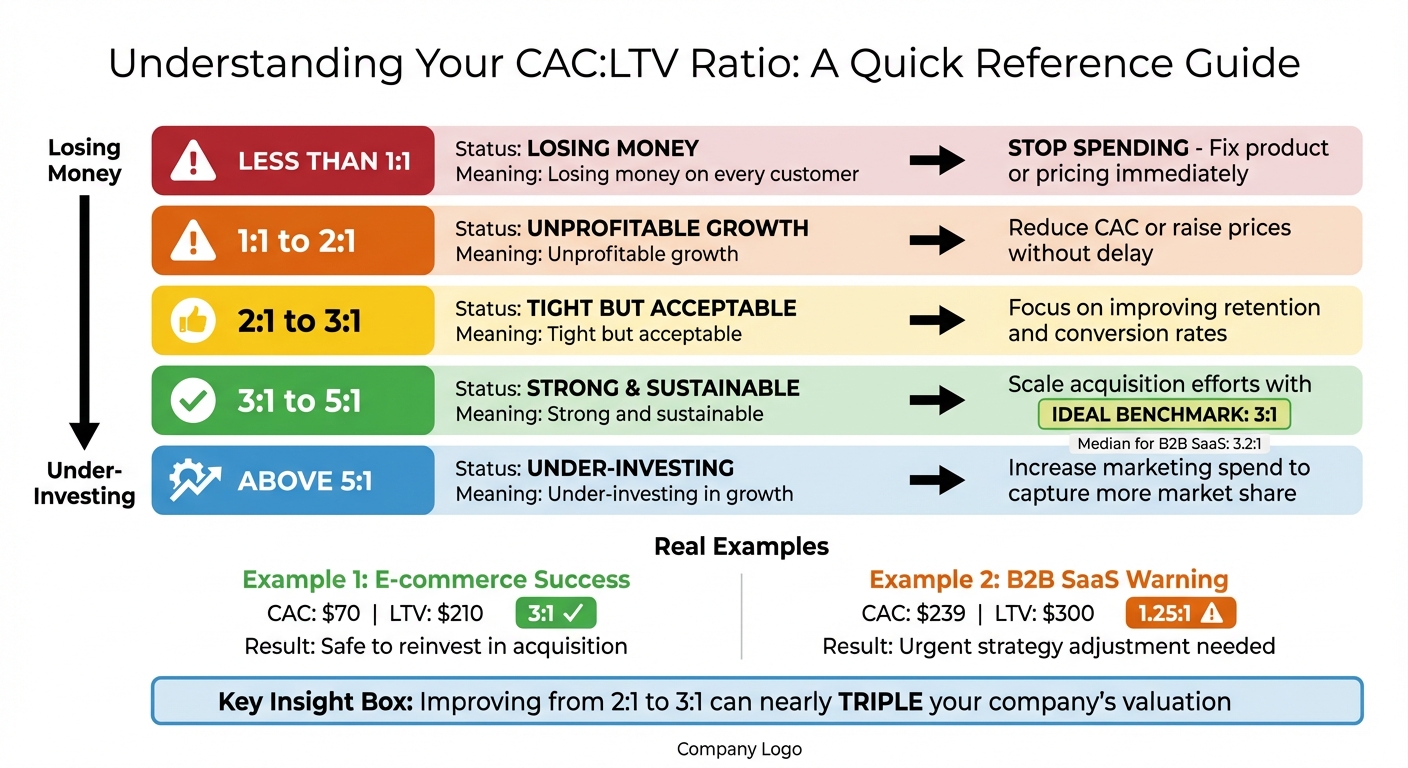
The table below provides a snapshot of what different LTV:CAC ratios signify and the recommended actions:
| LTV:CAC Ratio | What It Means | What You Should Do |
|---|---|---|
| Less than 1:1 | Losing money on every customer | Stop spending and fix product or pricing immediately |
| 1:1 to 2:1 | Unprofitable growth | Reduce CAC or raise prices without delay |
| 2:1 to 3:1 | Tight but acceptable | Focus on improving retention and conversion rates |
| 3:1 to 5:1 | Strong and sustainable | Scale acquisition efforts with confidence |
| Above 5:1 | Under-investing in growth | Increase marketing spend to capture more market share |
For example, an e-commerce business spending $70 to acquire customers who generate $210 in lifetime value operates at a solid 3:1 ratio, making it safe to reinvest in customer acquisition. On the flip side, a B2B SaaS company spending $239 to gain customers who generate $300 has a ratio of roughly 1.25:1, barely covering costs and signaling an urgent need for strategy adjustments.
The takeaway? The CAC:LTV ratio is dynamic and can be improved. Reducing churn boosts LTV, while optimizing the sales funnel lowers CAC. For SMBs with limited budgets, focusing on retention often delivers quicker results.
How to Optimize CAC and LTV
Lowering CAC Through Better Channels
Reducing customer acquisition costs (CAC) starts with identifying your Ideal Customer Profile (ICP) and focusing on high-value segments. This approach ensures your budget isn't wasted on low-intent leads who are more likely to churn. Once you've pinpointed the segments that convert best, you can shift your strategy away from costly paid ads. Instead, lean on organic channels like SEO, content marketing, and referral programs. Here's a compelling stat: customers gained through referrals typically cost 70% less than those acquired via paid search.
Another key tactic? Conversion rate optimization (CRO). Simple improvements like refining landing pages and cutting page load times to under 2 seconds can help you convert more visitors without needing to increase your ad spend. Regularly audit your marketing channels and reallocate at least 20% of your budget from underperforming channels to those with LTV:CAC ratios above 4:1. For context, in competitive B2B industries, the cost per qualified lead on platforms like LinkedIn or Meta averages between $150 and $250 as of late 2025. This underscores why channel efficiency is critical, especially for SMBs working with limited budgets.
Increasing LTV Through Retention
Once you've optimized CAC, the next step is to maximize Lifetime Value (LTV) by focusing on retention. Boosting customer retention by just 5% can increase profits by anywhere from 25% to 95%. Plus, retaining an existing customer is about five times cheaper than acquiring a new one. The first 90 days are especially important - companies that invest in high-touch onboarding have seen first-month churn rates drop by an average of 15% in 2025.
Retention strategies don’t stop at onboarding. Upselling and cross-selling play a big role in driving expansion revenue, which accounted for an average of 28% of total Annual Recurring Revenue (ARR) for successful B2B companies in 2025. These efforts generate high-margin revenue without the need for additional acquisition costs. Another effective method? Tiered loyalty programs. For example, Amazon Prime members spend an average of $1,400 annually, compared to $600 for non-members. Proactively monitor customer engagement, too - setting up alerts for a 40% drop in activity over two weeks allows you to deliver timely, targeted support.
Using AI to Align CAC and LTV
Technology, particularly AI, can be a game-changer for balancing CAC and LTV. AI tools streamline acquisition by automating real-time ad bidding, refining targeting, and using predictive modeling. These tools can analyze early customer behaviors - like usage frequency and feature adoption - within the first 90 days. This data helps businesses predict which customers will have the highest lifetime value, allowing them to focus acquisition efforts on similar profiles.
"AI tools are only as good as the data you provide. Regularly update your attribution models and audience parameters to keep your customer acquisition strategies agile and effective." – Hamlet Azarian, Azarian Growth Agency
AI also enables hyper-personalization at scale. Take Netflix, for example: 80% of content consumption on the platform is driven by its AI-powered recommendations. This kind of tailored experience fosters loyalty without requiring a proportional increase in human resources. Tools like BrandMultiplier.ai's Narrative OS go a step further by unifying your brand story across teams. It continuously optimizes CAC, deal speed, and LTV, helping align marketing efforts with key performance metrics like conversion rates and customer value.
Conclusion
Key Takeaways
Balancing CAC (Customer Acquisition Cost) and LTV (Lifetime Value) is more than just crunching numbers - it's about ensuring your business stays afloat. Stanford lecturer Bret Waters aptly warns: "Startups go broke two ways: gradually, and then suddenly". The ideal LTV:CAC ratio of 3:1 serves as your guiding principle for healthy growth. A ratio under 2:1 indicates you're spending recklessly, while anything above 5:1 suggests missed opportunities for expansion.
Cash flow is king, and poor management of it is a leading cause of failure for 82% of businesses. One critical metric to watch is the payback period - early-stage SMBs should aim to recover acquisition costs within 12 months to maintain financial stability.
It's also crucial to avoid the pitfalls of "blended CAC." Instead, break down metrics by channel and customer cohort to identify where your investments are paying off. For example, organic channels like SEO can deliver CAC that’s 40% to 60% lower than paid advertising, and SEO boasts an impressive ROI of 702% for B2B SaaS. On top of that, retention is a powerful growth lever. Boosting customer retention by just 5% can increase profits by 25% to 95%.
These insights underline the importance of focusing on the right metrics and strategies to drive sustainable growth.
Next Steps
Start by auditing your metrics and refining your strategy. If your LTV:CAC ratio is below 1:1, stop acquisition spending immediately and revisit your product or pricing. For ratios between 1:1 and 2:1, focus on reducing CAC through targeted acquisition channels while increasing LTV with strategies like upselling and personalized onboarding.
To execute these strategies effectively, consider using AI tools to unify and optimize your metrics. Tools like BrandMultiplier.ai's Narrative OS can help SMBs align brand messaging across teams and improve key metrics like CAC, conversion rates, and LTV. By codifying your strategic story and embedding it across leadership, sales, and marketing, tools like these ensure your efforts are consistently driving measurable results.
Channel-specific insights are your compass - use them to make smarter budget decisions. Set clear benchmarks, diversify your acquisition efforts, and prioritize retention strategies. These actions will position your business for steady, sustainable growth.
FAQs
Should I use gross margin in LTV?
Including gross margin in LTV calculations offers a clearer picture of customer profitability. By focusing on the actual profit generated throughout a customer's lifetime, you can better align your marketing and sales strategies with your business's long-term objectives.
How can I track CAC by channel accurately?
To measure Customer Acquisition Cost (CAC) by channel accurately, you need to allocate all associated expenses. This includes both direct costs, like advertising spend, and indirect costs, such as salaries, based on each channel's contribution to acquiring customers. Attribution models - like first-touch, last-touch, or multi-touch - can help distribute these costs more precisely.
It's also essential to keep a close eye on these figures. Use dashboards or analytics tools to track performance metrics regularly. This way, you can assess how efficient each channel is and make smarter decisions about where to invest your marketing budget.
What is a healthy payback period for SMBs?
A payback period of under 6 months is generally considered healthy for small and medium-sized businesses (SMBs). However, an ideal timeframe is under 3 months, especially for companies aiming for rapid growth. Why does this matter? Shorter payback periods mean businesses can recover their customer acquisition costs quickly. This allows them to reinvest sooner, opening up opportunities to scale and grow efficiently.
Ready to transform your brand story?
Schedule a free diagnostic to see how we can help.
Schedule The Diagnostic