
Checklist: Building a Neuroscience-Based Brand Story
Checklist: Building a Neuroscience-Based Brand Story
Your brand story isn’t just about facts - it’s about creating emotional connections that stick. Neuroscience shows that emotions heavily influence decisions, with 95% of choices driven by the subconscious. A well-crafted story can activate brain chemicals like dopamine (focus, memory) and oxytocin (trust, empathy), helping your brand stand out and build loyalty.
Here’s how to create a neuroscience-based brand story:
- Tap into emotions: Identify the core feeling your brand evokes - this drives connection and recall.
- Make the customer the hero: Position them as the protagonist solving a challenge, with your brand as their guide.
- Simplify your message: Keep it clear and structured to avoid overwhelming your audience.
- Use relatable and sensory details: Stories with real struggles and vivid language engage multiple brain areas.
- Test and refine: Use tools like neural coupling metrics to measure subconscious reactions and improve your narrative.
Key Insight: People remember 65% of information when paired with visuals and emotional cues, compared to just 10% with words alone. Focus on building trust and emotional resonance for lasting impact.
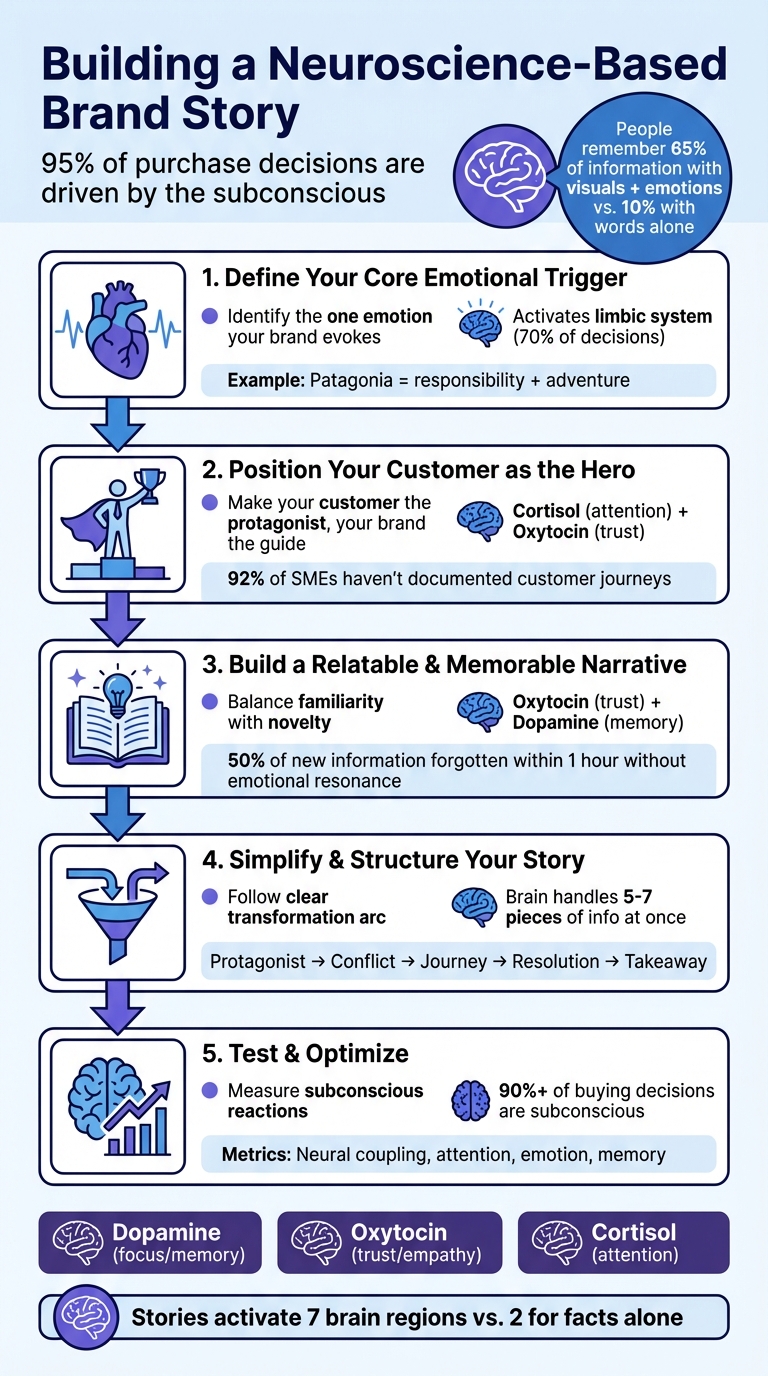
5-Step Neuroscience-Based Brand Story Framework
🎬 Storytelling x AI: Neuroscience, Brand Voice & Stand-Out Strategy with Aurora Winter 🚀
sbb-itb-63525a7
Step 1: Define Your Brand's Core Emotional Trigger
Start by identifying the one emotion your brand consistently evokes. This single, powerful feeling - often referred to by neuroscientists as a "meaning core" - is what makes your brand stick in people's minds.
Why is this so important? Because research shows that up to 95% of purchase decisions happen in the subconscious. This means emotions, not product features, are what truly drive decisions. People don't consciously weigh pros and cons - they respond to how your brand makes them feel. As branding legend Walter Landor famously said:
Products are made in the factory, but brands are made in the mind.
Find the Emotional Spark Behind Your Brand
Think back to the moment your brand was born. What problem, hope, or desire inspired you to start? These origin stories often reveal the emotional truth that will connect with your audience.
Take Patagonia, for example. They sell outdoor gear, yes - but their brand is about so much more. They inspire a sense of responsibility for the planet and a love for adventure. Their emotional trigger? The drive to protect wild places while exploring them. This mission goes beyond selling products; it taps into their customers' identity and values. Neuroscience backs this up: when your brand reflects a deeper purpose, it activates the limbic system - the part of the brain that drives about 70% of decisions through emotions, not logic.
To strengthen your brand's emotional connection, map out your customer's journey. Pinpoint the moments where frustration peaks and where relief or joy takes over. For instance, if your product eliminates tedious tasks, that feeling of freedom and efficiency could become your emotional anchor.
Then, make sure this core emotion aligns with what your audience values most.
Match Your Audience's Values and Emotions
An emotional trigger only works if it resonates with your audience's real feelings. To achieve this, you need more than assumptions - you need data. Dive into customer feedback to uncover their pain points and desires.
Pay attention to the words your customers use. Are they worried about missing out? Frustrated by complexity? Longing for connection? These emotional themes - like happiness, fear, nostalgia, or frustration - are the foundation of many successful campaigns. But here's the catch: it has to feel genuine. As Marty Neumeier, author of The Brand Gap, wisely said:
Your brand isn't what YOU say it is. It's what THEY say it is.
Audiences can spot insincerity a mile away. To build trust, your emotional trigger must align with your brand's real mission.
When this alignment clicks, something incredible happens: neural coupling. Your audience's brain activity syncs with your brand's message, creating a deep sense of connection and trust. And this isn't just a metaphor - scientists can actually measure this brain activity. It's what turns casual listeners into loyal advocates.
Step 2: Position Your Customer as the Hero
Here’s a common mistake brands make: they put themselves at the center of the story. But here’s the thing - your customer’s brain isn’t wired to care about your story. Neuroscience shows that people are drawn to narratives where they see themselves. It’s called neural coupling, and it’s your key to creating a connection. Your role? Make your customer the hero of the story - not your brand.
The next step is understanding the obstacles your customer faces, which deepens the emotional connection.
Identify the Customer's Conflict or Problem
Start by zeroing in on the exact problem your customer is dealing with. What’s keeping them awake at night? What frustrations are they battling? These pain points are where you can connect with them on a deeper level.
Now, raise the stakes. What happens if they don’t resolve this issue? Without a sense of urgency or risk, people tend to tune out. As Deirdre Martin, author and podcast host, puts it:
If there's no tension, there's no attention.
When you clearly define what’s at risk - whether it’s financial losses, missed chances, or damaged credibility - you activate cortisol, the stress hormone that grabs attention and sharpens focus. To uncover these pain points, dig into your customer journey maps and layer in empathy mapping. Tools like heatmaps and session recordings can pinpoint moments of peak frustration. It’s worth noting that 92% of SMEs haven’t documented their customer journeys. That means most brands are winging it when it comes to understanding their customers’ struggles.
Frame Your Brand as the Guide
Once you’ve established your customer as the hero who’s facing a real challenge, it’s time to introduce your brand. But here’s the catch: you’re not the hero in this story. Instead, your brand plays the role of the guide - the one with the tools, the plan, and the solutions to help the hero overcome their challenges.
This perspective shift is crucial. As Rob Vujaklija from Braintrust Growth explains:
The brain doesn't remember bullet points. It remembers stories.
Focus on showing how your brand transforms lives or outcomes instead of rattling off a list of features. For instance, instead of saying, "Our software includes advanced analytics", try something like, "Our software helped sales reps finally believe they could win again". This kind of narrative taps into oxytocin - the trust hormone - by sharing a story of real transformation. When you position your brand as the guide, you become a key part of your customer’s success story.
Step 3: Build a Relatable and Memorable Narrative
Now that your customer is the hero and your brand is their guide, it’s time to make your story unforgettable. This step deepens the emotional connection by weaving together shared experiences and surprising details. The key is balancing familiarity with freshness. When done right, this combination activates two powerful chemicals in the brain: oxytocin (which fosters trust) and dopamine (which builds anticipation and strengthens memories).
Here’s why this matters: nearly 50% of new information is forgotten within an hour if it lacks emotional resonance. By creating a connection and adding unexpected elements, you ensure your story sticks with your audience.
Incorporate Relatable Experiences
Start by grounding your narrative in experiences that resonate with your audience’s reality. When your story reflects their challenges and triumphs, it creates neural coupling - their brain activity aligns with yours, making them feel like they’re part of the story.
Highlighting real struggles alongside successes is a powerful way to build trust. As Deirdre Martin, author and podcast host, puts it:
Sharing a scar, a past challenge you've already healed from releases oxytocin, the trust chemical.
This kind of vulnerability strengthens the connection. Use vivid, sensory language to make your story come alive. For example, describing the "rich, earthy smell of leather" evokes a more visceral response than simply saying "the smell of leather".
Add Novel Details to Spark Interest
Once you’ve established a relatable foundation, introduce unexpected details to keep your audience intrigued. Novelty stimulates dopamine release, helping your story stand out and stick in their memory. Think about Apple’s iconic unboxing experience, where the tactile resistance of the box lid and the satisfying magnetic snap of closure create an immersive memory before the product is even used.
Adding tension to your narrative can also heighten engagement. Introduce an antagonist, like a market obstacle or internal struggle, to create a compelling arc. Paul J. Zak, Director of the Center for Neuroeconomics Studies, explains:
When you want to motivate, persuade, or be remembered, start with a story of human struggle and eventual triumph. It will capture people's hearts – by first attracting their brains.
Disney takes this concept to another level with Star Wars: Rise of the Resistance. They enhance the experience by incorporating holographic briefings, radio chatter, and even metallic scents, making visitors feel like they’re truly aboard a spaceship. These small but novel details keep guests engaged, even during long waits.
Step 4: Simplify and Structure Your Story for Maximum Impact
Once you've built emotional connections and added depth to your narrative, it's time to simplify and organize your story for maximum recall and effectiveness. Here's the thing: our brains can only juggle about five to seven pieces of information at a time. Overloading your audience with complexity risks losing their trust and attention. Simplifying isn’t about watering down your message - it’s about creating cognitive ease, which helps your story stick in long-term memory.
This streamlined approach sets the stage for a well-structured narrative, which we’ll dive into next.
Follow a Clear Transformation Arc
A strong story follows a natural progression that resonates with how our brains process information. Try this five-part framework:
- The Protagonist: A relatable character (hint: it’s not your company).
- The Conflict: A challenge that grabs attention and sparks curiosity.
- The Journey: The pivotal moment where your customer takes action.
- The Resolution: Tangible results paired with emotional impact.
- The Takeaway: A connection that allows your audience to imagine their own success.
This structure works because it activates key brain chemicals: cortisol for focus, dopamine for anticipation, and oxytocin for trust. As Rob Vujaklija from Braintrust Growth explains:
The brain doesn't remember bullet points. It remembers stories.
Adding an emotional element to your data - like describing how a team felt after exceeding their sales target by 112% - engages both the logical and emotional parts of the brain, boosting the likelihood of action.
Streamline Messaging for Clarity
Once your narrative structure is in place, refine your message for maximum clarity. Cut out jargon and corporate buzzwords. Instead, use sensory-rich, relatable language - think "crispy" or "bright citrus zest" - to capture attention. Enhance readability with subheadings, white space, and pull quotes, which help with visual processing and memory retention.
Want to build trust quickly? Include real faces and job titles in your stories. Seeing a human element releases oxytocin, making your audience more likely to connect with your brand. And remember, people forget nearly half of what they learn within an hour if it’s not reinforced. Simplify your structure and use visual hierarchy to make your story stick.
Step 5: Test and Optimize Your Brand Story
You've crafted your story - now it’s time to find out if it resonates as deeply as you intended. Neuroscience tells us that over 90% of buying decisions are made subconsciously. This means traditional surveys won’t give you the full picture. Your audience might say they like your story, but their subconscious responses could tell a different story. To ensure your narrative truly connects, focus on testing methods that measure subconscious reactions.
Leverage Neural Coupling Metrics
The key is to measure factors like attention, emotion, cognition, and memory - elements that drive subconscious engagement. For example, in July 2023, Monotype partnered with Neurons to study how different typefaces influenced audience reactions. The results were eye-opening: the right font increased brand relevance by 13%, memorability by 10%, and trustworthiness by 9%. These insights helped power their most successful brand campaign. What made this study stand out? They didn’t just rely on conscious feedback - they measured implicit responses like reaction time and emotional arousal.
To gauge your story’s effectiveness, track non-conscious reactions within the first 300 milliseconds. Tools that measure neural coupling - when your audience’s brain activity syncs with your narrative - are especially valuable. This synchronization indicates deep engagement. Why does this matter? Emotional response has proven to be the strongest predictor of purchasing behavior.
Once you’ve collected this data, you can refine your brand story with confidence.
Refine Your Story Based on Audience Feedback
Neural metrics provide actionable insights for improving your narrative. Don’t let this data sit unused - act on it. For instance, in 2024, Coca-Cola used fMRI scans to analyze how their logo and messaging activated brain regions tied to happiness and nostalgia. They then adjusted their emotional branding strategy based on these findings. You can do something similar by running A/B tests on different story elements, like narrative arcs or visuals, to identify which version sparks the most emotional connection.
Keep things simple by removing unnecessary complexity or jargon. Track metrics like shares, comments, and other forms of engagement - active participation strengthens neural pathways and deepens emotional bonds. Measure brand recall and evaluate how well your transformation arc resonates. Then, use these insights to adjust your story regularly - ideally every quarter. This ongoing process helps build a stronger emotional connection with your audience while ensuring your narrative remains impactful over time.
Integrating BrandMultiplier.ai's Narrative OS for Better Results
By leveraging neuroscience-backed techniques, you can integrate your optimized brand story seamlessly with Narrative OS. Offered by BrandMultiplier.ai, this system provides a structured way to develop, implement, and refine your brand story across all areas of your business - whether it's leadership, sales, or marketing.
Codify Your Brand Story
Narrative OS transforms your brand story into a framework that taps into key brain responses. It uses three neurological principles: Immersion (leaving lasting emotional impressions), Neural Coupling (aligning your story with your audience's brain activity), and Subconscious Priming (creating instant associations for better recall). Research shows that structured storytelling increases neural activity fivefold compared to presenting raw facts.
The system builds your story around a proven five-part structure: a relatable protagonist (your customer), a conflict that sparks tension, a journey with a pivotal moment, a clear resolution, and a forward-looking takeaway. This structure activates mirror neurons, enabling your audience to feel as though they’re experiencing the transformation your brand delivers. Additionally, the system uses simple, accessible language - comparable to a fourth-grade reading level - to minimize mental effort and make your story easier to process and remember.
Once your story is codified, the next step involves rolling it out systematically.
Install and Measure Real-Time Performance
After codifying your story, deploy it across leadership, sales, product, and marketing teams. Leaders can swap data-heavy speeches for genuine narratives that build trust by stimulating oxytocin, while sales teams can reframe case studies into stories featuring customer heroes to foster empathetic neural coupling. Marketing teams, on the other hand, can use sensory language and consistent symbolic cues to ensure your brand stays memorable and top-of-mind when customers are ready to make a purchase.
Narrative OS doesn’t stop at deployment - it tracks your story's impact on key metrics like customer acquisition cost (CAC), conversion rates, deal velocity, and customer lifetime value (LTV). It also evaluates "memory salience", or how deeply your brand embeds itself in customers' long-term memory - a critical factor, as up to 95% of purchasing decisions are made subconsciously. Every quarter, the system analyzes performance data and adjusts your narrative to strengthen emotional bonds and drive measurable results. This ongoing refinement ensures your story remains impactful now and continues to deliver for your business in the future.
Conclusion: Key Takeaways for Building a Neuroscience-Based Brand Story
Recap of the Checklist
Crafting a memorable brand story hinges on understanding how the brain processes and remembers information. Here’s a quick rundown of the five key steps that can help you create a narrative that resonates:
- Define emotional triggers that make your brand feel relatable and human, rather than distant and corporate.
- Position your customer as the hero to spark empathy and release oxytocin.
- Use relatable, sensory-rich narratives to engage multiple areas of the brain.
- Keep your message simple to avoid overwhelming your audience’s cognitive capacity.
- Test your story to confirm that it fosters genuine neural alignment with your audience.
Research shows that while facts and figures activate only a couple of brain regions, stories can light up as many as seven areas, including those tied to touch, movement, and sound. These steps use neuroscience to create emotional bonds that strengthen your brand story’s impact.
Next Steps for SMBs
Ready to put these principles into action? Start small. Pick one of the steps from the checklist and apply it to your current messaging. Instead of focusing on product features, try telling a story that highlights a customer’s journey of transformation. Pay attention to which emotions hit home - whether it’s empathy, nostalgia, or the excitement of conquering a challenge.
For SMBs looking for a more organized approach, BrandMultiplier.ai's Narrative OS can help. This system provides a clear framework to build, implement, and measure your brand story across all channels. It tracks how your story influences key business metrics like customer acquisition costs, deal speed, and lifetime value, while optimizing quarterly. Considering that up to 95% of buying decisions happen subconsciously, using a tool that measures these hidden responses could be the difference between being forgotten and becoming a brand your customers remember for years.
FAQs
How can neuroscience improve brand storytelling?
Neuroscience sheds light on how our brains react to stories, helping brands create narratives that leave a lasting impression. When we hear a story, something fascinating happens in our brains: neural coupling. This means the listener's brain mirrors the storyteller's, forming a deep, almost instinctive connection. On top of that, storytelling triggers the release of dopamine - a chemical that boosts emotional engagement and helps lock those memories in place.
By tapping into how stories shape emotions and decisions, brands can craft messages that truly connect. Incorporating emotions like empathy, nostalgia, or joy into a narrative can build stronger bonds with audiences, making the message resonate long after it's heard. Neuroscience also underscores the impact of language, symbols, and sensory details. These elements can spark powerful emotional reactions and subconscious links, driving not just attention but loyalty and action.
Why is it important to make the customer the hero of your brand story?
Putting your customer at the center of your brand story isn’t just a nice idea - it’s how our brains are wired to connect with stories. When customers see themselves as the hero, the narrative feels personal and relatable. This connection sparks emotions like trust and empathy, which are powerful motivators when it comes to making decisions.
Science backs this up. Stories about transformation or triumph trigger neurochemicals like oxytocin (linked to trust) and dopamine (associated with pleasure and memory). By highlighting your customer’s journey and success, you’re not just telling a story - you’re creating an emotional experience. This approach helps build loyalty and leaves a lasting, positive impression of your brand.
How can I measure if my brand story is effective?
Understanding how your brand story connects with your audience is possible through neuroscience-based tools that tap into emotional and subconscious responses. Techniques such as EEG (electroencephalography), eye-tracking, and facial coding allow you to measure real-time engagement and emotional reactions. These tools provide valuable insights into how your story resonates on a deeper level.
More advanced options, like wearable devices and neurotechnology platforms, take it a step further by analyzing subconscious responses to predict customer behavior and even sales outcomes. Unlike traditional surveys, these methods capture genuine emotional reactions - key drivers of loyalty and decision-making.
While tools like fMRI (functional magnetic resonance imaging) can deliver detailed insights, they may not always be practical due to their high costs and limited scalability. Still, when used strategically, these technologies can offer a powerful way to refine your brand storytelling.
Ready to transform your brand story?
Schedule a free diagnostic to see how we can help.
Schedule The Diagnostic