
Checklist for SMB Brand Guidelines Creation
Checklist for SMB Brand Guidelines Creation
Your brand is more than just a logo - it’s how people experience your business. Consistent branding builds trust, speeds up recognition, and can even justify premium pricing. But without clear rules, your brand can feel confusing or unprofessional. For small and medium-sized businesses (SMBs), having structured brand guidelines is essential to maintain consistency and avoid costly mistakes.
Here’s what you need to include in your SMB brand guidelines:
- Core Brand Elements: Define your mission, vision, values, personality, and target audience personas to guide all branding decisions.
- Visual Identity: Set rules for logo usage, color palettes, and typography to ensure a consistent look across platforms.
- Tone of Voice: Establish how your brand communicates, adapting tone for different contexts while keeping the voice consistent.
- Content and Media: Provide standards for imagery, illustrations, and adapting visuals for various platforms.
- Implementation and Audits: Make guidelines accessible, train your team, and regularly review for updates.
SMBs can use tools like BrandMultiplier.ai to simplify the process and tie branding efforts directly to measurable outcomes like customer acquisition cost (CAC) and lifetime value (LTV). Clear, accessible brand guidelines save time, reduce confusion, and strengthen your market position.
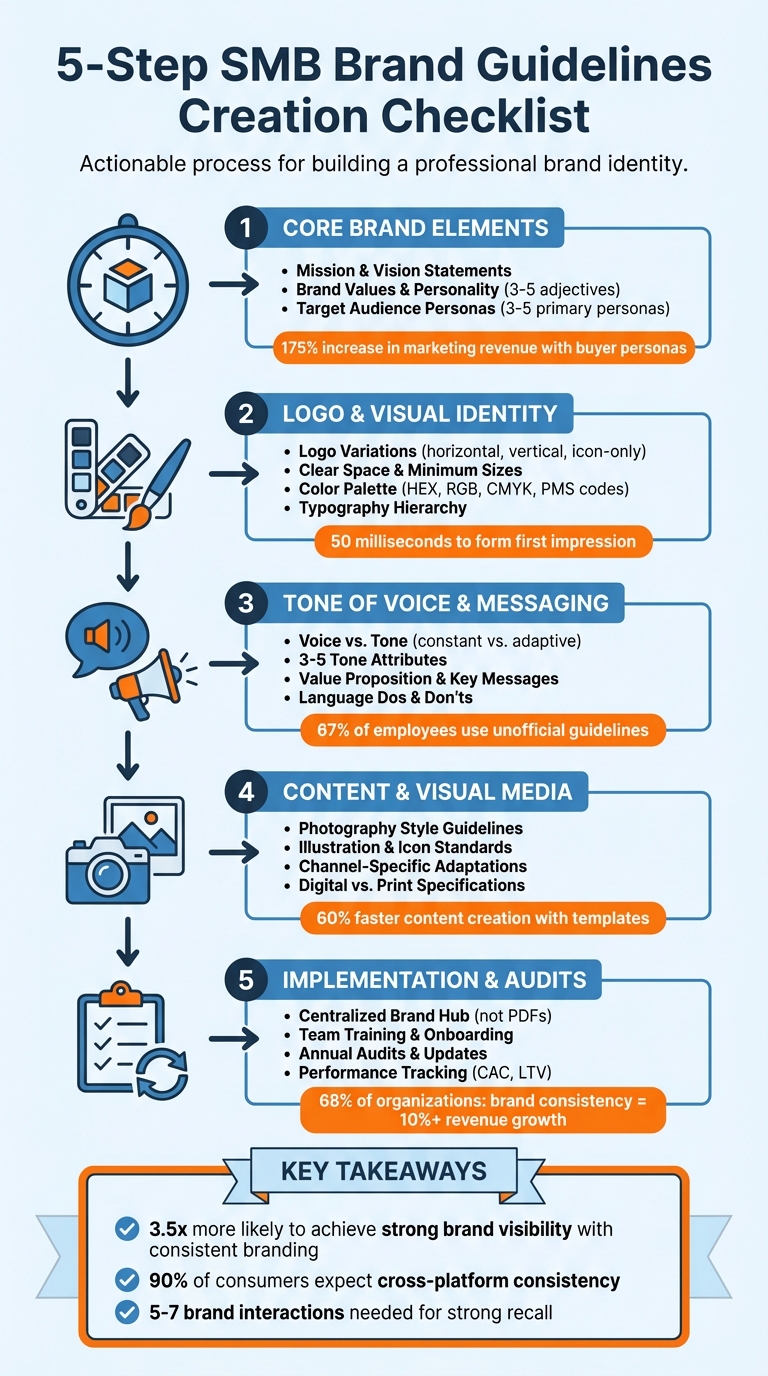
5-Step SMB Brand Guidelines Creation Checklist
How To Create a Brand Guideline (REAL Client Example)
sbb-itb-63525a7
1. Core Brand Elements
Before diving into visual guidelines, it’s crucial to establish the essence of your brand. These core elements are the foundation for every design choice, marketing strategy, and customer interaction. Without them, brand guidelines risk becoming a disjointed collection of visual rules without a clear direction.
Mission and Vision Statements
Your mission statement defines why your business exists today - it’s the problem you solve and the value you deliver. Meanwhile, your vision statement outlines where you’re headed, the long-term impact you aim to achieve. As Goalcast puts it, "Your vision should also serve as an outcome that you can test decisions and opportunities against".
Start with your mission. Clearly articulate your purpose and how your core values shape your goals. Highlight what sets you apart. Then, move to your vision by describing the ultimate success you’re striving for. Finalizing these statements beforehand ensures that your visual identity is built on a meaningful foundation.
"Your mission statement will be your brand's North Star. It will help teams and partners bring your brand to life in all facets of their work." - Danielle Templeton, Creative Manager, Acquia
Brand Values and Personality
Your brand values are the principles that guide how you operate - both within your team and in how you interact with customers. Similarly, your brand personality reflects the human traits that make your business distinct. Is your brand bold or reserved? Friendly or authoritative? Formal or relaxed?
To define these, reflect on the founder’s values and involve your team to identify guiding principles. Narrow these down to three adjectives that encapsulate your brand (e.g., "approachable", "fearless", or "trustworthy"). Then, clarify how these traits should influence your communication style. Try the personification method - imagine how your brand would speak to a close friend versus a client. This exercise ensures consistency across all interactions, from social media posts to customer emails, and builds trust over time.
Target Audience Personas
Personas are detailed profiles of your ideal customers. They go beyond basic demographics to include deeper insights like values, attitudes, goals, and frustrations. Research shows that using buyer personas can lead to a 175% increase in marketing revenue and reduce lead conversion time by 72%.
Build these personas using real data from tools like your CRM, website analytics, and feedback from sales and support teams. Conduct in-depth interviews with a select group of customers to uncover their motivations. Aim for 3–5 primary personas to maintain focus - too many can dilute your efforts. Give each persona a name, a face, and a specific "job to be done" (the outcome they’re seeking) to make them relatable. Review these personas quarterly and update them every 12–18 months to keep them relevant. These profiles will serve as a cornerstone for all future branding decisions, from messaging to design.
Once your core brand elements are firmly established, you can confidently move on to defining your visual identity.
2. Logo and Visual Identity Guidelines
Your visual identity reflects your brand's essence. It's not just about aesthetics - it's about creating a consistent, memorable impression. With people forming opinions in just 50 milliseconds, documenting clear visual guidelines becomes crucial. These guidelines ensure your brand's personality shines through every visual element.
Logo Specifications
Start by outlining all logo variations your brand needs. Typically, this includes at least three versions: a horizontal layout for headers, a vertical format for profile pictures, and an icon-only version for smaller spaces like app icons or favicons. A classic example is NASA's 1976 Graphics Standards Manual, which meticulously detailed logo usage.
Next, define the clear space around your logo. This buffer zone prevents visual clutter and ensures your logo remains prominent. Instead of fixed measurements, use a relative approach - like basing the space on the height of a specific letter in your logo (e.g., the "X" height). This method ensures adaptability across different formats.
Set minimum size requirements for both digital (e.g., 60px) and print (e.g., 0.75" or 20mm) formats to maintain legibility. Provide visual examples of what not to do, such as stretching, distorting, or altering colors. Netflix enforces this rigorously, allowing their white logo only as a video watermark to protect its integrity.
"More than identifying what the pieces are, brand guidelines' job is to show you how to use those things." - Ky Allport, Creative Director, Outline
Once your logo is defined, consistent colors will further reinforce your brand's identity.
Color Palette Rules
After finalizing your logo, create a color palette that works seamlessly across all platforms. Document the exact codes for each color in multiple formats: HEX and RGB for digital use, CMYK for print, and Pantone (PMS) for specialty applications like fabric or packaging.
| Format | Usage | Example Code |
|---|---|---|
| HEX | Websites, apps, social media | #1A73E8 |
| RGB | Digital screens, presentations | RGB(26, 115, 232) |
| CMYK | Brochures, business cards, posters | CMYK(89, 50, 0, 9) |
| PMS | Branded merchandise, packaging | Pantone 2935 C |
Define usage proportions to maintain harmony. A common rule is the 50-25-25 split: 50% primary color, 25% for each of two secondary colors. Be specific about when to use each color. For instance, use your primary blue for buttons and headlines, a neutral gray for body text, and a vibrant accent color sparingly for highlights. For digital designs, avoid pure black (#000000) and opt for dark grays to reduce eye strain.
A consistent color palette lays the groundwork for equally structured typography.
Typography Guidelines
Typography gives your brand its "visual voice." Define both primary fonts (for logos and key headings) and secondary fonts (for body text and detailed content). Some brands, like Burger King, even create custom fonts to reinforce their identity.
Establish a clear typographic hierarchy to guide your team. Specify font sizes, line heights, and letter spacing for headings, subheadings, and body text. For example: H1 headings at 32px with a 1.2 line height, H2 at 24px with a 1.3 line height, and body text at 16px with a 1.5 line height. Include alignment preferences - left-aligned for readability or centered for emphasis - and guidelines for when to use bold or italic styles.
To simplify implementation, provide font files or access links to licensed web fonts. Store these in a central location, such as an Adobe CC Library or a shared brand folder. Pre-create templates for common materials like social media posts, email signatures, and presentations, complete with pre-set typography styles. This level of preparation can streamline content creation, cutting time by up to 60% by eliminating guesswork.
3. Tone of Voice and Messaging Framework
Your visual identity might catch someone’s eye, but your tone of voice is what truly defines your brand. While your logo and colors create recognition, the way you communicate builds trust and fosters connection. Since customers often interact with your brand multiple times before making a purchase, maintaining a consistent voice across all channels is essential.
Tone of Voice Attributes
Let’s clarify the difference between voice and tone. Your voice is your brand’s personality - it’s constant and reflects who you are. Tone, however, adapts depending on the situation. Think of it this way: your brand should always sound like itself, but the tone adjusts to fit the context.
"Your voice is constant. Your brand should always sound like your brand, regardless of the channel or situation. Tone, on the other hand, is how your voice adapts to different situations." - Margaret Pilarski, Head of Strategy, Outline
Start by identifying 3–5 adjectives that encapsulate your brand’s personality. Skip overused terms like "professional" or "friendly" and aim for more descriptive, nuanced phrases. For instance, "Knowledgeable but not arrogant" or "Confident but humble" adds depth. To make this exercise more relatable, imagine your brand as a person. How would they talk to a coworker versus a customer? Would they use humor, or keep things serious? This exercise makes abstract ideas easier to grasp.
Next, create a tone matrix to show how your voice shifts across different channels. For example, your marketing tone might be "Confident and Inspiring", while customer support could lean toward "Empathetic and Helpful." Document these differences with examples to guide your team in adapting the tone effectively.
| Context | Tone | Example |
|---|---|---|
| Marketing | Confident, Inspiring | "Transform your workflow today." |
| Customer Support | Empathetic, Helpful | "We're sorry you're experiencing this; let's fix it." |
| Social Media | Conversational, Engaging | "Hot take: Your metrics might be lying to you." |
| Error Messages | Apologetic, Actionable | "Oops! Something went wrong. Try refreshing." |
A clear tone framework lays the groundwork for building your messaging strategy.
Key Messaging Pillars
Once your tone of voice is set, the next step is a messaging framework to ensure everyone tells the same story. This starts with three core elements:
- Value proposition: A one-sentence explanation of who you help, what you do, and the benefit you provide.
- Elevator pitch: A concise, 30-second summary of your brand.
- Positioning statement: An internal guide that defines your audience, their problem, your category, and your unique advantage.
From there, identify 3–5 key messages that align with your brand’s values and resonate with your audience. For example, if your audience is small business owners with limited time, a key message might be: "We automate tedious tasks so you can focus on growth." Always highlight the customer’s benefits rather than getting lost in technical details.
Since 67% of employees rely on creative guidelines that aren't part of their official brand standards, documenting these pillars is critical. Store your framework in a searchable, online format so it’s accessible to everyone on your team.
Language Dos and Don'ts
Your voice comes alive through the words you choose. Use "This vs. That" examples to illustrate on-brand versus off-brand language. For instance, if your tone is conversational, compare a statement like "We built this feature" with a detached alternative like "This feature was built."
Additionally, create a word list to maintain consistency. Define terms you embrace and those you avoid. Many brands steer clear of corporate buzzwords like "synergize" or "paradigm shift" and prefer straightforward alternatives, such as replacing "game-changing solution" with "saves 10 hours a week."
| Category | Language "Do" | Language "Don't" |
|---|---|---|
| Sentence Structure | Use active voice (e.g., "We built this") | Use passive voice (e.g., "This was built") |
| Clarity | Be specific (e.g., "40% faster") | Use vague claims (e.g., "industry-leading") |
| Vocabulary | Use conversational language and "you/we" | Use clichés like "game-changer" |
| Messaging | Lead with benefits and value | Bury the lead or use jargon |
Establish grammar and style rules to keep your writing polished. Decide on punctuation preferences (like the Oxford comma), capitalization rules, and whether you follow AP or Chicago style. Setting a target reading level - such as 8th grade for better accessibility - can also make your content more effective.
"Voice can make or break a brand since customers are more likely to shell out money for a company they know as reliable." - Anca Bradley, Brand Management Director, Fruition
Finally, appoint a Brand Steward, typically a marketing leader, to oversee these guidelines. This person ensures your brand voice stays consistent, approves exceptions, and reviews high-visibility materials. As your team grows, this role becomes increasingly important for maintaining authenticity.
4. Content and Visual Media Guidelines
Your brand’s visual content - whether it’s photography, icons, or other imagery - needs to align with your logo and color guidelines. Without a unified approach, your visuals can feel inconsistent, which makes it harder for customers to recognize and trust your brand.
Imagery and Photography Style
Define photography guidelines that reflect your brand’s personality. Decide on factors like lighting (natural vs. studio), color tones (warm vs. cool), and subject matter (candid vs. posed). For instance, an approachable brand might favor natural lighting with warm tones and authentic settings featuring real people. A more premium brand might lean toward studio lighting, minimalistic backgrounds, and carefully composed shots.
Organize your imagery into categories to address different needs, such as product photos, industry-related visuals, lifestyle imagery, or professional headshots. Each category should have technical specifications, like preferred angles, saturation levels, or composition rules. Mood boards can help clarify your vision by showcasing examples of what works - and what doesn’t. This makes it easier for designers and collaborators to stay on-brand.
"More than identifying what the pieces are, brand guidelines' job is to show you how to use those things." - Ky Allport, Creative Director, Outline
When working with stock imagery, set clear standards to avoid generic or off-brand visuals. Specify which stock libraries meet your criteria and provide examples of acceptable and unacceptable choices. Include visual examples to guide proper usage, cutting down on revisions and ensuring consistency.
Next, establish clear rules for illustrations and icons to further solidify your brand’s visual identity.
Illustration and Icon Standards
If your brand uses illustrations or icons, define their technical details - like line weight (thin vs. bold), corner styles (rounded vs. sharp), and whether the look is 2D or 3D. These small details create a cohesive look across all your materials. For example, if your icons use a 2-pixel line weight with rounded corners, that style should apply consistently across your website, presentations, and other assets.
Set usage guidelines for where and how often illustrations and icons should appear. Decide their ideal placement (e.g., headers, social media posts, or email signatures) and define “safety areas” to ensure icons have enough space around them to avoid clutter. Centralize all approved icons and illustrations in a digital asset management (DAM) system, so everyone has easy access to the correct files.
Finally, adapt these visual elements to suit the requirements of different platforms.
Content Adaptation Across Channels
Once your visual identity is established, tailor it for each platform’s technical and stylistic needs. Create channel-specific standards for color modes, like HEX and RGB for digital use (websites, social media) and CMYK or Pantone for print materials. Also, prepare logo variations for different contexts: primary logos for large spaces, secondary versions for smaller applications, and icon-only versions for things like app icons.
Design templates that align with each platform’s technical requirements while maintaining brand consistency. For example, Instagram might call for vibrant, high-energy visuals, while LinkedIn might require a more subdued and professional tone - but both should still clearly represent your brand. Templates can speed up content creation by 60%, freeing your team to focus on strategy rather than repetitive design work.
| Element | Digital Standards | Print Standards |
|---|---|---|
| Color Mode | HEX, RGB | CMYK, Pantone |
| Logo Format | SVG, PNG (transparent) | EPS, AI (vector) |
| Imagery Resolution | 72-150 DPI | 300+ DPI |
| Typography | Web-safe fonts, specific line heights | High-resolution print fonts |
Move away from static PDF guidelines and adopt a living digital platform like Frontify or Brandfolder. These tools allow for instant updates and centralized access to brand assets. This ensures everyone - whether internal teams or freelancers - works from the same set of standards. Conduct monthly audits to catch and fix any off-brand materials before they reach your audience. Without clear guidelines, brand confusion can increase customer acquisition costs by up to 40%.
5. Implementation and Audit Process
Once you've nailed down your brand's core elements and visual identity, the next step is ensuring consistency through an effective implementation and audit process. Even the best brand guidelines won't deliver results if your team can't access or understand how to use them. Here's a staggering fact: 68% of organizations report that brand consistency has contributed at least 10% to their revenue growth. But that only happens when guidelines are actively used, not left to gather dust in a forgotten PDF.
Team Accessibility and Training
Static PDFs? It's time to leave those behind. Instead, create a centralized brand hub using tools like Frontify, Notion, or your company's intranet. This ensures everyone has real-time access to the latest assets, from logos to color codes. A single source of truth makes it easy to avoid accidental use of outdated materials. Plus, providing ready-made templates for presentations, graphics, and email signatures helps teams stay on-brand without extra effort.
Training is just as important as accessibility. Go beyond a boring list of "do's and don'ts." Organize interactive training sessions that explain the why behind your guidelines. For instance, break down how specific colors were chosen to evoke emotions or how your tone of voice reflects your values. Workshops can be a great way to practice - review old materials against new standards or apply the brand voice to mock campaigns. Include brand training in your onboarding process for every new hire, and appoint a "brand champion" to answer questions and keep the team aligned.
"Think of your brand guide as your company's constitution. It isn't there to restrict creativity. It's about providing a framework where creativity can thrive in a way that's focused and effective." - ShortGenius
The work doesn't stop after training. Regular reviews and updates ensure the guidelines stay relevant and actionable.
Regular Audits and Updates
Brand guidelines aren't a "set it and forget it" deal. Schedule a full review at least once a year to make sure they align with your evolving business goals. Major milestones - like a rebrand, new product launch, or market expansion - are also great opportunities for an audit. During these reviews, check all brand assets, such as logos, images, and color codes, to remove anything outdated or off-brand. Scan through social media posts, email campaigns, and sales decks to catch any inconsistencies.
Feedback from your team is gold. Designers, marketers, and content creators are on the front lines, so set up a dedicated channel (like a Slack workspace or shared form) where they can flag confusing sections or suggest improvements. Why is this important? 67% of employees admit to using creative guidelines that aren't officially part of their company's documents. A clear, accessible feedback loop can help close this gap.
Performance Tracking and Metrics
Audits are great, but how do you know if your efforts are paying off? Start by tracking how your brand guidelines impact key business metrics. Tools like Digital Asset Management (DAM) systems or brand portals can show which assets and templates are being used. If adoption rates are low, it might mean your guidelines are overly complex or need more training support.
Keep an eye on metrics like customer acquisition cost (CAC), conversion rates, and customer lifetime value (LTV). Remember, it usually takes 5 to 7 interactions with your brand for customers to develop strong recall. Schedule quarterly reviews to compare these numbers against your baseline and refine your guidelines based on what’s working.
Using BrandMultiplier.ai for SMB Branding
For small and medium-sized businesses (SMBs), creating brand guidelines can feel daunting, especially with limited resources and tight deadlines. That’s where BrandMultiplier.ai steps in, offering a structured solution that ties your brand strategy directly to the metrics that matter most - like customer acquisition cost (CAC), lifetime value (LTV), and sales velocity.
The process kicks off with a Rumble discovery workshop, designed to help you define your brand’s core purpose, mission, and vision - your “why.” These workshops also focus on identifying your target audience personas, ensuring your brand guidelines address the specific needs and behaviors of your ideal customers. Additionally, you’ll conduct a brand audit to pinpoint inconsistencies across platforms such as social media, websites, and print materials. This audit lays the groundwork for creating guidelines that correct those gaps.
After the workshop, you’ll receive a customized brand playbook that serves as your strategic foundation. It includes detailed visual identity standards, such as logo specifications, color palettes (complete with HEX, RGB, and CMYK codes), and typography hierarchy. Beyond visuals, the playbook also covers verbal identity elements like tone of voice and key messaging pillars, ensuring your team communicates consistently across every channel.
What makes this approach stand out is its emphasis on measurable results. Inconsistent branding can lead to lower conversion rates and poor brand recall, which in turn increases CAC. On the flip side, consistent branding eliminates the need for costly rework and fixes to off-brand materials. A cohesive brand experience fosters emotional connections with customers, potentially boosting LTV. By aligning branding efforts with these tangible outcomes, businesses can directly link brand consistency to improved performance.
The top-tier offering from BrandMultiplier.ai, Narrative OS, takes things even further. Using a neuroscientific framework, it helps codify your most impactful strategic story and deploys it across leadership, sales, product, and marketing via custom AI. This system tracks how your brand story affects CAC, deal speed, and LTV, while continuously refining your strategy each quarter. The result? Your brand guidelines become a dynamic, evolving framework that grows alongside your business.
Conclusion
Creating brand guidelines doesn’t have to be overwhelming. The key is to view them as a dynamic framework that grows with your business. As Shopify Staff aptly states, "Brand-building is not a one-time exercise". Conducting regular audits - ideally once a year - helps ensure your guidelines stay relevant and aligned with your evolving market position.
When applied consistently, these living guidelines can deliver measurable business benefits. For example, companies with consistent branding are 3.5 times more likely to achieve strong brand visibility. Additionally, 90% of consumers expect brands to maintain consistency across all platforms they interact with. Considering it often takes 6-8 interactions before a consumer even considers a purchase, those consistent touchpoints play a crucial role in building trust.
The best guidelines combine visual and verbal identity into a single, user-friendly system. This includes documenting everything from color codes (like HEX values) to tone of voice, and ensuring every team member - not just the marketing team - can access and implement these standards effectively.
For small and medium-sized businesses (SMBs), platforms like BrandMultiplier.ai offer a practical solution. Their structured Rumble workshops and AI-driven tools can shrink a 6–12-week process into just a few hours. Beyond speed, these tools allow businesses to tie brand guidelines directly to key metrics like customer acquisition cost (CAC), conversion rates, and lifetime value (LTV). By continuously refining guidelines based on performance data, SMBs can achieve both operational efficiency and measurable growth. Incorporating tools like these into your brand strategy can make all the difference.
FAQs
What’s the minimum a brand guide needs to be useful?
A brand guide serves as the blueprint for maintaining consistency across all platforms and materials. At its core, it should outline four essential components: the logo, the color palette, the typography, and the tone of voice. Together, these elements create a unified framework that ensures every piece of communication stays true to the brand's identity.
How can we ensure freelancers and agencies stay on-brand quickly?
Creating effective brand guidelines starts with covering the essentials: logos, colors, fonts, tone of voice, and messaging. These elements form the backbone of your brand identity, ensuring consistency across all platforms and materials.
To keep things organized and easy to access, use a centralized digital platform. This allows you to share and update your guidelines in real time, ensuring every collaborator - whether they're internal team members, freelancers, or agencies - has the most current standards at their fingertips.
Why is this important? It minimizes inconsistencies and makes content creation smoother. When everyone follows the same playbook, there’s less room for errors, fewer corrections, and reduced back-and-forth communication.
Make sure your guidelines include clear instructions and are updated regularly to reflect any changes in your brand’s direction. This helps external partners produce content that’s not just aligned with your brand but also delivered efficiently.
Which KPIs prove brand guidelines are working (CAC, LTV, conversion)?
Key performance indicators (KPIs) can reveal how effectively your brand guidelines are working. For instance, customer trust and recognition are vital metrics. These can be assessed through the consistency of your brand's visual identity, messaging, and tone. When these elements align seamlessly, they help establish a cohesive and trustworthy image.
Other important KPIs include customer engagement and loyalty. Metrics like brand awareness, customer satisfaction, and repeat business offer insights into how well your brand connects with its audience. Together, these indicators show whether your brand is resonating with people and driving measurable growth.
Ready to transform your brand story?
Schedule a free diagnostic to see how we can help.
Schedule The Diagnostic