

The Complete Guide to Omnichannel Marketing for SMBs
The Complete Guide to Omnichannel Marketing for SMBs
Omnichannel marketing ensures your customers experience a consistent and connected journey across all platforms - whether they’re browsing your website, interacting on social media, or visiting your store. For small and medium-sized businesses (SMBs), this approach is no longer optional. Here’s why it matters and how to get started:
-
Why Omnichannel?
Customers now use an average of 8 channels and perform 6+ actions before purchasing. Businesses with strong omnichannel strategies see an 89% retention rate, compared to just 33% for those without. Plus, shoppers engaging across 4+ channels spend 9% more on average. -
Key Steps to Build Your Strategy:
- Map the Customer Journey: Identify touchpoints and remove friction.
- Centralize Customer Data: Use tools like CRMs to unify profiles.
- Segment and Personalize: Tailor messages based on customer behavior.
- Choose the Right Channels: Focus on where your audience interacts most.
- Maintain Consistency: Align branding and messaging across platforms.
-
Tools to Use:
Platforms like HubSpot, Salesforce, and AI-powered solutions can help centralize data, automate workflows, and personalize interactions. -
Measure Success:
Track metrics like Customer Acquisition Cost (CAC), Lifetime Value (LTV), and retention rates. Multi-touch attribution offers a clearer picture of what drives conversions.
Omnichannel marketing isn’t just for large corporations. SMBs can use their agility to create personalized, connected experiences that build loyalty and drive growth.
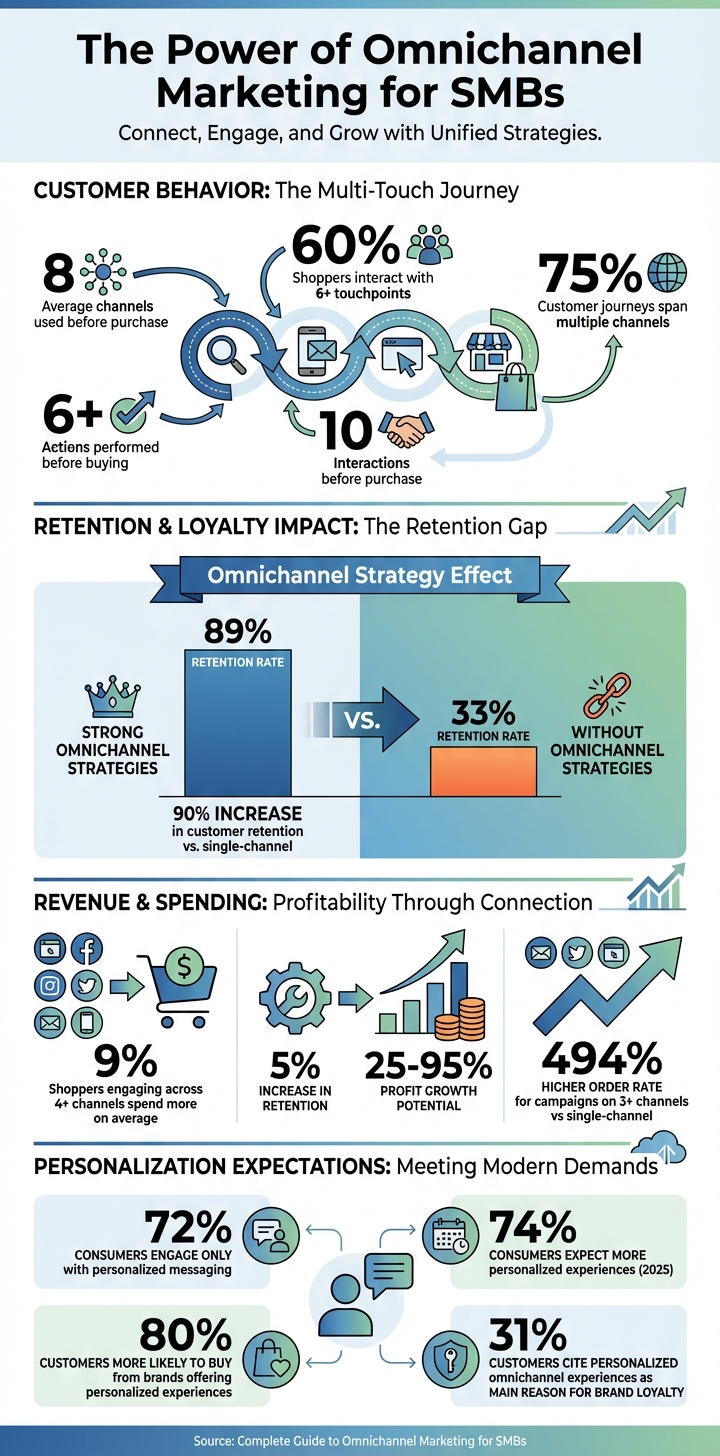
Omnichannel Marketing Statistics and ROI Impact for SMBs
How to Create the Perfect Omnichannel Marketing Strategy
sbb-itb-63525a7
How to Build an Omnichannel Marketing Strategy
Creating an effective omnichannel strategy starts with a customer-first approach. Here's how to lay the groundwork.
Step 1: Map the Customer Journey
Identify every touchpoint where customers interact with your brand - whether it’s on social media, through email, on your website, in-store, or during support calls. Research shows that customers interact up to 10 times before making a purchase, with 75% of those journeys spanning multiple channels.
To understand how customers move through their journey, analyze their behavior. Find out where they typically start, which devices they use for browsing versus purchasing, and where they drop off. Tools like Google Analytics can track website activity, while social media monitoring platforms provide insights into engagement. Surveys can also reveal obstacles customers face along the way.
Breaking the journey into stages - Acquisition, Conversion, Growth, Retention, and Win-back - helps pinpoint friction points. For instance, you might uncover issues like online promotions not being honored in-store or customers having to repeatedly provide their information across different channels.
"Omnichannel considers your business through the eyes of your customers, orchestrating the customer experience across all channels so that it's seamless, integrated and consistent." – BDC
A practical method to guide your strategy is the "Reverse ROI Funnel." Start by setting a revenue goal, calculate how many customers you need based on your average sale price, and then identify which traffic sources - like SEO, paid ads, or email - can help you reach that target.
Step 2: Centralize Customer Data
Bring all customer data together into a single profile to ensure seamless experiences. Without this, customers may need to repeat themselves every time they switch platforms or channels.
Using tools like a Customer Data Platform (CDP) or an integrated CRM system (e.g., HubSpot, Salesforce, or Pipedrive) can centralize your data. This approach has been shown to improve customer retention rates from 33% to 89%. Additionally, 80% of customers are more likely to do business with brands that provide personalized experiences. AI-powered tools can further simplify this process by reconciling duplicate or conflicting data into one unified profile. As third-party cookies phase out, prioritizing first-party data collected directly from your own channels becomes even more critical.
For smaller teams, start with basic steps like consolidating email, social media, and SMS communications into a unified inbox. Establish clear tagging and data entry guidelines to keep your records accurate and actionable.
Step 3: Segment Audiences and Personalize Messaging
With centralized data, you can segment your audience and deliver tailored messaging that resonates.
Divide your audience based on factors like purchase history, browsing habits, location, or their stage in the customer journey. For example, McConnell's Fine Ice Cream connected its ecommerce platform, POS software, and CRM (Klaviyo) to target customers by zip code for local delivery. This strategy led to an 8x year-over-year increase in revenue from automated email and SMS campaigns.
Personalization matters. Research shows that 72% of consumers engage only with personalized messaging, and nearly half believe tailored offers and recommendations improve their brand experience. AI tools like BrandMultiplier.ai’s Narrative OS can analyze your data to create individualized emails, dynamic website content, and ad variations in real time. Shifting from broad demographic segments to intent-based personalization can drive a 10–15% boost in retention and revenue.
Step 4: Choose the Right Channels
Focus on the channels that resonate most with your audience and deliver the best results.
Examine your data to identify which channels offer the highest engagement or lowest acquisition costs. On average, customers interact with a brand through six different channels during their purchase journey, while B2B buyers typically use around ten. Each channel serves a unique purpose - social media can drive awareness, email fosters retention, and your website is key for conversions. If you have a physical presence, offering services like Buy Online, Pick Up In-Store (BOPIS) can link digital and in-person experiences.
For instance, Toby’s Sports, a leading retailer in the Philippines, unified its online and offline operations by moving to Shopify Plus. This shift resulted in a 13.5x increase in sales, a 101% improvement in profitability, and a 50% boost in conversion rates. Demographics also play a role; Gen Z may gravitate toward platforms like TikTok, while older generations might prefer email or live chat. Testing small campaigns across various channels can help you determine what works best, as running campaigns on three or more channels often leads to higher purchase rates.
Step 5: Maintain Consistent Branding Across Channels
Consistency across all channels builds trust and reinforces your brand identity. This includes aligning your visual elements (logos, colors, and fonts), messaging (tone and key phrases), and storytelling across every touchpoint.
Tools like BrandMultiplier.ai’s brand playbooks can help document your brand guidelines, ensuring everyone - from social media managers to customer service teams - delivers a cohesive experience. Jenni Kayne, for example, used Shopify POS to unify inventory between its physical and online stores. By enabling "endless aisle" shopping, where customers can order out-of-stock items for home delivery, the brand doubled its physical store presence while maintaining a seamless experience. As Sam Mella, Director of Home Experience at Jenni Kayne, explained:
"We can sell everything from clothing to dinner tables all in one system. Everything just feels easy for our clients and our team."
Consistency also applies to promotions and customer data. If you run a promotion, ensure it’s honored across all channels. When customers update their preferences online, those changes should immediately reflect in your email system and in-store records. Even small touches, like syncing shopping carts across devices, can make a big difference in how customers perceive your brand.
Next, we’ll dive into the tools and platforms that can power your omnichannel strategy.
Tools and Platforms for Omnichannel Marketing
To succeed in omnichannel marketing, SMBs need tools that bring everything together - data, workflows, and branding - into one cohesive system. These tools ensure that every customer interaction feels seamless and consistent. Let’s dive into some key solutions.
BrandMultiplier.ai Plans and Features
BrandMultiplier.ai offers tailored plans to help SMBs scale their omnichannel efforts without breaking the bank. Each plan kicks off with a 3-hour "Rumble Session", a discovery workshop rooted in Design Thinking. This session replaces the traditional, weeks-long agency process, delivering a detailed brand data set. From there, BrandMultiplier.ai builds what they call Narrative OS, a growth system that aligns your brand's story with AI-driven tools to improve metrics like CAC, deal speed, and LTV in real time.
Here’s a breakdown of their plans:
- Brand Builder Plan ($4,995/month): Ideal for businesses looking to solidify their brand strategy, this plan includes a basic brand playbook, a creative content strategy, a content calendar, and two major content pieces per month. It’s perfect for those just beginning to unify their messaging across multiple channels.
- GTM Rocket Fuel Plan ($9,995/month): Designed for businesses ready to launch or relaunch with a strong go-to-market strategy. This plan includes customer journey mapping, audience personas, and a part-time creative director to oversee your 60-day rollout. It’s a great fit for funded startups or SMBs entering new markets.
- Growth Engine Plan ($14,995/month): This is a full-service option for businesses looking for comprehensive omnichannel execution. It includes unlimited content requests, a dedicated creative director, bi-monthly strategy refreshes, and everything from SEO strategies to email campaigns, social media content, and website copy. With this plan, BrandMultiplier.ai helped Relationships ReWired achieve a 78% sales increase and 91% subscription growth in just 90 days.
| Feature | Brand Builder ($4,995/mo) | GTM Rocket Fuel ($9,995/mo) | Growth Engine ($14,995/mo) |
|---|---|---|---|
| Discovery | 3-hour Rumble Session | 3-hour Rumble Session | 3-hour Rumble Session |
| Strategy Focus | Foundational Brand Playbook | GTM-Specific Narrative | Robust Omnichannel Strategy |
| Content | 2 Major Pieces/mo | Strategic Conceptual Creative | Unlimited Content Requests |
| Leadership | Strategic Oversight | Part-time Creative Director | Dedicated Creative Director |
| Mapping | Basic Audience Targeting | Customer Journey Map & Personas | Bi-monthly Strategy Refresh |
All plans come with BrandMultiplier.ai’s Impact Promise, which guarantees measurable improvements against agreed-upon KPIs within 60 days - or they’ll add an extra month of service at no cost. By integrating AI-based tools, these plans can boost productivity by up to 40% and cut costs by as much as 50% for SMBs.
Once your strategy is in place, the next step is integrating CRM and automation tools to maximize omnichannel effectiveness.
Integrating CRM and Automation Tools
Having the right plan is one thing, but integrating CRM and automation tools takes your omnichannel strategy to the next level. Without proper integration, personalization becomes challenging, and fragmented tools can disrupt the customer experience. This is a big deal - 74% of consumers now expect more personalized interactions, yet 60% of marketing teams juggle between 6–15 tools.
Start by syncing your CRM (like HubSpot, Salesforce, or Pipedrive) with your marketing automation platform. This allows you to use real-time behavioral data and triggers - such as abandoned carts or product views - to create personalized journeys across email, SMS, and push notifications. For example, automated emails can drive up to 41% of orders. Apparel brand Marine Layer used this approach by integrating data from ecommerce, retail, email, and SMS into one platform. This enabled them to create tailored welcome flows: in-store sign-ups received emails highlighting online offerings and free shipping, while online shoppers were encouraged to visit retail locations.
Another success story is Coffee Beanery, which adopted hybrid cross-channel flows to manage shipping alerts and replenishment reminders. By staggering emails and texts for dual subscribers, they achieved 12% year-over-year growth in flow revenue within just one quarter.
If your platforms don’t have built-in connections, tools like Zapier or Make can bridge the gap by syncing data between your CRM and marketing tools. To avoid overwhelming your audience, implement "Smart Sending" logic, which limits the number of messages a subscriber receives within a set time frame. Additionally, cross-channel suppression can automatically pause marketing promotions for customers with unresolved support tickets, ensuring a smoother experience.
"Omnichannel is the real holy grail of marketing automation. There is a level of personalization that can only be achieved by omnichannel marketing. When you provide this relevancy, customers respond better to it, they purchase more, and they come back more often." – Rytis Lauris, CEO and co-founder, Omnisend
For example, Ministry of Supply implemented a unified customer hub in 2024, integrating order history and tracking. This led to over 650 self-serve interactions in just four months, significantly reducing the workload for their support team. Marketers who use three or more channels in a single campaign see a 494% higher order rate compared to single-channel campaigns, proving that integrated tools drive both efficiency and engagement for SMBs.
Measuring Your Omnichannel Strategy Performance
Once your omnichannel strategy is in motion, the next step is figuring out if it’s actually working. Without clear metrics, you’re left guessing. The good news? You don’t need a huge analytics team to track success. With the right KPIs and tools, you can measure performance effectively.
Key Metrics to Monitor
Start with metrics that directly impact your revenue. Customer Acquisition Cost (CAC) tells you how much you’re spending to gain each new customer. To get the full picture, compare this to Customer Lifetime Value (LTV). If your CAC is $50 but your LTV is only $40, you’re losing money on every customer you acquire.
Another essential metric is Return on Ad Spend (ROAS), which shows how much revenue you generate for every dollar spent on advertising. However, standard ROAS doesn’t account for the cost of goods sold (COGS). That’s where Gross Margin ROAS comes in - it factors in product costs, giving you a clearer view of profitability. For example, a campaign with a 5:1 ROAS might still lose money if you’re selling low-margin products.
Engagement metrics like Click-Through Rate (CTR) and session duration reveal how well your messaging connects with your audience. If your email CTR is 2% but your social media CTR is 8%, it might be time to shift more budget toward social platforms. Average Order Value (AOV), on the other hand, shows whether your cross-sell and upsell strategies are working, while Win Rate (deals won divided by total deals closed) measures how effectively your sales team converts leads.
Retention metrics are where omnichannel strategies often shine. For instance, customer retention rates increase by 90% when using omnichannel approaches compared to single-channel efforts. Keep an eye on your Churn Rate and Renewal Rate to gauge long-term customer loyalty. Even a 5% boost in retention can increase profits by 25% to 95%. For B2B businesses, Pipeline Velocity - calculated as (Opportunities × Win Rate × Average Deal Size) ÷ Sales Cycle Length - helps you see how quickly deals move through your pipeline.
Avoid relying solely on "last-click" attribution models, which only credit the final touchpoint before a purchase. They miss the bigger picture, like the 60% of shoppers who interact with at least six touchpoints before making a decision. Instead, use multi-touch attribution to spread credit across all interactions, giving you a better understanding of which channels truly drive conversions.
| Metric | Formula / Definition | Why It Matters for SMBs |
|---|---|---|
| CAC | Total Marketing & Sales Spend / New Customers | Tracks efficiency of acquisition spending |
| LTV | Avg. Revenue per Customer / Churn Rate | Helps justify acquisition costs |
| ROAS | Revenue Attributed to Campaign / Ad Spend | Measures campaign profitability |
| Win Rate | (Deals Won / Total Closed Deals) × 100% | Shows sales team effectiveness |
| Pipeline Velocity | (Opptys × Win Rate × Deal Size) / Cycle Length | Tracks how fast deals close |
| AOV | Total Revenue / Number of Orders | Evaluates upsell and cross-sell success |
With these metrics in hand, you can use real-time dashboards to align your performance with your strategy.
Using Dashboards for Real-Time Insights
Manually pulling data from platforms like Shopify, Google Ads, and email campaigns can eat up valuable time. That’s where real-time dashboards come in - they pull all your data into one place. This unified view is crucial, especially since only 34% of marketers consistently track ROI, and nearly 70% say measuring campaign ROI is a challenge.
Dashboards offer the advantage of daily optimization. Businesses that check their metrics daily see 20–30% better ROAS compared to those that only check weekly. For example, if your Facebook ads are underperforming while Google Ads are exceeding expectations, you can reallocate your budget within hours instead of wasting resources.
What makes dashboards powerful is their ability to link spending to revenue. Instead of just tracking impressions or clicks, you can see how ad spend translates into sales, AOV, and gross margins. This closed-loop attribution removes the guesswork from your customer journey.
"These insights transform marketing from a cost center to a revenue driver with quantifiable returns by helping marketers target the right segments and allocate budget where it drives genuine growth".
Dashboards can also be tailored for different roles. Executives can focus on overall profitability and growth, while marketers dive into campaign-level details. This prevents information overload and ensures everyone is working from the same real-time data.
Set up automated reports to keep tabs on key metrics. For example, check abandoned cart rates daily, review revenue by channel monthly, and analyze LTV quarterly. Use cohort analysis to track new customers over 90 days and see which acquisition channels - like Instagram or TikTok - bring in loyal customers, not just one-time buyers.
| Dashboard Type | Key Metrics Tracked | Business Value |
|---|---|---|
| Sales Performance | Sales, AOV, Profit Margin, New vs. Repeat | Identifies revenue drivers |
| Customer Segmentation | Recency, Frequency, Monetary (RFM) | Highlights loyal vs. at-risk customers |
| Product Performance | SKU-level sales, Inventory, Margins | Prevents overspending on low-margin items |
| Subscription | Churn Rate, Recurring Revenue, LTV:CAC | Tracks growth for subscription models |
Common Challenges in Omnichannel Marketing
Even with the right metrics in place, small and medium-sized businesses (SMBs) often encounter hurdles when implementing omnichannel strategies. Issues like fragmented data, platform integration difficulties, and finding the right balance between personalization and privacy are common. Here's how to tackle these challenges head-on.
Breaking Down Data Silos
Customer data often lives in separate systems: your CRM holds contact details, your POS tracks in-store purchases, your eCommerce platform manages online orders, and your social media tools operate independently. When these systems don’t connect, customers can experience mismatched inventory information or repetitive messaging, leading to frustration and lost sales. In fact, 80% of consumers expect brands to deliver consistent experiences across all channels.
The key is creating a single source of truth - a centralized system where all departments access the same real-time data. Take Petco, for instance. By adopting SAP Emarsys in February 2025, they unified customer data and automated engagement, resulting in a 15% increase in won-back customers. Similarly, BrandAlley leveraged AI-driven analytics to shift from reactive to proactive marketing, reclaiming 24% of defecting customers within just 90 days.
Look for platforms with ready-to-use connectors that link your CRM, POS, and eCommerce tools without requiring custom coding. AI-powered ETL tools can automate data cleaning and mapping, reducing errors often caused by manual processes. For example, Office Depot integrated its supply chain data to ensure consistent product availability across channels, cutting inventory levels by 30% between 2023 and 2025.
| System Type | Common Data Stored | Impact of Siloing |
|---|---|---|
| CRM | Customer contact info, interaction history | Fragmented customer view; repeated questions |
| POS | In-store sales, local inventory | Online stores may show items as "in stock" when unavailable locally |
| WMS/ERP | Warehouse stock, supply chain logistics | Difficulty offering "Buy Online, Pick Up In Store" |
| E-commerce | Web browsing, cart data, online sales | Generic marketing instead of personalized cart reminders |
| Loyalty DB | Points, rewards, purchase frequency | Inconsistent rewards usage across channels |
The next step is ensuring these platforms work together seamlessly to deliver a unified customer experience.
Integrating Multiple Platforms
With 60% of marketing teams using between 6 and 15 tools in their tech stack, integration is often a challenge. Adding more tools can complicate workflows and the customer experience. Start by focusing on your most critical channels - like email, social media, and your website - and integrate those first. Once those systems are running smoothly, expand to other touchpoints.
Choose platforms that offer API-driven connectivity and cloud-based data sharing for real-time synchronization. These features are essential for ensuring the cohesive customer experience described earlier. Modern tools designed with marketers in mind reduce reliance on IT, allowing smaller teams to handle complex processes independently. Streamlining these integrations benefits both your team and your customers.
To bridge online and offline experiences, simple solutions like in-store QR codes can help convert foot traffic into digital subscribers. Features like "Smart Sending" logic can automate inventory updates and manage message timing. For example, you might send an email first, followed by a text if the email goes unopened. This staggered approach prevents overwhelming your audience.
Once integration challenges are addressed, it’s time to turn your attention to balancing personalization with privacy.
Balancing Privacy and Personalization
In 2025, 74% of consumers expect more personalized experiences, but they also demand that their privacy be respected. Striking this balance is essential for building trust and driving conversions.
Be upfront about how you use first-party data collected through sign-ups, purchases, and interactions. Centralized data not only allows for better personalization but also supports privacy controls, which are increasingly important in today’s market.
Empower customers by giving them control over their communication preferences. Instead of forcing an "all or nothing" approach, let them choose their preferred channels - whether email, SMS, or WhatsApp - and how often they want to hear from you. A preference center where customers can update their interests and frequency of communication further enhances their experience. Notably, 31% of customers say personalized omnichannel experiences are the main reason they stay loyal to a brand.
Use contextual suppression to avoid sending promotional messages when a customer has an open support ticket. Tools like "Smart Sending" can also limit how many messages a subscriber receives in a given timeframe, reducing fatigue and the risk of unsubscribes.
You can even encourage customers to share data by offering incentives, like discounts or exclusive content, for completing a preference survey. Just keep this in mind:
"More data means more responsibility" - Salesforce
Finally, ensure your tech stack can instantly process opt-out signals across all connected platforms to avoid potential privacy violations.
Conclusion
Omnichannel marketing has become a must-have strategy for small and medium-sized businesses aiming to grow and thrive. Companies with strong omnichannel engagement boast an 89% customer retention rate, compared to just 33% for those with weaker efforts. And here’s the kicker: even a modest 5% increase in retention can lead to profit growth of 25% to 95%. The numbers make it clear - this approach isn’t just a trend; it’s a game-changer.
The best part? You don’t need a massive budget or enterprise-level tools to get started. Begin by mapping out your customer journey and consolidating your data with a CRM or Customer Data Platform. From there, focus on connecting your 2–3 most active channels - whether that’s email, social media, or your website - before scaling up. As David Rusenko, Head of eCommerce at Square, puts it:
"Expectations for what was considered omnichannel three years ago was 'buy online, pick up in store'... That's just table stakes now".
Moving from a multichannel to an omnichannel approach means putting the customer first. Break down data silos, maintain consistent branding across all touchpoints, and leverage AI tools to create personalized experiences at scale. This shift is vital, especially since 74% of consumers expect more personalized experiences by 2025, and 31% of customers say personalized omnichannel experiences keep them loyal to brands.
Start small. Track key metrics like Customer Acquisition Cost (CAC), Lifetime Value (LTV), and cross-channel attribution. Use real performance data to refine your approach over time. The tools and strategies outlined here give you a roadmap to create a seamless, engaging customer experience that not only drives loyalty but also reduces costs and boosts engagement.
Your customers are already shopping across multiple channels. The question is: can you deliver the unified experience that turns occasional buyers into lifelong brand advocates?
FAQs
How can small and medium-sized businesses (SMBs) centralize customer data for a successful omnichannel marketing strategy?
To bring customer data together, small and medium-sized businesses (SMBs) should consider adopting a cloud-based platform like a Customer Data Platform (CDP) or an integrated CRM. These tools pull information from various customer interactions - whether it’s through websites, emails, social media, in-store purchases, or chat sessions - and assign a universal customer ID to create a single, comprehensive profile for each customer.
The next step is to organize and standardize the incoming data. Leverage tools with native integrations or APIs to gather details like purchase history, browsing patterns, and engagement stats. Regularly tidy up the data by removing duplicates, aligning fields, and ensuring compliance with consent regulations. Automation tools can simplify this process, keeping the data organized and reducing the need for manual input.
Finally, put the data to work by linking it to tools for segmentation and personalization. Build dynamic customer groups - like frequent shoppers or those who abandoned their carts - that update in real time. Use these groups across different channels such as email, SMS, or loyalty programs to deliver consistent messaging. This approach helps cut customer acquisition costs (CAC) and boosts customer lifetime value (LTV).
How can I ensure consistent branding across all marketing channels?
To keep your branding consistent, start by organizing all your brand assets - think logos, color schemes, fonts, and messaging - into a shared digital library. Make sure your entire team has easy access to this resource. On top of that, use a centralized customer data platform to guarantee that all channels - email, social media, in-store displays - are working with the most up-to-date and accurate brand materials.
From there, focus on creating a unified look and feel across every platform. Stick to the same colors, logo placements, and tone of voice for everything: ads, website copy, social media posts, and even in-store signage. Sync up your campaigns so promotions roll out across all channels at the same time, and conduct regular reviews to catch any inconsistencies. Automation tools can be a lifesaver here, helping ensure brand guidelines are followed before anything goes live.
Lastly, keep an eye on metrics like how well your message sticks with customers and how they perceive your brand’s consistency. Use these insights to fine-tune your strategy, making sure each new campaign builds on your established identity rather than reinventing the wheel.
How can small and medium-sized businesses (SMBs) evaluate the success of their omnichannel marketing efforts?
To evaluate how well an omnichannel marketing strategy is performing, SMBs should begin by setting specific, business-oriented objectives. These could include goals like increasing revenue, lowering customer acquisition costs (CAC), improving retention rates, or enhancing customer lifetime value (LTV). A unified dashboard is essential for tracking key metrics across all channels - whether it’s email, social media, paid ads, SMS, or in-store interactions. Attribution models, such as first-touch or data-driven approaches, can also help pinpoint how each touchpoint contributes to conversions.
Key metrics like ROI can be calculated using the formula (Revenue - Marketing Spend) ÷ Marketing Spend. Similarly, CAC can be determined with Total Spend ÷ New Customers, while LTV is calculated as Average Order Value × Purchase Frequency × Gross Margin. Beyond these, it’s also important to monitor metrics like retention rates, click-through rates, and conversion rates to assess customer engagement and overall experience.
AI-powered tools can simplify this process by consolidating data, spotting trends, and providing real-time updates on critical metrics. For optimal results, SMBs should review these insights regularly - weekly for digital campaigns and monthly for offline efforts. This routine analysis helps fine-tune strategies, allocate budgets more effectively, and showcase measurable progress.
Ready to transform your brand story?
Schedule a free diagnostic to see how we can help.
Schedule The Diagnostic