
Creating a Marketing Strategy That Drives Results
Creating a Marketing Strategy That Drives Results
A results-driven marketing strategy connects every effort to measurable outcomes like revenue growth, lower customer acquisition costs (CAC), and faster deal closures. For small and medium-sized businesses (SMBs), focusing on metrics like CAC, Lifetime Value (LTV), and deal speed can transform marketing investments into profits.
Here’s a quick overview of what works:
- Track Key Metrics: Focus on CAC, LTV:CAC ratio (aim for 3:1), and sales cycle length (under 30 days).
- Use AI Tools: AI helps segment audiences, personalize content, and optimize campaigns in real time, reducing costs and boosting conversions.
- Craft a Unified Brand Narrative: Tools like Narrative OS ensure consistent messaging across all channels, building trust and improving conversions.
- Leverage High-Impact Channels: Identify where your audience is most active and optimize content for those platforms.
- Optimize Continuously: Use AI to measure performance and refine strategies quarterly.
Businesses using AI-driven strategies report 5-8x higher sales growth, 19x greater ROI, and reduced acquisition costs by up to 50%. Start by setting clear goals, tracking metrics, and using AI to make smarter decisions.
The Ultimate Guide to Marketing Your Small Business [2024]
Step 1: Set Business Goals and Key Metrics
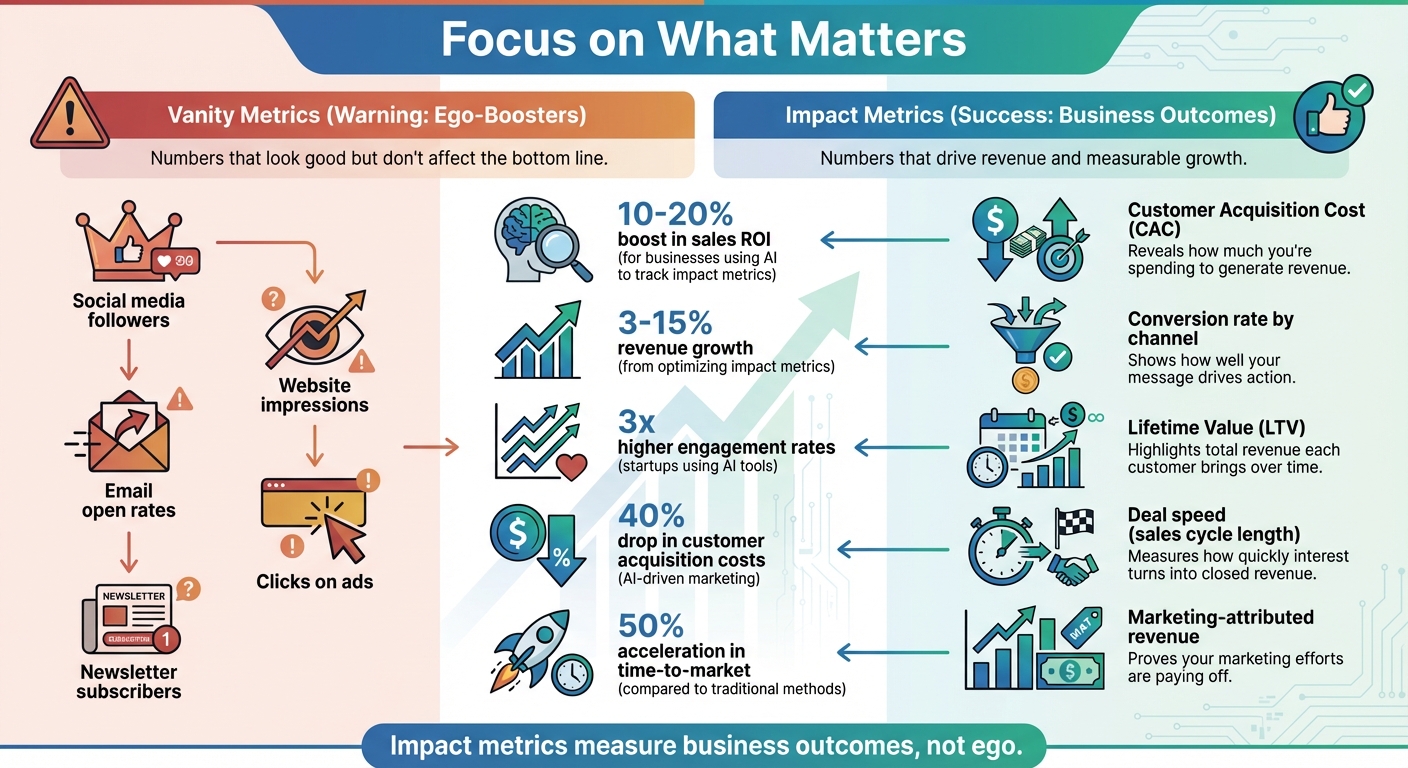
Vanity Metrics vs Impact Metrics: What Really Drives Marketing ROI
A strong marketing strategy starts with clear business goals and measurable metrics. Without these, you’re essentially throwing money at campaigns without knowing if they’re actually helping your bottom line. Tie your business objectives - like increasing revenue by 25% this year - to specific marketing metrics that will help you achieve those goals.
Connecting Business Objectives to Marketing Goals
Begin with your main business objective - whether that’s reaching $1 million in annual recurring revenue, entering a new market, or cutting churn by 15%. Once you’ve identified the goal, link it to marketing metrics that influence the outcome. For instance, if revenue growth is your target, focus on metrics like deal speed (how quickly deals close) and conversion rates at each stage of your sales funnel. Companies incorporating AI analytics into their core operations report 1.5x faster revenue growth and 1.4x higher returns on invested capital compared to those that don’t.
This is where closed-loop marketing comes into play. This approach ties your marketing efforts directly to sales and revenue by feeding sales data back into your marketing systems. Instead of celebrating vanity metrics like traffic spikes, you’ll focus on whether that traffic turns into paying customers - and at what cost. Shifting from surface-level metrics to meaningful ones is a key differentiator between businesses that thrive and those that stagnate.
Once you’ve identified the right metrics, organize them into a dashboard for easy tracking.
Establishing Baseline Metrics and Building Dashboards
Start by assessing your current performance. Pull data from tools like your CRM, Google Analytics, email platforms, or ad accounts to calculate your baseline for 5-8 key performance indicators (KPIs). For most small and medium businesses (SMBs), these KPIs might include:
- Customer Acquisition Cost (CAC)
- Conversion rate by channel
- Lead quality scores
- Campaign ROI
- Cost per lead (CPL)
If you’re running paid ads, also keep an eye on click-through rate (CTR) and cost per click (CPC).
Create a simple dashboard to display these metrics in one place. Tools like Google Sheets or your CRM’s built-in reporting features work well. The idea is to make the data accessible - your team should be able to quickly see whether you’re on track or falling behind. Update the dashboard weekly or bi-weekly, and use it to guide your optimization efforts. Automating reports can save time; for instance, 61% of SMBs using AI rely on it to handle routine tasks.
With your dashboard set up, the next step is to focus on metrics that directly impact revenue rather than ones that just look impressive.
Focus on Impact Metrics, Not Vanity Metrics
Impact metrics measure business outcomes and financial performance, while vanity metrics often just inflate your ego without showing real results. Here’s how they differ:
| Vanity Metrics | Impact Metrics | Why It Matters |
|---|---|---|
| Social media followers | Customer Acquisition Cost (CAC) | CAC reveals how much you’re spending to generate revenue. |
| Website impressions | Conversion rate by channel | Conversion rates show how well your message drives action. |
| Email open rates | Lifetime Value (LTV) | LTV highlights the total revenue each customer brings in over time. |
| Clicks on ads | Deal speed (sales cycle length) | Deal speed measures how quickly interest turns into closed revenue. |
| Newsletter subscribers | Marketing-attributed revenue | Revenue attribution proves your marketing efforts are paying off. |
Businesses using AI to track and optimize impact metrics report a 10-20% boost in sales ROI and 3-15% revenue growth. Startups leveraging AI tools for marketing often see 3x higher engagement rates, a 40% drop in customer acquisition costs, and a 50% acceleration in time-to-market compared to traditional methods.
Step 2: Use AI for Audience Segmentation
After setting your baseline metrics, the next step is pinpointing your target audience - and AI can make this process faster and more accurate than ever. Instead of relying on intuition or general assumptions, AI tools analyze real customer data to uncover patterns that might otherwise remain hidden. This approach helps you identify high-value segments, cut down on wasted ad spend, and create campaigns that truly connect with your audience. Let’s dive into how AI can help you craft precise customer profiles to ensure your marketing hits the right targets.
Analyze Customer Data with AI
Start by feeding your customer data into an AI tool. This data can include demographic details (like age, location, or job title), behavioral insights (such as website clicks, email interactions, and purchase history), and even unstructured data from social media posts, photos, or videos. Using machine learning and natural language processing (NLP), AI can analyze patterns in purchasing behavior, sentiment, and customer similarities.
However, the quality of your data is critical. Audit it for errors like inconsistencies, duplicates, or missing information. As Rob Martin, General Manager at Salesgenie, emphasizes:
"Clean data is the foundation of effective sales and marketing AI implementation. In our experience working with thousands of SMBs, those who invest in data quality see dramatically better results. It's not just about having data - it's about having complete, reliable data that AI can actually use for business health and growth."
Clean, accurate data allows AI to deliver actionable insights in minutes rather than weeks. For example, in 2025, a personal stylist used AI analytics to discover Instagram Stories were her top-performing conversion channel. Armed with this insight, she adjusted her content strategy to boost engagement.
Create Ideal Customer Profiles and Buyer Personas
AI doesn’t stop at analysis - it helps you find your most valuable customers and build detailed profiles to guide your strategy. Start by identifying your top customers based on metrics like lifetime value (LTV), purchase frequency, and engagement levels. These insights help form your Ideal Customer Profile (ICP), a detailed description of the people or companies most likely to benefit from your product and drive revenue.
Once you have your ICP, you can create buyer personas - detailed snapshots of your target customers that highlight their goals, challenges, purchasing habits, and preferred communication methods. AI keeps these profiles dynamic by continuously updating them with real-time data, ensuring they stay relevant and evidence-based. For example, Amazon’s recommendation engine uses browsing history, purchase behavior, and demographic data to suggest products, while Sephora’s AI-driven chatbots deliver personalized beauty advice.
Segment Audiences for Maximum ROI
With your ICPs and buyer personas in hand, you can use AI to divide your audience into actionable segments that drive results. AI digs deeper than basic demographics to identify groups like lookalike audiences (people similar to your best customers), churn-risk cohorts (customers showing signs of disengagement), and high-LTV segments (those likely to spend the most over time).
Here are a few ways segmentation can boost your ROI:
| Segment Type | What It Identifies | How to Use It |
|---|---|---|
| Lookalike audiences | People similar to your top customers | Expand your reach with ads targeting similar profiles |
| Churn-risk groups | Customers at risk of disengaging | Launch re-engagement campaigns or offer incentives |
| High-LTV cohorts | Customers with the highest lifetime value | Focus on retention efforts and upsell opportunities |
| Behavioral segments | Groups based on actions (e.g., cart abandoners) | Trigger automated emails or retargeting ads |
For instance, in 2025, a boutique retailer used automated email flows with product recommendations tailored to past purchases, leading to a 20% increase in repeat sales. Similarly, a handyman service cut ad spend by 30% by using Meta’s AI to retarget users who clicked on "Get a Quote". These examples show how precise segmentation can drive both efficiency and results.
The numbers speak for themselves: 90% of SMBs are already using AI in some capacity, and 89% of those adopters believe these tools are essential for success in the next year. If you’re not leveraging AI to segment your audience, you could be missing out on significant opportunities. Once your audience is segmented and insights are in place, it’s time to move forward and craft a compelling brand narrative with Narrative OS.
Step 3: Build Your Brand Narrative with Narrative OS
Once you've identified your audience and segmented them effectively, the next step is crafting a message that everyone on your team can deliver consistently. That’s where BrandMultiplier.ai’s Narrative OS comes into play. This isn’t just a set of guidelines - it's a complete framework that organizes your brand story. It defines your positioning, promise, proof points, and tone, ensuring that every team member, from leadership to sales and product teams, communicates a unified message across all channels. This consistency not only builds trust but also shortens sales cycles and drives growth you can measure.
Create a Brand Playbook
At the heart of Narrative OS lies your Brand Playbook, which establishes your brand’s identity and messaging. Start by identifying three to five key narrative pillars that should be present in all communications. These pillars guide everything, including:
- Positioning: The experience customers associate with your brand.
- Promise: The transformation or results your customers can expect.
- Proof: Case studies, testimonials, metrics, and product features that back up your claims.
- Tone: A clear voice map and a list of words or phrases to avoid.
BrandMultiplier.ai offers collaborative workshops to help distill your business identity into a clear, actionable Brand Playbook. The process begins with gathering data, which is summarized into an "Our Understanding" deck. This deck becomes the foundation for your Brand Playbook - a detailed guide that outlines your identity, positioning, target personas, and messaging strategy. It’s not just a marketing tool; it’s a "North Star" for your brand, doubling as an onboarding resource for new team members and external partners. To maintain authenticity, the playbook also includes prompt libraries and tone descriptions, ensuring AI-generated content aligns with your brand’s voice.
Align Your Narrative Across Teams and Channels
Once your Brand Playbook is ready, the next step is ensuring every department is on the same page. A unified narrative amplifies your brand’s impact when it’s consistently communicated across all teams - leadership, sales, product, and marketing. Narrative OS centralizes this effort by providing every team access to the same playbook, complete with voice maps and content guidelines. This goes beyond a simple content calendar, synchronizing all customer interactions, whether it’s a sales pitch, a social media post, or a product description.
BrandMultiplier.ai supports this alignment through tools like private dashboards, which streamline communication and provide visibility into content creation across teams. The Brand Playbook becomes a rallying point, helping everyone - from those writing emails to those pitching prospects - stay aligned. Research backs this up: companies that align sales and marketing around a shared narrative see 36% higher customer retention and 38% higher sales win rates. Additionally, consistent brand presentation across platforms can boost revenue by up to 23%. Clearly, alignment isn’t just beneficial - it’s essential for business success.
Measure and Optimize Your Narrative's Impact
With Narrative OS, storytelling isn’t a one-and-done effort - it’s a process you can measure and refine. During the strategy phase, BrandMultiplier.ai helps you set key performance indicators (KPIs) like customer acquisition cost (CAC), deal cycle length, lifetime value (LTV), conversion rates, and win rates to track the effectiveness of your brand narrative. The platform keeps tabs on these metrics, along with factors like message recall, consistency audits, and sentiment analysis, to ensure your narrative is hitting the mark.
For example, a well-executed narrative strategy led to a notable increase in both sales and subscriptions within just 90 days. To keep things on track, review and adjust your KPIs quarterly, taking into account new customer wins, product updates, and market trends. BrandMultiplier.ai even guarantees KPI improvement within 60 days - or they’ll extend their service by an additional month for free. Regular reviews and adjustments ensure your narrative evolves alongside your business, keeping it relevant and effective.
sbb-itb-63525a7
Step 4: Build an AI-Powered Channel and Content Strategy
Once your narrative is in place, it’s time to put it into action. An AI-powered approach ensures your messaging is timely, relevant, and impactful. This step focuses on optimizing your channels and crafting a content strategy that connects with your audience. The goal isn’t to be everywhere - it’s to be where your audience is, with content that inspires action.
Focus on High-Performing Channels
Not all channels are created equal. The key is to identify where your most valuable customers come from and which platforms offer the best results in terms of cost and efficiency. AI tools can sift through massive datasets - like social media activity, website interactions, and purchasing habits - to pinpoint where your target audience is most active and likely to convert.
Predictive analytics can also help you forecast which channels will deliver the best results based on past performance and market trends. This allows you to shift resources proactively, avoiding the trap of pouring money into underperforming campaigns. The channels that consistently bring in qualified leads at the lowest cost deserve your attention and investment.
Leverage AI for Personalized Content Creation
AI has transformed content creation, making it possible to generate personalized messaging at scale without losing your brand’s voice. From blog posts and email campaigns to social media updates and video scripts, AI tools can handle it all, freeing up your team to focus on strategy and big-picture ideas.
Personalization is where AI truly shines. By analyzing behavioral data - both historical and real-time - AI can tailor messages to specific audience segments and stages of the customer journey. This kind of precision pays off: 80% of consumers are more likely to buy from brands that offer personalized experiences, and 71% now expect companies to deliver such interactions. AI-driven targeting can improve ad effectiveness by 26% and boost conversions by 32%. For example, a prospect researching pricing might be shown ROI-focused case studies, while a lead in discussions with your sales team could receive content on implementation timelines.
Tools like BrandMultiplier.ai ensure that AI-generated content aligns with your brand’s tone and strategic goals by integrating prompt libraries and tone guidelines into your Brand Playbook. With 93% of marketers already using AI to speed up content creation, the question isn’t whether to use AI, but how to use it effectively to drive results.
Synchronize Messaging with an Omnichannel Content Calendar
An omnichannel content calendar is essential for keeping your messaging consistent across all touchpoints - email, social media, paid ads, your website, and even sales outreach. It should also account for U.S. holidays, time zones, and seasonal trends to ensure your campaigns resonate with your audience.
AI can simplify this process by identifying the best times to post and predicting how content will perform. A Unified Customer Data Platform (CDP) pulls together data from all your marketing channels, creating detailed customer profiles that guide when and where to engage. This eliminates guesswork and ensures your strategy is based on real customer behavior, not assumptions. The result? A coordinated effort where every piece of content reinforces your narrative and nudges prospects closer to conversion, no matter where they first interact with your brand.
Step 5: Measure, Optimize, and Scale
Turning your marketing strategy into a success story hinges on tracking the right metrics and acting on the insights they provide. This step is all about connecting your investments to actual business results and using AI to make smarter, faster adjustments.
Build a Measurement Framework
Every campaign needs to be tied to metrics that directly impact revenue. Focus on Customer Acquisition Cost (CAC), Lifetime Value (LTV), deal speed, and total revenue. These numbers reveal whether your efforts are driving profits. A strong framework includes setting clear goals, establishing baseline metrics, monitoring progress, and calculating ROI.
Here’s why this matters: Companies with an AI readiness score above 70% are three times more likely to implement AI successfully within a year. Businesses with mature data practices achieve 2.8 times better AI results, and those with standardized processes adopt AI tools 40% faster. For small and medium enterprises (SMEs), structured adoption strategies deliver 20–25% productivity gains in pilot phases, with ROI increasing as AI becomes more integrated. Plus, cloud-based AI solutions reduce deployment costs by 20% compared to on-premise systems.
Once your measurement framework is in place, AI becomes your tool for continuous improvement.
Leverage AI for Smarter Insights
AI tools are game-changers for spotting trends and predicting customer behavior. They analyze past performance to forecast future outcomes, helping you make decisions rooted in data. AI-powered dashboards monitor data streams in real time, flagging performance shifts, changes in customer behavior, or potential problems. These tools surface actionable insights, like which campaigns or offers are driving the most conversions.
Take Mongoose Media, for example. They used Jasper to speed up content creation, cutting blog writing time from 8–10 hours to just two hours per article. Even after Google’s Helpful Content update, one client saw organic traffic jump by 166%, growing monthly visitors from 3,000 to 8,000. Similarly, Zoom used Grammarly Business to streamline messaging for new regional audiences, improving 71% of communications in nine months and saving 7,000 hours of team time - equivalent to $210,000 in value.
These insights lay the groundwork for a disciplined approach to ongoing optimization.
Create a Quarterly Optimization Routine
Optimization isn’t a one-time task - it’s an ongoing process. Set up quarterly reviews to evaluate performance, pinpoint underperforming areas, and test new strategies. Use a test log to document each experiment, including the hypothesis, results, and next steps. This creates a feedback loop that turns lessons learned into actionable improvements.
Right now, 76% of marketers are using generative AI for content creation, with 85% reporting better content quality. By 2025, 80% of small businesses plan to integrate AI chatbots into their customer support strategies. The key is weaving AI into your daily operations instead of treating it as an add-on. Start by identifying where your team spends the most time, and use AI to tackle those bottlenecks. Companies with clear AI adoption strategies are twice as likely to sustain ROI beyond two years. Over time, AI enables you to scale successful campaigns, turning what works into a repeatable growth engine.
Conclusion: Take Action for Measurable Growth
A strategy focused on results links every marketing dollar to revenue growth. The five steps in this guide provide a straightforward approach: set goals aligned with CAC, LTV, and deal speed; use AI to segment audiences; develop your story with Narrative OS; implement AI-driven content; and refine your efforts continuously.
The numbers back this up. By 2024, AI adoption hit 72%, with generative AI expected to contribute $4.4 trillion annually. Additionally, over 70% of top executives believe advanced AI will provide a competitive edge, and 92% plan to increase AI investments despite skill shortages.
"AI is not just a buzzword – it's a transformative technology that can revolutionize the way small businesses approach marketing. The key is to find the right balance between AI-powered automation and human expertise to create a winning strategy." – Vocal.media
This makes it clear: the time to act is now. Start by identifying repetitive tasks that slow your team down. Test AI tools in small-scale campaigns, compare results to your baseline metrics, and expand on what works. Let AI handle routine operations so your team can concentrate on strategy and building customer connections.
Blending AI-driven insights with a strong brand narrative is essential for measurable marketing success. AI has become central to modern marketing. Companies with defined AI strategies see ROI last more than twice as long. Take the first step today - set your goals, select your tools, and start creating a marketing strategy that drives revenue.
FAQs
How can AI tools help improve the ROI of my marketing strategy?
AI tools have the power to elevate your marketing efforts by offering precise audience targeting, tailored customer experiences, and predictive analytics. These features can help cut customer acquisition costs, boost conversion rates, and fine-tune your spending as you go.
On top of that, AI-powered automation takes care of routine tasks, freeing up your time to focus on strategies that drive results. With data-driven insights, these tools enable quicker, more informed decisions that pave the way for tangible growth.
What are the most important metrics to monitor for a successful marketing strategy?
To get the most out of your marketing strategy, it's crucial to track key performance metrics in three main categories:
- Revenue and growth metrics: Focus on metrics like incremental revenue, customer lifetime value (LTV), and lead-to-customer conversion rates. These numbers help you gauge the overall impact your strategy has on the business's bottom line.
- Efficiency metrics: Keep tabs on cost per acquisition (CAC), the time saved, and how quickly campaigns are launched. These indicators show how effectively your resources are being used.
- Customer experience metrics: Pay attention to engagement rates and churn rates. These figures reveal how well your strategy is connecting with and retaining your audience.
By consistently reviewing these metrics, you can make smarter, data-backed decisions that improve performance and deliver real results.
How can I create a consistent and engaging brand narrative with Narrative OS?
To build a strong and engaging brand narrative using Narrative OS, start by connecting your core story to insights drawn from customer data. AI tools can help you analyze this data to identify key themes and fine-tune your messaging so it truly resonates with your audience. Every interaction should reflect your brand's values and mission, creating a cohesive and meaningful experience.
Consistency is key. Make sure your messaging stays clear and genuine across all platforms, aligning with what your audience cares about most. With the help of AI-driven personalization, you can craft stories that feel relevant and impactful, fostering deeper connections with your audience and driving measurable results.
Ready to transform your brand story?
Schedule a free diagnostic to see how we can help.
Schedule The Diagnostic