
Fixing Inconsistent Brand Messaging Across Channels
Fixing Inconsistent Brand Messaging Across Channels
Inconsistent brand messaging can confuse your audience, damage trust, and hurt your sales. When your website, ads, and emails tell conflicting stories, customers lose confidence - and that costs you. Studies show inconsistent messaging increases customer acquisition costs by 42% and extends sales cycles by 34%. The solution? A clear, unified brand narrative applied across every channel.
Here’s how to fix it:
- Audit your messaging: Check all platforms - website, social media, emails, sales materials - for conflicting terms, tone, or promises.
- Create a unified brand narrative: Define your audience, core promise, and key differentiators. Make it simple enough for your team to explain in two minutes.
- Use AI tools: Speed up audits, ensure consistency, and maintain alignment across platforms with AI-driven content checks and updates.
- Build a living playbook: Centralize your brand guidelines, messaging hierarchy, and templates in one accessible hub for your team.
Consistent messaging builds trust, shortens sales cycles, and can increase revenue by up to 23%. Start today by creating a clear narrative and auditing your content. Tools like BrandMultiplier.ai can help you stay on track and scale effectively.
How To Ensure Brand Messaging Consistency?
How to Find Messaging Inconsistencies Across Channels
Spotting messaging inconsistencies starts with mapping, auditing, and analyzing your content. By understanding how your brand communicates across various platforms, you can address gaps effectively.
Map Your Customer Journey and Touchpoints
Begin by outlining how customers engage with your brand, starting from their first interaction - whether it's through a social media post or a Google ad - all the way to becoming loyal customers. Use visual journey maps to track every touchpoint, helping you identify where messaging might falter.
Make a comprehensive list of all the channels where your brand has a presence. This includes your website, social media platforms, email campaigns, ads, sales presentations, support scripts, packaging, and even team email signatures. Take Duolingo as an example: they ensure their green owl mascot, playful tone, and quirky personality are consistent across their app, website, emails, and social media. When they introduced Duolingo ABC for kids, they retained the same brand identity, creating a seamless and familiar experience.
Run a Messaging Audit
Once you've mapped out your touchpoints, it's time to audit your content. Review everything - website pages, email sequences, sales materials, social media posts, case studies, and ad copy. Check for consistency in your claims, value propositions, tone, and visual branding elements like logos, colors, and fonts.
Pay close attention to areas where your messaging might contradict itself. For instance, your website might describe your product as "enterprise software", while your sales emails refer to it as an "innovative platform." These differences, though subtle, can confuse your audience. Create a prioritized list of these inconsistencies, focusing on those that could significantly impact how your brand is perceived.
Use AI Tools to Speed Up the Audit
Manually reviewing all your content can be a daunting task. AI tools can help by scanning your digital assets, analyzing tone, checking visual elements, and creating dashboards that highlight inconsistencies. These tools can compare content against your brand guidelines, flagging issues before they reach a human reviewer. This approach not only saves time but also streamlines the process, making it easier for small and medium-sized businesses to maintain strong brand governance, even without a dedicated branding team.
Build a Unified Brand Narrative
After identifying messaging gaps, the next step is to create a unified brand narrative. This isn't just a catchy tagline or a polished mission statement - it’s a complete, concise explanation of who you serve, what you promise, why you stand out, and how you deliver. The goal? To make it so clear and memorable that anyone on your team can explain it in under two minutes. Unlike a style guide that focuses on visuals like fonts and colors, this narrative ties those elements to a bigger story. It’s the strategic backbone for everything you communicate - whether it’s a sales pitch or a social media post. Simply put, this narrative is the foundation for all your brand messaging.
Core Components of a Unified Narrative
To build a strong narrative, focus on four key elements:
- Define your ideal customer: Be as specific as possible. Instead of saying "small businesses", describe your audience in detail, like “U.S.-based e-commerce brands earning $2–10 million annually, led by founders frustrated with fragmented marketing.” Include demographics, company size, challenges, and decision-making drivers.
- Craft a core promise: This should be one powerful, outcome-driven sentence. For example, “We turn scattered marketing into a unified growth engine in 90 days or less.”
- Highlight your value differentiation: Identify three to five reasons customers choose you. These could include things like done-for-you implementation, flat-rate pricing in U.S. dollars, or a U.S.-based support team.
- Collect supporting storylines: Gather stories that back up your claims, such as your origin story, measurable customer successes (e.g., "+32% conversion rate in 60 days"), and testimonials.
These four elements work together to create a cohesive message that can be adapted across all platforms without starting from scratch each time.
Deploy Your Brand Narrative with Narrative OS
BrandMultiplier.ai’s Narrative OS takes your unified story and turns it into a dynamic system. It organizes your narrative into reusable templates, like elevator pitches, value propositions, and objection-handling scripts, tailored for different teams - leadership, sales, marketing, and product. When you update your core promise or positioning, Narrative OS automatically flags related assets (e.g., sales decks, landing pages, ad copy) that need revisions, ensuring everything stays consistent.
The platform also includes AI-assisted content generation, so email campaigns, ad copy, and product descriptions pull directly from pre-approved narrative elements. This reduces off-brand improvisation and saves time for smaller teams. Built-in tools like consistency scoring and real-time alignment suggestions help content creators ensure their work matches your brand story. By codifying your narrative into an active system, you create a living playbook that evolves alongside your business.
Create a Living Brand Playbook
Your unified narrative needs a central hub where teams can access it daily. A living brand playbook translates your story into actionable, channel-specific guidelines that grow with your business.
This playbook should include:
- A one-page narrative overview
- Voice and tone guidelines (preferred tone, U.S. English spelling, do/don’t phrases)
- A messaging hierarchy that prioritizes your core messages
- Channel-specific rules for platforms like your website, email, LinkedIn, ads, and sales decks
- Objection-handling scripts tied to your value pillars
- A simple change log to keep everyone updated
Keep this playbook in a collaborative tool connected to Narrative OS, so it’s always searchable, up-to-date, and easy to use. Assign a brand steward to review and update the playbook quarterly, using feedback from campaigns, A/B tests, and sales calls. This ensures your narrative stays aligned with how your customers actually think and behave.
sbb-itb-63525a7
Use AI to Align Messaging Across Channels
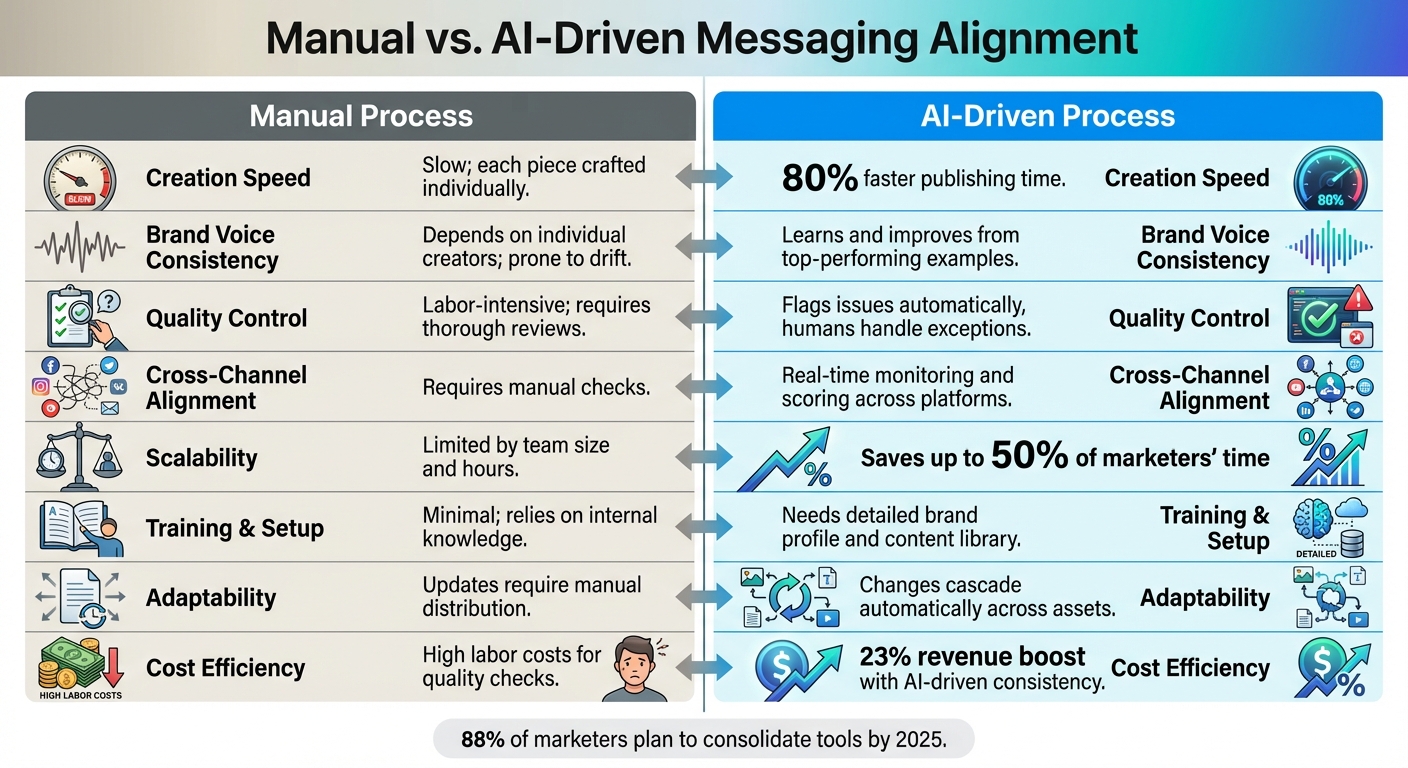
Manual vs AI-Driven Brand Messaging Alignment Comparison
After crafting your unified narrative and dynamic playbook, the next hurdle is ensuring consistency as your team churns out content daily across multiple platforms. This is where AI-powered tools shift from being a helpful addition to an absolute necessity. While 83% of marketers say AI speeds up content creation, only 25.6% feel it surpasses human-created content. Why the disconnect? Most teams rely on generic AI tools without proper training, leading to bland, off-brand results. The solution isn’t to avoid AI - it’s to use it wisely, with the right setup and oversight. This approach makes AI an essential ally in maintaining consistent messaging across all channels.
AI-Assisted Content Creation and Messaging Governance
AI can help craft platform-specific messaging, but only if it’s trained correctly. Start by feeding it 10–20 of your best-performing content pieces, your brand voice guidelines, and key strategic details. Specialized platforms can refine their outputs by learning from your content library and performance data. Some even offer advanced tools to replicate your brand’s unique tone and style, helping teams cut publishing time by up to 80% while keeping your brand voice intact.
To get the best results, structure prompts with clear instructions on voice, tone, audience, key messages, and exclusions. AI can then identify issues like grammatical errors, inconsistent terminology, or shifts in tone, suggesting edits to ensure your brand voice stays consistent. That said, human editors remain indispensable as "brand guardians", setting parameters, overseeing workflows, and maintaining emotional alignment. This blend of AI and human oversight is critical: while 64% of top-performing content marketers have documented brand voice guidelines, only 23% actively use them to train their AI tools.
Next, let’s explore how AI doesn’t just create content - it also governs messaging consistency across platforms.
Monitor and Score Messaging Consistency
AI doesn’t stop at content creation; it also helps ensure your messaging stays on-brand. By scoring content for alignment with your brand narrative in real time, AI can track consistency across all channels, pinpoint weak spots, and monitor how messaging evolves. AI tools can review content for potential issues before publication, flagging anything that might need human attention. Some platforms even centralize performance data from all channels into a single dashboard, making it easier to track and analyze.
Focus on metrics that matter: shorter editorial cycles, faster publishing, better audience engagement, higher conversion rates, and stronger brand recall. For instance, a 2023 Nielsen report found that brand recall contributes 38.7% to brand lift in emerging media - more than basic brand awareness. AI can also test content for multiple goals - like clarity, emotional impact, and conversion potential - across different audience segments, providing deeper insights than traditional methods. Establish regular reporting with these insights to fine-tune your AI strategy over time. The benefits are clear: brands using AI to create and align messaging see a 23% increase in revenue.
Manual vs. AI-Driven Messaging Alignment
| Aspect | Manual Process | AI-Driven Process |
|---|---|---|
| Creation Speed | Slow; each piece crafted individually | 80% faster publishing time |
| Brand Voice Consistency | Depends on individual creators; prone to drift | Learns and improves from top-performing examples |
| Quality Control | Labor-intensive; requires thorough reviews | AI flags issues automatically, humans handle exceptions |
| Cross-Channel Alignment | Requires manual checks | Real-time monitoring and scoring across platforms |
| Scalability | Limited by team size and hours | AI saves up to 50% of marketers’ time |
| Training & Setup | Minimal; relies on internal knowledge | Needs a detailed brand profile and content library |
| Adaptability | Updates require manual distribution | Changes cascade automatically across assets |
| Cost Efficiency | High labor costs for quality checks | 23% revenue boost with AI-driven consistency |
A staggering 88% of marketers plan to consolidate their tools by 2025, citing fragmented systems as a major barrier to consistency. Manual processes simply can’t keep up when you’re managing content across websites, emails, LinkedIn, ads, and sales decks all at once. AI-driven governance doesn’t replace human judgment - it enhances it. By catching inconsistencies before they reach your audience, AI frees your team to focus on strategy rather than repetitive quality checks. This side-by-side comparison underscores how AI-driven processes work hand-in-hand with your brand playbook to deliver reliable, cohesive messaging.
Embed Consistency for Long-Term Growth
You’ve set up your systems, trained your AI, and created a detailed playbook. Now comes the crucial step: weaving messaging consistency into your daily operations. The difference between brands that stay aligned and those that veer off course isn’t just about having the right tools - it’s about making consistency part of the everyday workflow. By leaning on your unified narrative and AI-driven processes, you can ensure that consistency is present in every interaction.
Make Messaging Consistency a Daily Practice
Consistency doesn’t happen by accident - it requires intentional effort in every step of your content creation process. Make it a rule for all content creators to use your living brand playbook, and establish checkpoints to review every piece of content. Use tools like your Narrative OS and centralized playbook to keep your brand messaging updated and aligned in real time.
Schedule regular workshops to refresh and reinforce your messaging guidelines. Centralize all your assets using a Digital Asset Management (DAM) system so teams always have access to the latest approved materials. This eliminates the risk of teams using outdated resources scattered across various platforms.
Don’t overlook internal communication - it’s just as critical as external messaging. Set up a dedicated space, like a Slack channel, where your marketing team can share updates, celebrate examples of on-brand content, and quickly address any inconsistencies that arise.
Key Metrics to Measure Messaging Impact
Once you’ve established consistent practices, it’s time to track their impact. Look at internal metrics like how often assets are reused, template adoption rates, and time-to-publish. For external metrics, focus on brand recall, engagement rates, and conversions. Regular audits can help you spot any deviations in messaging before they become bigger issues. Align these metrics with your business goals, whether you’re aiming for increased revenue or improved customer retention, to clearly see the value of unified messaging.
The Compounding Effect of Unified Messaging
As mentioned earlier, consistent messaging fosters trust - and that trust grows over time. A disciplined approach to messaging leads to stronger customer loyalty and steady growth. Unified messaging helps build recognition and loyalty, speeding up the journey from awareness to advocacy. Brands that treat consistency as a daily habit, rather than a one-off effort, are far better equipped to achieve long-term success.
Conclusion
Inconsistent brand messaging doesn’t just create confusion - it erodes trust and hurts your bottom line. When your website says one thing, your ads suggest another, and your sales team delivers a completely different pitch, potential customers are left wondering who you are and why they should care. The solution? Map out every customer touchpoint, audit your messaging, unify your brand story, and leverage AI tools to keep everything aligned. Studies show that brands with consistent messaging can increase revenue by 10–23%. Why? Because customers trust what feels familiar and reliable.
For small and medium-sized businesses (SMBs) competing in US markets, consistency is your secret weapon. When prospects experience the same promises, tone, and proof points across your homepage, emails, and Instagram ads, you come across as professional and trustworthy. Take a cue from brands like Dove and Volvo. Dove owns "real beauty", and Volvo owns "unwavering safety" because they’ve repeated those messages consistently for decades. You don’t need their massive budgets to achieve clarity - just discipline and the right tools.
That’s where AI-powered platforms like BrandMultiplier.ai come in. These tools simplify the process of staying on-brand by storing your core narrative, messaging pillars, and style guidelines. Whether it’s website copy, email campaigns, social posts, or ad content, BrandMultiplier.ai can generate materials that stay true to your brand. Plus, it’s designed with US conventions in mind - dollars, standard time formats, and local expressions - so your communication feels natural to your audience. It can even scan your existing content, flag off-brand phrases, and suggest rewrites, cutting down the time spent on audits.
Ready to get started? This week, define your brand promise and messaging pillars. Audit your top-performing assets and test AI-generated rewrites. Then, track metrics like conversion rates, cost per lead, and customer feedback to measure clarity and trust. Monitor customer lifetime value and referrals to see how consistency boosts loyalty and growth. Remember, consistency isn’t a one-and-done task - it’s a habit. Stick with it, and you’ll protect your brand, scale content effectively, and compete with confidence.
FAQs
How do I spot inconsistencies in my brand messaging across different channels?
To spot any inconsistencies in your brand messaging, begin by examining all your communication platforms - this includes your website, social media posts, email campaigns, and sales materials. Pay close attention to differences in tone, language, or key messages that might confuse your audience.
Perform a detailed brand audit to identify areas where your messaging doesn’t align. Work closely with your internal teams and seek input from your customers to reveal any gaps or misunderstandings. Taking this comprehensive approach ensures your brand voice remains clear and consistent across all touchpoints.
What are the key elements of a consistent brand message?
A strong and consistent brand message depends on a few essential elements working in harmony. These include your brand purpose, core values, positioning, and key messages. Equally important is keeping a consistent tone of voice and ensuring that your visual identity - like logos, color schemes, and typography - remains uniform across all platforms and materials.
Every interaction or piece of content you create should reflect these elements, weaving them into a cohesive story. This unified approach not only builds trust but also deepens customer connections and lays the groundwork for lasting brand success.
How do AI tools help ensure consistent brand messaging across channels?
AI tools are incredibly useful for keeping your brand messaging consistent. They analyze your content to ensure it matches your brand’s tone, style, and language across all platforms. These tools can even monitor your messaging in real-time, suggest tweaks, and automate content creation - all while sticking to your brand guidelines.
What makes them even more effective is their ability to learn from approved materials, which helps them improve future outputs. This means your messaging remains aligned and cohesive. By using AI, businesses can save time, minimize mistakes, and strengthen audience trust with a polished and unified brand presence.
Ready to transform your brand story?
Schedule a free diagnostic to see how we can help.
Schedule The Diagnostic