
How AI Personalizes Loyalty Programs
How AI Personalizes Loyalty Programs
AI is reshaping loyalty programs by analyzing customer behavior to offer rewards tailored to individual preferences. Unlike outdated systems with generic discounts, AI uses data like purchase history, engagement patterns, and even weather to predict what customers want next - boosting retention and spending.
Key takeaways:
- 71% of consumers expect personalized experiences; AI meets this demand by delivering real-time, customized offers.
- Predictive analytics helps businesses anticipate needs, reducing churn and increasing customer lifetime value (CLV).
- SMBs benefit from faster results and lower costs, as AI optimizes rewards to target high-impact opportunities.
- Examples like Starbucks and CAVA show how AI-driven programs drive loyalty and boost sales significantly.
AI-powered loyalty programs are transforming customer retention strategies, making them smarter and more effective.
How to design DTC loyalty programs with AI | Nathan Snell | Raleon
sbb-itb-63525a7
How AI Collects and Analyzes Customer Data
AI gathers and organizes customer touchpoints to enable smarter loyalty strategies. It starts by collecting raw data from every interaction, then uses machine learning algorithms to uncover patterns that people might miss. For instance, 72% of customers tend to ignore marketing content that doesn’t feel personalized. This highlights how crucial effective data collection and analysis is for creating tailored loyalty rewards.
Types of Customer Data AI Analyzes
AI draws from various data sources to create well-rounded customer profiles. Here's a breakdown of the key data types:
- Transactional Data: Metrics like purchase frequency, recency, and average monetary value (RFM) offer insights into spending habits.
- Behavioral and Navigational Data: Browsing history, app usage, and clicks reveal customer intent.
- Engagement Data: Tracks responses to promotions, preferred communication methods, and social sharing or referrals.
A great example is Sephora's Beauty Insider program. It analyzes purchase history, browsing activity, and in-store scanning to recommend products tailored to each shopper. This approach has resulted in a 70% higher conversion rate compared to generic suggestions and boosted average basket size by about 25%. Insights like these help fine-tune loyalty rewards, aligning them with each customer’s preferences.
Using Predictive Analytics to Forecast Behavior
Once customer data is collected, AI shifts gears to predict future actions. Machine learning models can estimate churn risk, purchase intent, and customer lifetime value (CLV), allowing businesses to take action before losing engagement. These systems also enable micro-segmentation, targeting specific customer journeys with precision. Advanced AI tools can process this data in milliseconds, ensuring timely offers and interventions. By identifying early warning signs of disengagement, businesses can deliver micro-offers that re-engage customers swiftly.
This ability to anticipate behavior doesn’t just improve retention - it also guides smarter reward strategies.
Benefits of Data-Driven Insights
When AI turns raw data into actionable insights, businesses can make decisions based on facts instead of intuition. Consider this: 80% of consumers are more likely to stick with a company that delivers personalized experiences, and 91% prefer shopping with brands that offer relevant recommendations. Personalization powered by AI has been shown to increase purchase frequency by up to 300% among loyalty members who receive tailored suggestions.
"For sure, AI personalization is the future of loyalty programs. With the vast amount of data available to businesses today, it is essential to leverage algorithms to analyze and make use of this data."
– Maria Wróblewska, AI Product Owner, Comarch
This shift from reactive to proactive loyalty strategies is redefining customer retention. While traditional programs reward past behavior, AI-driven systems anticipate what customers will need next, delivering value before they even ask. Achieving this level of personalization depends on having clean, unified data - integrating transactional records, CRM inputs, and app activity into a single, cohesive view. Without this solid foundation, even the most advanced AI tools can’t deliver the personalized experiences that drive loyalty.
AI Techniques for Personalizing Loyalty Programs
AI is taking loyalty programs to a whole new level by turning data insights into real-time, tailored actions. These advanced techniques allow businesses to create loyalty programs that respond dynamically to individual customer needs and preferences.
Real-Time Rewards Optimization
AI can fine-tune rewards instantly by factoring in real-world conditions like recent customer activity, weather, and inventory levels. Instead of relying on static, scheduled promotions, AI-driven systems react to what's happening right now. A great example is Starbucks' Deep Brew AI platform, which uses app transactions, weather data, and geolocation to send timely, relevant offers. Imagine getting a half-off cold brew deal during a heatwave - this kind of real-time personalization boosts customer engagement.
This approach also enables micro-segmentation, targeting customers based on specific behaviors rather than lumping them into broad demographic groups. For instance, if someone switches from regular milk to oat milk, the system adjusts future offers to reflect this change. AI also ensures notifications are sent at the perfect time, like a coffee discount popping up when a customer is near a store during their usual morning stop.
Behavior-Based Reward Recommendations
AI doesn't just look at past purchases - it combines that data with browsing history and real-time factors like location and time of day to craft tailored reward suggestions. Take Domino's, for example. In 2024, they revamped their loyalty program using AI-guided A/B testing to optimize how customers earn and redeem rewards. The result? A 6% boost in U.S. sales, with the loyalty program being a major contributor.
Puma also tapped into AI by partnering with Google Cloud. Their predictive AI model aligned online and in-store offers with individual customer preferences, leading to a 19% increase in average order value. The secret lies in AI's ability to learn from every interaction, constantly improving its recommendations.
"Predictive AI helps anticipate and mitigate challenges, machine learning optimizes and enhances those predictions, and generative AI delivers a more personalized, real-time customer experience."
– Laurens Van Wiele, Chief Product Officer, Talon.One
These precise recommendations are also key to keeping customers engaged and loyal.
Preventing Customer Churn with AI
AI is a powerful tool for identifying customers who might be on the verge of leaving. By analyzing subtle patterns, such as reduced purchase frequency or fewer app interactions, AI can detect early signs of disengagement - what some refer to as a "loyalty heartbeat". Once a potential issue is flagged, the system can send out automated interventions like personalized discounts, double-points offers, or exclusive rewards at just the right time.
These interventions are backed by propensity analysis, which predicts how likely a customer is to respond to a re-engagement offer. This ensures that businesses focus their resources on strategies that are likely to work. For high-value customers, AI-driven churn prediction has boosted retention rates by up to 20%.
How to Implement AI-Powered Personalization
You don’t need to overhaul your entire system to start using AI-powered personalization. Instead, take it step by step, prioritizing one high-impact area first. Below, we’ll look at how to integrate AI into your loyalty strategy effectively.
Connecting Your Data Sources
The foundation of AI-driven personalization lies in your data. Start by consolidating information from transactions, CRM systems, mobile apps, and in-store interactions into a unified customer profile tied to a consistent member ID.
Experts stress that success with AI in loyalty programs depends more on your data strategy than on the technology itself. Before choosing an AI vendor, make sure your data is accurate and comprehensive. Ideally, you should have at least 12 months of member-level transaction history. For reward recommendations, this should include details like purchase categories, redemption patterns, and at least one full earn-and-redeem cycle.
Setting Up AI Models for Customer Insights
Once your data is cleaned up and centralized, focus on a specific goal, like reducing churn or increasing repeat purchases. Smaller to mid-sized businesses often see results more quickly by targeting these high-impact objectives.
Go beyond general demographic groups to build detailed, individual behavioral profiles. This means tracking browsing habits, purchase trends, and interactions to anticipate future actions. For instance, you can predict purchase intent, detect lifecycle changes, or flag disengagement risks.
Set up automated triggers to act on these insights. For example, one loyalty program used triggers based on sales rep activity and customer purchase milestones, resulting in a 25% average sales boost among participants. After launching your AI models, keep an eye on their performance and adjust as needed to fine-tune your strategy.
Tracking and Improving Your Loyalty Strategy
With unified data and AI-driven insights, measure your program’s success using meaningful business metrics. Move beyond surface-level stats like enrollment numbers or points issued. Instead, focus on outcomes such as incremental revenue, retention growth, and customer lifetime value (CLV).
Ask yourself whether your program is truly inspiring new behaviors or just rewarding purchases that customers would have made anyway. AI can adapt rewards in real time based on shifting customer interests, ensuring your strategy stays relevant.
Many companies notice increased engagement and repeat purchases within just a few months of applying AI to key areas. Keep tracking these results, and remember: the real power of AI is in enabling faster, smarter decisions at scale.
Measuring the Performance of AI-Driven Loyalty Programs
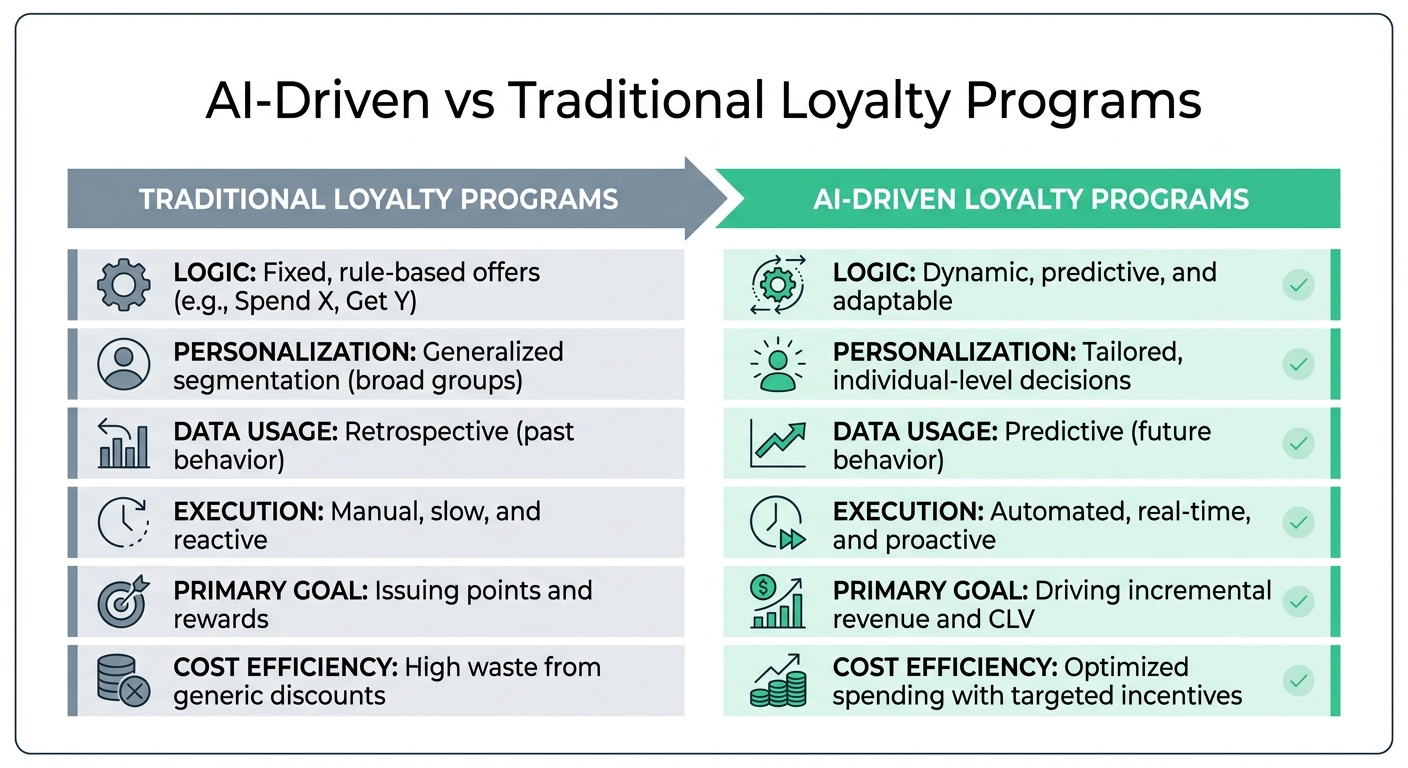
AI-Driven vs Traditional Loyalty Programs: Key Performance Differences
Key Performance Indicators (KPIs) to Monitor
When evaluating AI-driven loyalty programs, steer clear of surface-level metrics like total enrollments or points issued. Instead, focus on KPIs that directly impact your bottom line. A standout metric is incremental revenue - the extra sales generated by AI interventions, excluding purchases customers would have made anyway. Another critical measure is customer lifetime value (CLV), which reflects the long-term financial contribution of each loyalty member.
Pay attention to retention lift by comparing how many customers remain engaged versus a control group that doesn't receive AI-driven offers. Redemption rates are another key indicator; frequent and quick reward redemptions suggest strong engagement. Finally, tracking repeat purchase frequency helps you understand how often members return within specific periods.
Most companies notice improvements in engagement and repeat purchases within just a few months of implementing AI-driven loyalty strategies. To ensure accurate results, demand clear attribution from your AI platform. This will help you separate organic customer behavior from the incremental gains produced by your program.
These metrics highlight the stark differences in effectiveness between AI-driven and traditional loyalty programs.
AI-Driven vs. Traditional Loyalty Programs
The performance gap between traditional and AI-powered loyalty programs becomes evident when you dig into the data. Traditional programs rely on static rules, such as "spend $100, earn 10 points", and group customers into broad categories like "high value" or "inactive." In contrast, AI-driven programs make real-time, individual-level decisions, predicting future customer behavior rather than just analyzing past actions.
| Feature | Traditional Loyalty Programs | AI-Driven Loyalty Programs |
|---|---|---|
| Logic | Fixed, rule-based offers (e.g., Spend X, Get Y) | Dynamic, predictive, and adaptable |
| Personalization | Generalized segmentation (broad groups) | Tailored, individual-level decisions |
| Data Usage | Retrospective (past behavior) | Predictive (future behavior) |
| Execution | Manual, slow, and reactive | Automated, real-time, and proactive |
| Primary Goal | Issuing points and rewards | Driving incremental revenue and CLV |
| Cost Efficiency | High waste from generic discounts | Optimized spending with targeted incentives |
AI systems excel at improving customer retention while keeping costs in check. They achieve this by targeting incentives to customers most likely to respond, rather than offering blanket discounts. This approach ensures your marketing spend is more strategic and effective.
But the advantages of AI-driven programs don’t stop there. Incorporating customer feedback takes their performance to the next level.
Using Customer Feedback to Improve Results
AI not only relies on data-driven insights but also integrates customer feedback to refine loyalty strategies further. By analyzing both purchase behavior and customer sentiment, AI continuously adjusts and personalizes rewards. Sentiment analysis tools can classify customer feedback from reviews, social media posts, and support tickets as positive, negative, or neutral in real time. This allows businesses to address issues quickly, preventing potential drops in retention.
Beyond surveys, AI tracks behavioral signals - like which rewards customers redeem, which tasks they complete, and where they abandon their carts. These actions reveal what customers genuinely value, often more accurately than what they say they want. Every decision made by the AI is logged, creating an audit trail that includes triggers, decision logic, and outcomes. This feedback loop helps refine future strategies based on real customer behavior rather than assumptions.
Conclusion: What's Next for AI in Loyalty Programs
Key Takeaways for SMBs and Startups
AI-driven loyalty programs offer real, measurable benefits that can directly impact your business's profitability. For instance, AI can predict churn risks 4–8 weeks in advance, giving you a chance to act before losing a customer. And the numbers speak volumes: boosting customer retention by just 5% can lead to profit increases ranging from 25% to 95%, while also driving 37% higher spending from your customers.
For small teams, AI simplifies the process of delivering highly personalized rewards - like offers based on weather conditions - at scale. It automates data analysis and campaign management, letting you focus on strategy while ensuring your reward spending leads to meaningful customer actions instead of rewarding purchases that would have happened anyway. These capabilities set the stage for even more exciting advancements in loyalty programs.
Future Trends in AI and Personalization
The future of loyalty programs is poised for even greater transformation, thanks to emerging AI trends. One major shift is the move from assistive AI, which suggests actions, to agentic AI, which takes autonomous action to achieve specific goals like minimizing churn within 90 days. AI adoption in loyalty management is also growing rapidly, with usage jumping from 37.1% to 51.4% between 2025 and 2026.
Another trend to watch is the standardization of omnichannel integration, where loyalty programs seamlessly track and reward customer behavior across online, mobile, and in-store interactions. Gamification is also leveling up, moving away from basic point systems to AI-powered missions personalized to each customer’s purchase history. As Loyalytics aptly puts it:
"The future of loyalty isn't about offering more. It's about understanding better, and acting faster".
How BrandMultiplier.ai Supports AI-Driven Loyalty Strategies
BrandMultiplier.ai is designed to help SMBs and startups leverage these AI-driven advancements in loyalty programs. Using its proprietary Narrative OS - a Growth Operating System - it aligns your loyalty program with your brand’s most compelling story. This ensures your program doesn’t just rely on technology but also strengthens customer trust and connection.
The platform tracks the impact of your strategic story on key performance metrics like CAC, conversion rates, sales velocity, and customer lifetime value (LTV). It continuously refines your loyalty strategy in real time, turning loyalty programs from a static "spend X, get Y" model into a dynamic growth engine. For businesses ready to take loyalty to the next level, this approach delivers both measurable results and deeper customer relationships.
FAQs
What data do I need to personalize a loyalty program with AI?
To make a loyalty program more tailored using AI, start by gathering and analyzing customer data like purchase history, browsing habits, engagement trends, and individual preferences. This information helps build detailed customer profiles, making it easier to customize rewards. Incorporating real-time data, such as recent actions and how often customers make purchases, allows for on-the-fly adjustments. With these insights, AI can craft personalized offers, fine-tune rewards, and improve the overall experience for each customer.
How does AI decide which rewards to offer each customer?
AI customizes rewards for individual customers by diving into data like their purchase history, browsing behavior, preferences, and engagement patterns. Using machine learning, it spots trends and predicts what customers might want next, allowing businesses to offer personalized incentives like discounts or exclusive deals.
What makes this approach stand out is its ability to update recommendations in real time. As customer preferences change, the system adapts, ensuring rewards remain relevant and appealing. This dynamic strategy creates a stronger connection with customers, driving both engagement and loyalty far more effectively than generic, one-size-fits-all rewards.
How can I prove AI-driven rewards increase revenue (not just discounts)?
Tracking metrics like customer lifetime value (LTV), repeat purchase rates, and engagement levels can demonstrate how AI-driven rewards contribute to revenue growth beyond traditional discounts. AI tailors rewards to influence customer behaviors - like encouraging higher spending or more frequent visits - which directly boosts revenue. By prioritizing personalized rewards that build lasting loyalty, businesses can achieve greater profitability and retention without depending entirely on short-term discount strategies.
Ready to transform your brand story?
Schedule a free diagnostic to see how we can help.
Schedule The Diagnostic