
How Neuroscience Shapes Audience-Specific Narratives
How Neuroscience Shapes Audience-Specific Narratives
Stories are more powerful than facts. Neuroscience shows that storytelling activates multiple brain regions, making messages more engaging and memorable. Here's why it matters:
- Stories bypass skepticism: Facts trigger counterarguments, but narratives immerse the brain, reducing resistance to persuasion.
- Emotional connection: Stories release oxytocin (trust) and dopamine (memory), fostering deeper audience bonds.
- Tailored impact: Different audiences - sales, marketing, HR - respond uniquely to stories. Crafting audience-specific narratives enhances trust and relevance.
Key takeaway: By leveraging brain science, businesses can create stories that resonate, boost engagement, and drive results. The article explores how to craft these stories and measure their impact using neuroscience principles.
The Neuroscience of Good Storytelling with Paul J. Zak | The Future of StoryTelling Podcast
sbb-itb-63525a7
How the Brain Responds to Stories
When you hear a great story, your brain doesn’t just sit back and absorb the details. Instead, it actively brings the narrative to life through several neurological processes. These mechanisms make stories far more engaging than plain facts or lists. One key player in this process? Mirror neurons, which spark empathy by simulating the actions and emotions in the story.
Mirror Neurons and Empathy
Mirror neurons activate when you observe someone else’s actions, essentially letting you experience those actions internally. Ever felt your palms sweat during a high-stakes movie scene? That’s your mirror neurons at work. Neuroeconomist Paul Zak explains it perfectly:
"This is why your palms sweat when James Bond dodges bullets. And why you stifle a sniffle when Bambi's mother dies."
For brands, this is a game-changer. When your story shows a character solving a problem with your product, the audience’s mirror neurons respond as if they’re living that moment themselves. This reaction triggers the release of oxytocin, the "bonding hormone", which strengthens emotional connections.
Neural Coupling and Shared Understanding
Stories don’t just create individual experiences - they also bring the storyteller and listener into sync. This phenomenon, called neural coupling, aligns brain activity between the two in real time. Interestingly, fMRI scans reveal that a listener’s prefrontal cortex can light up even before the storyteller’s, showing anticipation of what’s coming next. This alignment helps establish common ground, making your message stick on a deeper level.
The Default Mode Network (DMN)
The brain’s Default Mode Network (DMN) is like its storytelling hub. This network, which includes areas like the medial prefrontal cortex and posterior cingulate cortex, helps process narratives by immersing you in the story and encouraging self-reflection. It also drives Theory of Mind, our ability to understand the thoughts, intentions, and motivations of others. When the DMN activates, it pulls from past experiences and visual imagery to create a vivid mental picture of the story. It’s almost like your brain treats the story as if it were a real memory or a vision of the future. Neuromarketers Morin and Renvoise capture this idea well:
"Stories have the power to reshape the beliefs and behaviors of the listeners because they fool the story receiver's primal brain in believing the story is real".
These neurological insights are essential for crafting stories that resonate deeply with your audience, making them feel personal and impactful.
Tailoring Stories for Different Audiences
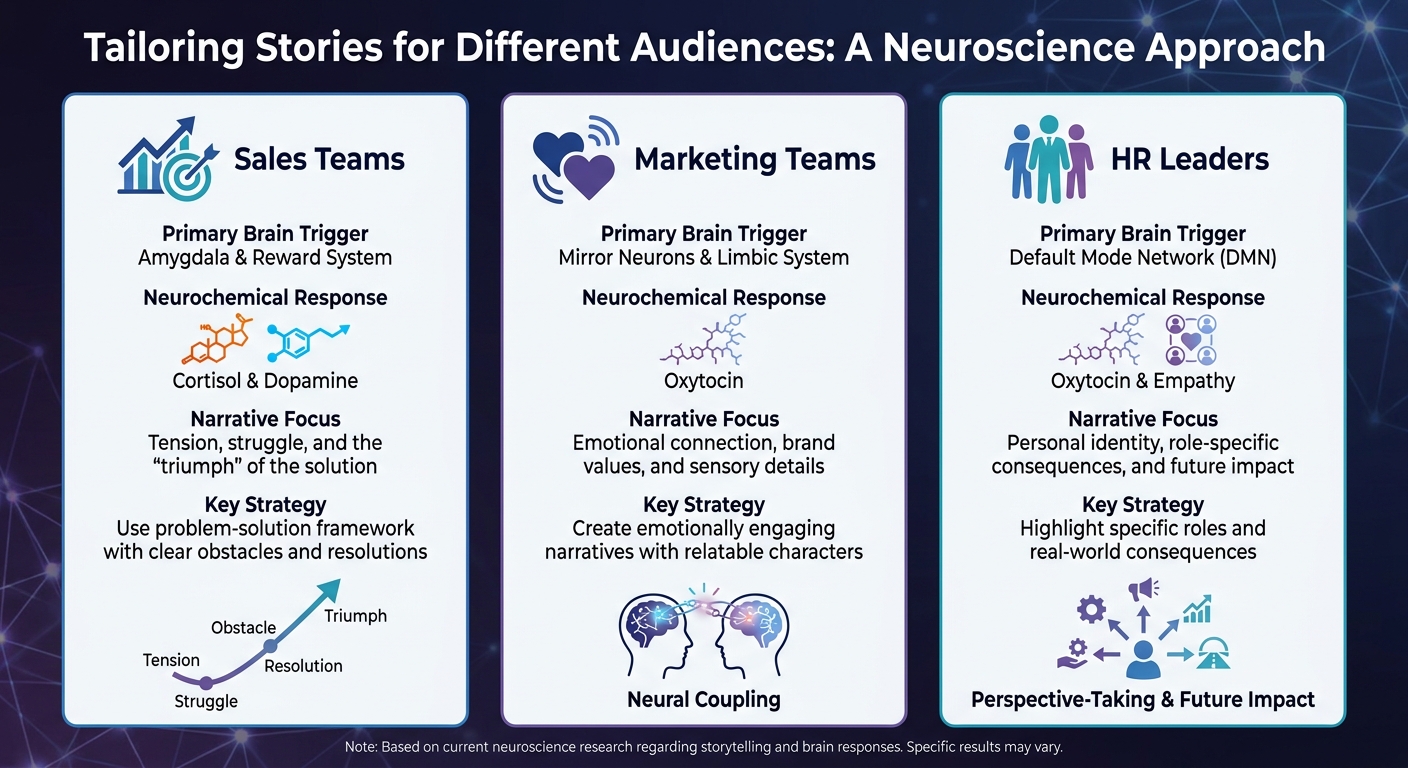
How Different Audiences Respond to Stories: Brain Triggers and Narrative Strategies
Not everyone reacts the same way to a story. A narrative that hooks a sales professional might completely miss the mark with an HR leader. The secret? Understanding the neurological triggers that resonate with each group and shaping your story to match. Here's how sales, marketing, and HR teams each connect with stories in their own way.
Sales Teams: Using Tension and Resolution
For sales teams, stories built around a clear problem-solution framework work wonders. Neuroscience shows that when you introduce a challenge or pain point, it activates the amygdala - our brain's threat detection system - creating a sense of tension. This tension is heightened by cortisol, fully engaging the brain. When the story resolves the issue, dopamine is released, leaving the audience feeling satisfied and reinforcing the solution.
As Rob Vujaklija, Director of Sales Performance at Braintrust, explains:
"The brain doesn't remember bullet points. It remembers stories".
For sales teams, this means crafting case studies or pitches where the protagonist faces a real obstacle, and your product or service swoops in to save the day. It's all about building suspense and delivering a rewarding resolution.
Marketing Teams: Building Trust Through Emotion
Marketing stories thrive on emotional depth. Neuroscience reveals that emotionally engaging narratives trigger oxytocin, the neurochemical tied to trust and connection. By weaving in relatable characters and heartfelt moments, you create "neural coupling", where the storyteller's and listener's brain patterns align.
This alignment makes your message more believable because the audience feels like they're experiencing the story with you. Paul J. Zak, Director of the Center for Neuroeconomics Studies, sums it up perfectly:
"When you want to motivate, persuade, or be remembered, start with a story of human struggle and eventual triumph. It will capture people's hearts - by first attracting their brains".
The key here is authenticity. If your story feels forced or fake, it loses its power. Stick to genuine experiences that align with your brand's message.
HR Leaders: Framing Identity and Impact
For HR professionals, stories that focus on personal roles and real-world consequences hit home. Instead of a generic company overview, highlight a specific HR manager by name and title. This activates mirror neurons, allowing your audience to step into the character's shoes and feel their challenges and successes.
Such narratives engage the Default Mode Network (DMN), encouraging HR leaders to imagine themselves taking similar actions. Including visual elements like headshots and names in your case studies adds credibility and boosts oxytocin levels, making the story more relatable and impactful.
These tailored storytelling approaches pave the way for a science-backed framework that connects with each audience on a deeper level.
| Audience Segment | Primary Brain Trigger | Neurochemical Response | Narrative Focus |
|---|---|---|---|
| Sales Teams | Amygdala & Reward System | Cortisol & Dopamine | Tension, struggle, and the "triumph" of the solution |
| Marketing Teams | Mirror Neurons & Limbic System | Oxytocin | Emotional connection, brand values, and sensory details |
| HR Leaders | Default Mode Network (DMN) | Oxytocin & Empathy | Personal identity, role-specific consequences, and future impact |
5-Part Storytelling Framework Based on Brain Science
This five-part storytelling framework taps into neuroscience to create stories that captivate and stick with your audience. By triggering specific neural responses, this structure ensures deeper engagement and better retention.
Protagonist Introduction
Start your story with a character your audience can connect with - someone who reflects their struggles, goals, and experiences. This activates mirror neurons, making the audience feel as though they’re living the character’s journey. At the same time, the temporal poles process social and emotional cues, while the amygdala evaluates the character’s emotions. For example, if your audience is a sales team, you might introduce a VP of Sales dealing with pipeline issues. For HR professionals, it could be a talent director tackling employee retention. By aligning the protagonist’s traits and challenges with your audience’s, you create what neuroscientists refer to as "emotional contagion". This sets the stage for a story that feels personal and immediately engaging.
In Medias Res Hook
Skip the slow build-up and dive straight into the action. Starting mid-conflict triggers a dopamine release, sharpening focus and enhancing memory, while cortisol ensures the brain pays attention. Picture this opening: "Sarah stared at the third resignation letter of the week." This approach grabs attention through novelty and urgency. Keep the language simple - stories written at an elementary reading level reduce cognitive strain, keeping your audience hooked.
Building Cognitive Tension
After grabbing attention, introduce a "knowledge gap" - a clear distinction between the current state and what could be. This engages the amygdala to process the conflict and activates the medial prefrontal cortex, which works to resolve uncertainty. Use sensory details to bring the story to life, engaging the sensory and motor cortex for a more immersive experience. Tailor this tension to your audience’s interests: sales professionals might respond to stories about meeting quotas, while HR leaders might connect with tales of improving workplace dynamics.
Resolution and Message Delivery
Wrap up the story with a transformation that delivers a dopamine boost, reinforcing the narrative and its takeaways. Highlight how the protagonist’s journey led to meaningful change - this makes your message more memorable. Combine concrete data with emotional impact. For instance, instead of simply saying, "conversion rates improved", show how that success boosted the protagonist’s confidence or strengthened team morale. This blend of logic and emotion ensures your story resonates and sticks with the audience.
Circular Closure for Memory Retention
End your story by tying it back to your audience’s reality. This activates the Default Mode Network (DMN), which helps people take perspective and imagine future actions. The posterior cingulate cortex plays a role in encoding the story into memory, ensuring it leaves a lasting impression. Add a subtle nudge toward future steps that align with your brand, leaving your audience inspired to act.
| Story Framework Part | Primary Neuroscience Principle | Neurological/Chemical Response |
|---|---|---|
| Protagonist Introduction | Mirror Neurons / Temporal Poles | Empathy, social/emotional processing |
| In Medias Res Hook | Dopamine / Cortisol | Heightened focus, arousal, and attention |
| Building Cognitive Tension | Amygdala / Medial Prefrontal Cortex | Threat detection, analyzing motives |
| Resolution | Reward System / Dopamine | Memory reinforcement, satisfaction |
| Circular Closure | Default Mode Network (DMN) | Perspective-taking, future-planning, action |
Using BrandMultiplier.ai's Narrative OS for Tailored Storytelling
Narrative OS, offered by BrandMultiplier.ai, takes storytelling to the next level by combining neuroscience with strategy. This system transforms storytelling into a measurable tool for growth, aligning leadership, sales, product development, and marketing efforts. It uses principles of brain science to craft narratives that resonate deeply with audiences, embedding these stories across your organization to achieve real, measurable business goals.
One of its core techniques is leveraging narrative transportation, a psychological state where the audience becomes fully immersed in the story. In this state, their analytical mind temporarily lets its guard down, reducing counterarguments and resistance. This not only improves customer acquisition costs (CAC) but also boosts conversion rates.
Narrative OS also uses the brain's natural chemistry to enhance storytelling impact. By strategically stimulating oxytocin, dopamine, and cortisol at specific moments, it creates shared neural experiences between your audience and your team. This process, known as neural coupling, builds stronger connections with your brand, improves memory retention, and increases customer lifetime value (LTV).
The system works seamlessly across different departments to ensure consistent messaging. For example:
- Sales teams use tension-and-resolution stories to adjust cortisol and dopamine levels, keeping prospects engaged.
- Marketing teams focus on character-driven narratives that spark oxytocin, fostering empathy and trust.
- HR teams craft identity and impact stories to promote internal cohesion, activating the brain’s Theory of Mind.
By tying these neuroscience-driven stories directly to performance metrics like CAC, deal speed, and LTV, Narrative OS ensures every story delivers tangible results. It continuously measures and refines its narratives to optimize their impact, translating into lower acquisition costs, faster deal closures, and greater customer loyalty.
Consistency across all channels is another key benefit. A unified narrative eliminates the skepticism that often arises from mixed messages. With neuroscience-backed stories integrated into custom AI tools and tracked against critical KPIs, Narrative OS turns storytelling into a precise and effective growth strategy.
Measuring How Well Your Stories Work
Understanding how well a story resonates with its audience requires precise neuroscience techniques. These methods help identify which moments captivate attention and which might fall flat. Once you've crafted a story using neuroscience insights, the next step is measuring its real-time impact.
Inter-Subject Correlation (ISC)
Inter-Subject Correlation (ISC) evaluates how synchronized brain activity becomes between the storyteller and the audience. When a story truly connects, the listener's brain activity mirrors that of the speaker, particularly in regions of the prefrontal cortex. This synchronization signals effective engagement and anticipation. Interestingly, during especially engaging narratives, the audience's prefrontal activity sometimes precedes the storyteller's. This suggests the brain is actively predicting upcoming elements and piecing together overarching themes for coherence.
EEG Patterns for Tension Phases
EEG data sheds light on when tension peaks within a narrative. A key indicator is the N400 event-related potential (ERP), which measures the difficulty of semantic processing. A spike in N400 amplitude signals increased processing effort, reflecting heightened engagement and tension.
"N400 amplitude increases as a function of the semantic distance between a target word and the prior discourse." - Peter Ford Dominey, Researcher, PLOS Computational Biology
Beyond EEG, tools like electrocardiograms and electrodermal sensors monitor heart rate and sweat levels. These metrics often peak during a story's climax, confirming the audience's emotional engagement. Additionally, vagal nerve activity provides insight into emotional connection and trust. Research shows that strong emotional resonance during key moments can influence audience behavior after the story ends.
Audience Recall and Belief Metrics
The ultimate test of a story's success lies in its lasting impact. When a narrative fully absorbs its audience, it triggers "narrative transportation", where listeners adopt the story's logic as their own. This deep immersion can lead to a "sleeper effect", where belief in the story's message strengthens over time. To measure this, it's important to assess audience recall and belief alignment not just immediately after hearing the story, but also weeks later - such as 14 days post-exposure.
"Stories have the power to reshape the beliefs and behaviors of the listeners because they fool the story receiver's primal brain in believing the story is real." - Morin and Renvoise
Conclusion
Stories have a profound impact on how audiences perceive and make decisions. By engaging mirror neurons, neural coupling, and the Default Mode Network, stories create lasting impressions. In fact, research shows that people remember stories 22 times better than plain facts. Without emotional context, nearly half of the information presented is forgotten within an hour. For businesses, these insights offer a clear advantage.
For small and medium-sized businesses (SMBs) and funded startups, leveraging neuroscience in storytelling isn't just theoretical - it’s a practical way to outpace competitors. By using storytelling techniques rooted in brain science, companies can lower customer acquisition costs (CAC), speed up deal cycles, and increase customer lifetime value (LTV). Neuroscience-backed strategies - like appealing to relatable pain points to trigger oxytocin, crafting satisfying resolutions to release dopamine, and building tension to engage cortisol - create narratives that stick with audiences, bypass skepticism, and make brands unforgettable.
"Stories, not spreadsheets, are how you build strong relationships with other human beings."
- Joe Lazer, CMO and Author
BrandMultiplier.ai’s Narrative OS takes these principles and turns them into actionable growth tools. It helps businesses craft their most impactful strategic story, integrate it across their organization, and measure its influence on CAC, deal velocity, and LTV. The system continuously fine-tunes these narratives, ensuring they remain effective quarter after quarter. This approach transforms storytelling from a creative exercise into a measurable driver of business growth.
Brands that succeed aren’t necessarily the ones with the biggest budgets - they’re the ones that know how to frame their story effectively. As Science Array puts it, "The person who controls the frame controls the decision." When you craft audience-specific narratives rooted in neuroscience, you’re not just telling a story - you’re reshaping how your audience views themselves, their challenges, and the role your brand plays in their success.
FAQs
How do I tailor one story for sales, marketing, and HR?
Tailoring a single story for sales, marketing, and HR means shaping it to align with the distinct priorities and needs of each audience.
- For sales, highlight how the story addresses specific challenges and offers solutions. Focus on emotional appeal to build trust and help accelerate decision-making.
- For marketing, aim for narratives that are memorable and relatable. The goal is to create emotional connections that leave a lasting impression.
- For HR, the story should reflect company values, inspire employees, and reinforce a sense of community and shared purpose.
What’s the simplest way to add “tension and resolution” to a business story?
Crafting a compelling business story means weaving in details that catch people off guard - those unexpected twists or unusual elements that grab attention. Why? Because these moments spark curiosity and trigger dopamine, the brain's reward chemical. It's what keeps your audience hooked.
To do this effectively, focus on creating a sense of tension and resolution. Build up moments of conflict or unanswered questions that make people lean in, then deliver a payoff that feels rewarding. The combination of curiosity and a satisfying conclusion is what makes a story stick.
How can I measure whether a story improved CAC, deal speed, or LTV?
To determine whether a story has positively impacted Customer Acquisition Cost (CAC), deal speed, or Lifetime Value (LTV), start by establishing clear benchmarks for these key metrics before rolling out your strategy. Once the story is in play, track changes over time by comparing the initial baseline data to the updated results.
Leverage analytics tools to monitor engagement metrics like time spent on content or click-through rates. These insights can help you connect storytelling efforts to tangible improvements in CAC, deal velocity, and LTV.
Ready to transform your brand story?
Schedule a free diagnostic to see how we can help.
Schedule The Diagnostic