

How Leadership Drives Brand Narrative Consistency
How Leadership Drives Brand Narrative Consistency
Consistency in your brand’s story is essential to building trust and driving growth. Every customer interaction - whether through marketing, sales, or support - should reflect the same purpose, tone, and values. Leadership plays a key role in ensuring this alignment across teams and channels.
Key Takeaways:
- Brand narrative consistency means delivering a unified message across all touchpoints.
- Leaders set the tone by defining the brand’s purpose and ensuring alignment across departments.
- Inconsistency damages trust, leading to lost customers and reduced revenue.
- Structured frameworks, like the 4 C's (Clarity, Consistency, Content, Communication), help maintain alignment.
- AI tools can support leaders by monitoring messaging and ensuring uniformity in real time.
Why it matters: Companies with consistent narratives see measurable results, like a 42% boost in conversion rates and shorter sales cycles. Leadership is the driving force behind this success, ensuring the brand’s story resonates internally and externally.
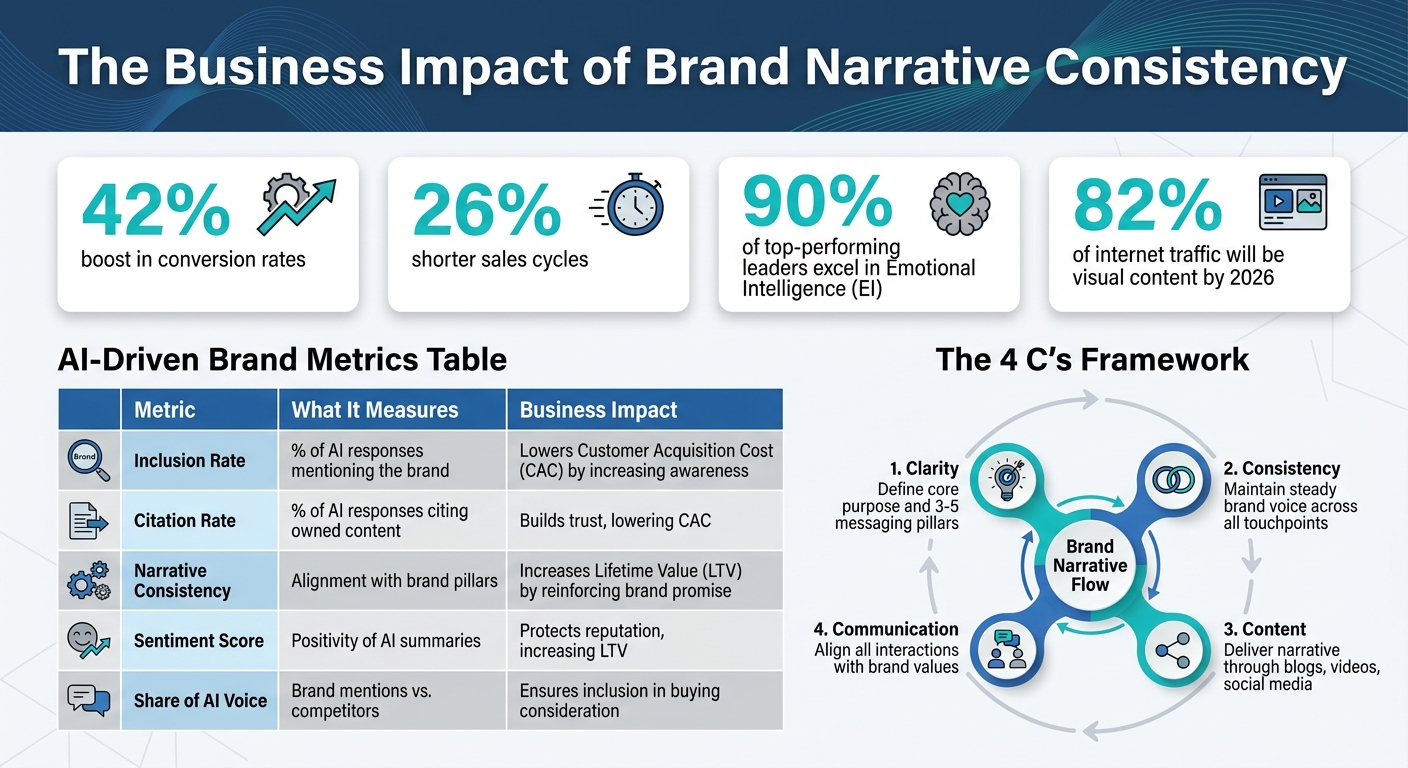
Impact of Brand Narrative Consistency on Business Performance
The Secret to Getting Your Whole Team Aligned and Telling a Consistent Brand Story
sbb-itb-63525a7
How Leaders Shape Brand Consistency
Leaders play a vital role in maintaining brand consistency by defining a clear purpose, fostering alignment across teams, and embodying the brand's core values.
Setting a Clear Vision and Purpose
Consistency starts with clarity. Leaders need to define the company’s purpose - the "Why" that goes beyond just making money. This purpose acts as a guiding star for teams across the organization. By distilling the brand’s narrative into 3–5 messaging pillars, leaders can translate high-level strategy into actionable points that resonate in sales pitches, product development, and customer support. When everyone operates from the same playbook, the customer experience feels seamless and cohesive.
To keep this vision relevant, regular audits are essential. These check-ins ensure that as the company evolves, its purpose remains intact and aligned with its goals.
However, defining the vision is only the first step. Leaders must also break down silos to ensure every team adopts and applies the shared narrative.
Building Cross-Functional Collaboration
Silos within organizations often lead to inconsistent messaging. For example, marketing might focus on innovation while sales highlights reliability, leaving customers confused. Leaders can tackle this by hosting discovery workshops that bring together teams from marketing, sales, product, and customer success. These sessions align everyone on a unified strategic foundation.
During these workshops, teams collaborate to develop a shared language for the organization. This ensures that every department - whether it’s sales, HR, or external partnerships - understands how to apply the brand framework in their specific roles. This shared language reinforces the leader’s overarching narrative, creating a consistent thread that runs throughout the company.
Different leadership styles can shape how collaboration unfolds:
| Leadership Style | Brand Culture Impact | Customer Perception | Growth Pattern |
|---|---|---|---|
| Transformational | Focuses on innovation | Inspiring and forward-thinking | Rapid growth through vision |
| Servant | Prioritizes service and support | Trustworthy and caring | Steady growth through loyalty |
| Democratic | Encourages collaboration | Approachable and flexible | Sustainable through engagement |
| Authoritarian | Driven by efficiency | Professional but distant | Dependent on leadership consistency |
Among these, democratic leadership often proves most effective in maintaining alignment. By valuing team input and distributing decision-making, it fosters collaboration and ensures that the brand culture remains consistent across departments.
Once alignment is achieved, the next step is for leaders to actively model the brand values in their actions.
Modeling the Brand Narrative
For a brand narrative to truly resonate, leaders must live it. Leadership builds what can be described as invisible brand equity. When leaders consistently act in line with the brand’s values, these behaviors become the standard for employees to follow. However, when there’s a disconnect between what leaders say and what they do, trust erodes quickly.
"A brand starts to deteriorate when trust breaks internally before it breaks externally."
- Rebecca Hoeft, CEO & Founder, Morris Hoeft Group
To avoid this, leaders must link their actions to the brand’s core values. For instance, if transparency is a key value, leaders should openly communicate both successes and setbacks. If innovation is central, they should encourage experimentation and treat failures as learning opportunities. These actions ensure that every customer interaction reflects the brand’s principles.
Emotional intelligence (EI) is another crucial factor. Research indicates that 90% of top-performing leaders excel in EI. Leaders with high EI are skilled at picking up on unspoken cues from both customers and employees, responding with authenticity, and building stronger relationships. This might involve reviewing team or client interactions to identify subtle emotional signals and improve future engagements.
"Leadership reputation is not what you say about yourself. It is what others consistently experience when they interact with your brand at every touchpoint."
- Reasonate Studio
When leaders genuinely embody the brand’s narrative, they create "reputation velocity." This is the compounding effect where consistent credibility accelerates growth across various channels. A strong CEO reputation doesn’t just enhance customer trust - it also boosts investor confidence, signaling the company’s cultural and strategic strengths for long-term success.
Frameworks for Maintaining Brand Narrative Consistency
To build a cohesive brand narrative across departments and channels, leaders need structured tools that embed brand strategy into daily operations. Without a clear framework, even the best vision can splinter, leading to inconsistent messaging. Two key approaches to maintaining alignment are the 4 C's Framework and the use of storytelling as a leadership tool.
The 4 C's Framework: Clarity, Consistency, Content, Communication
The 4 C's Framework provides a roadmap for leaders to evaluate and reinforce their brand narrative at every touchpoint:
- Clarity: This begins with defining your business’s core purpose - the "Why" that drives what you do. Tools like Simon Sinek's Golden Circle can help distill this into 3–5 key messaging pillars supported by data.
- Consistency: Trust is built through repetition. While tone may shift depending on the audience (e.g., empathetic for customer service, formal for investor relations), the brand's voice - its personality and vocabulary - must remain steady.
- Content: Content acts as the delivery mechanism for your narrative. Leaders can set up publishing schedules and create templates to ensure blogs, videos, and social media posts reflect consistent messaging.
- Communication: This ties everything together. Every interaction should align with brand values, and applying the 7 C's of Communication - Clear, Concise, Concrete, Correct, Considerate, Complete, and Courteous - helps ensure that all messaging stays on track with the brand's strategic goals.
Using this framework, leaders can turn abstract goals into actionable, measurable outcomes. It also sets the stage for incorporating storytelling techniques that bring the brand to life.
Using Storytelling as a Leadership Tool
Storytelling complements structured frameworks by making brand values tangible and relatable. Instead of simply listing features, great leaders use stories to connect emotionally with their audience. A powerful approach is positioning the customer as the hero and the brand as the guide. For example, Apple’s "Everyone has a story to tell" campaign demonstrates how a simple narrative can unify teams and resonate deeply with audiences.
"A strong brand messaging framework is your brand's North Star. It guides every word, every video, and every interaction to ensure customers get a consistent, memorable experience no matter where they find you."
To apply storytelling effectively, leaders can develop a messaging matrix. This tool maps specific brand stories and proof points to different audience segments and communication channels, ensuring marketing, sales, and support teams speak with one voice. Quarterly audits can identify gaps and refine the narrative as market dynamics change, helping balance flexibility with a strong core identity.
With visual content expected to dominate internet traffic - projected to account for 82% by 2026 - recurring video themes can further reinforce consistency. Storytelling should become second nature across the organization, integrated into HR onboarding, performance reviews, and agency workflows. When storytelling becomes a habit, consistency feels effortless rather than forced.
How AI Supports Leadership and Brand Consistency
When it comes to driving consistent brand narratives, leaders now have AI as a powerful ally. AI helps ensure that messaging remains aligned across all channels in real time. Unlike the old-school method of manually reviewing content, AI can analyze elements like tone, voice, style guides, and visuals to guarantee uniformity across vast amounts of material. This makes documenting and maintaining a cohesive brand story not just easier but also more efficient.
Documenting Brand Stories with Narrative OS
A critical first step in achieving consistency is documenting the brand story so it can be replicated across teams. Enter Narrative OS, a tool developed by BrandMultiplier.ai. This Growth Operating System uses a neuroscientific framework to capture the company’s strategic narrative and distribute it across leadership, sales, product, and marketing teams. It addresses a key challenge highlighted by Greg Wester:
"If a firm's narrative isn't optimized to win without its founder in the room, it's a growth bottleneck." - Greg Wester, Founder of Prezonate
One way leaders can identify inconsistencies is through a "Shadow Test." Team members independently describe the company’s story, and AI synthesizes these responses to identify gaps or misalignments. AI simplifies this process by organizing information, distilling interview transcripts, and creating outlines that can serve as the foundation for scalable brand documentation.
Measuring Brand Impact with AI-Driven Metrics
After documenting the narrative, AI helps track its consistency and measure its impact on business outcomes. For instance, in 2026, IBM used tools like Adobe Firefly and Adobe GenStudio to generate 100 assets and over 1,000 marketing variations for a single campaign. This approach maintained brand consistency across global markets while dramatically boosting output.
AI metrics have also evolved beyond traditional click-based analytics. Now, they focus on influence-based measures such as:
- Inclusion Rate: The percentage of AI responses that mention the brand.
- Narrative Consistency Index: How well AI platforms align with the brand’s core pillars.
- Citation Sentiment Score: The positivity of AI-generated summaries.
These metrics not only ensure consistent messaging but also improve key performance indicators like conversion rates and sales efficiency.
| Metric | Definition | Impact on KPI |
|---|---|---|
| Inclusion Rate | % of AI responses mentioning the brand | Lowers CAC by increasing awareness |
| Citation Rate | % of AI responses citing owned content | Builds trust, lowering CAC |
| Narrative Consistency | Alignment with brand pillars | Increases LTV by reinforcing brand promise |
| Sentiment Score | Positivity of AI summaries | Protects reputation, increasing LTV |
| Share of AI Voice | Brand mentions vs. competitors | Ensures inclusion in buying consideration |
Once leaders measure the impact, they can make agile adjustments to adapt to market changes.
Making Real-Time Adjustments to Messaging
Markets evolve fast, and AI gives leaders the tools to adapt without losing sight of their core brand identity. One key feature is "narrative drift" monitoring, where AI alerts leaders if public or AI-generated perceptions of the brand deviate from its intended positioning. This is especially critical in today’s environment of zero-click discovery, where answers provided by AI shape brand perceptions before potential customers even visit a website.
To stay on top of this, leaders can conduct monthly AI audits. By running 10–20 prompts through models like ChatGPT or Gemini, they can assess how their brand is currently described. If discrepancies arise, refreshing key product pages or case studies can provide updated information for the models to pull from.
"In LLM environments, you win by being included in the answer, not clicked in the link. Measurement models must evolve to track influence, not just interaction." - Rob Welsby, Global Head of SEO at Gravity Global
While AI handles the heavy lifting of high-volume content creation, human leaders remain essential for setting strategic goals and making nuanced decisions. This partnership ensures that brand narratives stay aligned with business objectives while keeping pace with changing market dynamics and customer expectations.
Conclusion: Leadership as the Driver of Brand Success
Consistency in a brand's narrative starts with leadership. Rebecca Hoeft, CEO & Founder at Morris Hoeft Group, sums it up perfectly: "Leadership establishes the conditions that shape employee behavior. Behavior creates the brand experience. And, the brand experience builds trust". When leaders define a clear vision, embody the narrative, and encourage collaboration across departments, they lay the groundwork for a brand that connects seamlessly across every interaction.
Internal misalignment can damage trust long before it reaches customers. If employees see a disconnect between the values promoted and the actions taken within the organization, that inconsistency will eventually show in customer interactions. Leaders need to ensure that the values they champion are evident in every decision - from hiring practices to product design and customer support.
The impact of cohesive messaging is undeniable. Companies that align their narrative see a 42% boost in conversion rates and shorten sales cycles by 26%. These aren't just numbers - they reflect tangible benefits like reduced customer acquisition costs and faster revenue growth. However, achieving and maintaining these outcomes requires a narrative that thrives even without the founder's presence. Gregory Wester, Founder of Prezonate, cautions: "If a firm's narrative isn't optimized to win without its founder in the room, it's a growth bottleneck". Tools like Narrative OS can help leaders address this challenge by embedding consistency into every aspect of the organization.
Platforms like Narrative OS allow leaders to codify their strategic story and integrate it into AI systems, ensuring the narrative is reinforced across teams. These tools also provide real-time insights into how the story influences key metrics like customer acquisition costs, deal velocity, and customer lifetime value.
At its core, brand consistency is about executing the leader's vision. It requires treating storytelling as both an art and a science - crafting a narrative that every employee can share with confidence and weaving it into the fabric of daily operations. When leaders take this approach, they turn their brand into more than just a collection of marketing efforts. It becomes a long-term advantage, shaping customer experiences and driving growth in a way that compounds over time. By operationalizing their vision, leaders transform messaging into a competitive edge that fuels sustainable success.
FAQs
How do leaders turn a brand purpose into daily behavior across teams?
Leaders bring a brand's purpose to life by consistently communicating and exemplifying its vision and values. When leaders provide this clarity, it sets clear expectations and ensures that team actions align with the brand’s mission. They further strengthen this connection by making decisions, fostering interactions, and empowering teams in ways that reflect the brand's core purpose. Tools like BrandMultiplier.ai’s Narrative OS can play a key role in this process. By codifying and measuring alignment in real-time, these tools help weave the brand narrative into everyday practices seamlessly.
How can we tell if our brand story is drifting across channels?
To spot if your brand story is losing its way, start by evaluating whether your messaging remains clear, consistent, and aligned with your core values. This means checking if your tone, visuals, and overall message feel uniform across all platforms - like social media, your website, and even internal communications.
Leadership is crucial here. Strong guidance ensures your brand stays on track and aligned with its original vision. Tools like BrandMultiplier.ai's Narrative OS can also step in to help. They allow you to measure and fine-tune your story in real-time, keeping everything consistent and on point.
What should we measure to prove narrative consistency is boosting revenue?
Consistent storytelling isn't just about creating a cohesive brand image - it directly ties to measurable business success. To see its impact, monitor key performance indicators like:
- Customer trust: Strong, consistent narratives help build and maintain trust over time.
- Engagement: Track how often and deeply customers interact with your content or brand.
- Conversion rates: A unified message can make the difference in turning prospects into customers.
- Sales velocity: Consistency can streamline decision-making, speeding up the sales process.
- Customer lifetime value (LTV): A reliable brand story often fosters long-term loyalty and repeat business.
- Sales cycle length: Clear, aligned messaging can reduce the time it takes to close deals.
These metrics shed light on how consistent messaging drives tangible results for your business.
Ready to transform your brand story?
Schedule a free diagnostic to see how we can help.
Schedule The Diagnostic