
Mastering Narrative Alignment for Market Growth
Mastering Narrative Alignment for Market Growth
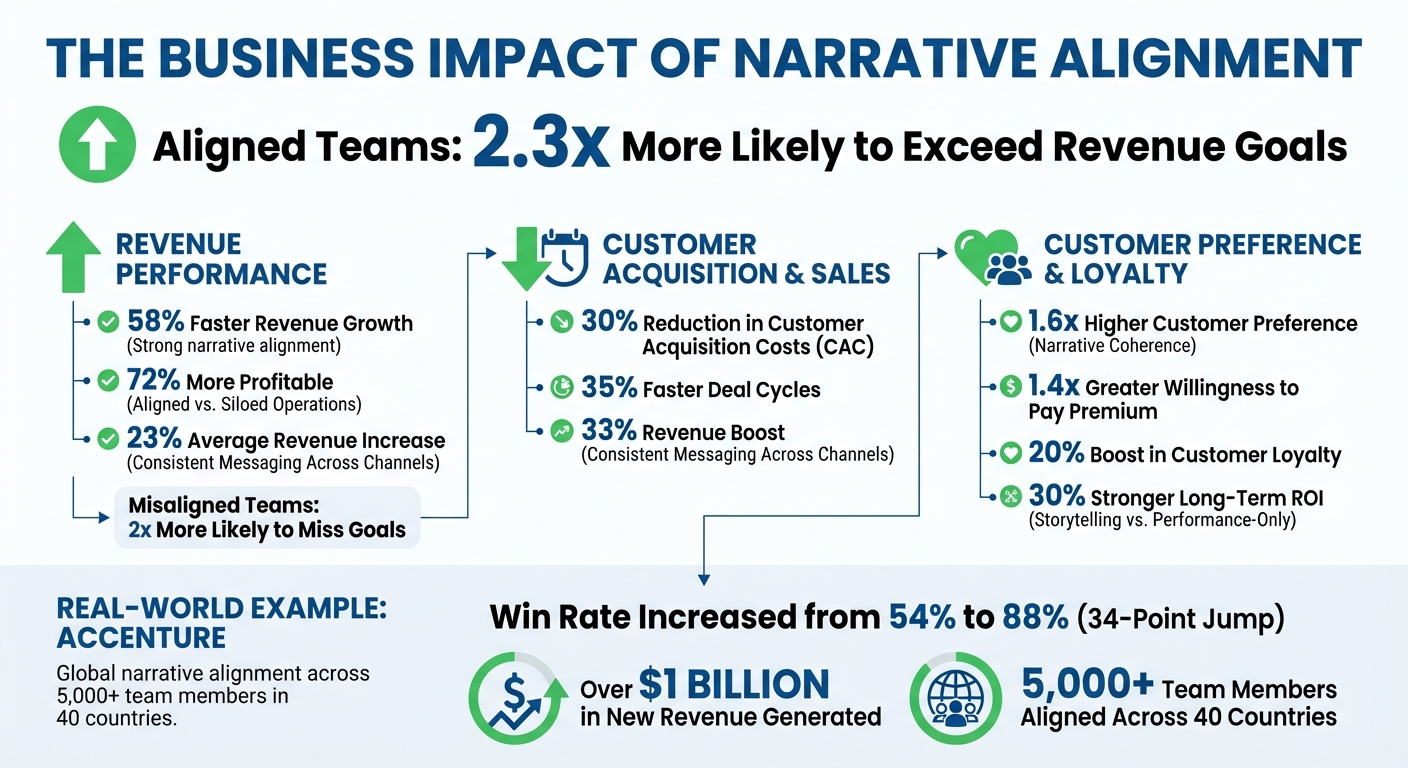
Want to grow your business faster? It starts with aligning your team on one clear story. When leadership, sales, product, and marketing all speak the same language, companies hit revenue targets 2.3x more often. But misalignment? It doubles the chances of missing goals.
Here’s the key: Narrative alignment isn’t just about slogans. It’s about syncing your company’s beliefs, promises, and actions into a single, consistent message. This guide breaks down how to build that alignment, from auditing your current messaging to embedding it across teams. The payoff? Lower customer acquisition costs, faster sales cycles, and stronger customer loyalty.
Key takeaways:
- Audit your narrative for gaps between leadership's vision and frontline messaging.
- Create a one-page messaging framework to unify your brand promise, pillars, and proof points.
- Involve leaders across departments to ensure everyone is on the same page.
- Use neuroscience-backed storytelling to emotionally connect with buyers.
- Track metrics like sales cycle length, customer retention, and revenue growth to measure success.
When teams share the same story, customers trust your brand - and trust drives growth.
Narrative Alignment Impact on Business Growth: Key Metrics and ROI
Building a Narrative Operating System that Scales Your Business
sbb-itb-63525a7
Building the Foundation
Take a close look at your narrative to spot any disconnects between the CEO's vision and how it's communicated on the frontlines. Misalignment here can confuse potential buyers, undermine trust, and slow down your sales process. The first step? Audit your current narrative to uncover these gaps.
Auditing Current Brand Narratives
Start with a positioning stack audit. Create a one-page summary that ties your single brand promise to three key product pillars, each backed by proof stories. Then, check for consistency across your homepage, sales decks, and demos. You'll often find discrepancies.
Next, do a touchpoint inventory. Review all customer-facing materials - websites, ads, presentations, onboarding guides, social media, and support scripts. Look for mismatched tone or terminology. For instance, does marketing call your product "enterprise-grade" while sales describes it as "simple and accessible"? These vocabulary clashes often hint at deeper misalignment.
To quickly pinpoint key issues, conduct a 90-minute audit. Focus on your homepage, pricing page, and sales deck headlines, and listen to a few recent sales calls. Identify the top five mismatches in messaging that need immediate attention. This exercise often uncovers how field teams have already tweaked the narrative to address objections - a crucial insight for refining your official messaging.
Interview your customer-facing teams to bridge the gap between internal strategy and actual customer experience. Sales reps often know which objections your marketing materials fail to address, while support teams hear how customers describe your product firsthand. Closing these gaps can pay off big: brands with consistent messaging across all channels report up to a 33% revenue boost, while alignment can cut customer acquisition costs by as much as 30%.
Creating Cross-Departmental Collaboration
Aligning your narrative isn’t just a marketing project - it requires input from multiple leaders. Form a core team that includes the CEO, Head of Product, Head of Sales, Head of Marketing, and RevOps. This group will oversee your narrative, ensuring all departments communicate with one voice and work toward common goals.
Develop a one-page messaging framework that outlines your brand promise, key pillars, and proof points. This concise document will serve as a daily reference - far more practical than a 40-page guide that no one uses. Pair it with a "use/avoid" glossary to standardize terminology across product, marketing, and sales. Consistent language creates a smoother experience for customers.
Set up feedback loops to catch and fix messaging drift. For example, join sales calls or review monthly drift reports to identify and correct inconsistencies. These steps help keep your narrative intact as your company grows.
The payoff is worth it. Teams that align their messaging are 2.3 times more likely to exceed revenue goals, while misaligned teams are twice as likely to fall short. Take Accenture as an example: by aligning over 5,000 team members across 40 countries with a Narrative Operating System, they increased win rates from 54% to 88% - a 34-point jump - and generated over $1 billion in new revenue.
"The #1 job of any brand leader is to drive alignment."
- Kira Klaas, Brand Leader
This foundational work is critical. Without a unified internal message, scaling your narrative effectively becomes nearly impossible. Once you've audited your current state and aligned your teams around shared goals and language, you'll be ready to create a narrative that drives real growth.
Codifying the Story
After laying the groundwork with audits and cross-departmental alignment, the next step is turning your strategic narrative into a structured framework. This process transforms scattered ideas into a cohesive story that resonates deeply. But don’t think of this as just another document destined to be forgotten. Instead, it’s about creating a neuroscience-backed storytelling framework that connects emotionally with buyers and delivers measurable outcomes.
Applying Neuroscientific Architecture
The human brain, specifically the limbic system, is wired to find meaning through stories. It thrives on a classic three-act structure: Setup, Problem, and Resolution. This is where the ABT Framework - And (Agreement), But (Contradiction), Therefore (Consequence) - comes into play.
Here’s the approach: position your customer as the hero of the story, while your brand takes on the role of the guide or mentor. When audiences engage with such narratives, their mirror neurons activate, allowing them to emotionally connect and experience the journey themselves. This emotional connection fosters trust far more effectively than a list of product features ever could.
And the results speak for themselves. Brands that excel in narrative coherence enjoy 1.6× higher customer preference and 1.4× greater willingness to pay a premium.
"The core emotion behind every strategic narrative is belonging."
- Andy Raskin, Strategic Narrative Consultant
The key to crafting a compelling narrative is to focus on creating a sense of belonging. Instead of highlighting technical specs or features, frame your story around a shift in perspective. For instance, rather than saying, “Our software is 20% faster,” you might say, “The era of manual workflows is over.” This approach invites your audience to join a movement or embrace a new way of thinking.
Developing a Brand Playbook
A brand playbook serves as your team's go-to guide, ensuring everyone - from sales to customer support - speaks the same language. It should include:
- Brand purpose: Why your company exists beyond just making a profit.
- Target personas: Insights into motivations and emotional triggers.
- Positioning statement: The unique space your brand occupies.
- Messaging pillars: Three to five core themes supported by proof points.
It’s also important to distinguish voice (your brand’s consistent personality) from tone (how the voice adjusts depending on the context). For example, marketing might use an inspirational tone, while customer support leans toward empathy. Both, however, must feel like they come from the same company. A “use/avoid” glossary can further standardize language across teams.
A critical piece of this playbook is the sales deck. As Andy Raskin puts it, “The sales deck becomes the ‘true north’ for the company”. By involving key leaders - like the CEO, Head of Product, Head of Sales, and Head of Marketing - in crafting this deck, you ensure alignment and buy-in from day one. This deck isn’t just a presentation; it’s a tool for testing and refining your narrative in real-world scenarios within just a few weeks.
BrandMultiplier.ai’s Narrative OS takes this concept further by using neuroscientific principles to craft a story that resonates deeply. It then integrates this narrative across leadership, sales, product, and marketing teams. The system even uses custom AI to ensure consistency at every touchpoint while tracking critical metrics like CAC, deal speed, and LTV in real time.
The impact of a unified narrative is substantial. Consistent messaging across all channels can increase revenue by an average of 23%. Additionally, brands that prioritize storytelling over purely performance-driven strategies see up to 30% stronger long-term ROI. Your playbook isn’t just a guideline - it’s the engine that drives growth. With this in place, the next step is embedding your narrative into every channel.
Installing and Operationalizing the Narrative
Once your brand playbook is complete, the next step is making sure it becomes part of your organization’s daily operations. A playbook alone won’t drive results - it’s the operational discipline behind it that turns it into a tool for growth. The goal is to move beyond static guidelines and establish Brand Ops, a system that weaves your messaging into the daily routines of every team member.
Your sales deck plays a critical role here, acting as the “true north” to ensure consistency. It prevents teams from cherry-picking their favorite messages and ignoring others. But it’s not just about having the materials; it’s about making sure every team member fully understands and applies the narrative in their work.
Embedding the Narrative Across Teams
For the narrative to truly impact revenue, it must be second nature to your team. This is where Team Fluency Certification comes in. If a sales rep, product manager, or support agent can’t explain the narrative in their own words, it hasn’t been fully absorbed.
To embed the narrative effectively, tailor its application to each department’s unique responsibilities. For example:
- Sales teams can use approved email templates and CRM prompts.
- Marketing teams can follow pre-launch checklists and ensure AI tools are aligned with the brand voice.
- Product teams can align their roadmaps with the narrative’s strategic vision.
- Customer support teams can use tone-matched response guidelines for consistency.
"Marketing writes the voice. Brand Ops makes sure everyone else speaks it." - aibrandunity.com
It’s also important to set up checkpoints to review content for narrative alignment before it reaches customers. These reviews ensure that whether content is created by a person or an AI tool, it matches the standards outlined in your brand playbook. Cross-functional feedback loops are equally valuable. For example, if your product team flags language in a marketing email that doesn’t align with their experience, it’s an opportunity to refine and sharpen the narrative.
Using AI for Omnichannel Consistency
After embedding the narrative manually, you can turn to AI to maintain consistency across all channels. To make this work, load your messaging framework into AI tools as a reference document. Then create prompts that guide the AI to follow your specific voice and style. This avoids the generic, overly corporate tone that AI might default to without proper guidance.
Tools like BrandMultiplier.ai’s Narrative OS take this a step further. They integrate your narrative into custom AI systems that ensure consistency across web, email, social media, and more. These systems don’t just generate content - they also audit it, catching any “narrative drift” before it reaches your audience.
The results of this approach are hard to ignore. Companies using these methods have seen a 30% drop in customer acquisition costs (CAC) and a 35% acceleration in deal cycles. When every channel delivers the same clear and cohesive message, customers don’t have to sort through mixed signals. They understand your story - and why it matters to them - right away.
Measuring and Optimizing for Growth
Once your narrative is in place, the next step is figuring out how well it’s working. Measuring its impact is essential, as narrative alignment can influence every part of the customer journey - from the first interaction to long-term loyalty.
Key Metrics to Monitor
You’ll need to track both leading and lagging indicators. Leading indicators help you gauge whether your teams are actually using the narrative before you see results in the market. For example, you can sample five employees each month and ask them to explain your core narrative in their own words. If they struggle, it’s a sign of a fluency issue.
Lagging indicators, on the other hand, show the narrative's business impact. Keep an eye on metrics like sales cycle time, close rates with your Ideal Customer Profile (ICP), and unaided message recall from customer surveys. To dig deeper, monitor your entire conversion process - from Marketing Qualified Leads (MQL) to Sales Qualified Leads (SQL) to Revenue. This will help you pinpoint where narrative misalignment might be causing friction and costing you deals.
| Metric Category | Specific KPIs to Monitor | Purpose |
|---|---|---|
| Acquisition (CAC) | Inbound lead growth, Cost per MQL/SQL, Brand search volume | Tracks how effectively the narrative attracts the right audience |
| Conversion | Demo-to-paid rate, Sales cycle length (Deal Speed), Close rate in ICP | Measures how well the narrative smooths the buying process |
| Retention (LTV) | Customer retention rate, Net Promoter Score (NPS), Upsell/Cross-sell rate | Evaluates long-term trust and emotional connection with the brand story |
| Coherence | Internal coherence score, Asset consistency audit, Decision alignment | Assesses whether the organization maintains a unified story internally |
| Market Presence | Share of Narrative, Unaided message recall, Social engagement | Analyzes how widely and effectively the narrative is adopted externally |
Data shows that companies with strong narrative alignment grow revenue 58% faster and are 72% more profitable than those operating in silos. Additionally, brands with compelling stories enjoy a 20% boost in customer loyalty, and consistent messaging across channels can increase total revenue by 23%.
Real-Time Tuning and Quarterly Reviews
Keeping your narrative aligned isn’t a one-and-done task - it’s an ongoing process. A monthly Drift Report can help by capturing updates like new customer objections, competitor strategies, and feedback from the field. Use structured feedback loops, such as weekly revenue meetings or dedicated Slack channels, to keep your messaging up-to-date. Revisit and refine your narrative quarterly to ensure it still aligns with your product and market realities.
Each quarter, review your one-page "Positioning Stack", which includes your brand promise, three key pillars, and three proof stories. This ensures your narrative continues to reflect your current product and market positioning.
If you’re looking for a more advanced approach, tools like BrandMultiplier.ai's Narrative OS can analyze how your story impacts metrics like CAC, deal speed, and LTV in real time. It also helps fine-tune your narrative over time. This isn’t just about small adjustments - aligned sales and marketing teams are 2.3x more likely to hit revenue targets, whereas misaligned teams are 2x more likely to fall short.
"Alignment isn't a nice-to-have. It's the growth engine."
- Tanya Thorson, Executive VP Strategic Growth Marketing
Finally, track your Share of Narrative - the percentage of media mentions and social conversations that reference your key messaging. Create a simple codebook of important terms and analyze social and media content monthly. When customers and the market start adopting your language, you’ll know your narrative is gaining traction.
Conclusion
Achieving narrative alignment isn't a one-and-done task - it's an ongoing process that fuels measurable growth. The approach involves a structured cycle: reviewing your current narratives, refining your story with neuroscientific principles, integrating it across all teams, and tracking its influence on key metrics. Companies that embrace this framework tend to grow faster and outperform teams that operate in silos.
The key difference between industry leaders and everyone else lies in consistent narrative alignment. When your product, marketing, and sales teams share the same language and rely on unified proof points, you eliminate the inconsistency that erodes customer trust and slows down execution. As Patrick Lencioni famously said:
"If you could get all the people in an organisation rowing in the same direction, you could dominate any industry, in any market, against any competition, at any time".
Moving beyond slogans is essential. This isn't about plastering the same tagline everywhere - it’s about creating a strategic framework that informs daily decisions, simplifies the buying process, and fosters a sense of connection with your customers. The most successful brands today - like Salesforce with "The Cloud" or Zuora with the "Subscription Economy" - didn't just highlight product features. They redefined market landscapes and positioned themselves as trusted guides through these changes.
For organizations ready to scale this approach, tools like Narrative OS from BrandMultiplier.ai offer a systematic solution. Instead of delivering static presentations, Narrative OS captures your unique value proposition, organizes it into a repeatable structure, and integrates it across leadership, sales, product, and marketing teams. Companies using this system have reported over 30% reductions in customer acquisition costs (CAC) and 35% faster deal cycles within six months. The platform tracks the impact of your narrative on metrics like CAC, deal speed, and lifetime value (LTV) in real time, with quarterly updates to adapt to market changes. By embedding this narrative system across your organization, you build a foundation for sustained success.
The takeaway: narrative alignment isn't just a strategy - it’s the engine that drives growth. When your entire organization shares the same story and purpose, you don't just compete - you lead.
FAQs
What’s the difference between narrative alignment and a tagline?
Narrative alignment focuses on ensuring that everyone within an organization - leaders, teams, and partners - shares a unified story and core message. This shared narrative helps guide decisions and behaviors, fostering internal consistency and trust.
A tagline, however, serves a different purpose. It’s a short, catchy phrase crafted for external audiences to enhance brand recognition and spark emotional connections. Unlike narrative alignment, a tagline doesn’t play a role in maintaining internal coherence or driving strategic alignment within the organization.
How do we create a one-page messaging framework that teams actually use?
To build a one-page messaging framework that your team will actually rely on, prioritize clarity and consistency. Start with your brand's promise - this is the foundation of your messaging. Then, outline your core pillars, which represent the main themes or values driving your brand. Support these with key proofs - specific facts or examples that back up your claims.
Make it actionable by including a shared vocabulary that everyone can use, a proof library with ready-to-go evidence, and concise, reusable stories tailored to common scenarios. These elements ensure your team speaks with one voice, no matter the situation.
Don’t let the framework gather dust. Regularly review and update it to reflect changes in strategy or market conditions. Finally, integrate it into your team’s daily workflows so it becomes a natural part of how they communicate.
How can we prove narrative alignment is improving revenue and CAC?
A well-aligned brand narrative doesn’t just sound good - it delivers measurable results. When your brand story is consistent and resonates across teams, it eliminates unnecessary friction. This creates smoother customer experiences, shortens sales cycles, and reduces acquisition costs.
The numbers back it up: brands with aligned narratives see up to 28% higher customer retention and 18% faster sales cycles. These improvements directly boost critical metrics like revenue growth and lower customer acquisition costs (CAC). In short, a unified story isn’t just about branding - it’s a smart business strategy.
Ready to transform your brand story?
Schedule a free diagnostic to see how we can help.
Schedule The Diagnostic