
Neuroscience in AI Storytelling
Neuroscience in AI Storytelling
Stories don’t just entertain - they sync our brains. Neuroscience shows that when we hear a story, our brain activity mirrors that of the storyteller. This connection, called neural coupling, makes storytelling a powerful tool for sharing emotions and ideas.
AI is now transforming this process by using brain imaging tools like EEG and fMRI to measure how stories impact engagement. It tracks neurochemicals like oxytocin (trust), dopamine (memory), and cortisol (focus) to refine storytelling for maximum impact. For example, AI can predict movie trailer success 20x more accurately than traditional methods by analyzing brain responses.
Here’s the key takeaway: AI-powered storytelling combines emotional resonance with data precision. While traditional methods rely on intuition, AI personalizes narratives, scales production, and delivers measurable results like higher retention and lower customer acquisition costs. However, it still can’t replace the emotional depth of human creativity. A hybrid approach - melding human storytelling with AI insights - offers the best of both worlds.
1. Traditional Storytelling
Emotional Engagement
Traditional storytelling taps into the brain's chemistry to create strong connections. For instance, oxytocin, often called the "bonding hormone", enhances empathy and encourages prosocial behavior. Meanwhile, moments of surprise or resolution trigger dopamine, which strengthens memory and sharpens focus.
The classic dramatic arc - exposition, rising action, crisis, climax, falling action, and denouement - isn't just a storytelling tradition; it’s a blueprint for engaging audiences. This structure mirrors the natural ebb and flow of attention, building tension and releasing it at just the right moments. By doing so, it activates the amygdala (the brain's emotion processor) and the hippocampus (responsible for forming memories), making stories up to six times more memorable than plain facts.
"When people feel an emotion tied to a story, the hippocampus and amygdala encode that moment - making emotional content up to six times more memorable than factual messaging." - The Gutenberg Blog
These emotional responses help create a personal connection, aligning the storyteller's brain activity with that of the audience - a phenomenon known as neural synchronization.
Personalization
Storytelling also fosters a sense of shared experience through neural coupling. This happens when a listener’s brain patterns align with the storyteller’s, thanks to mirror neurons that fire as they observe and empathize with the emotions being conveyed. It’s a powerful way to build connection.
However, traditional storytelling often takes a "one-size-fits-all" approach, which can miss the mark for different audiences. Research reveals that older adults process stories through conceptual memory systems, focusing on emotions and interpretations. In contrast, younger adults lean on perceptual systems, favoring sensory details. This difference in how people process information highlights a gap in tailoring stories to diverse demographics.
Scalability
While traditional storytelling excels at creating emotional connections, scaling it is a challenge. Crafting a compelling narrative - capturing customer insights, refining the message, and creating visuals - can take 4 to 6 weeks of effort. This manual process often relies on instinct rather than neuroscience-backed methods, which can sometimes limit its effectiveness in driving audience recall.
Impact on Business Metrics
When done well, traditional storytelling delivers tangible business results. Campaigns driven by stories achieve retention rates as high as 67%, compared to just 10% for fact-based ads. This not only lowers customer acquisition costs but also boosts customer lifetime value. A great example is BuzzFeed’s 2014 campaigns, which used relatable and targeted narratives to drive high sharing rates while cutting down acquisition expenses.
"Stories make us remember and they make us care. The reason content marketing works isn't artsy-fartsy. It's because our brains are programmed for stories." - Joe Lazauskas, Head of Content, Contently
These successes highlight the power of storytelling but also point to the potential for AI-driven advancements to bring even greater precision and scalability to the process.
2. AI-Enhanced Neuroscience-Driven Storytelling
Emotional Engagement
AI-powered storytelling goes beyond guessing what connects with audiences - it measures it. For instance, researchers at the Center for Neuroeconomics Studies analyzed viewer reactions to a St. Jude Children's Research Hospital video in February 2015. They discovered neural data could predict charitable donations with 82% accuracy by examining cortisol and oxytocin levels triggered by the story's emotional arc. This level of precision is reshaping how brands create meaningful connections.
One key tool is Inter-Subject Correlation (ISC), which measures how similarly different brains respond to the same narrative. High ISC not only reflects engagement but also predicts how likely a story is to go viral. In a study, ISC measurements of EEG activity during movie trailers outperformed traditional behavioral methods, predicting box-office success over 20 times more accurately. When AI scales this analysis, it identifies which parts of a story - like moments of tension, character development, or sensory details - resonate most.
By analyzing EEG, fMRI, and eye-tracking data, AI pinpoints the exact moments when neurochemical spikes occur. A study of Super Bowl commercials in 2014 showed no correlation between what viewers said they liked and their actual brain engagement, highlighting the limits of self-reported data and the value of AI in uncovering subconscious triggers.
This ability to measure engagement with precision paves the way for AI to personalize and scale storytelling like never before.
Personalization
AI takes emotional storytelling a step further by tailoring narratives to individual neural profiles. Traditional storytelling often assumes one size fits all, but AI uses behavioral data and neural insights to craft stories that activate specific brain regions tied to memory and attention. Platforms like Netflix and TikTok already use algorithms to match content to user preferences, keeping audiences engaged for longer.
AI fine-tunes this process by identifying which story formats work best for different audiences. For instance, starting a story "In Medias Res" (in the middle of the action) can spark dopamine release as the brain anticipates resolution, while using "One-Moment Frames" can activate sensory regions, making scenes feel more immersive.
| Neurochemical | AI-Optimized Trigger | Effect on Audience |
|---|---|---|
| Cortisol | Suspenseful moments, conflict timing | Grabs attention and sharpens focus |
| Oxytocin | Moments of vulnerability, empathetic characters | Builds trust and emotional connection |
| Dopamine | Rewarding resolutions, narrative payoffs | Boosts memory retention and creates satisfaction |
This approach goes beyond just selecting content. AI-driven tools enable teams to rehearse and refine narratives tailored to specific challenges, ensuring consistent and impactful messaging. The result? Stories that not only reach audiences but also resonate on a deeply personal level.
Scalability
Traditional storytelling often demands significant time and relies heavily on intuition. AI, on the other hand, speeds up production while maintaining - and often enhancing - the quality of narratives. By processing large datasets of neural and physiological responses, AI can identify patterns that human creators might overlook. For example, similar to how AI models detect cancer cells with 85% accuracy by spotting subtle patterns, it can uncover hidden storytelling elements.
The scalability of AI shines in practical applications. While a human team might take weeks to craft one optimized story, AI can generate and test dozens of variations simultaneously, each tailored to different audience segments and platforms. This doesn’t replace creativity - it complements it. AI serves as a co-pilot, using neuroscientific insights to optimize messaging while human creators infuse stories with emotional depth .
Even more groundbreaking is the integration of Brain-Computer Interfaces (BCIs), which allow for real-time interpretation of neural data. This means campaigns can adapt instantly based on audience reactions.
The combination of efficiency and personalization delivers measurable business benefits.
Impact on Business Metrics
By leveraging neural data for personalization and rapid storytelling, brands can see tangible improvements. Since 95% of consumer decisions happen unconsciously, traditional surveys and focus groups often fail to capture the true drivers of behavior. By combining neurophysiological metrics like facial expressions and skin conductance with machine learning, researchers can now predict ad preferences with 81% accuracy.
This precision directly impacts key business metrics. For example, Customer Acquisition Cost (CAC) drops when AI pinpoints effective creative elements before a campaign launches, reducing wasted spend. Neuromarketing techniques also enhance conversion rates by refining messaging that drives action. In one study, a public service announcement that boosted both ACTH (an arousal hormone) and oxytocin led to 261% higher donations compared to when these biomarkers didn’t rise.
"When people feel an emotion tied to a story, the hippocampus and amygdala encode that moment - making emotional content up to six times more memorable than factual messaging." – The Gutenberg Blog
The effects extend to Customer Lifetime Value (LTV). Emotionally compelling stories improve brand retention rates to 67%, compared to just 10% for purely factual ads. This isn’t just about short-term engagement - it’s about embedding messages into long-term memory, fostering loyalty and repeat business. The global neuromarketing market, for instance, is expected to grow from $1.67 billion in 2023 to $3.56 billion by 2031.
Platforms like BrandMultiplier.ai's Narrative OS illustrate this approach in action. By combining neuroscientific insights with real-time performance tracking, companies can align brand storytelling with measurable outcomes, bridging the gap between creativity and business results at scale.
When AI Meets Neuroscience | The Brainy Business podcast ep 510
sbb-itb-63525a7
Pros and Cons
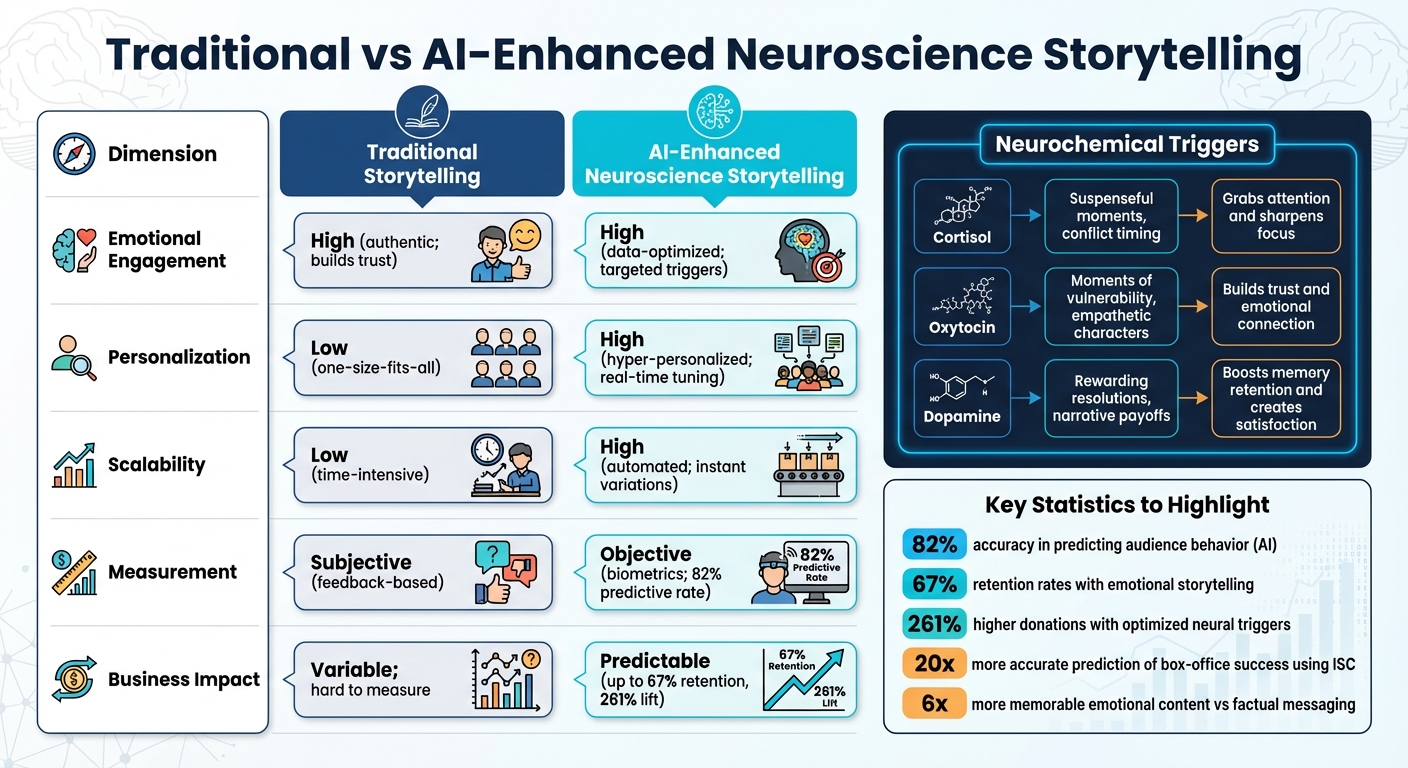
Traditional vs AI-Enhanced Storytelling: Key Differences and Business Impact
Both traditional storytelling and AI-driven neuroscience storytelling bring their own set of strengths and challenges when it comes to connecting brands with their audiences. Traditional storytelling excels at creating emotional bonds, fostering trust and empathy through neural coupling - an effect that triggers oxytocin, as Uri Hasson explains. However, the downside is that traditional methods often lack scalability and rely on subjective feedback, making it tough to measure and optimize effectively.
On the flip side, AI-enhanced neuroscience storytelling offers a more data-driven approach. Using tools like EEG, fMRI, and biometric tracking, it can predict audience behavior with up to 82% accuracy. For example, public service announcements that activate both arousal (ACTH) and empathy (oxytocin) can boost donations by as much as 261% compared to those that don't. AI also enables hyper-personalization, crafting narratives tailored to individual neural profiles - something manual methods simply can't achieve.
But AI isn't without its drawbacks. While it excels at leveraging data, it falls short in emotional depth and the nuanced creativity that comes from lived human experience. As Angus Fletcher, a Professor of Story Science at Ohio State University, points out:
"No computer can innovate because it cannot engage in negative thought".
AI operates within the boundaries of probabilistic patterns, which limits its ability to fully capture the richness of human storytelling. Paul J. Zak, Ph.D., Director of the Center for Neuroeconomics Studies, highlights this limitation with a simple but telling observation:
"The brain does not lie. The commercial is dull".
This serves as a reminder that even the most advanced AI can't replicate the vulnerability and authenticity that resonate deeply with audiences.
| Dimension | Traditional Storytelling | AI-Enhanced Neuroscience Storytelling |
|---|---|---|
| Emotional Engagement | High (authentic; builds trust) | High (data-optimized; targeted triggers) |
| Personalization | Low (one-size-fits-all) | High (hyper-personalized; real-time tuning) |
| Scalability | Low (time-intensive) | High (automated; instant variations) |
| Measurement | Subjective (feedback-based) | Objective (biometrics; 82% predictive rate) |
| Business Impact | Variable; hard to measure | Predictable (up to 67% retention, 261% lift) |
This comparison highlights the potential of a hybrid approach that combines the best of both worlds. By blending traditional storytelling's emotional authenticity with AI's ability to optimize and scale, brands can achieve a powerful balance. This is the foundation of the Narrative OS developed by BrandMultiplier.ai, which integrates neuroscientific insights and advanced AI to drive measurable improvements in customer engagement, acquisition, and lifetime value. Together, this hybrid model positions AI as a tool for augmentation, not replacement, ensuring both emotional depth and operational efficiency.
Conclusion
Traditional storytelling creates genuine emotional connections through neural coupling but often falls short when it comes to measurement and personalization. On the other hand, AI-driven methods tap into tools like EEG, fMRI, and biometric tracking to predict audience behavior with an impressive 82% accuracy. These technologies enable real-time adjustments that manual techniques simply can't achieve.
The business implications are hard to ignore. When a narrative captures attention (ACTH) and sparks emotional resonance (oxytocin), it leads to measurable improvements in key performance metrics. Moreover, ISC (Inter-Subject Correlation) has proven to be a strong predictor of commercial success, outperforming older, more traditional methods. This translates directly into benefits like lower customer acquisition costs (CAC), faster sales cycles, and higher customer lifetime value (LTV).
The takeaway? A balanced approach is essential. Human storytellers bring the emotional depth and authenticity crucial for effective neural coupling, while AI contributes the precision, personalization, and scalability needed for consistent results. As Ben Horowitz, Co-founder of Andreessen Horowitz, famously said:
"The most underrated skill in business is storytelling".
The real key to success lies in combining human creativity with data-driven optimization.
This hybrid model is exactly what BrandMultiplier.ai's Narrative OS exemplifies. It’s a Growth Operating System designed to codify your most impactful strategic story using neuroscientific principles. By integrating this story across leadership, sales, product, and marketing, and connecting it to custom AI, the system tracks how the narrative influences CAC, deal speed, and LTV. It then fine-tunes the story in real time, quarter after quarter. This approach lets businesses automate neuroscientific insights while preserving the human touch, turning storytelling into a powerful driver of measurable growth.
FAQs
How does AI use neuroscience to make storytelling more effective?
AI is transforming storytelling by tapping into neuroscience to craft narratives that truly connect with audiences. Studies reveal that stories stimulate brain areas linked to trust, emotion, and memory, triggering chemicals like dopamine and oxytocin. These natural responses create stronger engagement and a deeper sense of connection. By analyzing how the brain reacts to stories, AI can identify which elements - like plot twists or character arcs - are most likely to spark emotional reactions.
Today’s AI tools take this a step further by combining neuroscience insights with real-time audience feedback. For example, tools like BrandMultiplier.ai’s Narrative OS integrate a brand’s story into custom AI systems that adapt and improve based on performance metrics. This approach turns storytelling into a measurable strategy, driving growth by boosting key metrics such as conversion rates and customer lifetime value.
What are the challenges of AI storytelling compared to human creativity?
AI storytelling can mimic structural patterns and evoke basic emotions, but it often misses the mark when it comes to true human creativity. What sets human storytelling apart is the depth of lived experiences and the emotional nuances that fuel compelling narratives. Without authentic emotional triggers like empathy or anticipation, AI-generated stories can come across as flat, lacking the ability to truly connect with audiences on a deeper level.
Another limitation is AI’s struggle to match the human brain’s knack for weaving meaning, context, and personal relevance seamlessly. Instead, it tends to rely heavily on pre-existing data, which can lead to logical inconsistencies or overuse of clichés. Worse, this dependence on past data can inadvertently introduce cultural biases. While humans can adapt and innovate stories on the fly, AI remains confined by its programming, limiting its ability to improvise or bring fresh originality to the table.
BrandMultiplier.ai’s Narrative OS tackles these shortcomings by embedding a brand’s story into a neuroscientific framework, enhanced with custom AI tools. This unique combination blends the emotional resonance of human storytelling with AI’s precision and efficiency, delivering tangible results like better customer acquisition costs (CAC) and improved lifetime value (LTV).
How does AI-powered storytelling influence key business metrics like customer acquisition cost (CAC)?
AI-powered storytelling taps into the science of how our brains process emotions, crafting narratives that truly connect with people on a personal level. These emotionally engaging stories don’t just grab attention - they encourage audiences to act, helping businesses see better engagement, higher conversion rates, and even lower customer acquisition costs (CAC).
By aligning stories with how humans naturally think and feel, companies can create messages that stick. This method makes marketing efforts more impactful, translating into tangible benefits like faster sales cycles and an increase in customer lifetime value (LTV).
Ready to transform your brand story?
Schedule a free diagnostic to see how we can help.
Schedule The Diagnostic