
Neuroscience Messaging Tips for Lower CAC
Neuroscience Messaging Tips for Lower CAC
In marketing, lowering Customer Acquisition Costs (CAC) is a key challenge, especially for small and medium-sized businesses (SMBs). Rising ad costs and long sales cycles mean traditional approaches often fall short. This is where neuroscience-based messaging can help. By understanding how the brain makes decisions - primarily through emotional triggers - you can optimize your messaging to reduce CAC effectively.
Here’s a quick breakdown of actionable strategies:
- Use Benefit-Driven Headlines: Focus on emotional outcomes, not technical features, to activate the brain’s reward centers.
- Leverage Loss Aversion: Highlight risks of inaction or potential losses to increase conversions.
- Simplify Messaging: Reduce cognitive load with clear, easy-to-process language.
- Personalize Messages: Connect emotionally by addressing specific pain points and aspirations.
- Apply Neuropricing Techniques: Use tactics like charm pricing, anchoring, and the decoy effect to influence perceptions.
- Incorporate Social Proof: Build trust with reviews, testimonials, and user-generated content.
- Tell Stories: Engage the brain and improve memory retention with relatable narratives.
- Test Messages with Neuromarketing Tools: Optimize your campaigns by analyzing subconscious responses.
These principles are backed by data, such as a 35% CAC reduction and faster deal closures when emotional and neuroscience-based strategies are applied. Even small tweaks - like rephrasing headlines or simplifying pricing - can lead to measurable improvements.
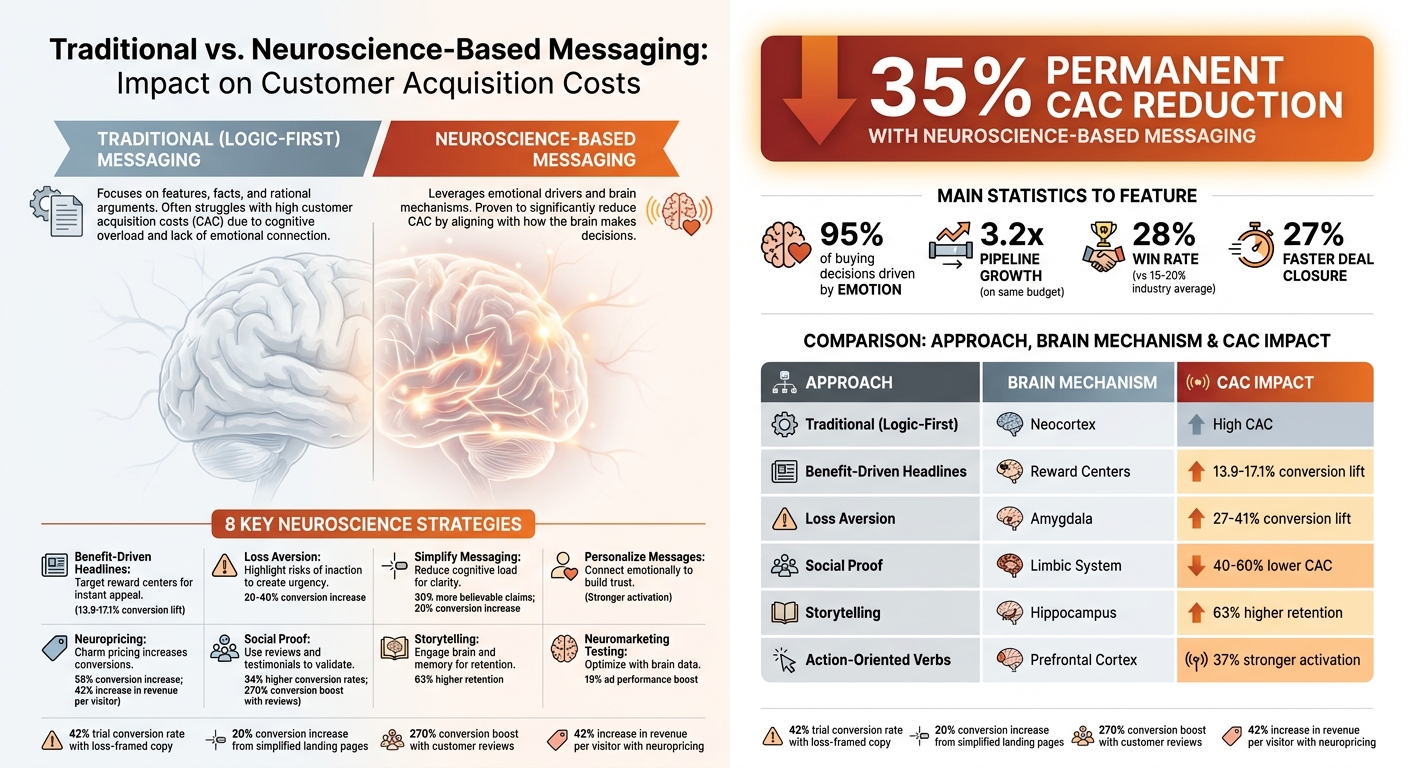
Traditional vs Neuroscience-Based Messaging: CAC Reduction Comparison
1. Target Reward Centers with Benefit-Driven Headlines
Neuroscience Principle Utilized
When people make purchasing decisions, they’re not just buying a product - they’re buying how it makes them feel. Research shows that when someone encounters a headline promising a meaningful benefit, their brain’s reward centers - specifically the ventral striatum and prefrontal cortex - release dopamine, the chemical that fuels desire and motivation. According to Stanford researcher Brian Knutson, the likelihood of making a purchase can be boiled down to a simple formula: Reward Activation minus Pain Activation.
Here’s the problem: many small-to-medium businesses (SMBs) rely on feature-heavy headlines like "robust CRM" or "award-winning software." While technically accurate, this kind of language often fails to connect emotionally. On the other hand, benefit-driven headlines focus on the transformation a product delivers. For instance, instead of listing features, headlines like "Regain hours in your day" or "No more late-night support fires" tap into the emotional payoff customers are seeking. These messages create positive brain associations, tipping the scales toward reward and making conversion easier and faster.
Impact on CAC Reduction
Focusing on benefits instead of features doesn’t just sound good - it directly lowers customer acquisition costs (CAC). Grant Gooding, CEO of Proof Positioning, explains:
"Decisions - yes, even big, complex B2B buying decisions - are driven by emotion up to 95% of the time".
When you lead with emotion, you grab attention faster, shorten decision-making time, and boost conversion rates. The result? Lower acquisition costs. Companies that use neuroscience-based messaging and behavioral intent scoring have reported a 35% permanent drop in CAC, along with pipeline growth averaging 3.2x on the same budget. Additionally, intent-scored opportunities see a 28% win rate - far above the industry average of 15–20% - and deals close 27% faster.
Practicality for SMBs
The best part? You don’t need fancy neuromarketing tools to apply this principle. Start by reviewing your homepage, ad copy, and email campaigns. Replace technical or feature-heavy language with descriptions that evoke feelings. For example, instead of saying "24/7 support included", try "No more late-night support fires. Just peace of mind that we're always here".
Ray Larson from Vende Digital suggests using the F.E.E.L. framework to craft emotionally resonant headlines:
- Frustration: Identify the pain point.
- Empowerment: Show how life improves.
- Emotion: Evoke feelings like relief or pride.
- Logic: Back it up with stats after the emotional hook.
Test emotional subject lines against logic-based ones to see what resonates more with your audience. You can also pull language directly from customer reviews to ensure your messaging aligns with how your buyers naturally speak.
Potential for Measurable Results
Switching from feature-focused to benefit-driven messaging delivers real, trackable results. Ads with strong sensory appeal see 23% better recall and a 15% boost in purchase intent. By reducing cognitive load with clear, outcome-focused headlines, you make it easier for the brain to process and say "yes".
Kenda Macdonald, CEO of Automation Ninjas, puts it this way:
"The only thing you can affect is the amount of reward center activation. The more positively people feel about your products or services, the less the pain of pricing will affect them".
sbb-itb-63525a7
2. Apply Loss Aversion in Ad Copy
Neuroscience Principle Utilized
Loss aversion plays a powerful role in decision-making. Nobel laureate Daniel Kahneman's research highlights that the pain of losing $100 feels about twice as intense as the joy of gaining the same amount. When considering an offer, people instinctively compare potential changes to their current situation. Losses tend to spark a much stronger emotional reaction than gains, a phenomenon amplified by the endowment effect. This effect makes people value something more once they feel a sense of ownership - even temporarily, like during a free trial. As Mamta Tainwala from Sybill puts it:
"Your prospects are making decisions with their amygdala, not their prefrontal cortex. And if you don't understand that, you're losing deals to reps who do".
Impact on CAC Reduction
Shifting from gain-focused to loss-focused messaging can dramatically improve conversion rates and reduce customer acquisition costs. Businesses that adopt loss-framed strategies have reported conversion rate increases ranging from 20% to 40%. In B2B sales, emphasizing the cost of inaction can close deals up to 23% faster. For SaaS companies, pairing free trials with messaging like "Don't lose your data" has raised trial-to-paid conversion rates from 20% to 42%. Similarly, in professional services, framing consultations around "protecting rights" or "preventing loss" has boosted lead-to-client conversion rates from 25% to 45%. These shifts in messaging deliver measurable improvements across industries.
Practicality for SMBs
You don’t need complex tools or resources to apply loss aversion to your marketing. Start by reframing your current messaging. Instead of saying, "Save $500 on maintenance", use "Don't lose $500 to emergency repairs." Replace "Increase your revenue" with "Stop losing customers to competitors". Quantify the cost of inaction to make the stakes clear. For example, instead of "Our tool improves productivity", you could say, "Your team is losing 780 hours of productivity annually, costing $28,000 per employee".
Free trials are another practical way to leverage the endowment effect. When the trial ends, customers often feel a genuine sense of loss. Pair this with money-back guarantees to reduce the fear of financial risk - most businesses report claim rates below 5%.
Potential for Measurable Results
Loss-framed messaging produces clear, trackable outcomes. For instance, a home security company using "Don't risk losing your valuables to a break-in" can outperform a more generic message like "Get peace of mind" by tapping into survival instincts. Genuine urgency also works well. Statements like "Only 3 spots left for Q2 implementations" can create a fear of missing out without relying on gimmicky countdown timers that might harm trust. As Kordless explains:
"Loss-framed messaging is about prevention, not fear. It's positive about your solution while acknowledging what customers stand to lose".
3. Simplify Messaging for Easier Processing
Neuroscience Principle Utilized
The human brain can handle about four chunks of information at once. When messages exceed this limit, understanding becomes harder. This is where cognitive fluency - how easily the brain processes information - comes into play. When information is easier to process, it reduces mental effort and even activates the brain's reward centers. Adam Alter, a professor at NYU's Stern School of Business, explains:
"When something is easier to process, we tend to like it more, find it more familiar, and believe it to be more true".
Simple messaging taps into the brain's fast, intuitive System 1 thinking. On the other hand, complex messaging forces the slower, more effortful System 2 to take over. Interestingly, the brain often equates processing ease with truth. In other words, information that's easy to read or hear is more likely to be seen as accurate and trustworthy.
Impact on CAC Reduction
Simplified messaging doesn't just clarify your message - it can also lower your customer acquisition costs (CAC). Clear communication minimizes hesitation and speeds up decision-making, which reduces acquisition expenses. For instance, consumers are 30% more likely to believe claims that are presented with high cognitive fluency. Simplifying landing page visuals can increase conversion rates by up to 20%. Companies excelling in customer experience fluency have seen 37% higher customer retention and 18% greater revenue growth compared to their competitors. Additionally, users typically leave a webpage within 10–20 seconds if they don’t immediately understand its value. As neuromarketing expert Keith Engelhardt puts it:
"Cognitive ease is a competitive moat".
Practicality for SMBs
Small and medium-sized businesses (SMBs) don’t need fancy tools to make their messaging simpler. Start by replacing technical jargon with straightforward, result-focused language. For example, instead of saying, "Our CRM is robust and scalable", try, "Our CRM removes daily chaos, so you can focus on growing your team". Use chunking to group information into three or four key points, making it easier for the brain to process. Avoid overwhelming your audience by gradually revealing details - start with emotionally engaging headlines and save the technical specifics for later. Additionally, use simple, high-contrast fonts like Arial or Helvetica and leave plenty of white space to reduce mental strain.
At BrandMultiplier.ai, we use these neuroscience-backed strategies to craft clear and engaging messaging that helps SMBs cut customer acquisition costs. These small changes can lead to noticeable improvements in how users respond.
Potential for Measurable Results
Simple messaging can improve comprehension in less than 400 milliseconds while boosting credibility and recall. Even small tweaks - like using rhymes to trigger the "rhyme-as-reason" effect - can make your claims feel more logical and memorable. As Norbert Schwarz, a prominent psychologist, explains:
"The easier the processing, the more positive the evaluation".
4. Personalize Messages for Emotional Connection
Neuroscience Principle Utilized
Did you know that emotions take the wheel in decision-making long before logic even comes into play? It’s all thanks to the brain's limbic system, which reacts to emotional triggers like frustration, pride, or relief before the prefrontal cortex processes logic. As Grant Gooding, CEO of Proof Positioning, explains:
"Logic plays a role in justification, but emotion captures attention, shapes perception, and influences memory, making it the true driver of choice".
By tailoring your messaging to tap into specific frustrations or aspirations of your audience, you create positive emotional memories. These memories are what ultimately sway buying decisions. The brain calculates the likelihood of a purchase by comparing the emotional "reward" of the product to the "pain" of spending. This makes emotional messaging a powerful tool for connecting with your audience.
Impact on CAC Reduction
Personalized, emotion-driven messaging doesn’t just boost engagement - it can also significantly lower your Customer Acquisition Cost (CAC). Companies that leverage buyer intent and behavioral scoring tools have reported a permanent 35% drop in CAC. Plus, they’ve seen their pipelines grow 3.2x, win rates jump to an average of 28% (compared to the industry average of 15–20%), and deals close 27% faster. Ray Larson from Vende Digital puts it best:
"Buyers may forget facts, but they won't forget how you made them feel".
Practicality for SMBs
For small and medium-sized businesses, this approach is entirely within reach. Start by talking to your existing customers - ask them how they felt before and after using your product or service. Use their feedback to uncover emotional triggers that resonate. Then, refine your website copy. Replace generic phrases with language that vividly highlights transformation and relief.
Testing is key. A/B test subject lines to see what works better: a neutral approach or something emotionally charged, like "Stop burning out on endless support calls". These small adjustments can make a big difference in how your message connects.
If you’re looking to scale this strategy, tools like Narrative OS from BrandMultiplier.ai can help. This platform uses neuroscience-based frameworks to codify your emotional messaging, deploy it across channels, and optimize its impact on CAC, deal speed, and customer lifetime value.
Potential for Measurable Results
Switching from logic-first to emotion-first messaging isn’t just a feel-good tactic - it delivers measurable results. Use multi-touch attribution models to track how emotional touchpoints influence the customer journey. Weekly dashboards can help you monitor metrics like influenced revenue and win rates. Even simple changes, like tweaking your copy to emphasize emotions, consistently outperform logic-heavy alternatives in testing. It’s a small shift with the potential for big payoffs.
5. Display Pricing Using Neuropricing Techniques
Neuroscience Principle Utilized
When it comes to pricing, consumers often rely on mental shortcuts. Take left-digit bias, for example: a price like $19.99 feels lower because our brains associate it with "teens", even though it's just a penny shy of $20. This is why strategies like charm pricing (ending prices in .99 or .95) are so effective.
Another key concept is anchoring. By presenting a high-priced option first - like a $500 enterprise plan - you set a benchmark that makes lower-priced options, such as a $99 mid-tier plan, seem much more appealing. Then there's the decoy effect, which introduces a less attractive option to nudge customers toward the choice you want them to make. These subtle cues don’t just shape how prices are perceived - they also boost conversions significantly.
Impact on CAC Reduction
Psychological pricing strategies can drive some impressive results. For instance, charm pricing alone can increase conversions by up to 58%, while neuropricing techniques can speed up decision-making by 73%. Businesses using the decoy effect often see a 20–40% jump in sales for their target premium products. In subscription-based models, decoy pricing can push 30–50% more customers toward the premium tier. On top of that, revenue per visitor can increase by 42%, and average transaction values can grow by 10–25%.
Practicality for SMBs
Neuropricing isn’t just for big players; small and medium-sized businesses (SMBs) can use it too. For products priced under $100, charm pricing has been shown to boost sales by 30–60%. If you’re running a subscription model, try offering three options: a basic plan, a decoy plan that’s priced similarly but delivers less value, and a mid-tier plan labeled as "Most Popular". Another trick? Present annual pricing as a daily cost - like $3/day instead of $1,095/year. This approach has been shown to increase purchase intent by 30%.
Potential for Measurable Results
To see how these strategies work for you, A/B testing is your best friend. Use your CRM to track metrics like conversion rates, average transaction values, and decision times. Companies that use multi-touch attribution to analyze pricing strategies across the customer journey gain clear insights into what’s effective. Even small tweaks - like changing $20.00 to $19.99 or adding a decoy option - consistently outperform more traditional pricing methods in tests. These techniques tap into subconscious decision-making, helping to lower CAC while driving better results.
6. Build Trust with Social Proof
Neuroscience Principle Utilized
Studies reveal that social proof taps into the ventromedial prefrontal cortex (vmPFC), while calming the amygdala, the brain's risk-assessment center. This shift, observed through fMRI scans, prompts a dopamine release in reward centers, reducing perceived risk and boosting confidence in decision-making.
Impact on CAC Reduction
Incorporating social proof can significantly increase conversion rates and reduce customer acquisition costs (CAC). For instance, websites that use social proof elements see a 34% higher conversion rate, while e-commerce platforms featuring customer reviews can experience a 270% boost in conversions. A real-world example? Gymshark. In Q1 2022, they added review widgets to product pages, doubling their conversion rates from 2.1% to 4.3% in just three months. This change cut their CAC by 28% - dropping from $15 to $10.80 per customer - all by showcasing over 1,200 reviews.
Practicality for SMBs
Social proof is a low-cost, high-impact strategy, especially for small and medium-sized businesses (SMBs) with tight budgets. Tools like Google Reviews, Trustpilot widgets, or user-generated Instagram content can be implemented quickly, often for free. For example, you can set up a carousel of testimonials under your call-to-action buttons, including specific details like "Sarah from Texas saved $500/month" or a star rating (e.g., 4.8/5 from 1,200 reviews). These simple additions can be achieved with free plugins in under an hour and immediately establish trust.
Potential for Measurable Results
Track the effectiveness of social proof using Google Analytics and UTM-tagged landing pages. Measure key metrics like conversion rates, bounce rates, and CAC before and after implementation, aiming for a 10–15% reduction in CAC as a target. A great example comes from Airbnb: between January and June 2021, they introduced guest review summaries on listings, which boosted bookings by 17% (from 1.2 million to 1.4 million monthly) and lowered CAC by 22% through increased trust. Use A/B testing tools like Google Optimize and review your metrics weekly to refine your strategy further.
7. Use Stories to Improve Memory Retention
How Stories Engage the Brain
A well-told story doesn’t just entertain - it activates multiple regions of the brain, including sensory, emotional, and motor areas. This makes the experience feel more vivid and immersive. Stories create what's called neural coupling, where the storyteller's brain syncs with the listener's, drawing them in and reducing skepticism. This phenomenon, known as narrative transportation, captures your full attention, making you lose awareness of your surroundings. Keith Engelhardt, Founder of NeuroMarket, explains:
"When your brain is transported, it can't mount its usual defenses against persuasion".
Additionally, stories release chemicals like oxytocin and dopamine, which help form positive feelings toward the brand. This kind of engagement makes your message not only persuasive but also more likely to stick in the audience's memory - ultimately helping to lower customer acquisition costs (CAC).
Why Stories Lower CAC
A compelling narrative can reduce counterarguments - the mental objections people often raise during traditional marketing tactics. Research by Slater and Rouner found that when people are deeply absorbed in a story, they’re less likely to counterargue, which is one of the biggest hurdles in converting potential customers. For example, a sales team exceeded their quota by 112% in just 10 weeks after adopting a story-centered approach to customer engagement.
Stories also encourage "elaborative processing", which essentially means they create multiple ways for the brain to retrieve the information later. This makes your message easier to recall, increasing the likelihood of conversions.
Storytelling Tips for SMBs
Small and medium-sized businesses can use storytelling techniques to turn ordinary customer testimonials into engaging narratives. Try structuring your case studies using a five-part framework:
- Protagonist: Your customer
- Conflict: The challenge or pain point they faced
- Journey: How they discovered your product or service
- Resolution: The results they achieved, backed by specific metrics
- Takeaway: A lesson or insight for the audience
To make the story relatable, include real names and job titles instead of focusing solely on your brand as the hero. This taps into mirror neurons, encouraging empathy and connection. Adding sensory details - like describing how a problem felt or looked - can also make the story more engaging and memorable.
Measuring the Impact of Storytelling
Storytelling’s effectiveness can be tracked using key behavioral and engagement metrics. For example, monitor changes in bounce rates, video watch times, and how often your content is shared. Tools like Google Analytics can help you compare these metrics before and after implementing narrative-driven content.
To dig deeper, conduct surveys to measure how well your audience remembers your brand message compared to non-story-based content. Sentiment analysis on social media comments can also reveal the emotional impact of your stories. Platforms like BrandMultiplier.ai's Narrative OS offer tools to help you refine your storytelling strategies in real time, ensuring your efforts are both effective and data-driven.
8. Test Messages with Neuromarketing Tools
Neuroscience Principle Utilized
Testing your messaging with neuromarketing tools is like giving your strategy a final polish to cut down on customer acquisition costs (CAC). Unlike traditional research, which relies heavily on self-reported data, neuromarketing dives into the subconscious - where most purchasing decisions are actually made. These tools measure brain activity, biometric responses, and even micro-expressions in real time. They can track what grabs attention through eye movements and measure emotional engagement using EEG patterns and facial coding. This level of insight goes far beyond what conventional methods can uncover.
Impact on CAC Reduction
Using neuromarketing tools to test your messages removes the guesswork from your campaigns, helping you allocate your ad budget more effectively. For instance, Hyundai used neuromarketing in 2024 to analyze EEG brainwaves and heart rate data while testing marketing for its IONIQ 5 N vehicle. The result? A 42% increase in U.S. electric vehicle sales year-over-year. By pinpointing emotional triggers that resonate and identifying potential friction points, you can focus on high-performing creative assets. This not only reduces wasted spending but also directly lowers CAC. Neuromarketing allows you to make data-driven decisions that amplify your marketing impact.
Practicality for SMBs
Small and medium-sized businesses (SMBs) don’t need massive budgets to get started with neuromarketing. Simple A/B tests can compare emotional headlines like "Feel secure" with logical ones like "Save 25%." Tools like Hotjar (free for up to 35 daily sessions) can create heatmaps, while platforms like MorphCast offer AI-powered facial coding. For example, travel brand Alpitour used MorphCast in a "Ragione vs. Emozione" campaign, tailoring content based on viewer sentiment. Another cost-effective tip? Use eye-tracking insights from sources like Nielsen Norman Group (available for about $98 per license) to position calls-to-action where they naturally draw attention, such as the upper-left corner of a screen.
Potential for Measurable Results
Once you’ve applied neuromarketing insights, you can track their effectiveness using familiar metrics. Research shows that neuromarketing optimization can boost ad performance by up to 19%. Metrics like bounce rates, video watch times, and click-through rates can reveal how well your revised messaging works. Platforms like BrandMultiplier.ai’s Narrative OS take it a step further, helping you structure your messaging with neuroscientific principles and measure real-time impacts on CAC, conversion rates, and customer lifetime value. This creates a feedback loop for continuous improvement, ensuring your campaigns keep delivering results quarter after quarter.
Neuroscience and Marketing: How to Hack the Buyer’s Brain
Comparison: Traditional vs. Neuroscience-Based Messaging
Neuroscience-based messaging takes a different path from traditional methods by prioritizing emotional appeal over pure logic. While traditional messaging assumes buyers make decisions by carefully analyzing features and specifications, neuroscience shows that emotions play the leading role in driving decisions. Rational justifications typically follow emotional responses, not the other way around.
Here’s a breakdown of how these approaches engage the brain, their impact on CAC (Customer Acquisition Cost), and supporting evidence:
| Approach | Brain Mechanism | Expected CAC Reduction | Evidence Source |
|---|---|---|---|
| Traditional (Logic-First) | Neocortex (Rational Brain) | High CAC due to low emotional resonance | Vende Digital |
| Benefit-Driven Headlines | Reward Centers (Dopamine) | 13.9% - 17.1% conversion lift | Mindscribe.ai |
| Loss Aversion/Scarcity | Amygdala (Loss Avoidance) | 27% - 41% conversion lift | Mindscribe.ai |
| Social Proof/Referrals | Limbic System (Trust/Safety) | 40% - 60% lower CAC | Athenic Academy |
| Storytelling | Hippocampus (Memory) | 63% higher retention | Mindscribe.ai |
| Action-Oriented Verbs | Prefrontal Cortex (Activation) | 37% stronger neural activation | Mindscribe.ai |
Traditional messaging focuses on rational appeals, often relying on lists of features that fail to tap into the emotional triggers critical for decision-making. Neuroscience-based messaging flips this approach by engaging emotions first - grabbing attention, building trust, and creating a connection - before introducing logical arguments for reinforcement. This strategy not only resonates on a deeper level but also significantly reduces CAC, as illustrated in the table above.
For example, TruckersReport achieved a 79.3% conversion lift by emphasizing commanding calls-to-action, while Amerisleep boosted orders by 13.9% by framing features as emotional benefits. Tools like BrandMultiplier.ai’s Narrative OS are designed to help businesses structure their messaging around neuroscience principles. These platforms also track real-time impacts on CAC, conversion rates, and customer lifetime value, creating a continuous improvement cycle.
The evidence is clear: while specs may be forgotten, the emotional impression your brand leaves behind is what sticks. By targeting the brain’s emotional centers, neuroscience-based messaging offers a powerful way to consistently lower CAC and drive better results.
Wrapping Up
In today’s crowded market, your marketing isn’t just competing for attention - it’s vying for emotional resonance. Research shows that emotion drives up to 95% of buying decisions, far outweighing pure logic. Small and medium-sized businesses (SMBs) that thrive don’t necessarily boast the longest feature lists. Instead, they understand how the human brain makes decisions. By targeting reward centers, reducing mental effort, and establishing emotional connections, you can meaningfully lower your customer acquisition costs.
Experts agree: emotion is at the heart of most buying decisions.
Even small tweaks can bring your messaging in line with how the brain naturally works. For instance, try reviewing a landing page to eliminate overly formal or "corporate beige" language. Test an emotional headline against a purely rational one. Swap out a dry feature description for a benefit that highlights the outcome your customer desires. These small steps can align your marketing with the brain’s decision-making process.
For SMBs looking to take this further, tools like BrandMultiplier.ai’s Narrative OS provide a structured way to integrate neuroscience into your marketing. This platform measures real-time effects on metrics like customer acquisition costs, conversion rates, and customer lifetime value. It’s not just about better messaging - it’s about turning marketing into a measurable, science-driven process.
The evidence is clear: neuroscience-based messaging delivers results. So, the question is, how much longer can you afford to overlook what the brain is telling you?
FAQs
Which neuroscience tactic should I try first to lower CAC?
Cognitive Load Balancing is a strategy rooted in neuroscience that focuses on managing the mental effort required from your audience when interacting with your marketing. By minimizing cognitive overload, your messages become easier to understand and more engaging. This clarity encourages customers to take action without feeling overwhelmed.
The result? Improved conversion rates and reduced customer acquisition costs. By presenting information in a way that's digestible and straightforward, you ensure that your audience can process your messaging effortlessly, boosting overall effectiveness.
How do I make benefit-driven headlines without sounding hypey?
To craft headlines that emphasize real benefits without coming across as overly promotional, focus on specific, measurable outcomes. For instance, instead of using vague claims, opt for something like "Cut Customer Acquisition Costs by 20%." Keep the language simple and directly address your audience’s needs, showing how your solution can help them achieve their goals. By prioritizing genuine value and steering clear of exaggerated language, you can build trust and capture attention effectively.
What’s the easiest way to test emotional vs. logical copy on a tight budget?
Testing your messaging doesn’t have to be complicated or expensive. Start by crafting two straightforward versions: one that taps into emotional triggers and another that highlights logical benefits. Use affordable methods like A/B testing or collecting direct feedback to see how each performs. Keep an eye on key metrics like click-through rates, conversions, or audience responses. This process allows you to fine-tune your messaging effectively without breaking the bank.
Ready to transform your brand story?
Schedule a free diagnostic to see how we can help.
Schedule The Diagnostic