
Neuroscience of Storytelling in Marketing
Neuroscience of Storytelling in Marketing
Stories are more than entertainment - they're a powerful marketing tool backed by neuroscience. Unlike traditional ads, storytelling activates multiple brain regions, including sensory, motor, and emotional areas. This process, called "neural coupling", creates a deep connection between the storyteller and the audience, making messages more memorable and persuasive.
Key takeaways:
- Stories bypass natural skepticism (counterarguing) through narrative transportation, immersing the audience and reducing resistance to marketing messages.
- Emotional storytelling triggers neurochemicals like oxytocin (trust) and dopamine (engagement), which drive action. For example, stories evoking empathy and arousal can boost donations by 261%.
- Sensory language (e.g., "warm cinnamon rolls") activates brain regions tied to real experiences, making messages feel tangible and engaging.
- Effective storytelling follows a structure: protagonist (customer), conflict, resolution. Brands should position themselves as the guide, not the hero.
Practical tips for marketers:
- Build emotional resonance with relatable challenges and resolutions.
- Use vivid sensory details to engage multiple senses.
- Highlight customer testimonials with clear tension–resolution arcs.
- Create suspense to hold attention and spark emotional responses.
- Simplify messaging for easy processing (cognitive ease).
How Stories Activate Your Brain: Neuroscience of Marketing Storytelling
How the Brain Processes Stories
Neural Coupling and Mirror Neurons
When you listen to a well-told story, something fascinating happens in your brain called neural coupling. This process aligns your brain's activity with the storyteller's, creating a strong connection between you and the narrative.
Mirror neurons take this connection even further. They allow you to "live" the story by simulating the actions, emotions, and sensations of the characters . For instance, if a story describes someone feeling joy after using a product, your brain mirrors that experience, almost as if you were feeling it yourself. Stories don’t just share information - they activate your sensory and motor regions. A description of a scent can light up your olfactory cortex, while details about textures can engage your tactile cortex .
This phenomenon can be tracked using Inter-Subject Correlation (ISC), which measures how similarly different people's brains respond to the same story. Interestingly, ISC has been shown to predict box-office success from movie trailers over 20 times better than traditional surveys. For marketers, this means a well-crafted story doesn’t just grab attention - it aligns your audience’s thoughts and emotions with your brand message, creating a foundation for emotional impact and long-term memory.
The Role of Emotions in Memory
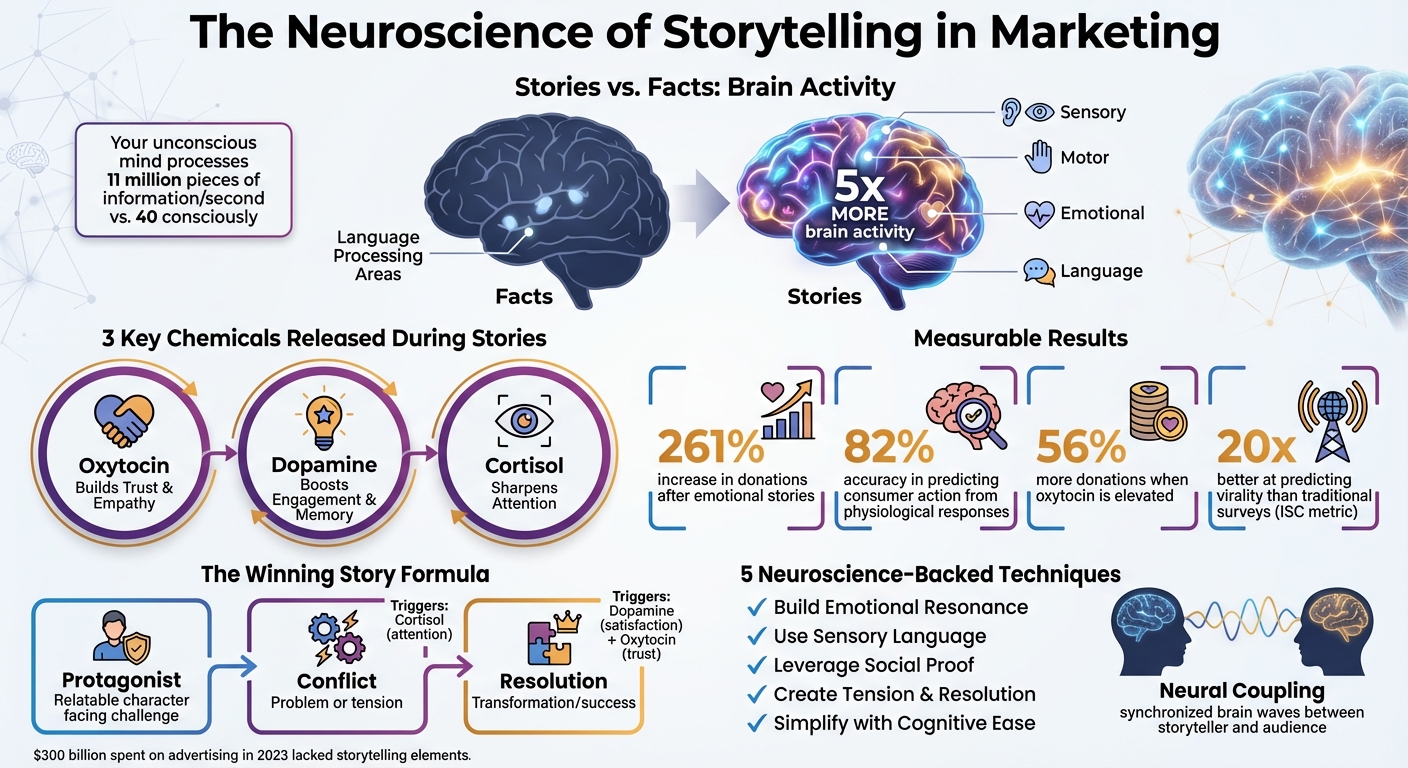
Once neural synchronization is established, emotions step in to make the story stick. Emotional narratives engage the brain in ways that plain facts simply can’t. While facts mainly activate language processing areas, stories ignite a "neurological symphony", sparking activity across sensory, motor, and emotional regions at the same time . In fact, your brain's activity can increase fivefold when listening to a story compared to processing raw data.
The amygdala plays a key role here, attaching emotional markers to the most impactful moments in a story. These markers make those moments easier to recall later. That’s why you might vividly remember a heartfelt customer testimonial years later, while a list of statistics fades from memory almost instantly.
Emotional stories also trigger a chemical response that strengthens their impact. Oxytocin promotes trust and empathy, dopamine boosts engagement and memory retention, and cortisol sharpens attention . For example, Paul J. Zak’s research demonstrated this power: participants who watched a 100-second video about a father and his terminally ill son experienced spikes in cortisol and oxytocin. These responses allowed researchers to predict with 82% accuracy who would donate to a childhood cancer charity. In contrast, a control video of the same characters at a zoo didn’t evoke the same reaction.
Narrative Transportation
Stories have the power to transport you, pulling you so deeply into their world that you lose awareness of your surroundings . In this state, known as narrative transportation, your brain’s natural tendency to counterargue or question the message essentially shuts down, making you more open to the story.
Keith Engelhardt captures this effect perfectly:
"When people are absorbed in stories, their counterarguing abilities simply vanish".
This immersion doesn’t just hold your attention - it influences behavior. Studies show that when a story increases levels of ACTH (associated with attention) and oxytocin (linked to empathy), donations after hearing the story rise by an incredible 261%. Researchers have even pinpointed specific brain activity patterns tied to high levels of narrative transportation, such as connectivity between the posterior medial cortex and the inferior frontal gyrus.
For marketers, the takeaway is clear: stories with tension and resolution don’t just entertain - they can drive real action. By tapping into these neural and emotional responses, you can create campaigns that resonate deeply and inspire meaningful engagement.
The magical science of storytelling | David JP Phillips | TEDxStockholm

5 Neuroscience-Based Storytelling Techniques for Marketers
Now that we’ve delved into how the brain processes stories, let’s look at five actionable strategies you can use to make your brand’s storytelling more impactful.
1. Build Emotional Resonance
Stories that stir emotions release oxytocin, a chemical that fosters trust and drives action. Interestingly, the more oxytocin released, the more likely someone is to take action - whether it’s making a purchase or donating to a cause .
Here’s how it works: conflict in a story triggers cortisol, grabbing attention, while oxytocin builds empathy and connection. Research shows that stories activating both ACTH (a stress hormone) and oxytocin can lead to 261% more post-story actions, like donations or purchases.
Paul J. Zak’s research team demonstrated this in a fascinating study. Participants given synthetic oxytocin donated 56% more to causes highlighted in public service announcements compared to those given a placebo. Even heart rate and skin conductance during storytelling predicted consumer behavior with 82% accuracy.
"When you want to motivate, persuade, or be remembered, start with a story of human struggle and eventual triumph. It will capture people's hearts – by first attracting their brains." – Paul J. Zak, Director of the Center for Neuroeconomics Studies
What does this mean for marketers? Start with a struggle. Let your customer be the hero, facing a relatable challenge - whether it’s an internal doubt, a market obstacle, or a specific pain point. Your product or service should act as the guide or tool that helps them triumph. Relatability is key for creating that instant neural connection. It’s also worth noting that what people say they like in surveys often doesn’t align with how their brains react. Physiological responses tell the real story.
Once you’ve nailed the emotional connection, amplify it with sensory details.
2. Use Sensory Language
Ever notice how phrases like "freshly brewed coffee" or "warm cinnamon rolls" seem to jump off the page? That’s because sensory language activates the same brain regions as actual sensory experiences . Your brain doesn’t just process the words - it feels, smells, and sees them.
This kind of activation engages multiple sensory areas, which makes your audience less likely to argue or doubt your message. Keith Engelhardt explains:
"When people are absorbed in stories, their counterarguing abilities simply vanish. Why? Because all their mental resources are occupied with following the plot, empathizing with characters, and visualizing scenes." – Keith Engelhardt, NeuroMarket
Here’s why this works: your unconscious mind processes about 11 million pieces of information every second, but your conscious brain can only handle 40 of them. Sensory language helps your message cut through the noise and stick.
So, swap generic descriptions for vivid sensory details. Instead of saying "great coffee", describe it as "a dark roast with hints of chocolate and caramel." Replace “comfortable chair” with “soft leather that contours to your back.” Even tactile phrases like "cold fingertips gripping a warm ceramic mug" can make your audience feel like they’re experiencing the product themselves .
3. Use Social Proof
Our brains are wired to learn from others. When we hear a detailed testimonial, our mirror neurons activate, making us feel as if we’re living that experience ourselves. This neural mirroring creates a personal connection and emotional engagement.
But not all testimonials are created equal. Generic phrases like "Great product!" don’t create the deep neural coupling needed to make stories stick. Instead, focus on detailed customer stories that follow a clear tension–resolution arc. Highlight their struggle, emotional state, and the transformation they experienced. This approach triggers cortisol for attention, oxytocin for empathy, and dopamine for satisfaction .
Once you’ve built credibility through testimonials, take it a step further by weaving in tension and resolution.
4. Create Tension and Resolution
Tension changes how your brain processes information. When a story is packed with suspense, your analytical mind takes a backseat, and you become fully immersed in the narrative. This phenomenon, called narrative transportation, leaves little room for skepticism.
Suspense activates the temporoparietal junction (TPJ), a part of the brain that processes attention. This synchronization across an audience makes the story more engaging and shareable. Meanwhile, the tension itself boosts oxytocin levels, and the resolution releases dopamine, creating positive associations with your brand .
Sarah Archambault, Editorial Director at Pinwheel, explains:
"The more a story successfully captured our attention, the stronger our connection and investment to the information. And character-driven narratives that create tension seem to work best." – Sarah Archambault
To leverage this, start your story in the middle of a conflict. Use a problem–solution–result framework, making sure the problem is something your audience can relate to, whether it’s a professional challenge or an emotional struggle. Your customer is the hero, and your brand is the tool that helps them succeed .
5. Simplify with Cognitive Ease
While emotions and vivid imagery are powerful, simplicity is just as important. Your brain is constantly deciding what to focus on, and anything that feels too complicated gets filtered out. On the flip side, content that’s easy to process is more likely to be absorbed and remembered. This is the principle of cognitive fluency.
sbb-itb-63525a7
Applying Neuroscience Principles to Marketing Campaigns
Now that the core techniques are clear, let’s look at how they can be applied to create campaigns that truly connect with your audience on a neurological level. The aim is to move from theory to practice, crafting marketing efforts that resonate deeply.
Crafting Brand Origin Stories
Your brand’s origin story is far more than a historical recap - it’s a key tool for connecting with your audience. When told effectively, it triggers neural coupling, aligning your audience’s responses with your narrative. This story becomes the backbone of your marketing, weaving its way through all your channels.
A strong story follows a classic dramatic arc: setup, conflict, and resolution. Joe Lazauskas, Head of Content at Contently, explains:
"The story about your product and where your company comes from doesn't just have to be a list of features. It can talk about the values that you have as a company, why you come to work every day to do what you do."
Identify a clear challenge - whether it’s a hurdle faced by the founder or a pain point for customers - and position your brand as the guide that helps overcome it. Make your customer the hero, not your company. Use sensory details to activate multiple areas of the brain, immersing your audience in the narrative. Writing in simple, accessible language - around a fourth-grade reading level - makes it easier for your audience to connect.
Genuine storytelling is more important than polished production. Audiences can sense when emotions feel forced, which can break their engagement and lead to skepticism. Stay true to your mission and honest about your beginnings.
Improving Customer Testimonials
Customer narratives can amplify the emotional impact of your brand story. Instead of generic testimonials, create mini-stories that follow a "hero’s journey" structure. These narratives should highlight a customer’s struggle and how your product or service provided the solution.
Choose testimonial subjects who reflect your target audience’s demographics, values, and challenges. For instance, a testimonial from someone navigating workplace tension or compliance issues will resonate more with viewers facing similar hurdles.
Encourage testimonials that emphasize the emotional journey - starting with doubts or challenges and ending with a rewarding resolution. This progression triggers attention through cortisol (stress) and delivers satisfaction with dopamine (reward).
Measuring Storytelling Success
To ensure your storytelling efforts are effective, rely on neuroscience-based metrics rather than traditional ones like "likability." For example, research on Super Bowl ads revealed that while the Budweiser "Puppy Love" ad was popular with viewers, its neural attention declined after 15 seconds because the predictable imagery eliminated suspense.
Instead, look to neuroscience-driven tools for deeper insights. Inter-subject correlation (ISC) measures how similarly different brains respond to your story. High ISC in areas like the Default Mode Network and sensory regions shows that your narrative is syncing audience emotions and thoughts - an indicator of potential virality. Studies reveal ISC is over 20 times more accurate than traditional surveys at predicting box-office success.
Biometric tracking offers real-time feedback on attention and emotion. Tools like electrocardiograms (ECG) can monitor vagus nerve activity linked to oxytocin release (trust and empathy), while electrodermal sensors measure skin conductance to track arousal. Some models can even predict with 82% accuracy whether someone will take action after hearing a story, based solely on these nervous system responses.
The Narrative Transportation Scale is another valuable tool, measuring how deeply your audience becomes absorbed in your story. High scores on this scale are strong predictors of recall and attitude shifts. Pinpointing moments where attention peaks or drops - often during climaxes - can help refine your storytelling for maximum engagement.
| Metric | What It Measures | Marketing Insight |
|---|---|---|
| Attention | ACTH release, heart rate, skin conductance | Shows how well your narrative captures focus |
| Empathy | Oxytocin release, vagus nerve activity | Indicates trust and likelihood of action |
| Suspense | Temporoparietal junction (TPJ) activity | Tracks the effectiveness of narrative tension |
| Immersion | Inter-Subject Correlation (ISC) | Predicts virality and social influence |
| Memory | Hippocampus activation | Measures long-term recall of your brand |
These metrics go beyond engagement, offering a way to validate the lasting impact of your brand's story. Tools like BrandMultiplier.ai’s Narrative OS use these insights to refine campaigns in real time, ensuring your message resonates where it matters most.
Implementing Narrative OS for SMB Growth
Narrative OS taps into how our brains are wired to respond to stories, transforming this natural process into a tool for consistent and measurable brand growth. For small and medium-sized businesses (SMBs), the challenge goes beyond crafting a good story - it's about ensuring that story delivers results across every interaction. BrandMultiplier.ai's Narrative OS treats your brand story as an ongoing system for growth, not just a one-off marketing effort.
Codify Your Brand Story Using Neuroscience
The starting point is creating what neuroscientists call a neural narrative framework. This is a structure that your audience's brain processes automatically, even before they consciously recognize it. It’s not about catchy slogans - it’s about designing a story that triggers specific biochemical responses. For instance:
- Oxytocin builds trust.
- Dopamine enhances memory and creates excitement.
- Cortisol sharpens focus.
Your story should feature a clear protagonist (your customer), an antagonist (their challenge), and a resolution that shows transformation. Using simple, clear language ensures your message is easily absorbed. Adding sensory details makes the story more vivid and engaging. The ultimate goal? To create a narrative so compelling that it synchronizes brain activity across your audience - a phenomenon called Inter-Subject Correlation (ISC), which is 20 times more effective at predicting virality than traditional behavioral metrics.
Deploy Stories Across Marketing Channels
Once your narrative is codified, the next step is weaving it into every aspect of your brand communication. This includes not only marketing materials but also leadership messaging, sales pitches, product descriptions, and even customer support interactions. Update your website, LinkedIn profiles, and social media bios with key elements of your brand story to ensure a consistent first impression.
Train your sales team to tell the story, not just memorize it. As Joe Lazauskas, Head of Content at Contently, puts it:
"Neurons that fire together, wire together".
By verbally sharing the narrative, your team connects with prospects emotionally, which is far more impactful than rattling off product features. You can also use serialized storytelling - releasing parts of your narrative gradually through videos or social media posts - to draw your audience in and keep them engaged. Tailor these stories with relatable, niche-specific details that feel personal, which increases the likelihood of shares within professional networks.
Consistent storytelling across all channels creates a foundation for ongoing improvement, driven by real-time feedback.
Real-Time Story Optimization with AI
The real game-changer is the ability to measure how your story performs. Narrative OS doesn’t rely on surface-level metrics like likes or impressions. Instead, it tracks how your story impacts critical KPIs like customer acquisition cost (CAC), deal velocity, and customer lifetime value (LTV).
Using advanced AI, the system analyzes biometric signals - such as heart rate variability, skin conductance, and vagal nerve activity - to predict consumer behavior in real time. These signals reveal whether your story is grabbing attention and creating the emotional connection needed to inspire action. The AI measures something called ZEST (Zak Engagement STatistic), which quantifies how attention and emotion combine to drive impact.
Over time, this system pinpoints which parts of your story resonate and which need adjustment. This data-driven approach allows you to refine your narrative based on actual neurological responses, not guesswork. The result? A story that remains powerful and relevant, adapting as your audience and market evolve.
Conclusion
Key Takeaways
Your brain doesn’t just process stories - it lives them. When you hear a well-told narrative, your brain becomes more engaged, making the story easier to remember. This isn’t just a fun fact - it’s rooted in biology. Oxytocin, often called the "bonding hormone", is released during a captivating story, and it directly influences how likely your audience is to take action - whether that’s buying a product, sharing content, or becoming a loyal customer.
The most impactful brand stories have three key ingredients: a protagonist your audience can relate to (typically your customer), a conflict or tension that grabs attention, and a resolution that sparks dopamine release and builds trust. Forget the corporate buzzwords - write simply and clearly. Studies show that content written at a fourth-grade reading level is more effective because it’s easier for the brain to process. Also, don’t underestimate the power of sensory language - it activates parts of the brain that make your audience feel like they’re experiencing your brand firsthand.
Joe Lazauskas, Head of Content at Contently, sums it up perfectly:
"Stories make us remember and they make us care. The reason content marketing works isn't artsy-fartsy. It's because our brains are programmed for stories".
Consider this: the U.S. media and entertainment industry, which thrives on storytelling, was valued at $717 billion in 2023. Yet, nearly $300 billion spent on advertising that same year lacked any storytelling elements. For small and medium-sized businesses (SMBs), this gap is a massive opportunity to stand out by embracing storytelling.
By using these neuroscience-backed principles, you can turn ordinary messaging into unforgettable brand experiences.
Next Steps for Your Brand
Now that you understand the science behind storytelling, it’s time to put it into action.
Start by identifying the main problem your customers face and how your product or service solves it. Craft a brand origin story or a compelling customer success narrative, and practice delivering it in a way that feels natural. Then, update your LinkedIn bio, website’s About page, and social media profiles with key elements of this story to create instant connections.
For a more systematic approach, tools like BrandMultiplier.ai’s Narrative OS can help. This platform uses neuroscience to structure your story, deploy it across all customer touchpoints, and track its impact on metrics like customer acquisition cost (CAC), deal velocity, and lifetime value (LTV). The system continuously adapts your narrative based on what resonates, ensuring your story evolves with your audience and drives measurable growth.
FAQs
How does storytelling impact consumer behavior in marketing?
Storytelling in marketing isn’t just about entertainment - it’s about connecting with people on a deeper level. According to neuroscience, emotionally engaging stories activate parts of the brain tied to memory and empathy, like the amygdala. This emotional link not only makes the story stick in people’s minds but also helps establish trust with the brand.
Here’s where it gets even more interesting: when someone connects with a good story, their brain releases oxytocin, often referred to as the "feel-good" hormone. This chemical reaction fosters a sense of connection and loyalty toward the brand. On top of that, storytelling can create something called "narrative transportation." This is when the audience becomes so immersed in the story that their skepticism fades away. As a result, the brand’s message feels more persuasive, influencing decisions and strengthening the relationship between the consumer and the brand.
Why are emotions key to making marketing messages unforgettable?
Emotions play a key role in making marketing messages stick. When emotions are triggered - whether it’s joy, fear, or empathy - they activate the brain’s emotional centers, like the amygdala. This part of the brain is crucial for forming and retrieving memories, which means emotional stories tend to leave a stronger, longer-lasting impression.
But it doesn’t stop there. Emotionally charged stories engage multiple areas of the brain, allowing people to visualize the narrative, connect with others, and process their own feelings. This deeper engagement not only captures attention but also makes the message more relatable and memorable. When marketers weave emotion into their storytelling, they create messages that linger in the minds of consumers, increasing the likelihood of action and connection.
How can brands use storytelling to create more engaging marketing strategies?
Using storytelling techniques grounded in neuroscience can transform your marketing approach. Why? Because stories light up multiple areas of the brain - those linked to memory, empathy, and emotions. This creates deeper connections with your audience.
When you craft narratives with relatable characters, clear conflicts, and satisfying resolutions, you’re mirroring how our brains naturally process stories. This makes your message not just engaging but also easier to remember.
Want to make your stories stick? Focus on evoking strong emotions like joy or empathy. These emotions trigger biochemical reactions, such as dopamine release, which helps with memory retention. And when your audience becomes fully absorbed in your story - something known as narrative transportation - they’re more likely to trust and connect with your brand.
The key is to align your storytelling with your audience’s values and decision-making patterns. By doing so, you can create meaningful, persuasive narratives that inspire action and build lasting relationships.
Ready to transform your brand story?
Schedule a free diagnostic to see how we can help.
Schedule The Diagnostic