

How Predictive Segmentation Improves Customer LTV
How Predictive Segmentation Improves Customer LTV
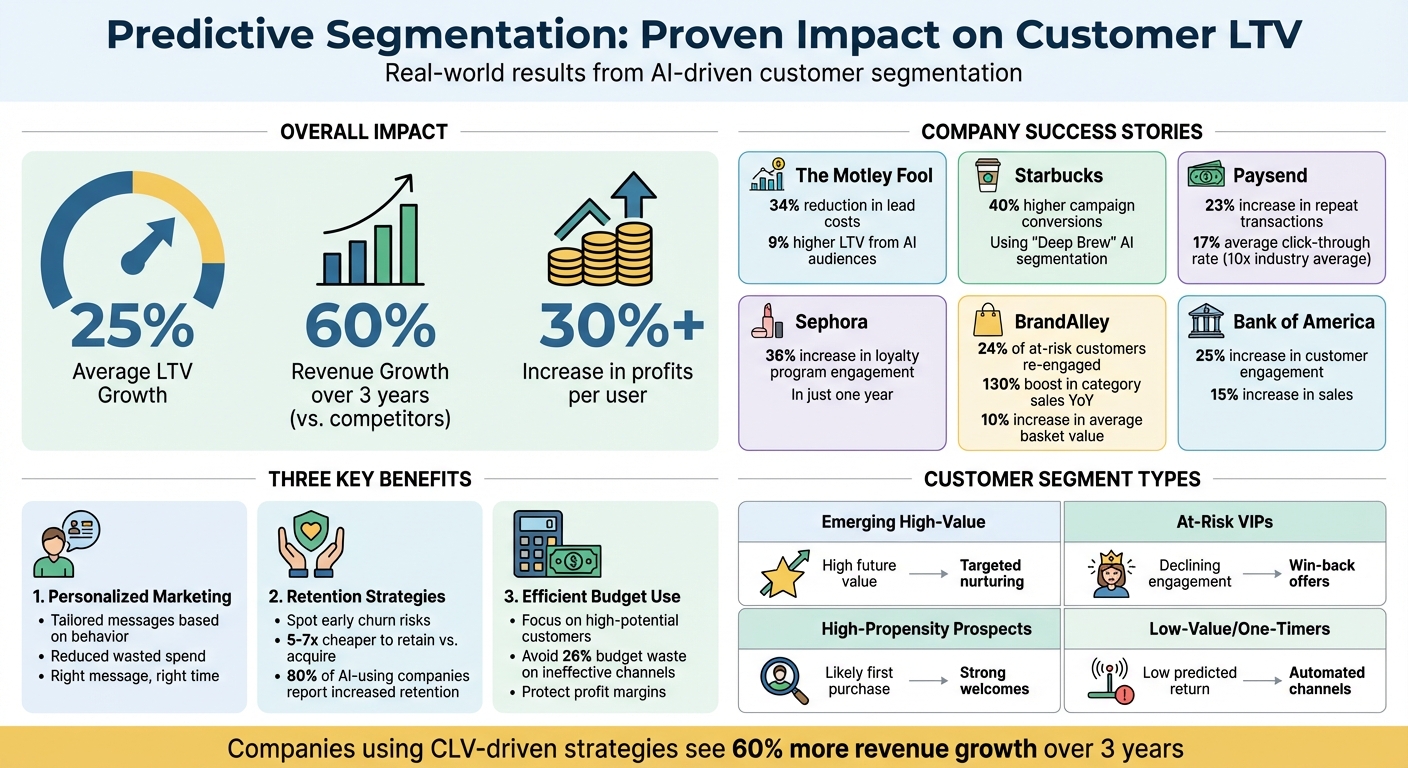
Predictive segmentation uses AI to analyze customer behavior and forecast future actions, helping businesses increase Customer Lifetime Value (LTV). Unlike static methods like demographics or RFM models, it processes real-time signals (e.g., email clicks, cart additions) to identify high-value customers, reduce churn, and allocate resources effectively. Companies using predictive segmentation report LTV growth of up to 25% and revenue increases of 60% over three years.
Key Benefits:
- Personalized Marketing: Tailor messages and offers based on customer behavior, reducing wasted spend.
- Retention Strategies: Spot early churn risks and act with targeted campaigns.
- Efficient Budget Use: Focus on high-potential customers and avoid overspending on low-value segments.
Examples:
- The Motley Fool: Reduced lead costs by 34% using predictive tools.
- Starbucks: Boosted campaign conversions by 40% with AI-driven segmentation.
- Paysend: Increased repeat transactions by 23% through targeted retention efforts.
To get started, consolidate customer data, use RFM analysis, and implement predictive models. Platforms like BrandMultiplier.ai can enhance results by aligning insights with marketing tools and providing continuous optimization.
Predictive Segmentation ROI: Key Statistics and Business Impact
Replace Static Segmentation with Predictive AI
sbb-itb-63525a7
How Predictive Segmentation Improves Customer LTV
Predictive segmentation reshapes how businesses interact with customers by enabling tailored marketing, reducing churn, and ensuring resources are used effectively.
Personalized Marketing and Targeting
Sending generic messages is like throwing darts blindfolded - it wastes time and money. Predictive segmentation helps businesses craft messages and offers that align with each customer’s likely next move. Instead of bombarding everyone with the same email, you send messages that fit where each customer is in their journey.
Take The Motley Fool, for example. They used Twilio Segment’s predictive tools to pinpoint the top 20% of users with the highest potential lifetime value (LTV). Feeding this data into Facebook’s lookalike audience tool cut lead acquisition costs by 34% and brought in customers with a 9% higher LTV compared to those from non-AI audiences. That’s not just better targeting - it’s smarter spending.
Retention gets a boost too. Starbucks leverages its "Deep Brew" AI to segment customers based on predicted value, tailoring promotions and rewards accordingly. This approach led to campaign conversions that were 40% higher than generic campaigns. As Mikkel Tophoj from SAP Engagement Cloud puts it:
It's all about the customer: sending the right message to the right person at the right time.
Predictive models don’t just identify high-value customers - they also highlight “Emerging High-Value Customers.” These are people who haven’t hit VIP status yet but are on track to get there. By offering exclusive deals and personalized content, businesses can nudge these customers toward higher spending.
| Segment Type | Predictive Insight | Marketing Action |
|---|---|---|
| Emerging High-Value | High future value but not yet VIP | Targeted nurturing to elevate them to VIP status |
| At-Risk VIPs | Declining engagement among high-value customers | Proactive win-back offers and personalized service |
| High-Propensity Prospects | Likely to make a first purchase based on lookalike data | Invest in acquisition and offer strong welcomes |
| Low-Value/One-Timers | Low predicted return with no repeat behavior | Move to low-cost automated channels |
This level of precision doesn’t just improve targeting - it lays the groundwork for proactive customer retention.
Improving Retention with Predictive Insights
Losing customers is costly - acquiring a new one costs 5 to 7 times more than keeping an existing one. Predictive segmentation helps businesses spot early warning signs, like reduced website visits, lower email engagement, or a drop in purchase frequency, and act before customers leave.
For instance, Paysend, a UK-based fintech company, used CleverTap’s predictive tools to identify users at risk of churning. They sent tailored push notifications to these users, leading to a 17% average click-through rate - 10 times the industry average - and a 23% increase in repeat money transfers quarter-over-quarter.
Similarly, BrandAlley used SAP Engagement Cloud’s AI to re-engage 24% of at-risk customers. By analyzing predictive trends, they shifted their focus to home and garden products, boosting sales in that category by 130% year-over-year and increasing average basket value by 10%.
The secret is acting before it’s too late. Predictive models continuously monitor customer behavior and trigger win-back campaigns when engagement drops - like when a customer hasn’t made a purchase in 90 days. This proactive approach works: 80% of companies using AI-driven segmentation report increased customer retention.
Better retention not only keeps customers around but also frees up resources for strategic investments.
Optimizing Resource Allocation
Not all customers are worth the same investment. Predictive segmentation ensures budgets are focused on high-potential customers, avoiding waste on low-value segments.
Marketers estimate that 26% of their budgets go to ineffective channels and strategies. Predictive segmentation changes that by identifying where premium efforts - like personalized onboarding or omnichannel campaigns - will deliver the most impact. At the same time, lower-value customers can be guided through cost-effective automated flows.
This strategy also protects profit margins. Predictive models can identify price-sensitive customers who need discounts to convert, while avoiding unnecessary incentives for loyal customers who would buy anyway. The result? Smarter spending and healthier margins.
Companies that focus on CLV-driven strategies see 60% more revenue growth over three years compared to their competitors. For smaller businesses and startups, this means stretching limited budgets further while driving growth. As Laura Wall from Plinc explains:
Predictive segmentation represents a fundamental shift in customer engagement, moving from a reactive approach to a proactive, data-driven strategy.
Research and Data on LTV Improvements
Evidence of LTV Growth
The numbers don’t lie - AI-driven segmentation is making a big impact. On average, it boosts customer lifetime value (LTV) by 25% and can drive revenue growth by as much as 60% over three years.
Let’s look at some real-world examples. Sephora used machine learning to analyze basket size and purchase frequency, which allowed them to revamp their loyalty program. The result? A 36% increase in loyalty program engagement in just one year, as reported in LVMH's 2023 Investor Relations Report. Similarly, Shopify introduced machine learning-powered CLV forecasting tools to its merchants in early 2023. Stores using these tools saw an impressive 25% revenue boost in the first quarter alone.
Other industries are also reaping the rewards. Bank of America implemented an AI-powered segmentation platform to get a comprehensive view of customer transactions. This led to a 25% increase in customer engagement and a 15% uptick in sales. Meanwhile, a major telecom provider used AI to analyze service usage and customer interactions, successfully reducing churn by 25% and increasing Average Revenue Per User (ARPU) by 15%.
Profitability is another area where AI-driven segmentation shines. Businesses using advanced CLV segmentation have seen profits per user grow by 30% or more. A retail chain working with Salesforce reported a 25% increase in customer LTV and a 15% drop in churn within a year. Similarly, Sigmoid helped lawn and garden brands achieve a 10% LTV boost while improving marketing spend efficiency by 15% using machine learning models.
These results highlight the transformative potential of AI-driven segmentation. But to achieve such outcomes, choosing the right predictive models and techniques is crucial.
Comparing Predictive Models and Techniques
Improving LTV starts with selecting the right predictive model. The complexity and accuracy of these models vary, so your choice should align with your organization’s data resources and goals.
- Historical averages are the simplest option. They require minimal data (12–24 months of transaction history) but offer low accuracy. This approach is best suited for broad, high-level planning.
- Cohort-based models take things a step further by factoring in seasonal trends and patterns. While more precise than historical averages, they still fall short for individual-level predictions.
- Probabilistic models like BG/NBD (Beta-Geometric/Negative Binomial Distribution) strike a balance between simplicity and accuracy. Using transaction history, these models estimate purchase frequency and churn probability. When paired with the Gamma-Gamma model, they can predict transaction values reliably, making them a good choice for customer-level LTV forecasting.
- Machine learning models offer the highest accuracy by incorporating a wide range of data, including behavioral signals like website visits and email engagement. For example, research using the Olist retail dataset showed that while a BG/NBD model achieved an R² of 0.61, a Hybrid Deep model reached an R² of 0.81, significantly reducing prediction errors.
Here’s a quick comparison:
| Model Type | Data Requirements | Accuracy Level | Best Use Case |
|---|---|---|---|
| Historical Averages | 12–24 months transaction history | Low | High-level planning |
| Cohort-Based | 12–24 months cohort data | Moderate | Evaluating trends at the channel level |
| BG/NBD + Gamma-Gamma | 6–12 months transaction history | Moderate/High | Customer-level predictions with limited data |
| Machine Learning | Large datasets + behavioral data | High | Personalization and VIP targeting |
For SMBs or startups with limited resources, starting with BG/NBD models is a practical choice. These models are less resource-intensive but still provide strong results. As your data capabilities grow, transitioning to machine learning pipelines can unlock even greater accuracy and personalization.
The key takeaway? Keep your models updated. Continuous updates improve accuracy over time as they incorporate new customer behaviors, narrowing prediction errors and delivering more reliable insights.
This comparison serves as a roadmap for SMBs and other businesses looking to build effective predictive segmentation systems for LTV growth.
Implementing Predictive Segmentation for Growth
Steps to Build a Predictive Segmentation Pipeline
Creating a predictive segmentation pipeline doesn’t have to be overly complicated. Start with the basics and build up as your needs grow.
The first step is consolidating your customer data. A Customer Data Platform (CDP) or unified data warehouse is essential. This system gathers information from sources like your e-commerce platform, email provider, support desk, and mobile apps, combining it into a single, comprehensive customer profile. Without this unified foundation, accurate predictions are nearly impossible.
Begin with RFM analysis - a simple yet effective framework that evaluates customer value based on Recency, Frequency, and Monetary value. This provides a clear picture of your current customer behavior before adding advanced AI-driven layers. From there, you can incorporate additional features, such as time since the last purchase, changes in basket size, engagement velocity, and SKU preferences, to refine prediction accuracy.
The next step is integrating predictive modeling. This includes identifying churn risks, purchase likelihood, and forecasting lifetime value (LTV). To maximize effectiveness, ensure the pipeline syncs these predictive insights directly with your marketing tools - such as Meta, Google Ads, or Klaviyo - so you can activate personalized, real-time customer journeys. For instance, if a customer is flagged as "high churn risk", they should receive a targeted win-back email within minutes, not days. This approach helps allocate resources more efficiently while increasing customer LTV.
Finally, use control groups and suppression lists to measure incremental impact accurately and protect your profit margins. These measures ensure your efforts are both effective and cost-efficient.
By following these steps, you’ll establish a predictive segmentation pipeline that’s ready to deliver measurable results, much like the strategy employed by BrandMultiplier.ai's Narrative OS.
Using BrandMultiplier.ai for Predictive Segmentation
BrandMultiplier.ai takes predictive segmentation to the next level by focusing on why customers buy, rather than just tracking their past purchases. At the core of their approach is a Rumble session - a three-hour workshop designed to capture untapped insights from founders and decision-makers. This session identifies nuanced signals that influence high-value customer behavior.
Their methodology uses a neuroscience-backed framework to organize customers into dynamic segments, such as "High Propensity to Churn", "Predicted High LTV", and "Ready to Upgrade", instead of relying on static categories like age or location. These insights are then shared across sales, marketing, and product teams, ensuring what BrandMultiplier calls "Voice Fidelity" - a unified narrative that resonates across all channels.
What sets this system apart is its continuous optimization loop. It tracks how your narrative impacts customer acquisition costs (CAC), deal speed, and LTV in real time, allowing for ongoing adjustments. Businesses using this approach have reported impressive results, including an average 30%+ reduction in CAC within six months and a 35%+ acceleration in deal cycles. For example, Apto Solutions leveraged this methodology to achieve a 41% year-over-year revenue increase.
The service starts at $7,500 per month for core narrative development, with higher pricing tiers offering additional leadership involvement and faster implementation. Unlike traditional agencies that deliver static reports, BrandMultiplier.ai provides an installed system that operates independently after setup, boasting a 75% retention rate beyond the initial project.
Conclusion and Key Takeaways
Why Predictive Segmentation Drives Growth
Predictive segmentation changes the game for customer engagement by focusing on what customers are likely to do next, rather than reacting to past behavior. This proactive approach delivers real results: businesses using customer lifetime value (CLV)-driven strategies see revenue growth outpacing competitors by an average of 60% over three years.
Instead of taking a one-size-fits-all approach, predictive segmentation allows you to deliver tailored messages at just the right moment. For example, you can send a win-back offer to a customer showing signs of churn or suggest a personalized upsell to someone ready for an upgrade. By focusing on high-value relationships, you reduce wasted marketing spend and get the most out of every dollar. As Kuma Marketing puts it:
Segmentation is not a reporting exercise. It is an operating system for growth.
This approach highlights the need to rethink traditional segmentation methods and embrace strategies that drive measurable business results.
Next Steps for SMBs and Startups
How can small businesses and startups take advantage of predictive segmentation? Start by shifting from static demographic-based segmentation to a dynamic, data-driven model. Here’s what to focus on:
- Consolidate your data: Bring all your customer data into one place for a clearer view.
- Run RFM analysis: Use recency, frequency, and monetary value to understand customer behavior.
- Incorporate predictive modeling: Identify your most valuable customers, those at risk of leaving, and hidden opportunities.
Once you have these insights, integrate them with your marketing tools to create real-time, personalized customer journeys.
For businesses looking to take it a step further, platforms like BrandMultiplier.ai’s Narrative OS offer a way to combine neuroscience-backed strategies with ongoing optimization. This lets you track how your messaging impacts key metrics in real time, ensuring your segmentation efforts are always aligned with your growth goals.
FAQs
What data do I need to start predictive segmentation?
To get started with predictive segmentation, gather essential data like transaction history, customer profiles, and engagement metrics. Make sure this data is properly cleaned, enriched, and combined to ensure accurate analysis. This step lays the groundwork for uncovering insights that can boost customer lifetime value.
How do I know predictive segmentation is actually increasing LTV?
To determine if predictive segmentation is enhancing lifetime value (LTV), dive into the data. Studies show that applying AI-driven segmentation can lead to an average 25% boost in customer LTV. Pay close attention to trends like better customer engagement, higher retention rates, and increased revenue growth within targeted groups. Recent case studies back up these findings, offering real-world examples of its impact.
How often should I retrain or refresh my predictive segments?
Predictive segments need regular updates - ideally every 30 to 90 days. This keeps them aligned with evolving customer behaviors and ensures they stay accurate in forecasting customer lifetime value. Frequent updates also help maintain their relevance, leading to improved business results.
Ready to transform your brand story?
Schedule a free diagnostic to see how we can help.
Schedule The Diagnostic