

How Real-Time Sales Data Boosts Deal Speed
How Real-Time Sales Data Boosts Deal Speed
Real-time sales data helps businesses close deals faster by providing instant insights into customer behavior, sales activities, and market trends. Unlike delayed reporting, it allows sales teams to make timely decisions, adjust strategies immediately, and reduce bottlenecks in the sales process. Key highlights include:
- Faster Deal Closures: Acting on live signals like website visits or funding announcements can reduce sales cycles by up to 40%.
- Improved Metrics: Real-time tracking enhances sales velocity, lead conversion rates, and time-to-close.
- Revenue Growth: Companies using real-time data report 17% faster revenue growth and up to 30% better team performance.
- Actionable Insights: Tools like AI analytics and live dashboards enable quick responses to buying signals and real-time performance monitoring.
Turning Sales Data into Action with Power BI
sbb-itb-63525a7
Sales Metrics Improved by Real-Time Data
Real-time sales data is changing the way businesses measure success, turning attention toward metrics that predict outcomes instead of just reporting them. Let’s explore how three key metrics evolve with instant pipeline visibility. These updated metrics provide actionable insights that can fine-tune every stage of your sales process.
Sales Velocity
Sales velocity tracks how quickly revenue moves through your pipeline. It’s calculated as (Number of Deals × Average Deal Size × Win Rate) ÷ Sales Cycle Length. With real-time data, you can tweak any of these components, creating a ripple effect across your pipeline. For example, AI-driven lead scoring can distinguish between serious prospects and less promising leads. Real-time insights, such as a prospect visiting your pricing page or a funding announcement from a target account, help your team act when buyer intent is at its peak.
The results are tangible. Real-time monitoring can boost performance by 30%. Instead of waiting until the end of the week to realize they’re behind on call targets, reps can adjust their efforts mid-day. This faster feedback loop - shrinking from weeks to hours - allows for immediate course correction while it still makes a difference.
Lead Conversion Rates
Real-time data pinpoints behavioral triggers right away, making it easier to convert leads. For instance, when a prospect downloads a case study, visits a demo page, or opens several emails in a row, your team can step in immediately while interest is high. In 2024, Ultima leveraged real-time intent data and direct dials through Cognism to identify active buyer signals. Acting quickly on these signals, they cut their Time to Engagement (TTE) and achieved full ROI in just eight weeks.
Modern tools emphasize target-account coverage and quick responses to live triggers. Henderson Scott, for example, used real-time alerts to track events like hiring, acquisitions, and investments. This allowed them to engage with high-intent accounts far faster than traditional research methods. Overall, real-time data can increase sales effectiveness by 30% and lead to 15% higher conversion rates.
Time-to-Close
Nothing derails a deal like bottlenecks, and real-time data helps you spot them before they become deal-breakers. For example, if a prospect lingers in the "Proposal" stage for two weeks - longer than your average time-to-close for that phase - an alert can prompt immediate action. Top-performing sales teams keep deal slippage under 15%, while less effective monitoring can let it rise above 25%. Shifting from post-mortem reviews to proactive coaching during active deals is key.
Real-time alerts and automated updates ensure bottlenecks are minimized, keeping deals on track and reducing the time-to-close. Businesses that adopt real-time sales visibility see revenue grow 17% faster.
"Good sales leaders don't wait for quarter-end to learn what the market was already saying."
- Semir Jahic, CEO & Co-Founder of Salesmotion
Shortening the time it takes to close deals, alongside improving conversions, strengthens your competitive edge. Together, these metrics give your team the flexibility to adapt quickly and speed up your sales cycle.
How to Implement Real-Time Sales Data Systems
You don't need to overhaul your entire tech stack to transition to real-time sales data. Start by strengthening your existing foundation and layering in real-time intelligence. Why? Because relying on outdated data can hold your team back. For example, B2B contact data deteriorates at a rate of about 2.1% per month, leaving nearly 22.5% of your CRM inaccurate by the end of the year. To combat this, aim for a 7-day data refresh cycle instead of the typical 6-week update.
To implement this effectively, your system should consist of three essential layers: CRM (e.g., Salesforce, HubSpot), data quality tools (e.g., Prospeo, Cognism), and revenue intelligence platforms (e.g., Gong, Sybill). The secret lies in creating a system that continuously ingests and processes data through event queues or message buses, rather than relying on outdated batch updates. This way, your team gets real-time insights instead of lagging behind.
Connecting AI Analytics to Your CRM
Making real-time data work starts with integrating AI analytics into your CRM. Automating CRM logging is a game-changer - it captures every call, email, and meeting automatically, eliminating the need for manual data entry. This is critical because 50% of CRM projects fail when fewer than 37% of sales reps use the system consistently. By removing the burden of manual logging, you ensure your data stays complete and your dashboards remain reliable.
Another step is automating stage progression. For example, your CRM can update opportunities automatically when certain triggers occur - like booking a meeting, sending a proposal, or signing a contract. AI agents can also monitor accounts for key signals, such as executive changes, funding announcements, or hiring trends, and feed this information directly into your CRM. Companies using AI agents for account monitoring have reported 2.5x faster pipeline generation.
When it comes to forecasting, allow for a 90-day calibration period for AI tools to reach 85-95% accuracy, compared to the roughly 65% accuracy of manual methods. This upgrade not only improves accuracy but also saves each sales rep an average of 23 hours per month previously spent on manual forecasting.
Building Live Dashboards
Once your CRM is equipped with AI analytics, the next step is creating live dashboards that deliver actionable insights. A strong dashboard should quickly answer three essential questions: What changed? Why did it change? Who needs to act?. To achieve this, structure your dashboard into four layers:
- Activity: Tracks effort as a baseline.
- Conversion: Measures quality.
- Efficiency: Focuses on speed.
- Management: Highlights coaching opportunities.
Focus on leading indicators like signal-to-outreach conversion rates and response times to live triggers, rather than lagging metrics like closed revenue. For smaller teams (under 50 reps), native CRM dashboards (like those in Salesforce or HubSpot) are often sufficient.
Set up threshold alerts to flag significant changes, such as a 15% drop in deal probability, to prompt immediate action from managers. High-performing teams keep deal slippage below 15%, while less effective teams let it climb above 25%.
"A dashboard should answer three questions fast. What changed, why it changed, and who needs to act."
- Semir Jahic, CEO & Co-Founder, Salesmotion
Take FigTree Financial as an example. They unified their disconnected systems into a single CRM (Salesforce Pro Suite) and saw 10% less busywork for reps, a 50% improvement in forecast accuracy, and automated over 60 client touchpoints monthly. They started with small, high-impact use cases and expanded after proving ROI with a pilot group.
These upgrades not only simplify workflows but also drive faster deal closures and improve overall sales velocity.
Benefits of Real-Time Sales Data
Real-time systems don't just sound impressive - they deliver measurable results. By enabling faster responses and sharper decision-making, real-time sales data can transform key metrics like sales cycle length and close rates. Companies leveraging real-time visibility into their sales activities report 17% faster revenue growth compared to those stuck with batch updates. This combination of speed and accuracy gives sales teams the tools they need to act decisively.
Shorter Sales Cycles
One of the most immediate advantages of real-time data is the ability to shorten sales cycles. Acting on live buying signals - like a prospect visiting your pricing page or a company announcing new funding - means you can engage potential buyers before they turn to competitors. Delays are costly; every additional week in the sales cycle reduces the likelihood of closing by 7%.
Take Ultima, for example. In 2025, they implemented Cognism's real-time intent data and direct dials. By targeting leads showing active intent and following up immediately, they recovered their investment in just 8 weeks. Another company, using Salesforce consulting to integrate AI-powered deal management and workflow automation, cut their average sales cycle by 40%. Automation like this can trim sales cycles by 30%, and reducing a sales cycle by 20% can increase pipeline velocity by 25%.
Real-time data also eliminates the drawn-out back-and-forth of traditional discovery calls. Sales reps can confirm key details - budget, timeline, decision-makers - by the second call, saving weeks of effort. Teams that gather these details upfront close deals 30-40% faster than those that don’t. Moreover, 43% of sales reps waste over three hours each week updating CRMs with outdated information, a problem solved entirely by syncing data in real time.
Higher Close Rates
Real-time data doesn’t just speed things up - it helps you win more deals. Sales teams that track both quantity and quality metrics in real time achieve 72% win rates, compared to just 47% for their peers. This data allows you to prioritize high-value accounts showing urgency, such as those with recent acquisitions or hiring surges, rather than wasting time on static lists.
For instance, Built-In adopted Apollo's real-time scoring and intent signals in 2025/2026, leading to a 10% increase in win rates and a 10% boost in Average Contract Value (ACV). Teams using AI agents for account monitoring generate pipelines 2.5x faster. High-performing teams that rely on real-time monitoring keep deal slippage below 15%, while teams without it see slippage climb above 25%.
Even the act of making performance visible can drive improvement. As noted by Harvard Business Review, "Visibility alone can lift individual performance by up to 12 percent, simply because people respond to transparency about their own progress.".
Real-time tracking also enhances team performance by 30% when progress toward goals is monitored. Skilled managers leveraging real-time signals can drive 29% higher revenue. For SMBs with sales cycles averaging 14-30 days, these improvements mean faster cash flow and more consistent revenue streams.
Measuring Revenue Impact from Real-Time Data
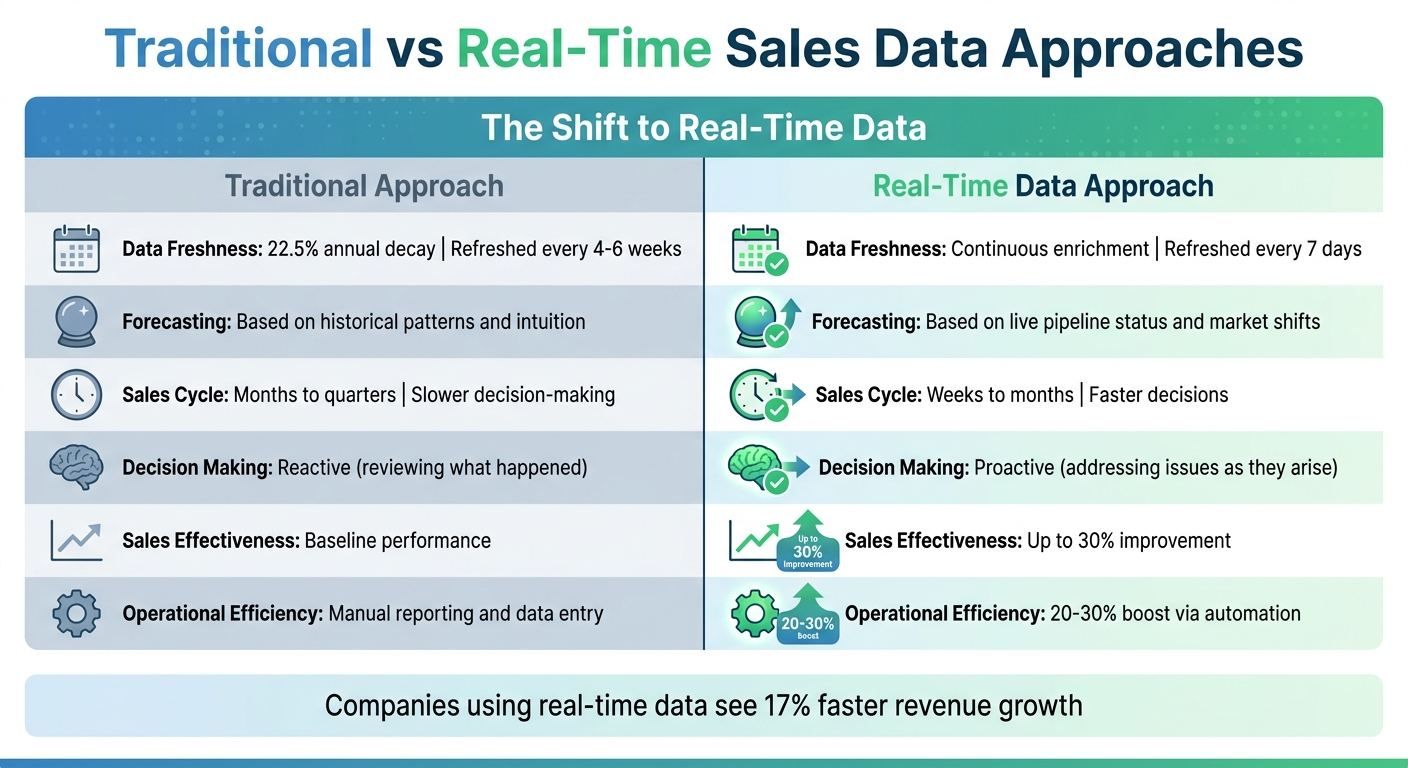
Traditional vs Real-Time Sales Data: Performance Metrics Comparison
Tracking the right metrics is essential for validating the impact of real-time sales data. For SMBs, having a structured way to measure returns from real-time systems is crucial. Here, the standard ROI formula comes into play: (Net profit ÷ Cost of investment) × 100 = ROI%. Net profit includes the benefits of faster sales cycles, improved conversion rates, and reduced customer acquisition costs, minus the expenses of implementing your data system.
What sets real-time data apart is its focus on leading indicators - the behaviors that influence outcomes. Unlike traditional methods that rely on lagging indicators (what happened after deals close), real-time data tracks actions like how quickly sales reps respond to buying signals.
"Good sales leaders don't wait for quarter-end to learn what the market was already saying."
- Semir Jahic, CEO of Salesmotion
Traditional vs. Real-Time Data Approaches
The shift from traditional to real-time data methods becomes evident when you compare their metrics. Traditional systems, which typically update every 4–6 weeks, suffer from 22.5% annual data decay as contact details grow outdated. Real-time systems, on the other hand, refresh data every 7 days, keeping it current and actionable. This alone can reduce forecast variance by 15%, even without introducing additional tools.
Here's a side-by-side comparison of how real-time data reshapes key metrics compared to traditional methods:
| Metric | Traditional Approach | Real-Time Data Approach |
|---|---|---|
| Data Freshness | 22.5% annual decay; refreshed every 4–6 weeks | Continuous enrichment; refreshed every 7 days |
| Forecasting | Based on historical patterns and intuition | Based on live pipeline status and market shifts |
| Sales Cycle | Months to quarters; slower decision-making | Weeks to months; faster decisions |
| Decision Making | Reactive (reviewing what happened) | Proactive (addressing issues as they arise) |
| Sales Effectiveness | Baseline performance | Up to 30% improvement in effectiveness |
| Operational Efficiency | Manual reporting and data entry | 20–30% boost via automation |
KPIs to Track
To measure ROI effectively, focus on 5–7 core metrics that directly impact performance. At the top of the list is sales velocity, which provides a snapshot of pipeline health. Use this formula to calculate daily revenue potential: (Number of Opportunities × Average Deal Value × Win Rate) / Length of Sales Cycle. Unlike standalone metrics, this compound figure gives a more comprehensive view of your sales process.
Other key metrics include:
- Customer Acquisition Cost (CAC): Helps refine ad spend and targeting strategies.
- Customer Lifetime Value (LTV): Tracks churn predictions and feature adoption in real time.
- Pipeline Coverage: Aim for 3–4x your quota to ensure accurate forecasting.
- Deal Slippage: Monitor deals with delayed closing dates. High-performing teams keep this below 15%, while less effective ones see it exceed 25%.
Conclusion
Access to real-time sales data has shifted from being a luxury to a must-have for SMBs aiming to close deals faster and drive revenue growth. Instead of waiting weeks for outdated reports, live data gives teams the power to act in the moment. This shift transforms sales strategies from reactive to proactive, allowing immediate adjustments rather than relying on periodic reviews.
Businesses that embrace real-time visibility see tangible results: a 17% increase in revenue growth and a 30% improvement in sales team effectiveness. Speed becomes a critical edge. Engaging buyers at just the right moment - whether responding to a pricing page visit or following up within 24 hours of a demo - creates a momentum that traditional, slower approaches simply can’t replicate.
For SMBs, where decision-making often rests with a single owner, this approach aligns perfectly. There’s no need for complex consensus-building. Instead, the focus is on quickly acting on key signals. However, this strategy is only as strong as the data it’s built upon.
The quality of your data is the foundation. A dashboard is only as reliable as the information feeding into it, emphasizing the importance of continuous data enrichment and automated logging. Start by refining your data layer, prioritize 5–7 actionable indicators, and ensure your team can instantly track progress.
Integrating real-time insights into your sales strategy doesn’t just speed up deal closures - it establishes a scalable system for consistent growth. Tools like Narrative OS can help by codifying your most effective sales story and optimizing key metrics like deal speed, customer acquisition costs (CAC), and customer lifetime value (LTV). With the right framework and data, you’re set to turn insights into lasting success.
FAQs
What counts as a “real-time buying signal” worth acting on?
Real-time buying signals are clues that someone is ready to make a purchase. These signals could include engaging with specific content, recent changes within a company, or other timely actions that hint at intent to buy. By spotting these signals, sales teams can act fast, increasing their chances of closing deals and speeding up the sales process.
How can a small sales team add real-time data without replacing their CRM?
Small sales teams can make the most of real-time data by incorporating visibility layers or dashboards that sync directly with their existing CRM. This approach ensures that key metrics - like calls, meetings, and pipeline updates - are automatically displayed within their current tools, eliminating the need for extra manual work. To get the most accurate insights, it's crucial to maintain data quality and automate updates. This way, teams can rely on real-time data without the hassle of completely reworking their CRM system.
Which 5–7 metrics should I track to prove real-time data ROI?
To effectively showcase the ROI of real-time data, focus on tracking these key metrics:
- Pipeline health: Understand the overall condition and potential of your sales pipeline.
- Deal velocity: Measure how quickly deals move through the pipeline.
- Lead and activity engagement: Track how leads interact with your outreach efforts and activities.
- Individual progress toward targets: Monitor how team members are performing against their goals.
- Peer benchmarking: Compare individual and team performance to industry or internal standards.
- Sales cycle length: Evaluate the time it takes to close deals.
These metrics offer a clear snapshot of performance and help assess how real-time insights influence sales results.
Ready to transform your brand story?
Schedule a free diagnostic to see how we can help.
Schedule The Diagnostic