

Sales Velocity: AI Strategies for SMBs
Sales Velocity: AI Strategies for SMBs
Want to speed up your sales process? Here's the key: Sales velocity measures how quickly your team converts leads into revenue. For SMBs, this metric is critical - it impacts cash flow and growth directly.
Here’s what you need to know:
- Formula: (Opportunities × Average Deal Value × Win Rate) ÷ Sales Cycle Length
- Example: 50 leads worth $5,000 each, with a 30% win rate and a 25-day cycle = $3,000/day.
- SMBs typically aim for $500–$1,000/day, while SaaS startups target $1,000–$2,000/day.
AI tools can triple or even quintuple your sales velocity by automating lead qualification, follow-ups, forecasting, and proposal creation. This saves time, reduces errors, and helps sales teams focus on closing deals.
Key Benefits of AI in Sales:
- Lead Qualification: AI automates scoring in seconds, boosting conversion rates by 30%.
- Follow-Up: AI drafts emails, schedules meetings, and tracks engagement, saving 70% of time.
- Forecasting: AI improves accuracy by 43%, reducing costly errors.
- Proposals: AI generates documents faster, increasing win rates by 40%.
Takeaway: AI simplifies repetitive tasks, enabling SMBs to focus on building relationships and closing deals. Start by cleaning your CRM data and integrating AI tools to see faster results.
1. Traditional Sales Methods
Lead Qualification
Conventional sales teams often rely on frameworks like BANT and MEDDIC to evaluate whether a lead is worth pursuing. Sales Development Representatives (SDRs) typically spend 5 to 20 minutes per prospect researching firmographic details and contact information. However, this manual process is highly subjective - one rep might prioritize budget, while another focuses on company size, leading to inconsistent evaluations across the team.
This approach results in only 60-70% accuracy due to human error and varying standards. On top of that, sales reps dedicate 67% of their time to leads that never convert, with an average lead-to-opportunity conversion rate of just 13%. When lead volume exceeds 800-1,000 per month, manual qualification processes often falter.
"The qualification problem isn't that teams lack a framework. It's that the frameworks we've relied on for decades were designed for a different buying environment." - Natasha Brennan, Prospectory Team
Inefficiencies in follow-up processes further exacerbate these challenges, slowing down sales momentum.
Follow-Up Efficiency
In traditional sales setups, reps spend 60% to 70% of their time on administrative tasks like data entry, creating proposals, and scheduling meetings. These non-selling activities significantly drag down productivity, with reps losing about 2 hours daily to tool-switching, manual research, and CRM updates. Annually, this adds up to over 500 hours of lost productivity per rep.
The follow-up process itself is flawed. Most teams follow a first-in-first-out (FIFO) method, prioritizing leads based on arrival time rather than intent. This often results in wasted effort on low-potential leads while high-intent prospects wait. Manual processes also lead to delays between sales stages and missed opportunities to engage.
These inefficiencies ripple into other areas, like forecasting, where human error and outdated methods create further obstacles.
Forecasting Accuracy
Traditional forecasting struggles with accuracy because it relies on humans to predict complex outcomes with incomplete data. The average forecast miss rate is 34%, and only 7% of organizations achieve accuracy above 90%. For a company generating $50 million in revenue, a 10% forecast miss can result in a $1.2 million loss.
"Traditional forecasting is fundamentally broken, not because people are bad at it, but because we're asking humans to do something humans aren't wired to do: accurately predict complex outcomes with incomplete information." - Simone Adeyemi, RevOps Leader
Three main issues plague traditional forecasting:
- Optimism bias: Reps often overlook potential delays or budget constraints.
- Stale data: Weekly updates quickly become outdated, often within 48 hours.
- Political buffering: Projections are either inflated or sandbagged to manage expectations.
Additionally, 30-40% of opportunities are assigned incorrect stages or placeholder close dates, making CRM data unreliable.
Proposal Creation
Creating proposals in traditional sales processes is another major bottleneck. Reps spend hours piecing together documents, searching for pricing sheets, case studies, and other resources scattered across disconnected systems. This fragmented approach slows response times and often results in inconsistent proposals - some reps rely on outdated information, while others struggle to locate the right materials.
Switching between administrative tasks and selling further diminishes focus and performance. With only 2.9% of Marketing Qualified Leads converting to revenue in traditional models, every hour spent on manual proposal creation takes away valuable selling time, directly impacting revenue potential.
Altogether, these traditional challenges severely limit the speed and efficiency of turning leads into revenue.
sbb-itb-63525a7
2. AI-Powered Sales Methods
Lead Qualification
AI has revolutionized the way sales teams qualify leads, replacing the tedious manual research process with lightning-fast evaluations. Tasks that once took 10 to 30 minutes can now be done in just 2 to 3 seconds. By analyzing hundreds of data points - such as funding rounds, executive changes, website activity, and call sentiment - AI pinpoints which leads are most likely to convert.
The results speak for themselves: companies leveraging AI for lead scoring report a 30% boost in conversion rates and a 25% improvement in win rates. High-performing sales teams are 2.8× more likely to use AI for lead prioritization compared to their lower-performing counterparts. This eliminates the inconsistencies of relying on "gut feelings" and ensures that every lead is evaluated using the same criteria.
"Reps can log in and get valuable account insights within 30 seconds to a minute."
- Joe DeFrance, VP of Sales, Incredible Health
AI also slashes the time spent on lead qualification by 40–60%, allowing sales teams to focus on meaningful interactions rather than administrative tasks.
Follow-Up Efficiency
AI doesn't just stop at qualification - it also supercharges follow-up processes. By automating tasks like drafting emails, scheduling meetings, and updating CRM systems, AI saves sales reps up to 70% of their follow-up time. It can even initiate outreach automatically when leads engage with pricing pages or download resources, ensuring no opportunity is missed.
Take the example of a B2B services SMB that adopted AI sales automation in March 2026. Within just four months, they reduced their sales cycle from 45 days to 18 days, improved their close rate by 22%, and increased quarterly revenue by 38% - all without adding more staff. AI also excels at nurturing long-term prospects, keeping "ghosted" leads engaged so they don’t fall off the radar.
Shikha Chauhan, a Product Manager at Hexalog, reported that using Inventive AI's response automation sped up their RFP process by 90%, resulting in a 50% improvement in win rates. These efficiencies not only save time but also create a foundation for more accurate sales forecasting.
Forecasting Accuracy
AI takes forecasting to the next level by analyzing thousands of variables, such as deal velocity, email engagement, and even how deeply prospects scroll through pricing pages. While traditional forecasting methods can have error rates of 30–40%, AI narrows that gap significantly, delivering revenue predictions within 5–10% accuracy.
"AI-driven analytics are delivering up to a 43% increase in forecast accuracy."
- Nathan Thompson, Fullcast
A great example is Sybit, a B2B tech firm that adopted AI-driven forecasting in 2025 under CRO Thilo Kerner. By identifying mismatched deal stages and incomplete customer profiles, they reduced forecast errors by nearly 30% in just two quarters and boosted productivity by 50%. AI also acts as an early warning system, flagging deals at risk - like when a key decision-maker disengages - so teams can act before it’s too late.
Sales teams using AI are 3.7× more likely to hit their quotas. Plus, with AI retraining on fresh data weekly or even daily, forecasts can adapt in real time to market changes, unlike static quarterly models. It's no surprise that 72% of top-performing sales teams now rely on AI for forecasting, cutting forecast variance by 35%.
Proposal Creation
AI also simplifies proposal creation, making it faster and more efficient to generate sales documents. For instance, Amazon Web Services uses Generative AI to craft account summaries, reducing proposal preparation time by 35 minutes per opportunity and increasing opportunity value by 4.9%. This streamlined approach not only saves time but also enhances the quality and impact of sales proposals.
Unlocking SMB Revenue with Sales Close Agent | Dynamics 365
Comparison: Strengths and Weaknesses
Traditional vs AI-Powered Sales Methods: Performance Comparison
Both traditional and AI-powered sales methods have their perks, but they differ greatly in speed, accuracy, and scalability. Traditional methods rely heavily on manual effort, which, while thorough, can slow down the sales process. On the other hand, AI-driven methods streamline repetitive tasks and process data on a large scale. However, these require clean data and careful implementation to work effectively.
Here’s a breakdown of how these approaches compare in key sales activities:
| Sales Activity | Traditional Approach | AI-Powered Approach | Measurable Impact |
|---|---|---|---|
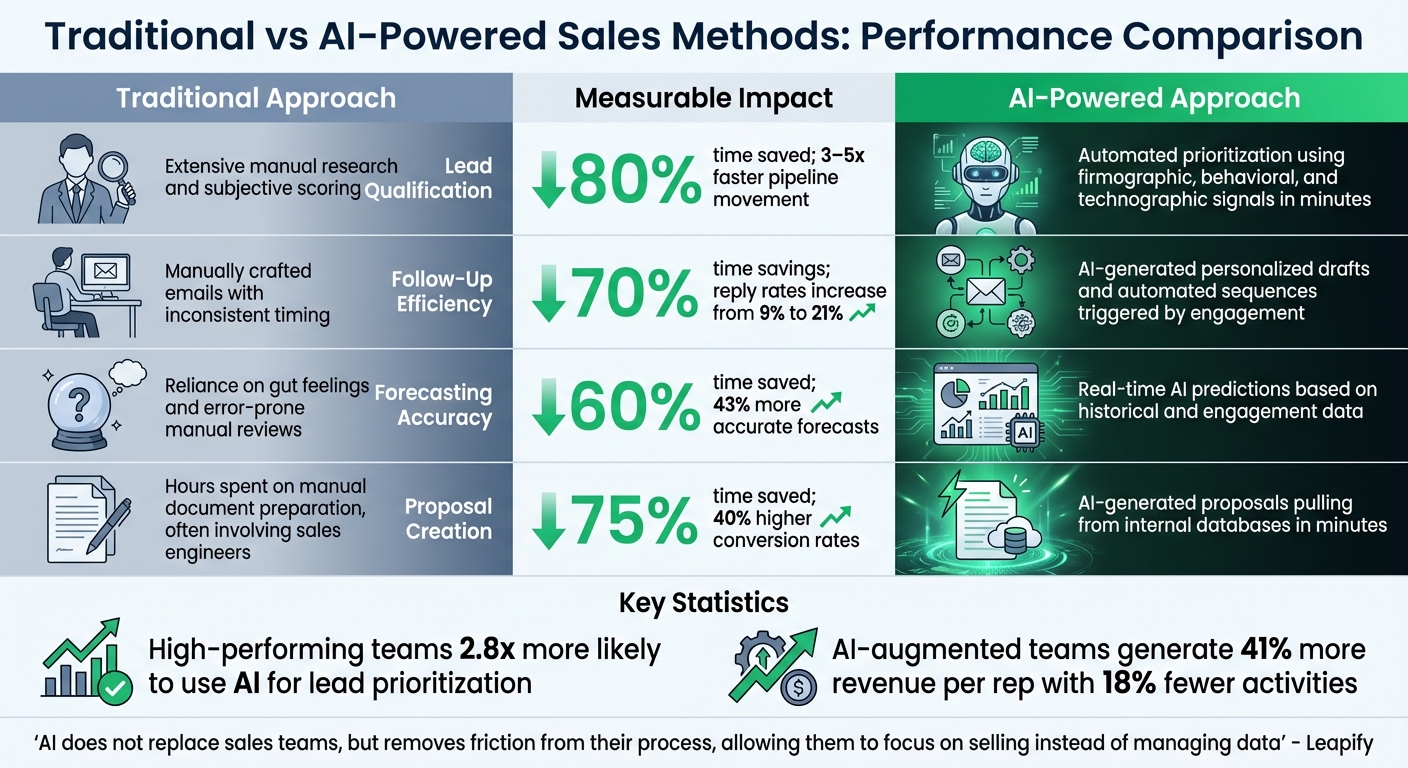
| Lead Qualification | Extensive manual research and subjective scoring | Automated prioritization using firmographic, behavioral, and technographic signals in minutes | 80% time saved; 3–5x faster pipeline movement |
| Follow-Up Efficiency | Manually crafted emails with inconsistent timing | AI-generated personalized drafts and automated sequences triggered by engagement | 70% time savings; reply rates increase from 9% to 21% |
| Forecasting Accuracy | Reliance on gut feelings and error-prone manual reviews | Real-time AI predictions based on historical and engagement data | 60% time saved; 43% more accurate forecasts |
| Proposal Creation | Hours spent on manual document preparation, often involving sales engineers | AI-generated proposals pulling from internal databases in minutes | 75% time saved; 40% higher conversion rates |
This comparison highlights how AI reduces administrative hurdles, freeing up sales teams to focus on closing deals and nurturing relationships.
While traditional methods excel at providing a personal touch and fostering trust, they often fall short when it comes to scaling efficiently - especially for small and midsize businesses (SMBs) handling a large volume of leads. In contrast, AI-powered approaches deliver speed and consistency but require upfront investments to ensure data quality and proper setup. Notably, high-performing sales teams are 2.8x more likely to use AI for lead prioritization, and AI-augmented teams generate 41% more revenue per rep with 18% fewer activities.
The real advantage lies in striking a balance. AI shines in eliminating repetitive, time-consuming tasks - like CRM updates, lead scoring, and follow-up drafting - allowing salespeople to focus on what they do best: building trust, navigating negotiations, and closing deals. As Leapify puts it:
"AI does not replace sales teams, but removes friction from their process, allowing them to focus on selling instead of managing data".
Ultimately, AI isn’t about replacing the human side of sales - it’s about enhancing it. For SMBs trying to boost sales velocity, leveraging AI for routine tasks can enable teams to concentrate on high-value, relationship-driven efforts. This balance between automation and human interaction is key to modernizing sales processes effectively.
Conclusion
AI is reshaping the world of sales, bridging the gap between traditional methods and modern efficiency. This transformation isn’t just about adopting new technology - it’s about achieving better speed, scale, and focus. As discussed earlier, traditional sales methods often rely on manual research, instinct-driven forecasting, and repetitive administrative tasks that can drag out the sales cycle. In contrast, AI-powered approaches streamline these processes, automating routine tasks and enabling sales teams to focus on what matters most: building relationships and closing deals. For example, small and medium-sized businesses (SMBs) using AI have reported sales cycle reductions of 30–60% and improvements in forecast accuracy by up to 43%.
However, implementing AI successfully requires a thoughtful, step-by-step approach. Start by cleaning up your CRM data, ensuring clear data ownership, and integrating AI tools into your existing systems to avoid creating new silos. Clearly define which tasks AI will handle automatically - such as logging activities or confirming meetings - and which will still require human oversight, like pricing decisions or contract negotiations. This careful balance between human expertise and AI automation is key to modernizing the sales process.
By reducing friction in the sales workflow, AI empowers teams to focus on strategic selling. As Deelan.ai aptly states:
"AI doesn't replace your sales team – it replaces the friction around them."
With less time spent on administrative tasks, sales reps can dedicate themselves to discovery calls, nurturing relationships, and negotiating deals - the human elements that ultimately drive success.
For SMBs aiming to accelerate sales while maintaining genuine customer connections, the solution is clear: let AI handle the repetitive tasks, track results against key metrics like deal speed and win rates, and keep your team focused on high-value interactions. The most successful companies today aren’t choosing between automation and the human touch - they’re combining both in a way that maximizes impact.
At BrandMultiplier.ai, our Narrative OS embodies this philosophy, seamlessly integrating AI across sales, leadership, marketing, and product teams to deliver measurable growth. By shortening deal cycles and boosting customer lifetime value, we’re helping businesses achieve results that truly matter.
FAQs
Which sales velocity lever should I improve first?
When it comes to improving sales velocity, the best place to start is by tackling your biggest bottleneck. For small and medium-sized businesses (SMBs), focusing on shortening the sales cycle can often yield the fastest results. Why? Because it speeds up cash flow and enhances operational stability - two critical factors for growth.
AI can play a big role here. By automating repetitive tasks, prioritizing leads with high intent, and streamlining the sales process, it reduces delays and keeps things moving efficiently. Beyond that, you might also consider other areas to optimize, such as increasing the number of opportunities, improving win rates, or growing the average deal size. The right focus depends on what your business needs most right now.
What CRM data do I need before adding AI?
Before you bring AI into your CRM, make sure your data is in top shape - accurate, complete, and dependable. The key data you’ll need includes things like customer interaction history, deal records, engagement signals (such as emails, calls, and calendar events), web activity, product usage patterns, and customer success metrics like churn rates or renewal reasons. Don’t forget to include outcome labels (like won or lost deals, along with the reasons behind them) to help train the AI effectively. Clean and compliant data isn’t just a nice-to-have - it’s critical for generating reliable insights and boosting sales efficiency.
How do I keep AI automation from hurting personalization?
Balancing automation with a personal touch is key to maintaining meaningful interactions. AI tools are great for handling tasks like lead scoring and conducting research, making processes faster and more efficient. However, they should work alongside - not in place of - human involvement.
By using AI-driven insights, you can gain a deeper understanding of customer preferences and create experiences that feel relevant and engaging. The real objective is to combine the efficiency of AI with the empathy only humans can provide, ensuring every interaction feels authentic and tailored.
Ready to transform your brand story?
Schedule a free diagnostic to see how we can help.
Schedule The Diagnostic