
Storytelling for SMBs: Neuroscience Insights
Storytelling for SMBs: Neuroscience Insights
Want to boost sales and customer loyalty? Start with storytelling. Neuroscience shows that stories, not facts, are what truly engage our brains. For SMBs, this means less focus on product features and more on emotional connections. Here’s why it works:
- 95% of buying decisions happen subconsciously.
- Stories activate brain activity 5x more than plain facts.
- Emotional storytelling triggers oxytocin, building trust and loyalty.
Take Hyundai, for example. By using neuroscience to enhance their marketing, they increased U.S. electric vehicle sales by 42% year-over-year.
The key? Crafting stories that tap into the three parts of the brain:
- Reptilian brain: Focus on urgency and survival (e.g., “limited-time offers”).
- Limbic system: Build emotional bonds with relatable stories.
- Neocortex: Reinforce with logical data and testimonials.
This guide explores how SMBs can use these insights to create memorable stories that improve metrics like Customer Acquisition Cost (CAC) and Lifetime Value (LTV). Ready to transform your marketing? Let’s dive in.
The magical science of storytelling | David JP Phillips | TEDxStockholm
sbb-itb-63525a7
The Triune Brain Model and How It Shapes Storytelling
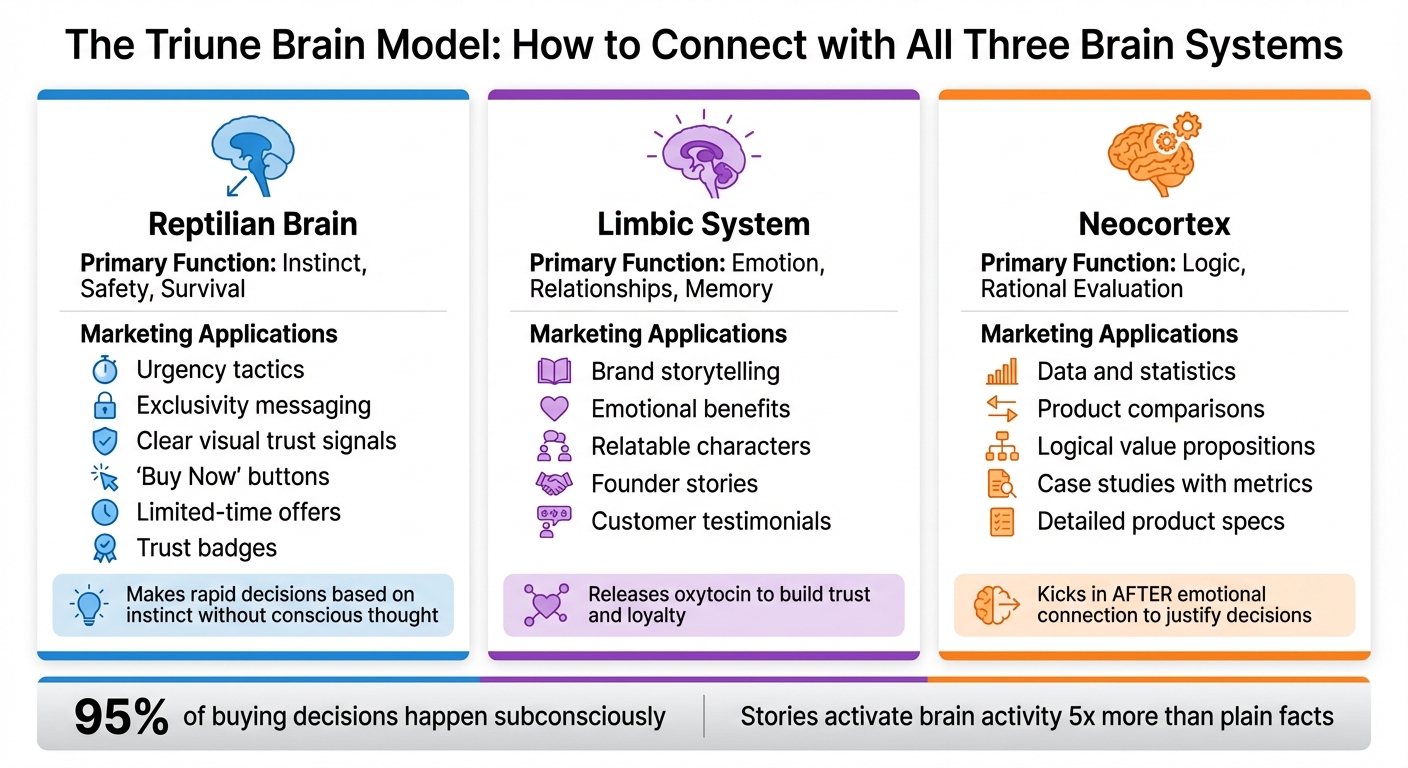
Triune Brain Model: Marketing Applications for Each Brain System
When we hear a brand story, our brains process it through three distinct systems. This idea comes from the Triune Brain Model, which divides the brain into three regions: the reptilian brain (instinct and survival), the limbic system (emotion and relationships), and the neocortex (logic and reasoning). The best stories connect with all three.
This model explains why so many decisions happen without conscious thought. Customers aren’t meticulously analyzing every product feature - they’re making emotional and instinctive judgments long before logic kicks in. As Gerald Zaltman of Harvard Business School points out, most purchase decisions bypass rational thought entirely.
| Brain System | Primary Function | Marketing Application |
|---|---|---|
| Reptilian | Instinct, safety, survival | Urgency, exclusivity, clear visual trust signals |
| Limbic | Emotion, relationships, memory | Brand storytelling, emotional benefits, relatable characters |
| Neocortex | Logic, rational evaluation | Data, product comparisons, logical value propositions |
Using this framework, you can craft stories that tap into instinct, emotion, and logic.
Connecting Through Emotion: The Limbic System
The limbic system governs emotions, social bonds, and trust - all essential for building brand loyalty. Stories that strike an emotional chord activate the amygdala, making them more memorable. These emotional connections release oxytocin, the same chemical that strengthens personal bonds.
For small and medium-sized businesses (SMBs), this means focusing less on technical details and more on emotional benefits. Ann-Sophie Hollenbeck, Senior Content Strategist at Pipedrive, sums it up:
"The limbic system is emotional. It processes feelings, relationships and social connections. To trigger this system, focus on brand storytelling and emotional benefits. Build customer relations instead of highlighting features".
Sharing relatable stories, like your founder's journey or how your product has improved lives, directly engages this part of the brain, fostering long-term loyalty.
Simple Messages for the Reptilian Brain
The reptilian brain, the oldest part of our brain, prioritizes survival and safety. It makes rapid decisions based on instinct, reacting to visual cues and urgency without conscious thought. This is why elements like "Buy Now" buttons, limited-time offers, and trust badges are so effective - they speak to this primal system.
Mark O'Neill explains this well:
"The brain does not ask, 'Is this true?' It asks, 'Does this make sense?' And 'sense,' neurologically speaking, means narrative coherence".
To resonate with the reptilian brain, your messaging needs to be clear and straightforward. Complex language slows people down, while simple, accessible wording (think Hemingway’s fourth-grade reading level) keeps things moving. Add urgency with real-time scarcity signals to encourage quick action.
Using Logic to Engage the Neocortex
The neocortex handles rational thinking and evaluates data, comparisons, and logical arguments. However, it usually kicks in after an emotional connection has been made. People feel first, then use logic to justify their decisions.
Once you’ve captured attention with emotional and instinctive appeals, you can introduce logical content to reinforce the decision. This is where case studies, testimonials with specific metrics, and detailed product specs shine. These elements satisfy the neocortex’s need for evidence while building on the emotional groundwork set by the limbic system. Mark O'Neill refers to this as a "compression algorithm" for the brain, where complex information is presented as part of a cohesive story. By weaving statistics into a narrative, you can appeal to both emotion and reason.
This approach lays the foundation for creating stories that connect with your audience while driving meaningful business results.
Brain Science Principles for Better Stories
The Triune Brain Model offers a fascinating lens through which to craft brand stories that stick. By understanding how our brains process narratives, small and medium-sized businesses (SMBs) can create stories that resonate deeply. Three key neuroscience principles determine whether your brand story will linger in memory or fade within an hour.
Building Brand Loyalty Through Emotional Connection
Discounts might get customers through the door, but emotional bonds keep them coming back. Emotional loyalty taps into the brain's limbic system, forming connections based on trust and shared values rather than mere transactions. This kind of loyalty makes customers more resistant to competitors, even when better deals are on the table.
Here’s where oxytocin comes in. When people hear your brand's story, their brain releases this trust-building chemical - yes, the same one that strengthens personal relationships. Suddenly, your brand feels less like a business and more like a trusted friend.
Take the Coca-Cola versus Pepsi experiment as an example. Using fMRI technology, researchers discovered that when participants didn’t know the brand, they preferred Pepsi based on taste. But when the brands were revealed, Coca-Cola lit up the brain's memory and emotion centers, causing a strong preference shift. The emotional associations with Coca-Cola overpowered the physical taste.
For SMBs, the lesson is clear: understand your audience’s struggles and connect with them emotionally. Bombas, for instance, ties its mission to helping the homeless, emphasizing empathy and social impact over product features. This approach activates the limbic system, driving loyalty and support for the brand’s purpose.
Mirror Neurons and Relatable Characters
Emotional loyalty is just the start. Mirror neurons, which help us empathize, play a crucial role when your audience encounters relatable characters in your story. Instead of just understanding the narrative, they experience it. This happens because relatable stories trigger oxytocin release and heightened neural activity compared to dry facts.
The secret? Make your characters relatable. Your audience needs to see their own challenges and aspirations reflected in the story. That’s why customer success stories often outperform generic case studies - real people facing real problems create a connection.
Highlight your customers as the heroes of your narrative. Show them grappling with the same issues your prospects face and illustrate how they achieved success. This lets potential customers imagine themselves in those shoes, making your story - and your solution - feel personal and achievable.
Making Stories Memorable with Unexpected Elements
Surprises grab attention. The amygdala, which processes emotions and memories, lights up when we encounter something unexpected, making those moments far more memorable. Without emotional reinforcement, nearly 50% of new information is forgotten within an hour.
Hyundai’s marketing for the IONIQ 5 N electric vehicle offers a great example. In September 2025, they used EEG brainwave tracking and heart rate monitoring to pinpoint moments of peak excitement during high-performance driving. By emphasizing these thrilling sensations in their campaigns, they saw a 42% increase in US electric vehicle sales year-over-year.
You don’t need advanced neuromarketing tools to use this principle. Add vivid sensory details - think striking visuals, unexpected sounds, or engaging textures - to create moments that stick. Emotional touchpoints, when designed thoughtfully, can make your story unforgettable and drive real engagement. By weaving in the unexpected, you’ll not only capture attention but also leave a lasting impression.
Practical Storytelling Methods for SMBs
Brain science lays the groundwork for your storytelling strategy, but these techniques bring it to life. Here are three practical methods small and medium-sized businesses can use to craft stories that resonate.
Sharing Your Founder Story
Your origin story is more than just a history lesson - it’s a way to connect deeply with your audience. Sharing why you started your business, especially when it ties to solving customer struggles, triggers an emotional response. This happens because stories like these release oxytocin, fostering trust and empathy. Joe Lazauskas, Head of Content at Contently, puts it perfectly:
"The reason we tell stories is to build connections with people. I don't see it as manipulation, but rather the very human thing we do in every conversation we have".
Focus on emotional pain points rather than rattling off product features. Use simple, clear language to make your story easy to follow. Add vivid, specific details to create mental images that stick. For instance, instead of saying, "We worked late", you could paint a picture with, "The Slack channel went quiet for 12 straight minutes". These small, relatable details engage multiple brain regions - stories activate 6–7 areas, compared to just two for plain facts.
Using Customer Testimonials as Social Proof
Turn testimonials into compelling narratives with a 5-part structure: introduce a relatable customer (name, job title, and all), explain their challenge, describe their journey with your solution, share measurable results, and tie it back to your audience.
Make testimonials personal. Include headshots alongside names and titles - seeing a face builds trust by triggering oxytocin. Frame your customer as the hero who overcame a problem, helping potential clients imagine their own success. Specific examples like "Sarah cut her team's reporting time from 8 hours to 45 minutes" are far more impactful than vague claims like "improved efficiency."
Adding Sensory Details to Your Content
Sensory language doesn’t just tell - it immerses. By using vivid descriptions, you engage your reader’s sensory cortex, making them curious and more invested. In fact, brain activity can increase fivefold when hearing a well-told story.
Incorporate sensory adjectives across all five senses. For example, instead of saying "good coffee", try something like "ripe berry undertones with drizzled honey sweetness". Pair these descriptions with visuals - images of smiling faces and dynamic scenes provide instant context. According to the Forgetting Curve, nearly 50% of information is forgotten within an hour unless it’s tied to emotional context. Sensory details create those emotional anchors, making your content harder to forget.
Building Stories with Narrative OS
Understanding brain science is one thing; putting it into practice is another. Narrative OS bridges this gap by turning neuroscientific principles into actionable strategies that grow your brand. BrandMultiplier.ai's Narrative OS uses these principles to craft, measure, and refine compelling brand stories.
How Narrative OS Builds Your Brand Story
Narrative OS begins by identifying and codifying your most impactful strategic story. It taps into narrative transportation - a concept introduced by Green and Brock in 2000 - which describes how immersive storytelling can bypass an audience's analytical defenses. Keith Engelhardt from NeuroMarketing Insights explains it best:
"When your brain is transported, it can't mount its usual defenses against persuasion. The persuasive message slips through undetected while your mental bouncer is distracted by the story."
Using this foundation, Narrative OS combines emotional storytelling with analytical precision to develop a "Neural-Narrative" strategy. By leveraging mirror neurons, it enables audiences to mentally simulate the experiences within your brand story, creating a sense of empathy and connection.
Beyond crafting the narrative, the system ensures consistency across all touchpoints - leadership, sales, product, and marketing - so everyone communicates the same message. This alignment doesn't just strengthen your brand; it also reduces Customer Acquisition Cost (CAC) and speeds up sales cycles. Once the narrative is in place, the system tracks its impact on key business metrics.
Tracking How Stories Affect Business Metrics
Unlike traditional branding methods, Narrative OS directly ties storytelling performance to critical metrics like Customer Acquisition Cost (CAC), deal velocity, and customer Lifetime Value (LTV). It also evaluates how team alignment influences revenue, conversion rates, and marketing ROI.
By analyzing this data, Narrative OS identifies which elements of your story drive the best results. Through predictive analytics, it even forecasts how specific storytelling choices will influence conversion rates before you allocate resources. This means no more guesswork - whether you're debating between a founder's story or a customer testimonial, you'll have the numbers to back your decision. The result? More sales at a lower cost.
Refining Stories Over Time
Narrative OS operates like a "Narrative Flywheel", continuously improving your brand story based on real-time data. AI-driven insights detect inconsistencies in messaging across different channels, ensuring your story stays cohesive - whether a prospect encounters your brand on LinkedIn, visits your website, or interacts with your sales team.
The system doesn't stop there. Regular updates keep your narrative relevant and effective. It tracks audience reactions and fine-tunes story elements to maintain what neuroscientists call elaborative processing - embedding information within rich, memorable contexts that create multiple "memory hooks" in the brain. This ongoing refinement ensures your brand story evolves alongside your audience and market demands.
Conclusion
Neuroscience offers a practical and powerful framework for storytelling, especially for SMBs aiming to create memorable, impactful narratives. By understanding how the triune brain processes information - logic, emotion, and instinct - you can craft messages that resonate on multiple levels. The payoff? Better brand recall, stronger customer connections, and noticeable boosts in conversion rates.
Consider the numbers: Emotional storytelling can increase neural activity fivefold. With 95% of buying decisions happening subconsciously and nearly half of all information forgotten within an hour, the case for emotionally charged narratives is clear . These principles aren’t just helpful - they’re essential for growth. Applying them allows SMBs to deepen customer relationships while improving metrics like CAC, conversion rates, and brand loyalty.
Joe Lazauskas captures it best: “Storytelling builds human connections”. These connections go beyond transactions, turning one-time buyers into loyal advocates who stick with your brand because of how it makes them feel - not just because of price.
The key to success lies in continuous refinement. The best SMBs don’t just tell their story once; they track and optimize it. By analyzing how narratives influence metrics like Customer Acquisition Cost, deal velocity, and Lifetime Value, you can identify what works and adjust accordingly. This ongoing process ensures your messaging stays relevant as your audience and market shift.
Whether you’re sharing your founder’s journey, showcasing customer testimonials, or weaving sensory details into your content, neuroscience-backed storytelling gives you an edge. Start small - test one technique, measure its results, and expand from there. Tools like Narrative OS by BrandMultiplier.ai can help you measure and refine your story for growth. It’s time to start building your neuroscience-powered brand story today.
FAQs
How can I tell if my marketing hits emotion, urgency, and logic?
To truly connect with your audience, tap into the power of storytelling rooted in neuroscience. Stories that resonate emotionally can create a bond by aligning with your audience's feelings and experiences.
Want to inspire action? Infuse a sense of urgency into your messaging - this motivates people to act quickly. But don’t stop there. Pair that emotional and urgent pull with logical benefits. Show your audience the clear, practical value of what you’re offering.
How do you know if it’s working? Dive into your engagement metrics. Look for indicators like emotional responses, click-through rates, and conversions. These data points provide insight into how well your story is landing. If something’s off, tweak your messaging to better balance emotional appeal, urgency, and logic. The right mix can amplify your message’s impact and drive stronger results.
What’s the simplest story framework an SMB can use today?
For small and medium-sized businesses (SMBs), crafting a compelling story doesn’t have to be complicated. A straightforward narrative with three key elements can do the trick:
- A struggle: Highlight a relatable challenge.
- The action taken: Show the steps or solutions implemented.
- The positive outcome: Share the results or benefits achieved.
This structure taps into the brain's empathy and reward systems, making your audience feel connected to your story. By focusing on challenges people can identify with, offering clear solutions, and showcasing meaningful results, you can create a story that truly resonates and builds an emotional bond with your audience.
How do I measure if storytelling is lowering CAC or raising LTV?
To determine whether storytelling can reduce Customer Acquisition Cost (CAC) or increase Customer Lifetime Value (LTV), keep an eye on key metrics like conversion rates, deal speed, and retention both before and after introducing storytelling strategies. Tools like BrandMultiplier.ai’s "Narrative OS" can help fine-tune your story in real time, making it easier to improve these numbers. Also, track engagement metrics such as repeat purchases and the emotional connection customers feel with your brand. These insights will show how storytelling influences CAC and LTV over time.
Ready to transform your brand story?
Schedule a free diagnostic to see how we can help.
Schedule The Diagnostic