

5 Storytelling Frameworks Backed by Neuroscience
5 Storytelling Frameworks Backed by Neuroscience
Storytelling isn’t just entertaining - it’s science. The way stories activate your brain can boost memory, attention, and emotional connection. Neuroscience reveals that storytelling triggers chemicals like oxytocin (trust), dopamine (focus), and cortisol (attention), making narratives far more engaging than plain facts.
Here are five proven storytelling frameworks that leverage these brain responses:
- ABT (And, But, Therefore): Context, conflict, and resolution. Keeps audiences hooked by creating tension and delivering clarity.
- Hero’s Journey: A 12-step structure showing growth through challenges, tapping into empathy and reward systems.
- Four-Step Narrative: Stage-setting, challenge, solution, and outcome. Guides audiences from problem to resolution with emotional engagement.
- Dobzhansky Template: Focuses on one unifying idea, ensuring clarity and emotional resonance.
- Narrative Spine: An 8-step circular arc that mirrors human transformation, creating relatable and memorable stories.
These frameworks don’t just tell stories - they influence behavior. Research shows they can predict actions with 82% accuracy and increase engagement by up to 67%. Whether pitching ideas or building brands, applying these techniques can make your message unforgettable.
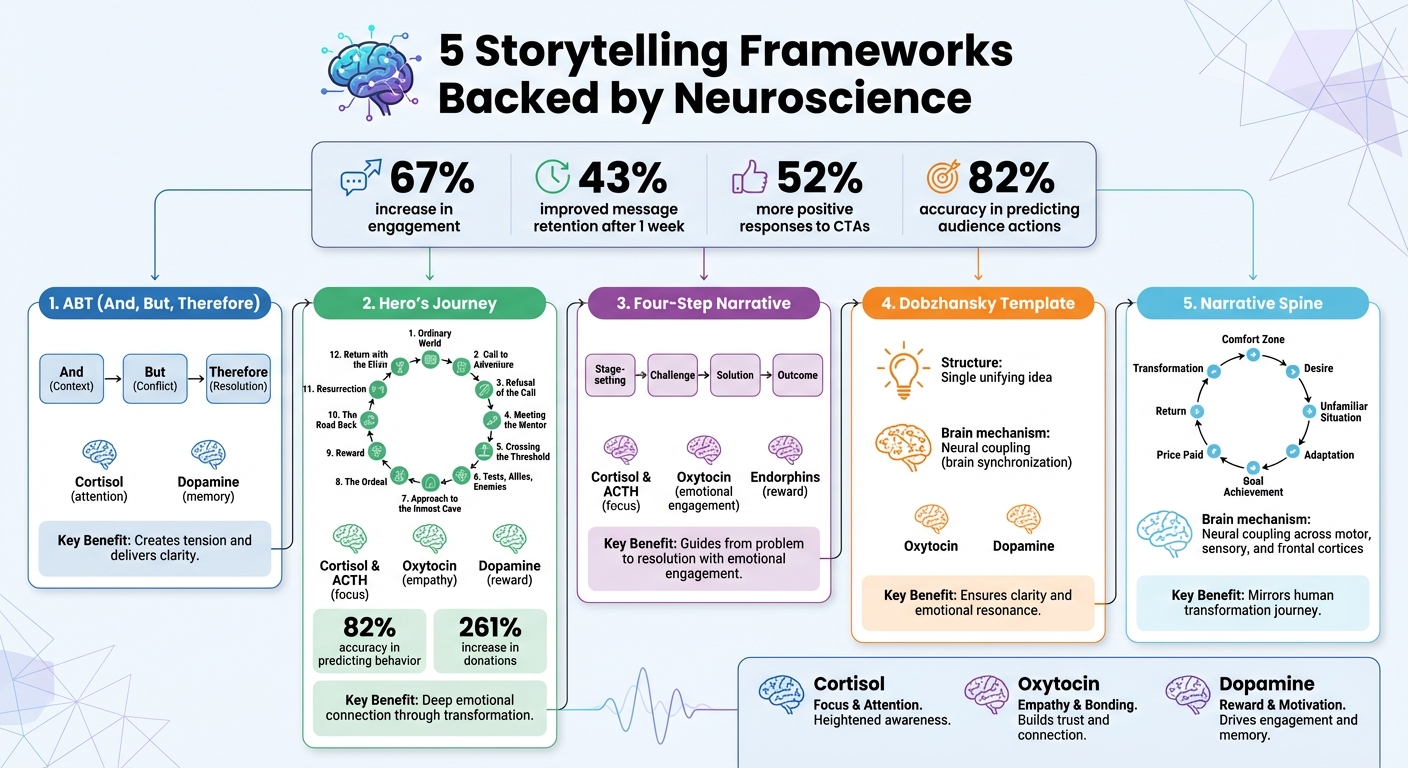
5 Neuroscience-Backed Storytelling Frameworks Comparison
The 5 Neural Hooks in Storytelling
sbb-itb-63525a7
1. ABT Framework (And, But, Therefore)
The ABT Framework is a storytelling method backed by neuroscience that taps into how our brains naturally respond to context, conflict, and resolution. It’s built on three simple parts: "And" sets the stage, "But" introduces a challenge, and "Therefore" delivers the solution. Each step engages the brain in a way that keeps the audience hooked.
The And phase lays the groundwork by creating a shared understanding and establishing context.
The But phase introduces a challenge or obstacle, creating a gap between the current situation and a better outcome. This contrast triggers cortisol, a hormone that sharpens focus and attention.
The Therefore phase provides the resolution, releasing dopamine, which enhances memory and leaves a lasting impression.
"When you want to motivate, persuade, or be remembered, start with a story of human struggle and eventual triumph. It will capture people's hearts – by first attracting their brains." – Paul J. Zak, Director of the Center for Neuroeconomics Studies, Claremont Graduate University
These three phases work seamlessly to take the audience on a journey - from understanding the situation to feeling emotionally invested in its resolution.
A great example of the ABT Framework in action is Chipotle's 2012 animated short film, "Back to the Start." The story begins with a farmer (Context), highlights his struggles with industrial farming (Conflict), and concludes with his return to sustainable practices (Resolution). The campaign was a hit, earning the Cannes Film Lions Grand Prix and amassing over 8 million YouTube views.
The real strength of the ABT Framework lies in its ability to take the audience from confusion or uncertainty to clarity and resolution. This "Aha!" moment not only grabs their attention but also strengthens the connection between the storyteller and the audience. Up next, we’ll dive into another framework that uses similar brain-based principles to captivate and engage.
2. Hero's Journey Framework
The Hero's Journey is a 12-stage storytelling structure that Christopher Vogler adapted from Joseph Campbell’s monomyth. This framework reflects how we navigate conflict, insecurity, guidance, and transformation. It’s so effective that over half of Hollywood films use it as their backbone.
What makes this framework so powerful? It taps into our brain chemistry. For example, when the hero faces the "Call to Adventure", cortisol and ACTH levels increase, sharpening our focus. As we empathize with the hero, oxytocin floods our brains, pulling us deeper into the story - a phenomenon called narrative transportation. And when the hero triumphs or transforms, dopamine is released, giving us a sense of reward and satisfaction.
"As the cortisol that feeds attention mixes with the oxytocin of care, we experience a phenomenon called 'transportation.' For the duration of the story, our fates become intertwined with those of imaginary people." – Jeremy Adam Smith, Editor, Greater Good Magazine
Dr. Paul J. Zak’s research at Claremont Graduate University demonstrates just how impactful this structure can be. In one study, a Hero's Journey narrative about a father and his terminally ill son was used. Neurological responses predicted donation behavior with 82% accuracy. When ACTH and oxytocin levels spiked, donations increased by an astonishing 261%. Mirror neurons also played a role, firing as viewers internalized the hero’s struggles, making the story feel deeply personal and real.
These findings underscore the Hero's Journey’s ability to forge profound emotional connections. It’s a testament to how storytelling, when rooted in neuroscience, can resonate on a deeply human level.
3. Four-Step Narrative Framework
The Four-Step Narrative Framework simplifies storytelling into four essential components: setting the stage, introducing a challenge, presenting a solution, and showcasing the outcome. This structure taps into specific neural pathways, guiding your audience from context to resolution in a way that resonates deeply.
Setting the stage kicks off the process by activating neural coupling. This is when your listener's brain syncs with yours across motor, sensory, and frontal cortices, creating a shared mental connection.
Next, introducing a challenge sparks the release of cortisol and ACTH, which heighten focus and attention. This step primes the brain for anticipation, driven by dopamine.
When you present a solution, the brain releases oxytocin, which enhances emotional engagement. At this point, the anterior insula and posterior medial cortex work together, helping your audience connect the story's meaning to their own experiences.
Finally, showcasing the outcome triggers the release of endorphins, creating a sense of reward. This "Aha!" moment not only leaves a lasting impression but also strengthens the memory of your story and its message. By leveraging these neural responses, this framework ensures your narrative engages and sticks with your audience.
Dr. Paul Zak's 2015 research highlighted the power of this storytelling arc. He found that narratives following this structure activated brain responses associated with increased generosity, such as higher donation rates.
"When you want to motivate, persuade, or be remembered, start with a story of human struggle and eventual triumph. It will capture people's hearts – by first attracting their brains." – Paul J. Zak, Director of the Center for Neuroeconomics Studies, Claremont Graduate University
4. Dobzhansky Template Framework
The Dobzhansky Template gets its name from Theodosius Dobzhansky, an evolutionary biologist who wrote the influential 1973 essay, "Nothing in Biology Makes Sense Except in the Light of Evolution." In storytelling, this framework revolves around anchoring your narrative to one central, unifying idea. By sticking to a core theme, your story becomes more focused and less prone to distractions - something crucial in a world where attention is fleeting.
"If a story does not sustain our attention, then the brain will look for something else more interesting to do." – Paul J. Zak, Director of the Center for Neuroeconomics Studies, Claremont Graduate University
This framework taps into our brain's natural tendency to find meaning in patterns. When a narrative is well-structured and centers on a clear idea, it can activate neural coupling - a phenomenon where the listener's brain starts mirroring the storyteller’s. This synchronization engages multiple brain regions, making the story more immersive. Research by Uri Hasson backs this up, showing how storytelling can transfer ideas, emotions, and thoughts directly into the listener’s mind.
But it’s not just about structure - emotional connection plays a big role too. Stories that focus on struggles and eventual triumphs can trigger the release of oxytocin and dopamine, fostering empathy and leaving the audience feeling rewarded. In fact, studies on public service announcements found this approach significantly increased donations. By weaving emotional resonance into a coherent narrative, this framework amplifies audience engagement.
To make the most of the Dobzhansky Template, ensure every detail, action, and message ties back to your central theme. This alignment creates a story that’s not just memorable, but also persuasive and impactful.
5. Narrative Spine Framework
The Narrative Spine Framework, also referred to as the 8-point circular story pattern, provides a structured way to craft stories that resonate deeply with audiences. At its core, this framework revolves around transformation, reflecting the natural human journey of growth and change. It takes a character from their "Comfort Zone", through challenges and struggles, and ultimately to a state of "Having Changed." This progression creates a complete and relatable arc that captivates the audience.
What makes this framework so effective is its ability to create a seamless flow of ideas. The NeuroLeadership Institute highlights the importance of coherence: "Coherence helps us focus and cut through the noise". This clarity triggers neural coupling, a phenomenon where the listener's brain aligns with the storyteller's brain across various regions, including motor, sensory, and frontal cortices. As Uri Hasson, a neuroscientist at Princeton University, explains, "I'm trying to make your brain like mine in ways that really get the meaning, the situation, the schema - the context of the world".
The framework unfolds in eight key steps:
- Starting with a character in their "Comfort Zone"
- Introducing a desire or goal
- Entering an unfamiliar situation
- Facing adaptation and struggle
- Achieving the initial goal
- Paying a price for growth
- Returning to a familiar situation
- Demonstrating lasting transformation
Each step builds on the one before, creating a natural and engaging progression that mirrors how the brain processes change. Research even shows that this kind of structured storytelling can predict audience actions.
To use the Narrative Spine effectively, always begin by establishing a clear "Comfort Zone." This starting point creates psychological safety while setting up the contrast needed for the audience to embrace change. A helpful tool here is the "So What?" Test: ask "So what?" three times for any goal until you uncover its true human impact. For instance, instead of stopping at "efficiency", dig deeper to reveal something more relatable, like "preventing burnout". Finally, ensure the transformation is shown through tangible actions rather than vague statements. By doing so, you make the change feel real and meaningful to your audience.
How Brands Apply Neuroscience-Based Storytelling
Neuroscience-based storytelling has proven to be a game-changer for brands, increasing audience engagement by up to 67%, improving message retention by 43% after just one week, and driving 52% more positive responses to calls-to-action.
This approach has delivered impressive results in high-stakes business scenarios. For example, in 2024, a pharmaceutical executive secured $47 million in funding by reworking her investor presentation using neuroscience-driven storytelling techniques. Similarly, a tech startup CEO raised $15 million in Series A funding by adopting the "Failure-Lesson-Success Arc." This narrative highlighted how an initial failure led to a pivot based on systematic customer research, which ultimately instilled confidence in investors.
The benefits of neuroscience-based storytelling go beyond anecdotes - they create measurable opportunities for brands. By consistently integrating neurochemical triggers into brand interactions, companies can see tangible improvements in conversion rates, customer engagement, trust, and even lifetime value.
To make this process more systematic, BrandMultiplier.ai's Narrative OS offers a solution that embeds a brand's most compelling story across every touchpoint. This platform uses neuroscience-backed frameworks to align leadership, sales, product, and marketing teams around a unified narrative. It doesn’t stop there - it continuously monitors performance metrics like Customer Acquisition Cost (CAC), deal velocity, and Lifetime Value (LTV), making real-time adjustments every quarter to optimize both storytelling and business outcomes.
Modern brands are doing more than just crafting compelling stories - they're using neuroscience to spark the exact brain responses that drive action, build trust, and nurture long-term loyalty.
Conclusion
Storytelling, backed by neuroscience, taps into the brain's natural processes to drive attention and action. Techniques like ABT and the Narrative Spine work by triggering neural responses that boost engagement. These structured methods activate neural coupling and release a mix of cortisol, dopamine, and oxytocin, turning listeners from passive observers into active participants.
Research highlights the powerful effects of storytelling. For example, combining ACTH and oxytocin has been shown to increase donations by an impressive 261%. Additionally, by measuring peripheral nervous system responses, researchers can predict with 82% accuracy whether someone will act after hearing a story.
"Our brains are not hard-wired to understand logic or retain facts for very long. Our brains are wired to understand and retain stories" – Jennifer Aaker, Marketing Professor at Stanford Graduate School of Business.
These storytelling frameworks offer a way to replace dull presentations with compelling narratives, creating emotional engagement through dramatic arcs. Whether you're pitching an idea, launching a product, or building a brand, these techniques help your audience not just hear your message but feel it, as though they’re living the story themselves.
By consistently reinforcing a single narrative spine, brands can create a cohesive message that stands out amidst digital noise and builds stronger connections. The science behind storytelling doesn't just validate its effectiveness - it provides practical tools for brands to implement strategies that resonate deeply.
For businesses ready to embrace these principles, BrandMultiplier.ai's Narrative OS offers a way to weave storytelling into every aspect of operations. With consistent application, brands can see measurable gains in metrics like customer acquisition cost (CAC), deal velocity, and lifetime value (LTV). This approach ensures your story doesn’t just get heard - it drives action.
FAQs
How do storytelling frameworks like ABT and the Hero’s Journey improve audience engagement?
Storytelling frameworks like ABT (And → But → Therefore) and the Hero’s Journey work so well because they tap into the way our brains naturally process information. A well-structured narrative grabs attention, builds curiosity, and keeps people hooked by following a flow that feels both familiar and emotionally engaging.
The ABT framework thrives on contrast and resolution, satisfying the brain’s craving for closure. On the other hand, the Hero’s Journey, with its stages like the call to adventure and the hero’s triumphant return, aligns with the brain’s love for rhythmic patterns. These structures do more than just entertain - they trigger brain chemicals like oxytocin, which fosters trust and emotional bonds, and dopamine, which keeps us engaged and leaves a lasting impression. This is why stories built around these frameworks tend to stick with us and feel persuasive.
Brands can take advantage of these neuroscience-driven techniques to craft narratives that deeply connect with their audiences. By doing so, they not only enhance recall but also build emotional connections that drive action. Tools like BrandMultiplier.ai’s Narrative OS make it easier to design and refine these strategic stories, helping businesses improve key metrics like customer acquisition costs (CAC), sales velocity, and customer lifetime value (LTV).
How do brain chemicals like oxytocin and dopamine enhance storytelling?
Stories have a fascinating way of capturing our attention, and it all comes down to brain chemistry - specifically oxytocin and dopamine. Oxytocin, often referred to as the "bonding hormone", increases when we hear stories that strike an emotional chord. This chemical boost helps build trust, empathy, and a sense of connection - not just with the characters in the story but also with others around us. It's why a well-told story can make us feel safe and emotionally invested, even when the subject matter is tough.
Then there's dopamine, the brain's "feel-good" chemical. It kicks in when a story includes surprises, builds anticipation, or delivers a satisfying conclusion. Dopamine doesn't just make the experience enjoyable - it also sharpens focus, enhances memory, and keeps us motivated to stick with the narrative. Together, these two chemicals create a powerful effect: oxytocin deepens emotional engagement, while dopamine ensures the story sticks with us, making it both meaningful and unforgettable.
How can brands use neuroscience to create more engaging stories?
Brands can use neuroscience to create stories that truly connect with their audience by following a few key principles. Start with a three-act structure - setup, conflict, and resolution. This classic format mirrors the brain’s natural preference for patterns, keeping your audience engaged. A relatable protagonist facing a clear challenge can hold attention and trigger neural responses like dopamine release, which enhances both excitement and memory retention.
To build stronger emotional bonds, weave in sensory-rich details and emotional stakes that spark empathy. This taps into the brain's mirror-neuron systems, making the audience feel more connected to the story. Aligning your narrative with your audience’s core values can also stimulate oxytocin release, promoting trust and a sense of connection. For practical application, link each part of your story to a specific brain response - like using curiosity to trigger dopamine or shared struggles to encourage oxytocin release - and apply these elements consistently across all platforms, from advertisements to sales presentations.
To ensure your storytelling efforts are effective, track essential metrics such as customer acquisition cost (CAC), conversion rates, and lifetime value (LTV). Tools like BrandMultiplier.ai’s Narrative OS can provide real-time AI-driven analytics to fine-tune your story, helping it resonate deeply with your audience while driving business growth.
Ready to transform your brand story?
Schedule a free diagnostic to see how we can help.
Schedule The Diagnostic