
5 Storytelling Frameworks for SMB Content
5 Storytelling Frameworks for SMB Content
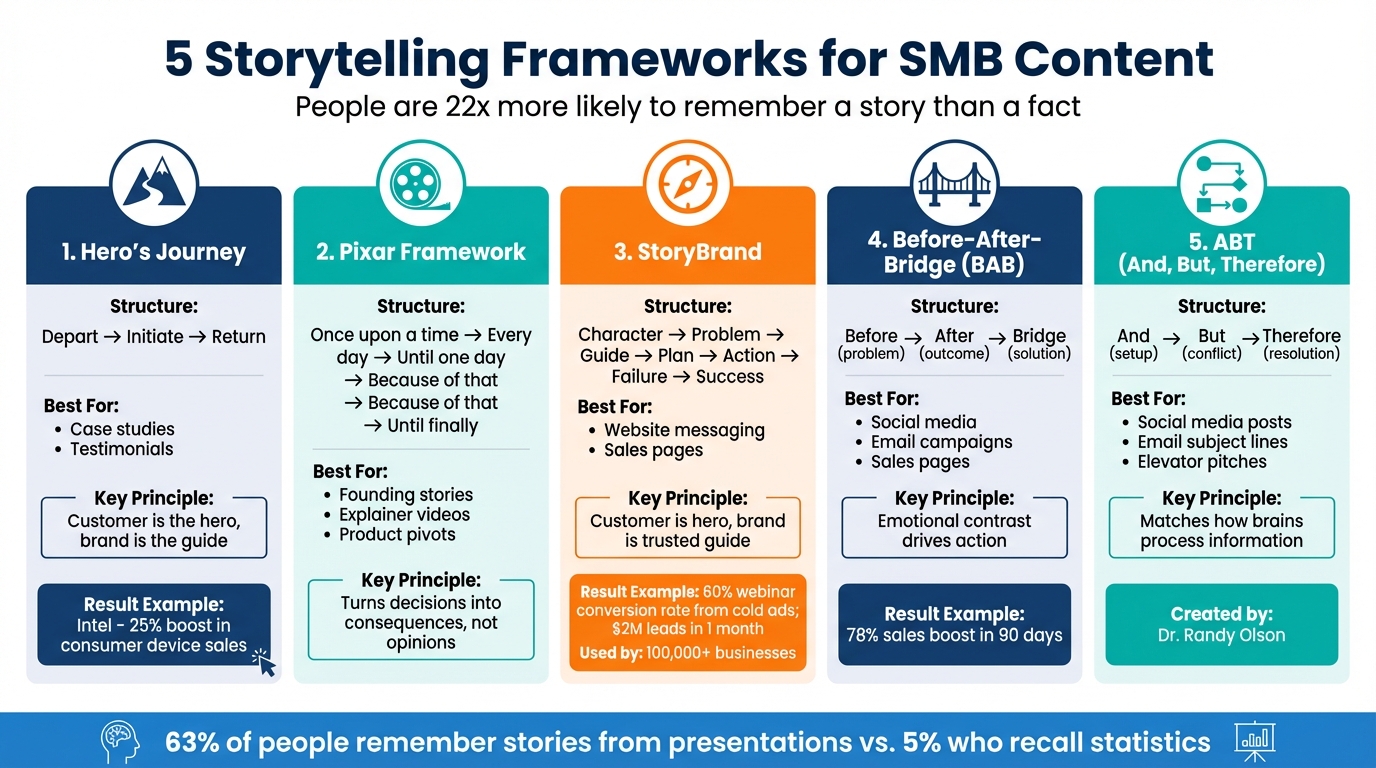
Struggling to connect with your audience? For small businesses, storytelling isn't just a buzzword - it's a tool that can transform how customers perceive and engage with your brand. Research shows people are 22x more likely to remember a story than a fact, and businesses using structured narratives have seen measurable success, like a 78% sales boost in 90 days.
Here are five storytelling frameworks to simplify your content creation and drive results:
- Hero's Journey: Make your customer the hero and your brand the guide solving their challenges.
- Pixar Framework: Use a six-step story arc for clarity and emotional impact.
- StoryBrand: Position your brand as the expert helping customers overcome problems.
- Before-After-Bridge (BAB): Highlight the problem, show the ideal outcome, and connect the two with your solution.
- ABT (And, But, Therefore): Present context, introduce a problem, and resolve it with your solution.
These frameworks help you craft content for websites, social media, and emails that builds trust, engages readers, and drives action. Let’s explore how to use them effectively.
5 Storytelling Frameworks for Small Business Content Marketing
How To Master Storytelling (As A Business Owner)
sbb-itb-63525a7
1. Hero's Journey
The Hero's Journey is a storytelling framework that maps out a hero's journey through departure, struggle, and eventual triumph. For small and medium-sized businesses (SMBs), the hero isn't your brand - it’s your customer. Your role? To be the trusted guide, helping them overcome their challenges.
This structure unfolds in three acts: Depart, where the customer and their problem are introduced; Initiate, where your brand steps in as the guide offering solutions; and Return, where the customer's transformation is showcased. Starting with a clearly defined challenge creates a compelling story arc, and this approach has been proven effective in real-world campaigns.
Take Intel, for example. In 2015, Creative Director Chris Rubin spearheaded a messaging overhaul for Intel.com. The focus shifted from technical "inside the box" specs to a user-first narrative - highlighting what customers could achieve with Intel's technology. The result? A 25% boost in consumer device sales.
In this framework, the "villain" isn't a person but the specific problem your customer struggles with. It could be anything from "wasted time" to "outdated technology" or "inconsistent results". By identifying this pain point and positioning your brand as the empathetic guide, you immediately connect with your audience on a deeper level.
Donald Miller emphasizes that when you make the customer the hero and your brand the mentor, you build trust and drive results. This approach turns case studies and testimonials into powerful stories where your customers shine as the heroes, and your brand becomes the reliable partner that helped them succeed.
2. Pixar Framework

Storytelling isn't just about grabbing attention - it's a way to clarify your strategy and make it actionable. Building on the idea of customer journeys, the Pixar Framework offers a simple six-step structure to break down complex concepts. This method, made famous by Pixar, has been credited with the studio's success and acclaim.
Here’s how the framework works, step by step:
- Once upon a time... – Introduce your main character and their world.
- Every day... – Describe their routine or the status quo.
- Until one day... – Highlight the event or disruption that changes everything.
- Because of that... – Show the immediate consequence of the change.
- Because of that... – Continue the chain of events and reactions.
- Until finally... – Conclude with the resolution or outcome.
Some businesses add a seventh step - "And ever since that day..." - to emphasize how the change created lasting impact.
"The Pixar Formula works because it turns decisions into consequences, not opinions." – MyFramework.net
This structure works especially well for founding stories, explainer videos, and announcements about product pivots. For example, when explaining why your product took a new direction, you can use "Until one day" to introduce the specific customer feedback that sparked the change. Then, guide your audience through the "Because of that" steps to demonstrate how each improvement naturally led to the next. This makes your solution feel like the inevitable result of thoughtful action rather than just a sales pitch.
What makes this framework so effective? It taps into the brain's natural responses, boosting attention, engagement, and empathy. For SMBs working with tighter marketing budgets, that’s a powerful edge. While the Pixar Framework is one approach, it’s not the only way to craft a compelling narrative - there’s more to explore in the next section.
3. StoryBrand Framework
Small and medium-sized businesses (SMBs) often struggle to grab their audience's attention because their messaging lacks clarity. The StoryBrand Framework, created by Donald Miller, tackles this issue by flipping the script: your customer becomes the hero of the story, and your brand takes on the role of the trusted guide. This approach has helped over 100,000 businesses refine their messaging and connect more effectively with their audience.
At its core, the framework follows a seven-part structure: a Character (your customer) encounters a Problem, meets a Guide (your brand), receives a Plan, is called to Action, avoids Failure, and ultimately achieves Success. What makes this framework especially impactful is its focus on three levels of problems:
- External: The visible, tangible obstacle.
- Internal: The emotional frustration caused by the problem.
- Philosophical: Why the problem feels inherently unfair.
For instance, a plumber doesn't just repair a broken pipe. They also ease the homeowner's embarrassment over a flooded bathroom and help restore their sense of control.
"Don't make your customer burn calories to understand what is it that you do." – Donald Miller
To effectively position your brand as the guide, two key elements are crucial: empathy (showing you truly understand your customers' frustrations) and authority (proving your expertise). Pair these with a straightforward three-step plan to eliminate any hesitation about working with you. The results can be dramatic - one business secured two $2 million leads in just a month after revamping its website using this framework. Another saw a 60% conversion rate on its webinar registration page from cold ads.
What makes this framework so effective? It aligns with how our brains naturally process information. When messaging is confusing or unclear, people tune out to save mental energy. By making your customer the hero and positioning your brand as their guide, you create a story that feels relatable and engaging. This approach not only clarifies your message but also ensures it resonates deeply with your audience, driving greater connection and action.
4. Before-After-Bridge
The Before-After-Bridge (BAB) framework is a simple yet powerful storytelling method that helps turn passive viewers into engaged customers. It works by following a three-step sequence: Before (highlight the customer's current challenge), After (showcase the ideal outcome), and Bridge (present the solution that connects the two). Because of its simplicity, BAB is perfect for small and medium-sized businesses (SMBs) looking to convey their value quickly through social media posts, email campaigns, or sales pages.
What makes BAB so effective is the emotional contrast it creates. Start by vividly describing a specific frustration, such as "spending hours every day manually entering data", instead of using broad phrases like "inefficient processes." Then, paint a picture of the transformation - emphasize the relief, time saved, or confidence regained when the problem is solved. Finally, position your solution as the clear link between the problem and the desired outcome. This approach directly connects the customer's pain to a tangible result, encouraging immediate action.
BAB thrives in fast-paced digital environments because it’s straightforward and quick to implement. In one case study, businesses saw notable improvements within just 90 days of applying this framework.
"Facts tell. Stories sell." – Raj Khera, Co-Founder, MakeMEDIA
This quote perfectly captures the essence of BAB. When you use it effectively, it can elevate your content strategy by making your messaging more relatable and persuasive.
To make BAB work for your SMB, focus on using compelling language to highlight the customer's pain in the "Before" stage and their relief in the "After." Reinforce your "Bridge" with data, testimonials, or social proof, and include a clear call to action that guides your audience from their current struggle to your solution. This straightforward framework is especially useful for industries like SaaS, coaching, and home services, where quick, relatable storytelling can make all the difference.
5. ABT (And, But, Therefore) Framework
The ABT Framework is a simple yet powerful way to craft clear and compelling narratives. Created by Dr. Randy Olson, a marine biologist turned screenwriter, this three-part structure - And (Setup), But (Conflict), Therefore (Resolution) - taps into how our brains naturally process information. By following this framework, small and medium-sized businesses (SMBs) can deliver messages that are easy to understand and resonate with their audience.
Here’s how the framework works:
- And: Start by laying out the context or facts that your audience can agree with.
- But: Introduce a problem or contradiction that creates tension and grabs attention.
- Therefore: Conclude with a solution that resolves the issue logically and persuasively.
This approach keeps your message focused and impactful, making it especially effective for short-form content like social media posts, email subject lines, or elevator pitches - where clarity is key.
For example, Morning Brew faced a major challenge in September 2021. Despite having over a million subscribers, their outdated HTML process was eating up valuable writer-hours. But by switching to TinyMCE's WYSIWYG editor, they streamlined newsletter creation down to just 10 minutes and cut new writer training time to 20 minutes. Senior Product Lead Tyler Denk highlighted the transformation, showing how a clear problem and solution narrative can drive results.
"The ABT is THE most powerful framework for communication that I have ever used." – Greg Head, Founder, ScalingPoint
To make the most of the ABT Framework, avoid falling into the trap of "and-then" storytelling, which lacks tension. Instead, use the But section to spotlight a problem your competitors may overlook, and position your business as the solution in the Therefore. This method ensures your message is not only clear but also memorable.
Conclusion
The five storytelling frameworks - Hero's Journey, Pixar Framework, StoryBrand, Before-After-Bridge, and ABT - offer small and medium-sized businesses (SMBs) a clear path to creating content that resonates deeply with their audience. Instead of relying on generic marketing messages, these structures empower you to craft narratives that spark emotional connections, build trust, and turn potential customers into long-term supporters. Research highlights the power of storytelling: while 63% of people remember stories from a presentation, only 5% recall specific statistics. This underscores how structured storytelling leaves a lasting impression.
But knowing these frameworks is only half the battle - applying them consistently across all your communication channels is where the real work begins. Experts agree that storytelling is more than a marketing tool; it’s a transformative strategy. To be effective, your story must flow seamlessly across your website, social media, sales pitches, and even customer support. Any disconnect in messaging can lead to wasted resources and missed opportunities.
This is where BrandMultiplier.ai's Narrative OS comes into play. Rather than treating storytelling frameworks as one-off tactics, Narrative OS integrates your most compelling story into every aspect of your business using a neuroscientific approach. It ensures alignment across leadership, sales, product development, and marketing, creating a unified narrative that drives both strategy and operations. Even better, it tracks critical metrics like Customer Acquisition Cost (CAC), deal speed, and Lifetime Value (LTV), adjusting the narrative in real time to maximize results.
For example, between 2024 and 2025, BrandMultiplier.ai partnered with Relationships ReWired to implement a strategic narrative. The results? A 78% increase in sales and a 91% jump in subscriptions - achieved in just 90 days. That’s the difference between using storytelling as an occasional tool and embedding it into the core of your business strategy.
Whether you choose to start small with a Rumble session ($1,895) or go all-in with the full Growth Engine package ($14,995/month), the key is moving away from random content creation and embracing strategic storytelling that delivers measurable outcomes.
FAQs
How do I choose the best storytelling framework for my small business?
To pick the right storytelling framework, start by clarifying your goals and understanding your audience. For instance, if you want to showcase a transformation - like solving a customer’s challenge - the Before-After-Bridge (BAB) framework is a straightforward and effective tool for ads or email campaigns. On the other hand, if your aim is to position the customer as the hero of the story, the Hero’s Journey framework is ideal for illustrating how your product or service helps them achieve success. For short, snappy content like social media posts, the Pixar formula offers a fun and structured way to craft engaging stories.
You’ll also want to consider your brand’s tone, the complexity you’re comfortable managing, and the platform where the story will appear. Simpler frameworks like BAB or Pixar are easy to execute quickly, making them great for fast-paced mediums. More detailed structures, such as the Three-Act Story or Freytag’s Pyramid, are better suited for long-form content like case studies or webinars. If your brand is focused on a mission or purpose, Simon Sinek’s Golden Circle can help you lead with your “why” before diving into product specifics.
Finally, don’t forget to test and refine your storytelling strategy. Tools like BrandMultiplier.ai’s Narrative OS can help you streamline your story, ensure alignment across teams, and measure its impact on metrics like customer acquisition cost (CAC) and lifetime value (LTV). By analyzing results and making adjustments over time, you’ll discover the framework that best connects with your audience and drives meaningful outcomes for your business.
What are the benefits of using storytelling frameworks in content marketing?
Storytelling frameworks offer a structured way to make your content more engaging and unforgettable. Approaches like the Hero’s Journey or Before-After-Bridge take raw data and shape it into relatable narratives. This makes it easier for your audience to connect emotionally and take action based on your message.
Stories also work on a deeper level by influencing the brain’s chemistry, sparking emotions that create stronger bonds. This emotional connection doesn’t just help people remember your message - it builds trust and loyalty. For small and medium-sized businesses (SMBs), this can translate into higher engagement rates, improved conversions, and a competitive edge in crowded markets.
Tools like BrandMultiplier.ai’s Narrative OS make it possible for SMBs to weave storytelling into every aspect of their business. By combining AI with neuroscience-based strategies, you can create stories that consistently drive results. Whether it’s lowering customer acquisition costs (CAC), speeding up deal cycles, or boosting lifetime value (LTV), storytelling ensures your brand message remains compelling and effective over time.
How can storytelling boost customer engagement and sales for small businesses?
Storytelling has the unique ability to turn your brand message into something unforgettable and emotionally resonant. By tapping into proven storytelling techniques, small businesses can craft content that feels more engaging and personal. This kind of connection doesn’t just capture attention - it inspires customers to act.
Science backs this up: stories trigger brain chemicals like dopamine and oxytocin, which help people remember information and build trust. For small businesses, this translates to practical benefits like higher conversion rates, increased time spent on your site, and more referrals through word of mouth. When you position your customer as the hero of the story and your brand as their trusted guide, the path from awareness to purchase becomes smoother. Best of all, this approach doesn’t require a hefty marketing budget to deliver real growth.
Ready to transform your brand story?
Schedule a free diagnostic to see how we can help.
Schedule The Diagnostic