
Top AI Tools for Topic Clustering in 2025
Top AI Tools for Topic Clustering in 2025
Topic clustering is now a must for organizing content to rank well in search engines and AI-driven tools. By grouping related keywords into clusters, businesses can create content hubs that boost authority and avoid keyword cannibalization. AI tools have made this process faster, cutting planning time by up to 91% and reducing costs by 67%.
Here’s a quick look at the top tools for 2025:
- Topical Map AI: Generates detailed keyword maps in under 2 minutes, starting at $49/month.
- SearchAtlas: Combines clustering with AI-written articles and integrates with content calendars, starting at $99/month.
- Surfer SEO: Focuses on NLP-based clustering and auto internal linking, starting at $99/month.
- Clicks.so: Offers fast visualization for niche exploration, with a free plan available.
- Optimo: Free tool for quick subtopic ideation, ideal for startups.
- HackTheSEO: Uses NLP and competitor analysis to create detailed maps, with a free plan available.
- KeywordInsights: SERP-based clustering with AI briefs, starting at $58/month.
- Answer Socrates: Focuses on question-based keywords, starting at $9/month with a free plan.
These tools simplify clustering, helping small and medium-sized businesses compete with enterprise strategies. Whether you're looking for free options or advanced features, there's a tool to fit your needs. The key takeaway? Start building content hubs now to stay visible in an AI-driven search landscape.
1. Topical Map AI
Automated topic clustering features
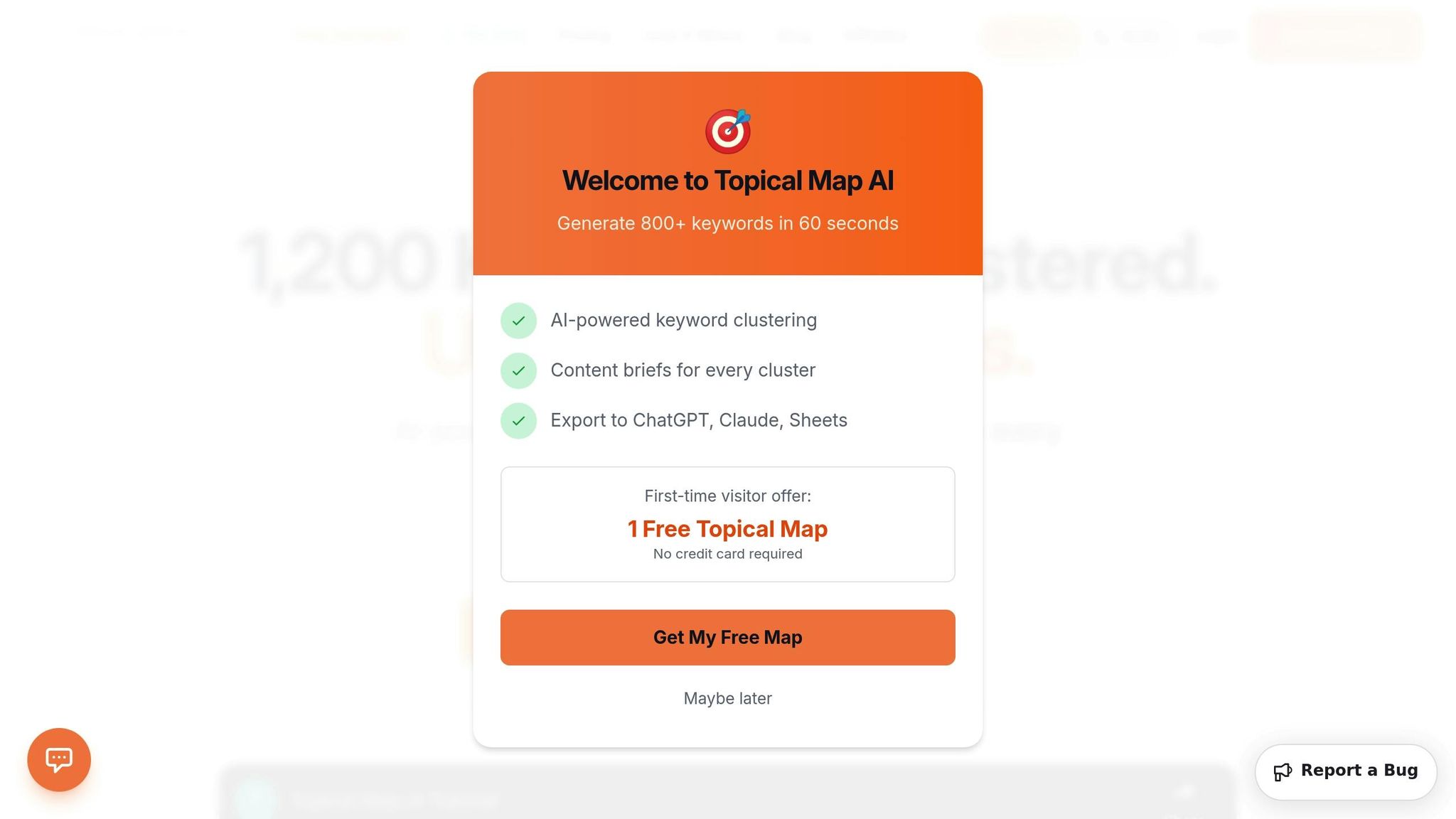
Topical Map AI is a tool that creates detailed keyword maps in just 60–120 seconds using a single keyword or niche as input. These maps group 800–1,200 keywords into clusters, each complete with search volume, competition metrics, and even URL suggestions.
The platform offers six types of maps tailored to different content needs: SEO Maps, Product Maps, News Maps, Social Maps, Question Maps, and Keyword Maps. This flexibility allows teams to focus on specific content goals without needing separate workflows. Once the AI generates a map, users can further refine it by adjusting subtopics or reorganizing the hierarchy before finalizing.
For small and medium-sized businesses (SMBs), this tool removes the hassle of manually clustering keywords in spreadsheets. It creates a "topic source of truth" that aligns SEO, content, and product marketing teams on priorities. The maps can be exported as CSV files or SVG visuals, making them easy to integrate into content workflows or client presentations.
Pricing tiers (in USD)
Topical Map AI offers a straightforward pricing structure. Users can make a one-time payment of $49 (as of January 2026) or opt for a $49/month subscription plan. The platform works on a credit system, where generating a map costs between 1 and 5 credits depending on its size. This system is especially useful for SMBs looking to streamline their content strategy. Available plans include Starter, Pro, and Agency tiers, with API access reserved for Pro and Enterprise users.
Free options available
New users can try the platform risk-free with 1 free credit upon signing up - no credit card required.
2. SearchAtlas (Topical Map + OTTO)
Automated Topic Clustering Features
SearchAtlas combines its Topical Map Generator with OTTO, an AI-powered SEO assistant, to create a streamlined content execution system. It automatically builds keyword clusters from a seed topic, crafts SEO-friendly titles for long-tail keywords, and lets users control cluster depth by defining the number of clusters and keywords they need.
The platform’s Bulk AI Article Writer can churn out hundreds of optimized articles in a single day based on the generated topical map. Powered by an extensive database of backlinks, indexed domains, and keywords from 200 countries, the clustering logic evaluates each cluster using keyword difficulty, search volume, and search intent. This efficient clustering process sets the stage for well-organized content strategies.
"Search Atlas just blows other tools out of the water. Tools like Ahrefs and Jasper have gone up in price quite a bit and just haven't kept up. Search Atlas replaces both of them."
– Josh Blakeley, Founder & CEO, JBL Digital Marketing
Integration with Content Calendars
The Content Planner tool helps teams seamlessly move keyword clusters into marketing calendars or drafts, all within one dashboard. Custom columns can be added for tasks like assigning writers, setting deadlines, or defining word count targets. For WordPress users, the MetaSync plugin enables 1‑Click Publishing, allowing AI-generated articles to be uploaded directly to their site. Mike Anderson, Owner of Aim High Digital, shared his experience: "Search Atlas transformed my agency workflow, allowed rapid creation of hundreds of articles!"
Pricing Tiers (in USD)
SearchAtlas offers several pricing plans to suit different needs:
- Starter Plan: $99/month – Includes 1 OTTO SEO project with 120 target keywords.
- Growth Plan: $199/month – Covers 2 projects with 300 target keywords.
- Pro Plan: $399/month – Adds the Topical Map Generator and Bulk AI Article Writer, supporting 4 projects and 600 target keywords.
- Agency Plan: $999/month – Designed for 10 projects with 1,500 target keywords and includes white-label reporting.
The platform has received high user ratings, with a 4.8/5 on G2 (91 reviews) and a 4.9/5 on Capterra (63 reviews).
Free Options Available
SearchAtlas provides a 7‑day free trial for its Starter, Growth, and Pro plans, and there’s no credit card required to get started.
3. Surfer SEO
Automated Topic Clustering Features
Surfer SEO uses NLP-based clustering to organize keywords into meaningful groups, creating a visual subtopic map to guide your content strategy. Its Topic Discovery tool categorizes keyword groups by search intent, helping you align your content with what users are actively searching for.
The platform's Content Planner dissects top-ranking pages to identify which related terms should appear together, reducing the chances of keyword cannibalization. Once clusters are mapped, Surfer generates automated briefs with structured H1–H4 headings, mirroring successful competitor strategies and ensuring comprehensive coverage of user intent - all without the need for manual research.
A standout feature is Auto Internal Links, which scans your site to add relevant links between pillar and cluster pages. This helps search engines better understand the relationships between your topics. Additionally, Surfer highlights content gaps - missing subtopics or context that your competitors have already addressed but you haven't.
"Surfer's search console integration with Content Planner has helped us automate crucial steps in our optimization process."
– Jeremy Galante, Senior SEO Manager, ClickUp
These tools have delivered measurable results. For example, Lyzr.ai, an enterprise AI platform, saw a 150% increase in organic traffic, while GetResponse achieved 15% organic growth in just a month by incorporating NLP-optimized keywords into three existing articles.
By automating both analysis and execution, Surfer not only simplifies the process but also ensures your content strategy is comprehensive and efficient.
Integration with Content Calendars
Surfer takes its clustering capabilities a step further by integrating directly with content planning tools. By connecting to Google Search Console, Surfer provides a domain-wide map that highlights covered clusters and identifies any gaps. This Topical Map is updated every 30 days, reflecting new content and suggesting additional topics to keep your editorial calendar fresh.
The "Enter Topic" feature allows you to input a seed keyword and instantly generate a cluster-driven strategy complete with article ideas, sorted by difficulty. For example, Matthis Janssen, Head of Client Services at YOYABA GmbH, used Surfer's Content Editor to create 32 text briefings in just 4.5 hours, filling two months' worth of content needs.
Surfer integrates with platforms like WordPress, Google Docs, Contentful, and Zapier, making it easy for small and medium-sized businesses to sync their strategies with tools like Trello or Asana. The Grow Flow module further simplifies the process by offering weekly SEO tasks, such as finding missing subtopics and internal-link opportunities, making it a great resource for teams without a dedicated SEO expert.
Pricing Tiers (in USD)
Surfer SEO offers several pricing options to fit various needs:
- Essential Plan: $99 per month, covering basic clustering and content optimization.
- Advanced/Max Plans: Designed for larger teams with higher content demands.
- Rank Tracker Add-on: $8.50 per month for tracking up to 100 keywords.
With a 4.8/5 rating and over 150,000 content professionals using it daily, Surfer has become a trusted tool in the SEO space.
Free Options Available
While Surfer does not offer a permanent free plan, it provides a $1 trial that includes 600 clustering credits. Additionally, there are free tools like the AI Content Detector, AI Content Humanizer, and an AI Search Optimization Masterclass through Surfer Academy.
For smaller websites (under 100 pages), the Grow Flow module offers basic SEO recommendations at no cost.
4. Clicks.so Topical Map & Clustering
Automated Topic Clustering Features
Clicks.so brings a streamlined approach to topic clustering, catering to early-stage SaaS founders, lean growth teams, and freelancers. Using AI, the platform creates topical maps that highlight keyword clusters, subtopics, and internal linking opportunities. This makes it easier to explore niches and validate ideas quickly.
What makes Clicks.so stand out is its focus on speed and ease of use. By entering a seed topic, users can instantly visualize their niche, uncover content gaps, and generate AI-ready outlines and FAQ sets. The tool also allows for custom keyword lists, enabling users to craft maps tailored to their specific needs. This results in a strategic plan for content creation.
These outputs can serve as prompts for AI writing tools or act as a foundational guide for content teams. Whether you're just starting out or refining your strategy, Clicks.so offers a practical solution for identifying opportunities and building a solid content plan.
Pricing Tiers (in USD)
Clicks.so offers a flexible pricing structure to accommodate different needs:
- Free Tier: Provides access to the basic topical map generator, ideal for testing content ideas and exploring new angles.
- Pro Tier: Includes advanced features and higher usage limits through a monthly subscription (pricing details not disclosed).
- Agency Tier: Designed for large-scale projects, offering enhanced capabilities for teams managing multiple campaigns (pricing details not disclosed).
Free Options Available
The free version of Clicks.so’s topical map generator is perfect for small teams and freelancers. It allows users to test the tool’s features, validate content ideas, and experiment with verticals - all without any upfront cost. This makes it an excellent starting point for those considering a paid upgrade.
5. Optimo Topical Map Generator
Automated Topic Clustering Features
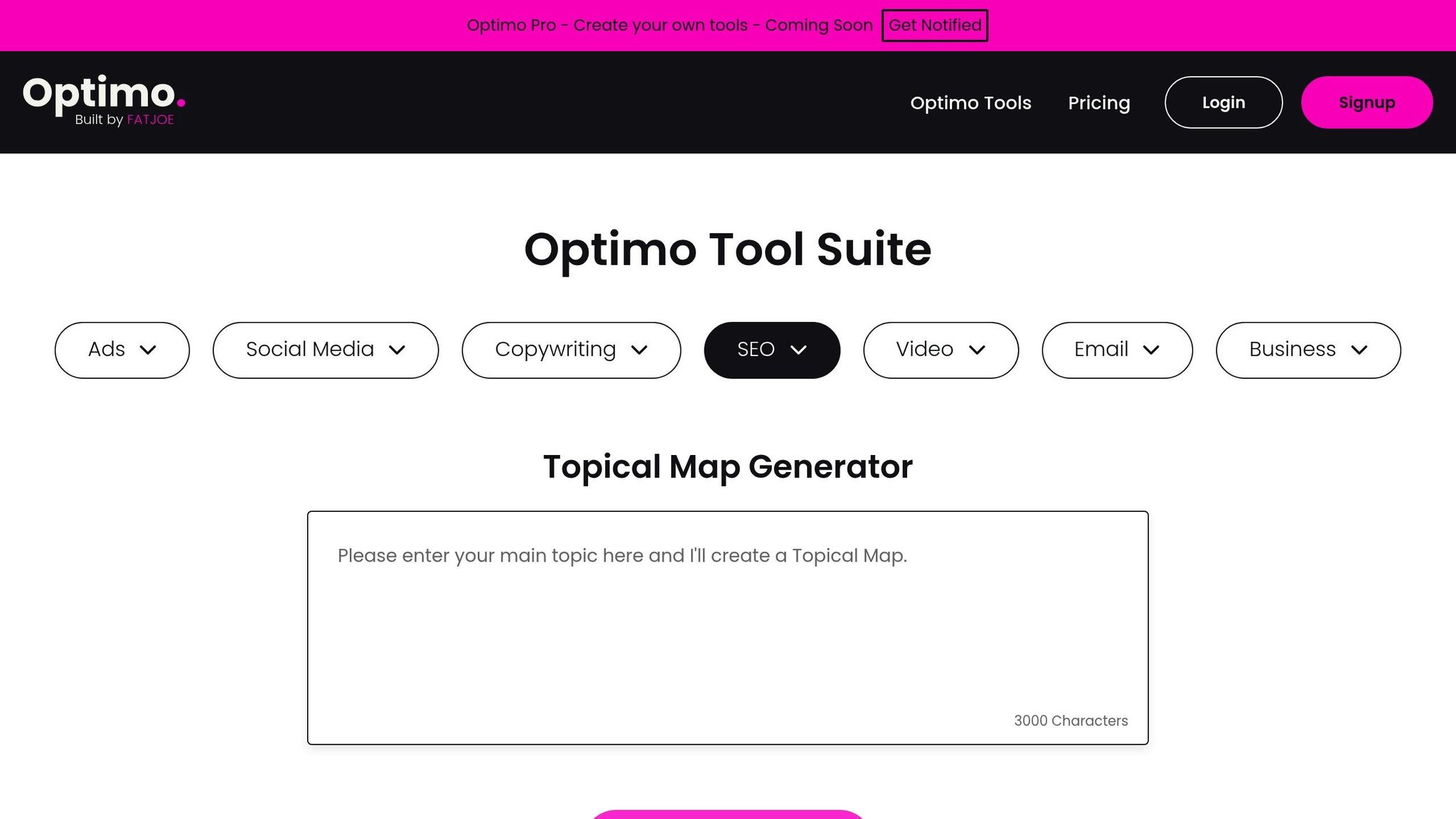
Optimo takes a straightforward and free approach to content planning by turning a seed topic into a structured list of subtopics. Unlike tools that rely on SERP analysis, keyword difficulty scores, or performance metrics, Optimo skips these steps to provide an instant AI-generated framework for your content ideas.
This tool is especially handy for solo entrepreneurs or small teams looking to validate content ideas, outline blog themes, or dive into niche topics - all without requiring an SEO budget. After generating your initial topic map, you can refine it with more advanced tools or incorporate it seamlessly into your AI writing process. The simplicity of this process makes content planning quick and accessible.
Free Options Available
For startups and small businesses needing a fast way to test content ideas, Optimo's topical map generator is completely free. There are no hidden fees, usage limits, or subscription tiers for its core features. This makes it a great choice for early-stage planning or quick brainstorming sessions before committing to more complex platforms.
Using Optimo is easy: just input your topic, receive a list of subtopics, and copy these results into your planning documents or keyword lists for further work. While it doesn’t offer the detailed control of tools like KeywordInsights, its user-friendly design is perfect for quick ideation and planning.
Integration with Content Calendars
Optimo doesn't have built-in integrations with content calendar tools or CMS platforms, so you'll need to manually transfer the generated subtopics into your planning systems. Even with this limitation, many teams use it to inspire content calendar ideas or organize smaller projects without the complexity of all-in-one tools like SearchAtlas.
6. HackTheSEO Topical Map
Automated Topic Clustering Features
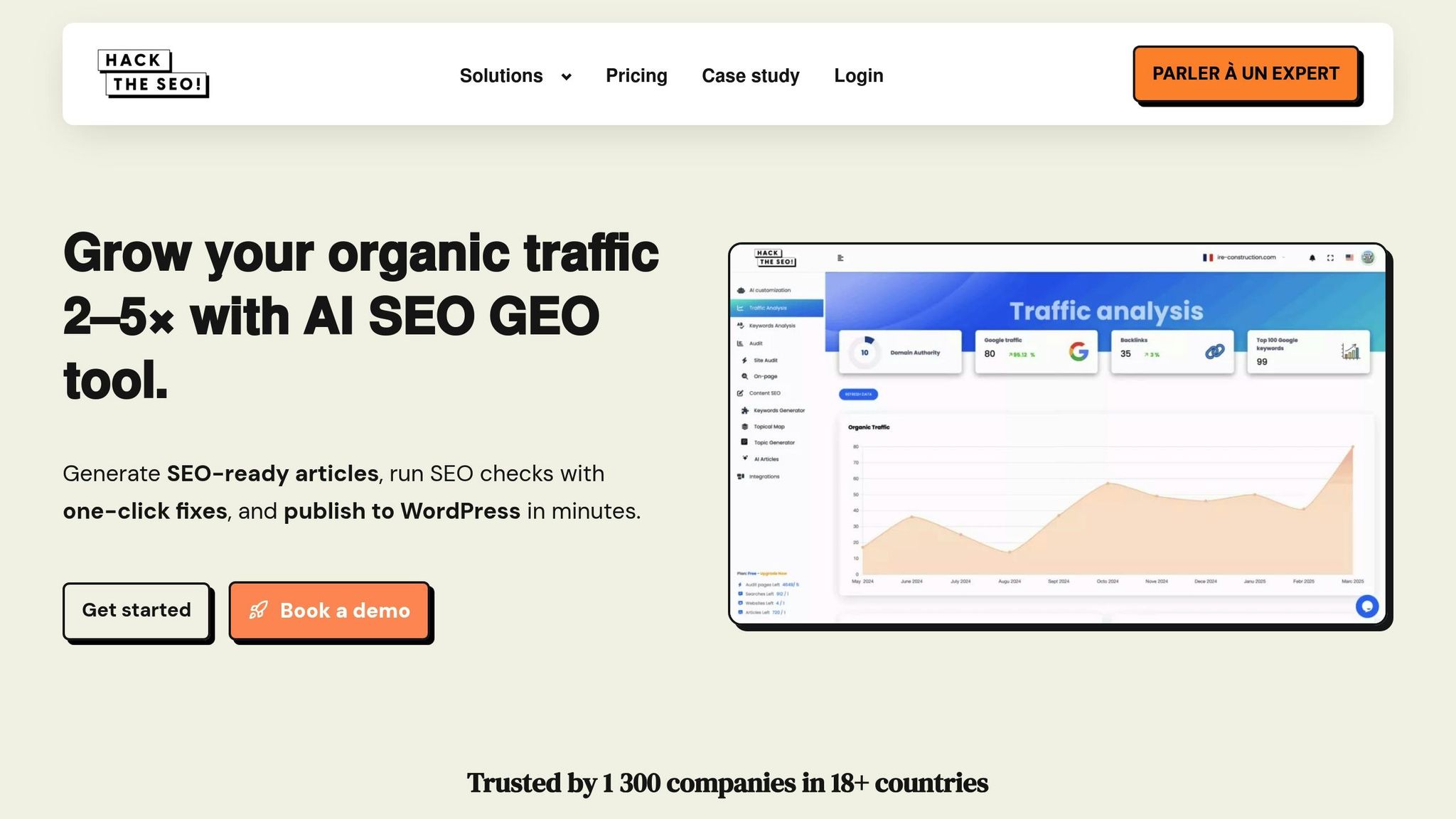
HackTheSEO uses natural language processing (NLP) and live SERP data to group keywords by semantic categories and search intent - whether it's Informational, Commercial, Transactional, or Navigational. This intent-driven approach ensures your content aligns with every stage of your marketing funnel.
One standout feature is the ability to reverse-engineer your competitors' content strategies. Just input a competitor's URL, and HackTheSEO maps their content hub, exposing overlooked subtopics. For added precision, connect your Google Search Console to uncover high-potential topics based on your site's actual performance data. The tool then generates a 3–6 month editorial roadmap with AI-suggested article titles, streamlining your planning process.
"A clear site structure with cohesive topical groups significantly helps our algorithms understand what your site is really about. It's not just about internal links, but about demonstrating deep expertise on a topic."
– John Mueller, Search Advocate at Google
HackTheSEO aligns with this principle by recommending a natural silo structure. This setup links cluster articles back to a central pillar page, improving internal link equity. Sites adopting this architecture have seen a 2.3x boost in crawl rates and are 4x more likely to secure featured snippets compared to those using traditional structures.
Pricing Tiers (in USD)
HackTheSEO offers flexible pricing to cater to both individual users and agencies. The free plan includes one topical map per month, AI-generated subtopics, internal linking suggestions, and CSV export capabilities - no credit card required. For those needing more, premium plans unlock unlimited topical maps, priority support, automatic content brief creation, and integration with an AI writing tool. While exact monthly pricing isn't listed, some sources mention a $49 one-time fee for visual cluster-building features.
Integration with Content Calendars
HackTheSEO allows you to export topical maps as CSV files, which can then be imported into your content management system. While it doesn’t offer direct API integrations with external calendar tools, the CSV format simplifies the transition from planning to execution, fitting seamlessly into your existing workflows.
sbb-itb-63525a7
7. KeywordInsights
Automated Topic Clustering Features
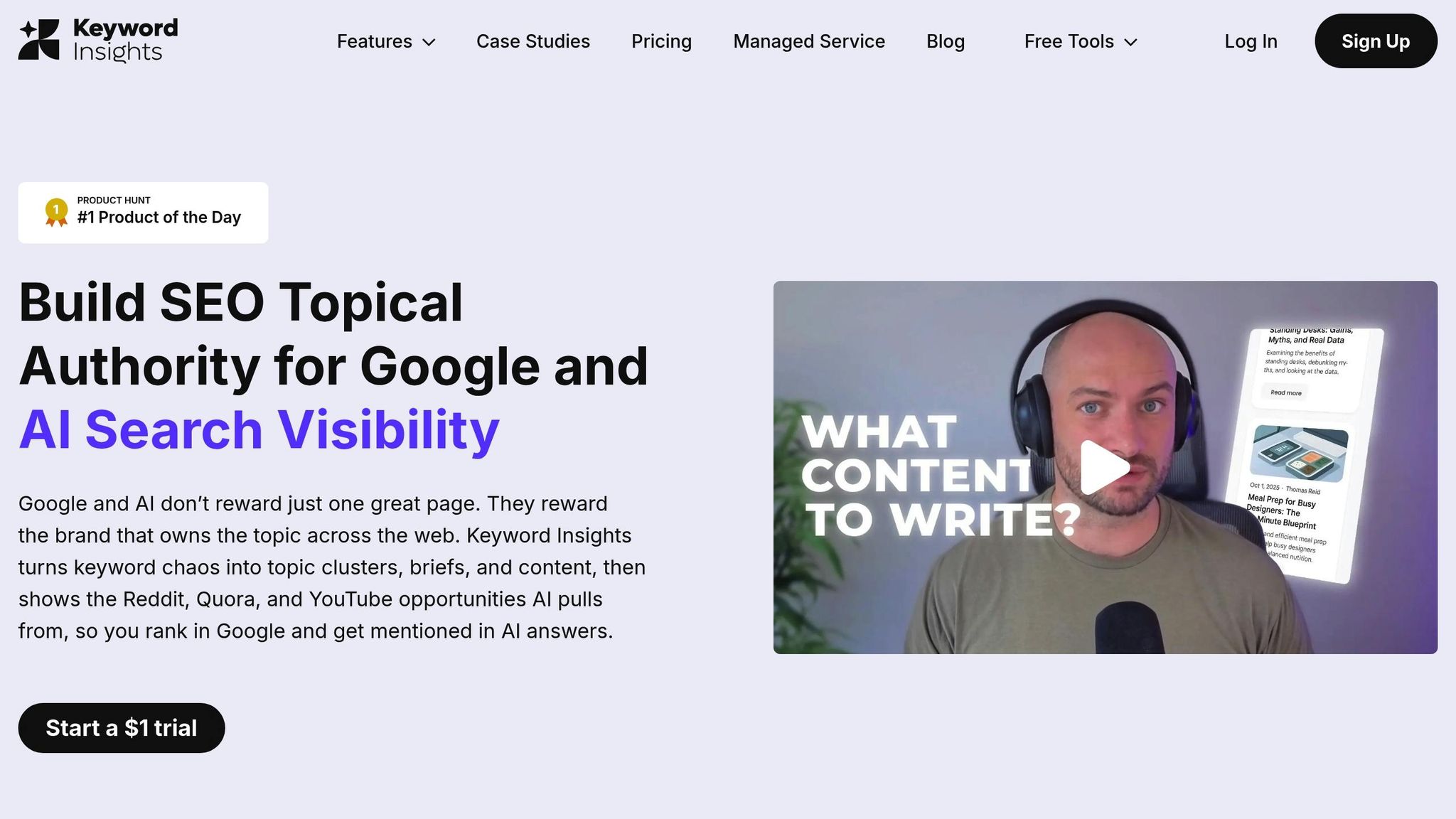
KeywordInsights takes keyword clustering to another level with its SERP-based method. Instead of relying on basic pattern matching, it analyzes live Google search results to group keywords that share top-ranking URLs. This approach ensures that a single, well-optimized page can effectively target all keywords in a cluster. With an accuracy score of 70–95 out of 100, it far surpasses traditional pattern-matching tools, which typically range between 11–35.
The platform doesn’t just stop at grouping keywords. It automatically categorizes clusters by search intent and uses natural language processing (NLP) to reveal semantic connections between them. This makes it easier to create logical content calendars, evaluate your site’s performance, identify gaps in your strategy, and even uncover competing pages.
The results speak for themselves. Ignite SEO, a London-based agency, used KeywordInsights to tackle keyword cannibalization and saw a 190% increase in traffic for one of their clients. Similarly, Land of Rugs generated over $130,000 in revenue from blog content created with the tool’s clustering features since January 2021. The platform can handle massive datasets, processing up to 200,000 keywords per report, with enterprise plans scaling up to 5 million keywords. It supports users across 212 countries and 127 languages, making it a global solution.
"Keyword Insights has revolutionized our content strategy process. Tasks that once took days, like grouping 20,000 keywords, now take just 30 to 60 minutes."
– Artur Perrella Glukhovskyy, SEO Content Strategist, Organic Hackers
Pricing Tiers (in USD)
KeywordInsights uses a credit-based pricing model. Here’s a breakdown of the plans:
- Basic: $58/month for 12,000 credits
- Professional: $145/month for 36,000 credits
- Premium: $299/month for 100,000 credits
If you decide not to renew your subscription, the account automatically switches to a pay-as-you-go plan.
Free Options Available
For those wanting to test the waters, KeywordInsights offers a $1 trial for 4 days. This includes 6,000 credits, 40 keyword searches, 1 content brief, and 5,000 AI-generated words. Additionally, the free plan provides access to standalone tools like SERP Similarity, SERP Explorer, Title AI, and Reddit Insights, though clustering credits are not included.
Integration with Content Calendars
KeywordInsights makes it easy to integrate its insights into your workflow. It connects directly with platforms like Google Search Console and WordPress, enabling users to move seamlessly from analysis to publication. You can export topical maps and content briefs as CSV files or push them to Google Sheets, simplifying the process of importing data into tools like Notion or your existing content calendar. The platform also supports CSV uploads from tools like Ahrefs or Semrush, automatically mapping the columns for you.
8. Answer Socrates
Automated Topic Clustering Features
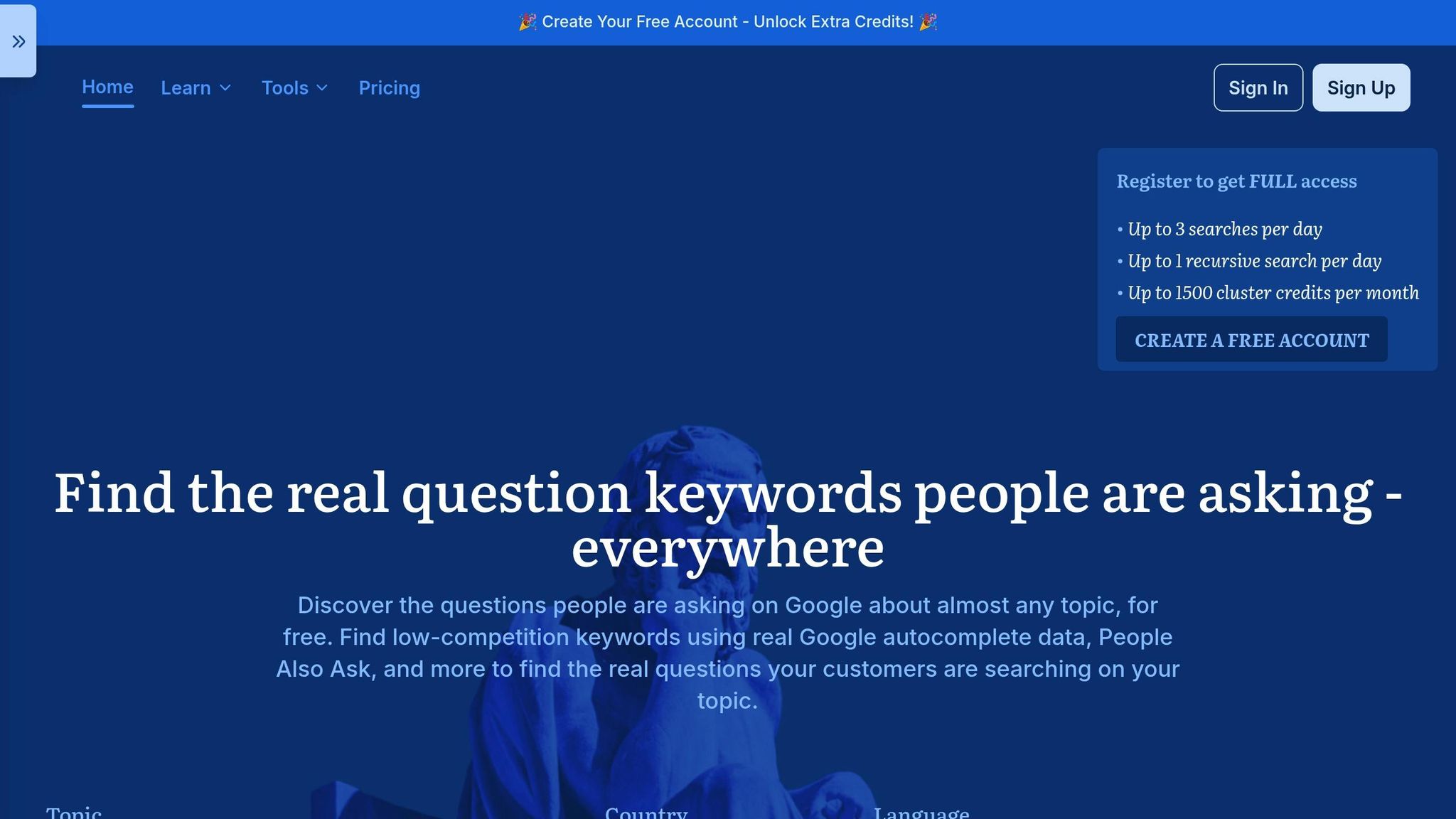
Answer Socrates takes a unique approach by focusing on question-based keywords. Instead of just grouping similar terms, it identifies the specific questions people type into search engines, offering a clearer picture of user intent. With the help of AI and machine learning, its recursive search feature organizes question-based keywords into meaningful clusters. Each cluster includes metrics like search volume, CPC, and competition, and they’re categorized by funnel stages (TOFU, MOFU, BOFU). Impressively, this tool supports keyword research across more than 190 countries and languages. This question-first method complements broader clustering strategies discussed earlier.
"Answer Socrates' question-based approach makes it one of the best keyword clustering tools because it starts with genuine user intent rather than algorithmic similarity scores." – Jamie I.F., Founder, Answer Socrates
Pricing Tiers (in USD)
Answer Socrates is budget-friendly, with its paid plan starting at just $9 per month. This plan includes 3,000 monthly keyword clustering credits, making it a cost-effective choice compared to many enterprise-level tools.
Free Options Available
The free plan is surprisingly generous. It offers 1,500 monthly clustering credits, 3 daily searches, and 1 daily recursive search - all at no cost. Users can download reports and clustering results as CSV files. Signing up for a free account adds more perks, like extra credits and the ability to save searches indefinitely in a "Saved Searches" section. However, the free plan does have limits, such as the monthly credit cap and restricted daily recursive searches.
Integration with Content Calendars
Like other tools in this category, Answer Socrates focuses solely on clustering and doesn’t directly integrate with content calendars. Users need to manually export data via CSV files, which adds a step to the workflow. Despite this, its affordability and speed make it an excellent option for teams willing to handle manual data transfers. By emphasizing user intent, Answer Socrates simplifies content planning while offering a fresh perspective on keyword clustering.
How to Create Keyword Clusters & Content Outlines with KeywordInsights.AI
Tool Comparison Table
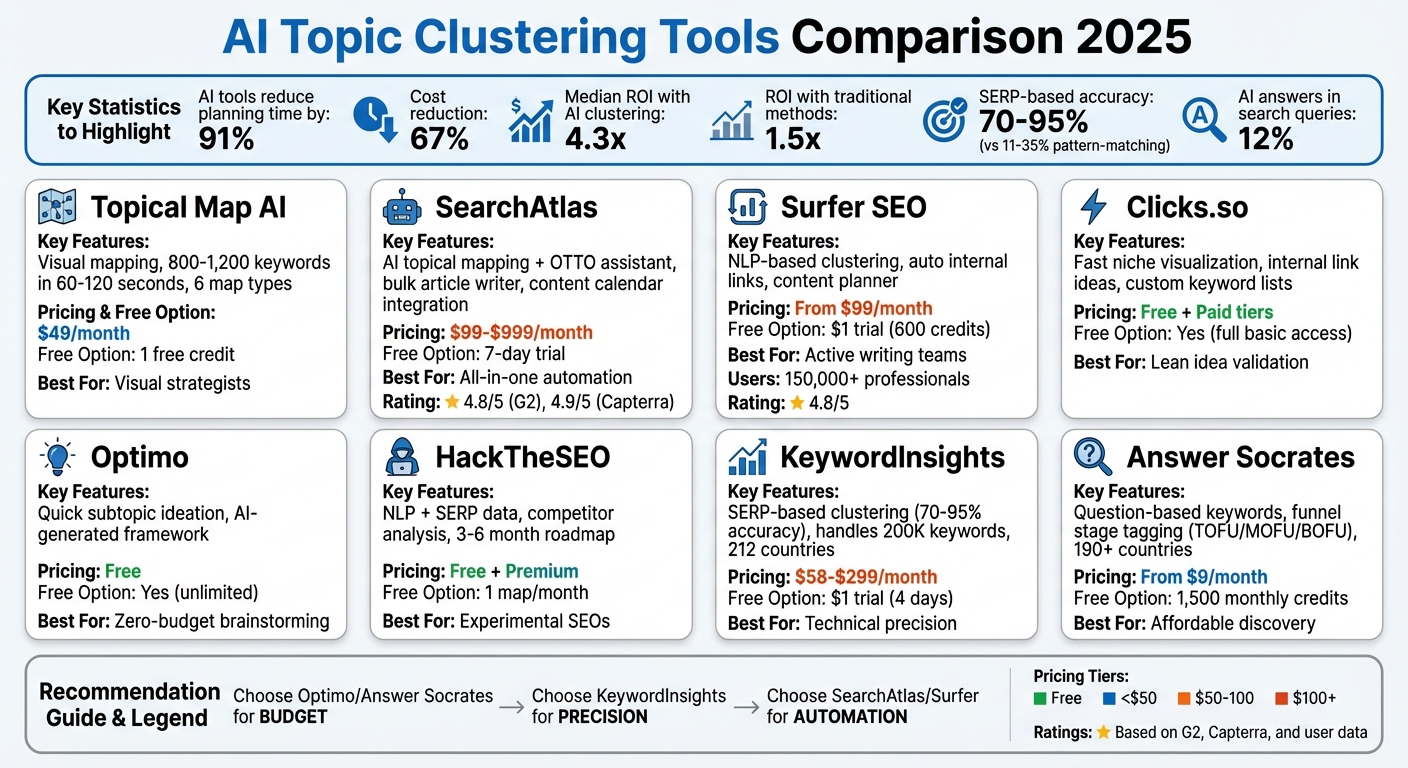
AI Topic Clustering Tools Comparison 2025: Features, Pricing and Best Use Cases
Selecting the best clustering tool depends on your budget, the complexity of your workflow, and how much automation you need. Here's a quick comparison of key features, pricing, and suitability for small and medium-sized businesses (SMBs):
| Tool | Key Automated Clustering Features | Pricing (USD) | Free Plan/Trial | SMB Fit |
|---|---|---|---|---|
| Topical Map AI | Visual mapping, entity focus, bird's-eye view of silos | From $49/mo | Yes (Limited) | Ideal for visual strategists |
| SearchAtlas | AI topical mapping, OTTO AI assistant, bulk article writer | From $99/mo | Trial available | Great for all-in-one automation |
| Surfer SEO | Intent-based grouping, content hubs, real-time editor scores | From $99/mo | No | Best for active writing teams |
| Clicks.so | Industry-specific maps, internal link ideas, rapid visualization | Free / Paid | Yes | Perfect for lean idea validation |
| Optimo | Subtopic ideation, content angle generation | Free | Yes | Excellent for zero-budget brainstorming |
| HackTheSEO | Semantic clusters, on-page optimization, personalization | Paid Tiers | Trial available | Best for experimental SEOs |
| KeywordInsights | SERP-based clustering (40% overlap), intent tagging, AI briefs | From $58/mo | $1 Trial | Suited for technical precision |
| Answer Socrates | Question-based discovery, recursive search, TOFU/MOFU/BOFU labels | From $9/mo | Yes | Great for affordable discovery |
SERP-based tools tend to outperform pattern-matching platforms, scoring between 70–95 compared to 11–35. Tools like KeywordInsights and SearchAtlas help prevent content cannibalization and improve topical authority by analyzing live Google data.
For SMBs working with limited budgets, Answer Socrates ($9/month) and Optimo (free) provide excellent value. On the other hand, platforms like SearchAtlas and Surfer SEO justify their higher price tags by integrating clustering directly into content creation and publishing workflows.
Generative Engine Optimization (GEO) places a growing emphasis on Q&A-style content and structured entities, which boost visibility in AI-powered overviews and answer engines. Tools that tag search intent - like informational, commercial, or transactional - can help you avoid competing articles . This structured approach to intent tagging aligns with the broader strategy of building a well-organized content hub, saving time and enhancing topical authority.
Conclusion
The move from focusing on individual keywords to adopting comprehensive topic clustering marks a major change in how small and medium-sized businesses (SMBs) compete for online visibility. Experts agree: relying solely on isolated keyword strategies just doesn’t cut it anymore.
AI-powered tools are delivering real results. Data shows they significantly reduce planning time and improve ROI, making them a game-changer for lean teams with limited budgets. These tools not only speed up production but also help create structured content hubs that both search engines and AI-driven answer engines favor.
With AI-generated answers now appearing in about 12% of search queries, the opportunity to establish topical authority is shrinking fast. Companies leveraging AI clustering are already seeing a median 4.3x ROI on their efforts, compared to just 1.5x for those sticking to older methods. Websites using entity-based topical maps are also gaining more recognition from AI-driven search engines.
The message is clear: acting quickly with AI-backed strategies is crucial. Whether you start with free tools or invest in more advanced platforms, the priority is to move from planning to execution. Begin by building a pilot cluster around a high-intent topic, connect your content strategically, and focus on tracking metrics for the entire cluster - not just individual pages. These actionable steps and tools provide a measurable edge.
This is about working smarter, not harder. By using AI to transform scattered content into well-organized, authoritative hubs, SMBs can not only improve their SEO but also strengthen their position in the market. Embracing topic clustering isn’t just an upgrade - it’s a necessity for staying competitive.
FAQs
What are the advantages of using AI tools for topic clustering in content strategy?
AI tools for topic clustering bring a lot to the table when it comes to shaping a content strategy. They help group related keywords, subtopics, and ideas into structured clusters, making it easier to create a well-organized content plan. This kind of structure not only boosts how search engines perceive your expertise but also enhances the experience for users by providing clear and comprehensive information.
These tools are also great at analyzing search intent and spotting connections between topics, helping you craft content that’s both detailed and relevant. Plus, they can help you steer clear of common pitfalls like keyword cannibalization or thin content. By using AI for clustering, brands can build stronger SEO authority, climb higher in search rankings, and create strategies that meet the needs of both search engines and their audience.
What are the key differences in pricing and features among the best AI tools for topic clustering?
AI tools for topic clustering in 2025 come with a range of price points and features, making them accessible for various budgets and content strategies. While many offer free basic versions, premium plans often include features like semantic clustering, intent detection, and workflow integration. These paid options typically provide faster processing speeds, improved accuracy, and more robust functionality, catering especially to enterprise-level needs.
Common features among these tools include semantic grouping, topical map creation, and GEO-targeted capabilities. Some even incorporate AI-powered automation to simplify SEO tasks. The best tool for you will depend on your goals, budget, and how complex your content strategy needs to be.
Why is topic clustering important for SEO and online visibility in 2025?
In 2025, search engines are smarter than ever, prioritizing content that goes beyond just keywords. Algorithms like Google’s BERT and MUM now focus on how well content reflects depth, intent, and the connections between related ideas. This means that creating isolated, keyword-stuffed pages is no longer enough to rank well.
Instead, topic clustering has become essential. This method involves organizing your content around a central pillar topic, supported by related subtopics. Think of it as building a web of information that showcases your expertise in a specific area. Not only does this make your content more relevant and engaging for users, but it also helps avoid problems like keyword cannibalization - where multiple pages compete for the same search term.
In an era where AI-driven search engines dominate, topic clustering is one of the most effective ways to establish long-term SEO authority and stay ahead of the competition.
Ready to transform your brand story?
Schedule a free diagnostic to see how we can help.
Schedule The Diagnostic