
How to Write Video Scripts That Convert
How to Write Video Scripts That Convert
Crafting a video script that drives action is all about clarity, focus, and understanding your audience. Here’s how to make your scripts convert:
- Start Strong: Hook your audience in the first 3–5 seconds with a bold question, surprising statistic, or relatable problem. Avoid slow intros or generic greetings.
- Know Your Audience: Go beyond demographics - focus on their challenges, habits, and what they care about. Tailor your message to address one specific pain point.
- Set One Clear Goal: Stick to a single objective, like boosting clicks or reducing acquisition costs. Trying to do too much confuses your audience and lowers conversions.
- Use Proven Frameworks: Organize your script with structures like Problem-Agitate-Solution (PAS) or AIDA (Attention-Interest-Desire-Action) to guide viewers from interest to action.
- Keep It Conversational: Write like you’re talking to a friend. Use simple language, short sentences, and contractions. Avoid jargon and overly technical terms.
- Test and Refine: Use data to tweak your script. If viewers drop off early, improve your hook. If your call-to-action (CTA) isn’t working, make it more specific and actionable.
A strong script isn’t just about words - it’s about delivering a clear message that resonates with your audience and drives measurable results. Focus on clarity, structure, and continuous improvement to create videos that convert.
Tips to Creating a video script that converts
sbb-itb-63525a7
Know Your Audience and Set Clear Goals
Before diving into scriptwriting, take a moment to define two critical elements: who you're speaking to and what you want them to do. Without these, even the most polished video won’t drive results. Identifying your audience forms the backbone of every decision you’ll make in your script.
Identify Your Target Viewers
It’s not just about demographics. Go deeper - think about your audience’s pain points, the tools they rely on daily, and where they turn for information. The best scripts resonate because they focus on specific roles, challenges, and habits, not just broad categories like age or location.
"If your answer is 'everyone,' you're setting yourself up to connect with no one."
– Lorenzo Nicolini, CEO, Moonb
Start by digging into your CRM data and purchase histories to uncover patterns among your most loyal customers. Complement this with social listening to understand how people discuss your brand and what matters most to them. For instance:
- In B2B, narrow in on industry, company size, and budget considerations.
- In B2C, consider life stage, income level, and psychographics.
The results are worth the effort. When you zero in on a single, specific challenge your audience faces and craft your script around solving it, your message hits home. For example, a script tailored for marketing managers at mid-sized SaaS companies (50–200 employees) struggling with lead generation will always outperform a generic pitch to a broader professional audience.
Set Measurable Goals
Now that you know your audience, focus on a single, clear objective. Trying to juggle multiple goals - like generating leads, building brand awareness, and explaining features - all in one video? That’s a recipe for confusion, and confusion kills conversions.
"A confused message fails to convert."
– Lorenzo Nicolini, CEO, Moonb
Decide how you’ll measure success before you start writing. Are you aiming for higher click-through rates, more demo bookings, or a lower customer acquisition cost (CAC)? For example, in 2025, Toggl, a time-tracking software company, boosted its conversion rates by 32% and slashed its CAC by 27% by sticking to a clear video content strategy with measurable goals.
Match your video type to your goal. Want to raise awareness? Go for behind-the-scenes content. Need leads? Explainer videos work wonders. Looking to drive conversions? Testimonials are your best bet. Each goal demands a unique script approach, so pick one and commit to it completely.
Hook Your Audience in the First 3-5 Seconds
When it comes to grabbing attention, you’ve got mere seconds to make an impression. On Facebook, mobile users spend just 1.7 seconds engaging with content before scrolling, while desktop users might give you 2.5 seconds. That’s all the time you have to prove your video is worth watching.
"You have about three to five seconds to convince someone to keep watching. That's it. Your hook is, without a doubt, the single most critical element of your script."
– Ian Sells, Administrator, JoinBrands
Your hook needs to answer one critical question: "What’s in it for me?" If your video starts with a slow logo animation or a generic greeting like "Hello everyone", you’ve likely lost your audience already. The first 10% of your video experiences the highest drop-off rate, so treat those opening seconds as the most valuable part of your content.
Use Attention-Grabbing Techniques
Lead with value. Start with a question or statement that hits a nerve. For example: "What if you could finish your weekly reports in ten minutes?" This kind of question immediately resonates with a common frustration. Or, try a surprising statistic: "Did you know 70% of marketing projects fail due to poor communication?". Numbers naturally catch the eye.
Make it visually dynamic. The first three seconds need movement to hold attention. Instead of a static intro, try something unexpected, like a split-screen reveal or a quick sneak peek. Take the Squatty Potty ad from 2016 as an example. It featured a “Prince of Poop” and a unicorn dispensing ice cream - an absurdly creative visual that immediately hooked viewers. The result? Over 150 million views, 1.5 million social shares, and more than $100 million in sales [CoSchedule, 2017; VMG Studios, 2026].
Use audio wisely. A well-timed sound effect, like a "whoosh" during a scene change or a brief pause after a bold statement, can emphasize key moments. Pair your music to your message - upbeat tunes for launches, calmer tones for educational content. And since many people watch videos on mute, always include text overlays to reinforce your hook.
Once you’ve nailed your hook, you’re ready to structure the rest of your video using proven frameworks.
Choose and Apply Proven Script Frameworks
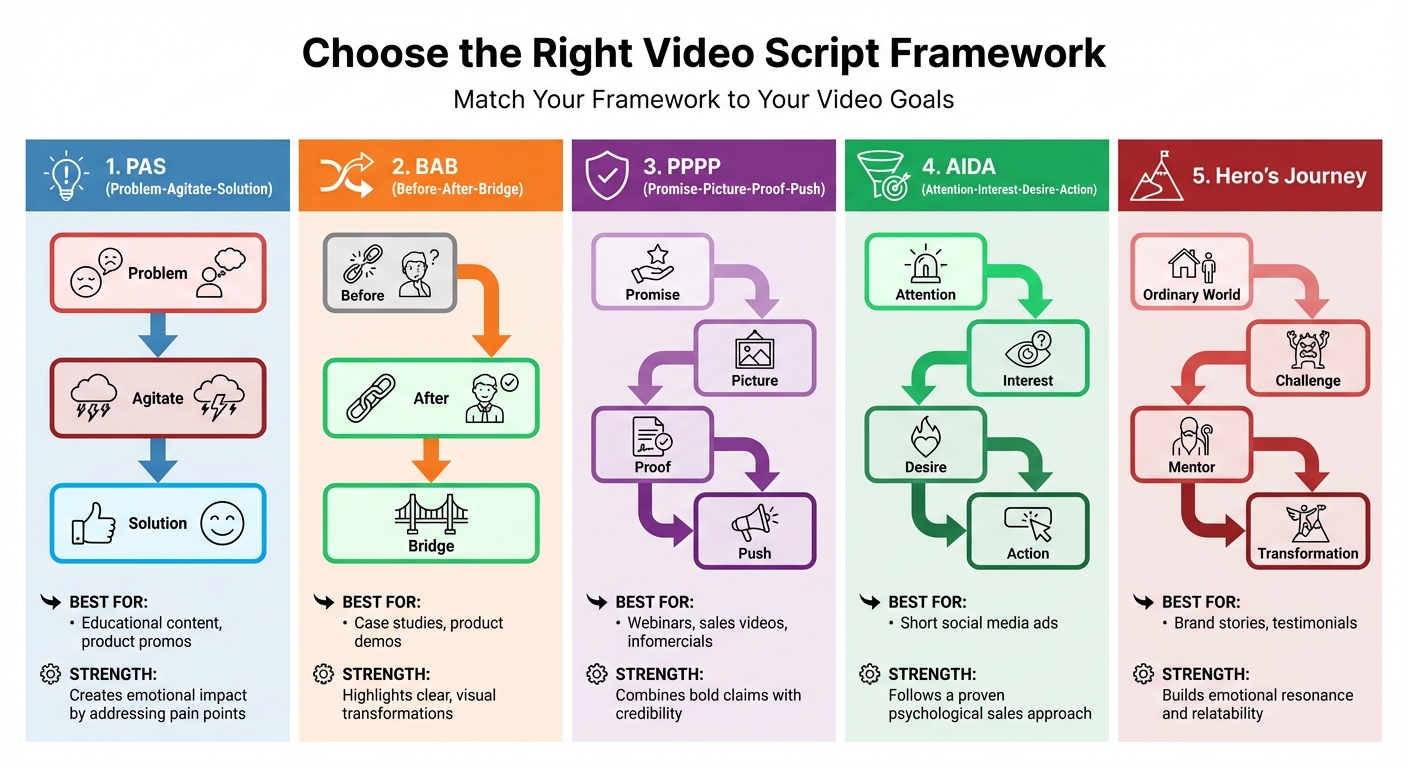
Video Script Framework Comparison Guide: PAS, BAB, PPPP, AIDA, and Hero's Journey
Once you've captured attention with a strong hook, the next step is to guide your audience seamlessly from problem to solution. This is where script frameworks come into play. These frameworks provide a clear structure, keeping viewers engaged while steering them toward taking action. The key is to select a framework that aligns with your audience's needs and your specific goal - whether that's to inform, inspire, or drive quick conversions. Below, you'll find some tried-and-true frameworks that can turn viewer interest into meaningful action.
Popular Script Frameworks
Problem-Agitate-Solution (PAS) zeroes in on a pain point, amplifies the discomfort, and offers a clear solution. For example, a video promoting project management software might start with: "Drowning in endless email threads?" It then stirs the issue further: "Every day, your team wastes hours searching for updates buried in their inbox." Finally, it provides the answer: "A platform centralizing conversations, files, and deadlines."
Before-After-Bridge (BAB) contrasts the "before" (the struggle) with the "after" (the improvement), and connects the two with the "bridge" - your product or service. This approach is ideal for showcasing visible transformations, such as fitness apps, design tools, or productivity software. It's especially effective in case studies or product demo videos where the audience can see tangible results.
Promise-Picture-Proof-Push (PPPP) begins with a bold promise like "Cut your customer support tickets in half", paints a vivid picture of what life could look like after solving the problem, and backs it up with proof - testimonials, data, or case studies. It wraps up with a strong call-to-action. For example, a stat like "92% of marketers report a positive ROI from video content" or a customer success story can make your claims feel credible and persuasive.
"The first 30 seconds of a video are crucial. An interesting statistic, a provocative question, a funny anecdote – you need something strong right out of the gate to hook people in."
– Alex Johnson, Scriptwriting Pro
AIDA (Attention-Interest-Desire-Action) follows a classic sales funnel approach. It grabs attention with a compelling hook, sparks interest by highlighting key features, stirs desire with emotional appeal, and closes with a direct call-to-action. This framework is especially effective for short-form social media ads, such as 15- to 60-second clips on platforms like Instagram or TikTok.
The Hero's Journey places the viewer as the protagonist of the story. It begins with their "ordinary world" and a challenge they face, introduces your product as the mentor to guide them, and ends with their transformation. This narrative structure builds strong emotional connections and works well for brand storytelling or customer testimonials.
Comparison of Frameworks
Here's a quick breakdown to help you decide which framework fits your video goals:
| Framework | Structure | Best For | Strength |
|---|---|---|---|
| PAS | Problem → Agitate → Solution | Educational content, product promos | Creates emotional impact by addressing pain points |
| BAB | Before → After → Bridge | Case studies, product demos | Highlights clear, visual transformations |
| PPPP | Promise → Picture → Proof → Push | Webinars, sales videos, infomercials | Combines bold claims with credibility |
| AIDA | Attention → Interest → Desire → Action | Short social media ads | Follows a proven psychological sales approach |
| Hero's Journey | Ordinary World → Challenge → Mentor → Transformation | Brand stories, testimonials | Builds emotional resonance and relatability |
Choosing the right framework depends on your video's purpose. Use PAS or BAB to educate and address pain points, PPPP to establish trust and credibility before a sale, AIDA for quick, engaging social media content, and The Hero's Journey to create a deeper emotional connection with your audience.
Structure Your Video Script for Maximum Impact
Once you've chosen a framework, it's time to organize your script in a way that captivates viewers and encourages them to take action. A classic approach is the three-act narrative arc: start with a hook to grab attention, follow with a body that delivers value, and wrap up with a conclusion that includes a clear call-to-action. This structure helps guide your audience through a cohesive and engaging journey. It also works seamlessly with the visual and audio plans you'll develop later.
To ensure everything aligns perfectly, use a two-column AV (Audio-Visual) format. In one column, outline the visual elements like camera angles, graphics, and B-roll. In the other, detail the audio components such as dialogue, cues, and sound effects. This method ensures that the visuals and audio work together to amplify your message.
Key Script Elements
With your structure in place, focus on including elements that not only inform but also persuade. Start by weaving a relatable story that resonates with your audience. Introduce a problem they might face and position your product or service as the solution. Instead of listing technical specs, emphasize how your offering makes their life better. As Brian Clark, Founder of Copyblogger, wisely says:
"One of the most repeated rules of compelling copy is to stress benefits, not features".
Adding social proof is another powerful way to build trust. Use testimonials, expert endorsements, or data to back up your claims. For example, you might mention that "92% of marketers consider video an essential part of their marketing approach", or share a customer success story that highlights real-world results.
Finally, end with a strong call-to-action (CTA). Be specific - avoid generic phrases like "Let us know what you think." Instead, guide viewers with clear steps like "Click the link in the description to download your free script template" or "Comment below with your biggest scriptwriting challenge." Remember, including a video on a landing page can increase conversion rates by over 80%.
Use Conversational Language
Your script should feel as natural as a conversation. Since spoken language is different from written text, aim for a tone that sounds effortless when read aloud. Use contractions like "you're", "it's", and "don't" to keep things friendly and approachable. Keep sentences short and snappy.
Avoid industry jargon that might confuse or alienate your audience. As George Rowlands, Marketing Journalist at NetHunt CRM, puts it:
"Trust is the name of the game, and you're not going to win it with big words in big sentences and industry jargon".
A simple way to check your script's tone is the "explain it to a friend" test - if it doesn’t sound like something you’d say in casual conversation, simplify it.
Before finalizing, read your script aloud to catch any awkward phrasing or pacing issues. Aim for a speaking rate of around 130 to 150 words per minute - this ensures your message fits within your video's target length. Additionally, adjust your perspective based on the video's format. For example, use first-person ("I'll show you") for talking head videos to create a personal connection, and second-person ("You'll click on") for tutorials to guide viewers through specific actions.
Write, Test, and Optimize Your Script for Conversions
What separates a script that drives action from one that misses the mark? It’s all about refining and testing until every word earns its keep. Think of this process as your script’s final polish - removing the rough edges, tightening the message, and ensuring it’s laser-focused on conversions.
Refine for Clarity and Brevity
Start by reading your script out loud. This simple exercise helps you spot sentences that are too long, clunky word choices, or phrases that just don’t sound natural when spoken. If you find yourself tripping over a sentence, chances are your audience will feel the same way.
Keep paragraphs short - stick to 3–4 sentences at most. This structure makes it easier to read from a teleprompter and keeps the pacing natural. Cut out filler words like "just", "really", or "basically" to keep your message crisp and to the point. As Lorenzo Nicolini, CEO at Moonb, wisely says:
"A script is tight when you can no longer remove a word without damaging the message."
Run a practice recording to identify pacing issues and pinpoint where you might need to adjust emphasis or timing. Once your script feels clear and concise, it’s time to see how it performs in the real world.
Test and Optimize Performance
The real work begins when your video goes live. Use data to guide your next steps. For example, if you notice a high drop-off rate in the first few seconds, it’s time to rework your hook. A strong, engaging opening is essential to keeping viewers interested.
Track your conversion metrics - whether you’re aiming for clicks, sign-ups, or purchases. These numbers will tell you if your script is hitting the mark. Also, pay attention to engagement signals like comments, shares, and click-through rates. If your viewers aren’t taking action, revisit your call-to-action (CTA). Make sure it’s clear, direct, and well-timed.
The best scripts aren’t static - they evolve based on performance data. Metrics like viewer retention, conversion rates, and Customer Acquisition Cost (CAC) provide valuable insights for fine-tuning your message.
For teams looking to scale their video strategy, tools like BrandMultiplier.ai’s Narrative OS offer advanced optimization. This system uses neuroscience-based storytelling to craft a strategic narrative, integrating it with custom AI for ongoing improvements. It tracks how your messaging impacts key metrics like CAC, deal speed, and customer lifetime value, allowing you to refine your script in real time, quarter after quarter. With this kind of data-driven approach, your script can continuously adapt to deliver better results.
Conclusion
As outlined earlier, start by truly understanding your audience and setting a single, measurable goal for your video. Use the first few seconds to grab attention - whether through a relatable pain point or a thought-provoking question - then deliver value with a clear, structured narrative that speaks directly to your viewers' needs. Wrap it all up with a strong, actionable call-to-action.
The numbers back this up: 92% of marketers say video is essential to their strategy, and 68% of consumers prefer learning about products through short videos. Video can also increase landing page conversions by over 80%, as shown in our earlier analysis. Sophia Bernazzani Barron from HubSpot emphasizes this perfectly:
"A good script can make or break the success of your video".
When writing, aim for conversational language, short sentences, and contractions. Read your script out loud to catch any awkward wording or unnecessary fillers. For pacing, stick to about 150 words per minute, which means a two-minute video should be roughly 300 words.
Don’t settle for your first draft. If viewers drop off early, rethink your opening. If your call-to-action isn’t leading to conversions, revise it. By refining these elements, you’ll create scripts that consistently drive results.
Take action today: download a two-column script template, draft a brief for your next video, and focus on delivering one clear message to one specific audience. As marketing journalist George Rowlands wisely notes:
"The magic doesn't happen when the camera starts rolling - it happens in the scriptwriting phase".
With practice and data-driven tweaks, you can transform your videos into powerful tools for driving conversions. Apply these strategies, and watch your videos go from simply engaging to delivering measurable results.
FAQs
How can I identify my audience's pain points for writing effective video scripts?
To write a video script that truly connects with viewers, start by diving into their biggest challenges. If you don’t address their concerns right away, you might lose their interest in seconds. The key is to gather insights from sources like surveys, interviews, social media comments, and product reviews. Then, organize this feedback into clear themes and focus on the obstacles that stand in the way of their goals - whether it’s cost, time, effort, or relevance.
Once you’ve pinpointed their main pain points, zero in on the most pressing issue for your target audience. Ask yourself: Who are they? What keeps them awake at night? Where do they discuss these struggles online? Use these answers to shape your script, offering a solution right from the beginning. For a quicker, data-driven approach, tools like BrandMultiplier.ai’s Narrative OS can analyze interviews and social media data to highlight top concerns. It even aligns these insights with business metrics like CAC and LTV, helping you create a script that speaks directly to what matters most to your audience.
What’s the difference between the PAS and AIDA script frameworks?
The PAS (Problem → Agitate → Solution) and AIDA (Attention → Interest → Desire → Action) frameworks are two well-known methods for creating scripts that grab attention and inspire action. While both are powerful, they take slightly different routes to achieve their goals.
PAS zeroes in on a specific problem, amplifies the audience’s emotional connection to it, and then offers a solution. It’s especially useful for addressing pain points and creating a sense of urgency.
AIDA, on the other hand, takes the audience on a step-by-step journey. It starts by grabbing their attention, builds interest, ignites desire, and finally encourages them to take action. This approach works well for storytelling and gradually drawing viewers in.
Both methods can deliver results, and the right choice depends on your objectives and what resonates best with your audience.
What’s the best way to test and improve a video script for better results?
Testing and fine-tuning a video script is a crucial step to boost both engagement and conversions. Start by reading the script out loud or creating a quick recording. This simple exercise can reveal awkward wording, uneven pacing, or unclear calls-to-action that might go unnoticed otherwise. It’s a great way to polish the language before diving into full production.
After that, gather feedback from your team or a small sample of your target audience. Be specific when seeking input - ask about the script’s clarity, its relevance to the audience, and whether it inspires action. Use their insights to tweak and improve areas that might be falling short.
Lastly, test critical elements like your opening hook or call-to-action (CTA) through A/B testing. Monitor key metrics such as click-through rates (CTR), conversion rates, and cost-per-acquisition (CAC) to see which version hits the mark. Keep refining and testing until your script not only meets your objectives but also connects effectively with your audience.
Ready to transform your brand story?
Schedule a free diagnostic to see how we can help.
Schedule The Diagnostic